AI and Tech Layoffs in the Bay Area Housing Market
What’s really changed in the housing market lately isn’t just about mortgage rates or how much homes cost. It’s about how people feel. Confidence, or how sure people are about buying or selling a house, has taken a big hit. This shift in confidence is a major factor in what’s happening in the market right now.
In the Bay Area, two big things are affecting how buyers feel about the market: the growth of AI and tech layoffs uncertainty that’s ongoing. People still want to buy, but they’re thinking differently now. They’re asking tougher questions, being more careful, and making more thoughtful decisions than they did when the market was booming.
Why confidence matters more than many people realize
Housing markets do not move on numbers alone. They also move on how people feel about their future.
When people feel good about the future, they’re more likely to take risks and spend money. They think their pay will go up, their job will be safe, and the market will keep doing well if they make quick decisions. However, when confidence starts to weaken, even the most motivated buyers slow down. They get picky, think about what could go wrong, and don’t rush into things as much.
This change can be easy to miss because it does not stand out like a mortgage-rate graph or an inventory chart. However, it has the power to significantly alter the way the market behaves, and that’s something worth paying attention to.
How AI and tech layoffs changed buyer psychology
In tech-driven markets, buyer confidence has changed because optimism and uncertainty are now showing up at the same time.
In the best of times, when the market is booming, people feel confident. Companies are hiring left and right, stock prices are high, and incomes are growing steadily. It’s no wonder that many professionals feel like they can afford to buy a home – the future looks bright and stable, so why not take the plunge? Everything seems predictable and secure, making it easier to make big decisions like buying a house.
Today, the environment feels different.
AI is creating real excitement around innovation, investment, and long-term economic growth. There is a growing belief that AI could power the next major wave of expansion, especially in the Bay Area.
At the same time, layoffs across major tech companies changed how many professionals think about money and long-term commitments. Even high-income workers are now asking different questions:
How stable is my income over the next few years?
What happens if my company restructures?
Should I wait until things feel more certain?
That change in mindset matters. It does not mean people no longer want to buy homes. It means they are thinking more carefully before they do.
What this looks like in the Bay Area
The Bay Area is a great example of this change, it’s really obvious there.
People are still looking to buy homes in great areas with good schools and nice neighborhoods that will be worth something in the long run. Buyers are out there, they’re just looking at things differently now. They’re being more careful and thoughtful in their approach to the market.
Buyers are being more careful when they make a deal. They think about if they can really afford it each month. They’d take their time to consider the risks and if they are comfortable with the payments. They also think about if it’s a good idea in the long run. So, the way people used to buy things based on emotions, especially when the market was very competitive, is changing. Now, people are making more thoughtful decisions.
The current market is more complex than just being labeled as good or bad. There is still a demand, but it’s become more picky.
Fear and opportunity are both shaping decisions
Right now, it’s pretty clear that there’s a big gap growing between people who are scared and those who see chances to do something new.
Some people who want to buy things are holding back because they’re not sure about the economy or if they’ll have a job. This is a reasonable thing to do.
A few of them have a different view of the market. They think it’s not as competitive, so there’s more space to talk and agree on prices. This means they can make a careful, long-term plan to enter the market without the stress of the busy times.
It’s really important to see things from a different angle. What happens is that the housing market usually starts to pick up before people feel totally confident again. And by the time everything seems okay, lots of other people are jumping back in, so competition gets fierce really fast.
Some buyers understand that. They are focusing less on headlines and more on fundamentals: location, payment comfort, neighborhood quality, and long-term fit.
In that sense, AI and tech layoffs are not just influencing employment conversations. They are also influencing how buyers judge timing, risk, and opportunity.
Why the Bay Area still matters long term
Despite some short-term worries, the main factors that drive the Bay Area housing market are still in place.
The Bay Area is still a hub for new ideas, skilled workers, and well-paying jobs. Companies that work with artificial intelligence are getting more investments, hiring people, and starting new businesses. This doesn’t mean everything is certain right now, but it does show that the underlying demand for housing in the Bay Area will likely stay strong in the long run.
This moment is complicated, not simple, and that’s what makes it feel that way.
Caution is real. So is long-term opportunity.
What AI and tech layoffs mean for buyers right now
Today’s market is not rewarding emotional decisions. It is rewarding informed and disciplined ones.
For some people looking to buy, it might be a good idea to wait a bit. If you’re not sure about your income or you don’t have a lot of extra money, it’s probably smart to be careful.
This more stable environment can be a big plus for some people. With less stress and more time to think, they can negotiate better deals. It’s a big change from the crazy competition we saw before, when it was hard to find any advantages. Now, people have more room to breathe and make smarter decisions.
The biggest shift happening right now is not just in rates or inventory. It is in mindset.
The way people think and feel when they’re buying a house can have a big impact on what happens next in the Bay Area housing market, maybe even more than any other factor.
Why have AI and tech layoffs changed buyer behavior so much recently?
Bay Area buyer confidence has shifted because many buyers are balancing optimism around AI growth with caution around job stability, layoffs, and long-term affordability.
Is demand for homes in the Bay Area disappearing?
No. Demand has not disappeared. It has become more selective and more disciplined.
How are tech layoffs affecting home buying decisions?
Tech layoffs are making buyers think more carefully about long-term income stability, monthly affordability, and how much risk they want to take on.
Is AI helping or hurting buyer confidence?
It is doing both. AI is driving investment and long-term optimism, but it is also creating uncertainty around jobs, hiring, and career stability.
Are Bay Area buyers still making competitive offers?
Yes, but usually with more care. Buyers are more focused on value, payment comfort, and long-term fundamentals than they were during the peak frenzy.
Why are some buyers seeing opportunity in this market?
Because slower competition and more negotiating room can create entry points that were much harder to find when the market was moving faster.
Should buyers wait until the market feels more stable?
That depends on income stability, reserves, timeline, and confidence in a long-term plan. Waiting may be right for some buyers, but not for everyone.
What matters most in the Bay Area market right now?
Location quality, affordability, school districts, neighborhood desirability, and long-term value continue to matter a great deal.
Is buyer psychology really shaping the market?
Yes. Confidence, caution, and decision-making behavior are influencing market activity in a way that goes beyond rates and inventory alone.
About the author
Anand Venkatesha
Co-Founder and CEO at ficustree.ai
I write about the real journey of buying a home. Hidden costs, mistakes buyers discover too late, and insights to make smarter decisions. Built from experience in AI, data, and listening to real homebuyers and realtors.
What the Housing Market Shift in 2026 Means for Buyers
The housing market for buyers is starting to look a bit better in 2026. It’s not a complete buyer’s market just yet, but things are more balanced now compared to when sellers had all the power. Mortgage rates have come down from their peaks, and there are more homes available in many areas. This means buyers have a bit more breathing room to compare different homes and negotiate prices. They could make moves without feeling so much pressure, which is a nice change from the chaos of the past few years.
For Bay Area buyers, the shift is more nuanced. Strong homes in strong locations are still competitive. Even so, overpriced homes and weaker listings are facing more resistance. Leading to longer time on market, and more pricing pressure. That is often where thoughtful buyers start to find better openings.
Why 2026 feels different from the last few years?
For a while now, people looking to buy a home have been in a tough spot. Interest rates on mortgages were pretty high, there just weren’t enough houses for sale, and prices didn’t drop enough to make a big difference. So, a lot of buyers just put their plans on hold, waited to see what would happen, or kept looking around without feeling like it was the right time to make a move. They didn’t have enough confidence to go ahead with buying a home.
The 2026 housing market for buyers looks different, not because conditions have suddenly become easy, but because the balance is no longer as one-sided. Buyers today have more time to think, more leverage to ask questions, and more ability to negotiate than they did during the most aggressive phases of the market.
That shift matters. A market does not need to collapse to become more workable for buyers. In many cases, a quieter, more balanced environment creates better decision-making conditions than a fast market driven by fear of missing out.
What is changing in 2026?
It’s not just one big thing that’s changing everything, but a bunch of smaller things all happening together that are really making a difference.
Mortgage rates have come down a bit from their highest points. They’re still higher than they were when rates were really low, but they’re not as shocking as they used to be, which had stopped a lot of buyers from moving forward. Even small changes in rates can make a big difference in how much people pay each month, and that can be enough to make buyers feel more confident about getting back into the market.
As things stand, the number of homes for sale is going up in some areas. More and more homeowners are coming to terms with the fact that interest rates are not going to drop drastically anytime soon. So, they’re deciding to put their homes on the market instead of waiting around. Just because there are more homes for sale, it doesn’t mean buyers are suddenly in the driver’s seat. But it does give them more options and takes some of the pressure off – they don’t have to feel like they have to make a decision right away or risk losing out.
These days, people who are looking to buy something are changing the way they think. They’re not as quick to rush into things or ignore potential problems. Instead, they’re taking their time to compare prices, think about what they’re getting for their money, and make smarter decisions. They want to know exactly how much something will cost them each month and what they’re getting in return. It’s like they’re being more careful with their money and not just jumping into something because they feel like they have to.
How buyer behavior is shifting
The 2026 housing market for buyers is shaped as much by buyer behavior as by rates and inventory.
Buyers today are more analytical. They are paying closer attention to affordability, concessions, inspection findings, and long-term carrying cost. They are also more selective about which homes are worth pursuing aggressively and which ones deserve a harder negotiation.
Things are changing from how they used to be. Before, people had to act fast when buying a house because the market was so competitive. Now, it’s not as crazy, and while speed is still important for the best houses, it’s more about making smart decisions. You have to think carefully and consider what you’re doing, rather than just rushing in. This is a big difference from the past, when people felt like they had to move quickly or they would miss out. Now, it’s more about being thoughtful and making a good choice.
More and more buyers are shifting their focus away from trying to perfectly time the market, and instead, they’re looking for the right opportunity that’s actually out there. This approach tends to lead to more sensible decisions, as it’s based on what’s really available, rather than trying to predict what might happen in the future. By doing so, buyers can make more informed choices that suit their needs, rather than getting caught up in the uncertainty of market trends.
A closer look at the Bay Area Housing Market
The Bay Area is a bit of a mixed bag, and its story is more complicated than what’s happening in the rest of the country.
People still want to buy homes, but they’re being picky now. If a house is in a great spot and the price is right, it can still get a lot of attention, especially in areas where there aren’t many homes for sale and people feel good about buying. But if a house is overpriced, needs repairs, or doesn’t have what buyers are looking for these days, they’re not as interested. It’s like the market is splitting into different groups, with some homes being really popular and others not so much.
That is why the Bay Area is not moving as one single market. Some homes still move quickly. Others sit longer, adjust pricing, or need a better negotiation strategy to get done.
The local job market is still important. The Bay Area is closely linked to the tech industry, new ideas, and investments in artificial intelligence. This doesn’t mean there won’t be ups and downs, but it does create a steady demand for housing, even when things slow down. For people looking to buy, this means the market might be a bit more relaxed than it was before, but that doesn’t mean houses will suddenly become affordable.
Is 2026 really a turning point for buyers?
That depends on what you mean by a turning point.
Don’t count on housing prices plummeting or the market suddenly flipping to favor buyers overnight – that’s just not how it usually works. Housing markets tend to be pretty stable, and big changes don’t happen without some major economic upheaval. In other words, if you’re waiting for a huge shift in the market, you might be waiting a while, unless something big happens in the economy.
So, if we think of a turning point as the moment when things start to shift, then maybe we’re already seeing that happen.
The housing market for buyers in 2026 is showing some signs of change. For one, buyers have a bit more room to breathe now. They’ve got more options to choose from, which means they can negotiate better deals. And they’ve got more time to think about what they really want.
These might seem like small things, but they’re actually pretty big changes. And even though they’re happening slowly, they’re still meaningful. It’s like the balance is starting to tip, and buyers are getting a little more control. They can take their time, weigh their options, and make more informed decisions. That’s a big deal, even if it’s not happening overnight.
Turning points in housing are often clearer in hindsight. By the time a shift feels obvious to everyone, many of the quieter opportunities have already been taken.
What could accelerate the shift
A few factors could strengthen buyer leverage further.
Mortgage rates play a big role here. If they go down even more, it’s likely that some buyers will start looking again. This could be good for demand, but it might also affect how people think about what they can afford, and that can change fast.
Inventory plays a crucial role as well. When supply keeps increasing, buyers have more options and bargaining power, which typically leads to more stable prices and better negotiating conditions for them. This shift in balance can make a big difference in how deals are made.
As time goes on, people’s expectations start to shift. When buyers and sellers spend more time in this environment, they begin to change how they behave. Buyers become more careful and thoughtful in their decisions. Sellers, on the other hand, start to have a more realistic view of things. This can lead to a more balanced and stable market, which is a big improvement from the extreme ups and downs we saw before. Eventually, this can create a healthier market dynamic, where both buyers and sellers have a more realistic understanding of the situation.
What this means for buyers, sellers, and investors
For Buyers:
Now is a good time for buyers to take a closer look and think carefully about their options, rather than waiting for everything to be perfect. The housing market for buyers in 2026 is still competitive, but it’s not as crazy as it used to be. Buyers have a bit more space to breathe, compare different homes, and negotiate prices based on facts. They can make decisions without feeling rushed or panicked, and that’s a big plus. It’s a chance for buyers to take control and make smart choices, rather than just jumping into something because they feel like they have to.
It’s really helpful to have a clear idea of how much you can afford and what you’re comfortable paying each month. When you know your budget and monthly payment limits, you can focus on finding the best value instead of just looking at the price tag.
For Sellers
When it comes to selling a home, having a solid strategy in place is crucial. It’s not just about timing, but about presenting your home in the right way and pricing it correctly.
If you get these things right, your home can still attract a lot of interest and sell well, even in a tough market. But if you make mistakes like overpricing your home, not presenting it in its best light, or ignoring what buyers are looking for, you’ll likely see the consequences pretty quickly.
Your home might sit on the market for longer than you’d like, and you might even have to reduce the price to get it sold. So, it’s really important to get things just right if you want to succeed in today’s market.
For Investors
For investors, this kind of market rewards discipline. There is often less noise, less hype, and more room to judge opportunities on fundamentals. That does not mean every deal works. It means the market may be giving more space for serious underwriting and clearer comparisons.
How to position yourself for what comes next
The biggest mistake right now is assuming the perfect moment will announce itself clearly.
Markets tend to develop slowly before they become apparent. New opportunities can emerge without much fanfare. This is exactly why being prepared is more important than trying to predict what will happen. By the time something becomes obvious, it may already be too late to take advantage of it.
When you’re looking to buy a home, it’s a good idea to take a closer look at your budget and figure out what you can really afford. You should also think about what kinds of concessions might affect how much cash you need to close the deal. And it’s worth researching which neighborhoods are giving buyers more power to negotiate. On the other hand, if you’re selling a home, you need to be smart about pricing and understand what buyers are looking for.
If you’re an investor, it’s often better to wait for the right moment, when all the factors line up in your favor, rather than rushing into something that might not pay off. This way, you can avoid getting caught up in all the noise and make a more informed decision.
2026 might not be the year that everything changes overnight. It could be the year that things start to shift in a way that savvy buyers can really take advantage of.
To get a better sense of how this change affects you in the Bay Area, consider setting up a short meeting with us at ficustree. We can help you go over your plans, budget, and the areas you’re interested in.
It may be a better time than the past few years for some buyers because the market is more balanced, inventory is improving in some areas, and buyers often have more room to negotiate.
Is the 2026 housing market for buyers finally improving?
The 2026 housing market for buyers appears more workable than the peak seller-dominated period, though it is not a full buyer’s market everywhere.
Are mortgage rates lower in 2026 than their recent highs?
Rates have eased from their peak levels, which has helped some buyers re-enter the market, even though borrowing costs are still elevated versus the ultra-low-rate period.
Is the Bay Area becoming a buyer’s market in 2026?
Not broadly. The Bay Area remains nuanced. Strong homes in strong locations can still attract serious demand, while weaker or overpriced homes are seeing more resistance.
Why does inventory matter so much in 2026?
Inventory shapes buyer leverage. More listings usually mean more choice, less pressure, and a better chance to compare homes without reacting purely out of urgency.
Should buyers wait for rates to drop further?
That depends on budget, timeline, and market conditions. Waiting may help in some cases, but better rates can also bring more competition back into the market.
What should buyers focus on most right now?
Buyers should focus on realistic monthly affordability, negotiating room, property quality, and long-term fit rather than trying to guess the absolute bottom of the market.
What does this market mean for sellers?
Sellers still have opportunities, but pricing discipline and presentation matter more now. Buyers are more selective and less willing to overlook weak positioning.
What does this market mean for investors?
For investors, a less frenzied market can create more room to evaluate deals on fundamentals rather than emotion or hype.
About the author
Anand Venkatesha
Co-Founder and CEO at ficustree.ai
I write about the real journey of buying a home. Hidden costs, mistakes buyers discover too late, and insights to make smarter decisions. Built from experience in AI, data, and listening to real homebuyers and realtors.
You’re under contract. The inspection report just landed in your inbox. It is 40 pages long, contains dozens of flagged items, and now you need to decide what to ask for.
In California, the inspection contingency gives buyers a limited window to request repairs or credits from the seller. How you use that window matters. What you ask for, how much you request, and how you frame it can determine whether you close with thousands saved or leave money on the table.
This guide shows you how to get the right seller credit after inspection. It explains which items are defensible, what dollar amounts make sense, and which contract language mistake can cause last-minute lender issues.
Quick answer
For major systems (roof, HVAC, sewer), ask for credits equal to full replacement cost if the
system is at or near end of life, or prorated cost based on remaining useful life if it has years
left. Bundle all items into one closing cost credit, not a repair credit. Cap your request at
your actual closing costs. This is the simplest way to estimate a seller credit after inspection without weakening your request. See the full repair cost reference table below.
How seller credit after inspection works
A seller credit after inspection is money the seller gives you at closing, applied toward your closing costs. It is not cash, and it cannot be wired to you directly. The credit appears as a line item on your Closing Disclosure and reduces the out-of-pocket cash you bring to the table.
Credits after inspection are almost always the better choice over asking the seller to make repairs themselves, for three reasons:
You control the quality. Seller-completed repairs are often done cheaply and quickly. When you take a credit, you choose the contractor and oversee the work.
You control the timing. Seller repairs can delay closing if contractors can’t schedule in time. Credits close on schedule.
You keep flexibility. You may find a better price, prioritize differently, or combine repairs with future renovation work.
The Critical Contract Language Rule
Just as important as the amount you request is the way the credit is described in the contract.
Never ask for a “repair credit.” Always ask for a “closing cost credit.”
If your agent writes, “Seller to credit buyer $15,000 for roof repairs,” your lender’s
underwriter may require the roof to be repaired before funding.
The loan may not close until the repair is complete and documented. Write instead,
“Seller to credit buyer $15,000 toward buyer’s closing costs.”
How Much Should You Ask For? Repair Cost Reference Table
Once you understand the credit structure, the next question is how much to ask for.
The right seller credit after inspection depends on the repair cost, the system’s age and remaining useful life, and how much of the cost is defensible. Use contractor estimates, not inspection report estimates as your basis. Lenders may require documentation for large credits.
Use this CA repair cost reference table to estimate a defensible seller credit after inspection
Repair / System
Typical CA Range
Ask for full credit?
Ask for partial?
Source
Roof replacement (asphalt shingle, 2,000 sq ft)
$12,000–$26,600
Yes — if 10+ yrs old or active leak
Yes — prorate remaining life
[A][B]
HVAC full replacement
$6,000–$15,000
Yes — if 15+ yrs or broken
Yes — age-based proration
[C][D]
Sewer line repair (CA spot repair)
$3,500–$6,500
Yes — full credit standard
Rarely needed
[E]
Sewer line full replacement (CA)
$6,500–$22,000
Yes — major structural issue
Yes — if partial damage
[E]
Electrical panel upgrade (100→200A)
$2,500–$5,000
Yes — safety issue / code
Partial if some life remains
[F]
Foundation repair (crack sealing)
$2,000–$7,500
Yes — if structural
Yes — cosmetic cracks
[F]
Water heater replacement
$900–$2,500
Yes — if end of life
Yes — last 2–3 yrs life
[F]
Minor plumbing repairs (leaks, fixtures)
$200–$1,500
Yes — bundle all items
N/A
[F]
Cosmetic issues (paint, carpet, fixtures)
Varies
Rarely — weak leverage
Only if substantial
[F]
Sources: [A][B] roof costs; [C][D] HVAC costs; [E] sewer costs; [F] other costs. All ranges are for California. Get a licensed contractor estimate for your specific property before submitting any credit request. See full sources at end of article.
Proration: When You Can’t Ask for the Full Amount
If a system still has useful life left, asking for full replacement cost is less likely to succeed. Sellers reasonably argue they shouldn’t pay for a system that isn’t yet at the end of life. For that reason, proration is the most defensible way to calculate a seller credit after inspection.
Proration formula
Credit = Replacement Cost × (Age of System ÷ Total Expected Lifespan)
Consider replacing both together if near end of life
Water heater (tank)
8–12 years
10 years
CA requires seismic strapping [K]
Water heater (tankless)
20 years
15 years
Flush annually; scale buildup reduces life
Electrical panel
25–40 years
40 years or <200A
FPE/Zinsco panels: always request full replacement credit
Sewer line (PVC)
50–100 years
50+ years or roots
Camera inspection required before requesting credit
Foundation (minor cracks)
Structure of home
Any structural crack
Get structural engineer report — not just inspector note
Credit Limits: How Much Can the Seller Actually Give You?
Your credit request cannot exceed your actual closing costs, regardless of loan type or how large the repair list is. Additionally, federal loan program rules cap total seller contributions. [H][I] Even if your repair list is large, there is still a practical cap on what the seller can actually credit.
If you already have a lender credit (from accepting a slightly higher interest rate),
that credit counts toward the same total. A seller credit plus a lender credit combined
cannot exceed your actual closing costs.
Many transactions must be restructured at the last minute because agents negotiate
large seller credits without checking whether a lender credit already exists. Tell your
lender about any seller credit as soon as it is agreed upon. [G][I]
Step-by-Step: How to Structure Your Credit Request
Once you know the numbers, the next step is structuring the request in a way that is clear, defensible, and lender-safe.
Most buyers get this wrong in one of three ways: asking for too many small items (signals unreasonableness), using repair language in the contract (triggers underwriting delays), or not telling their lender until the last week. Here’s the correct sequence:
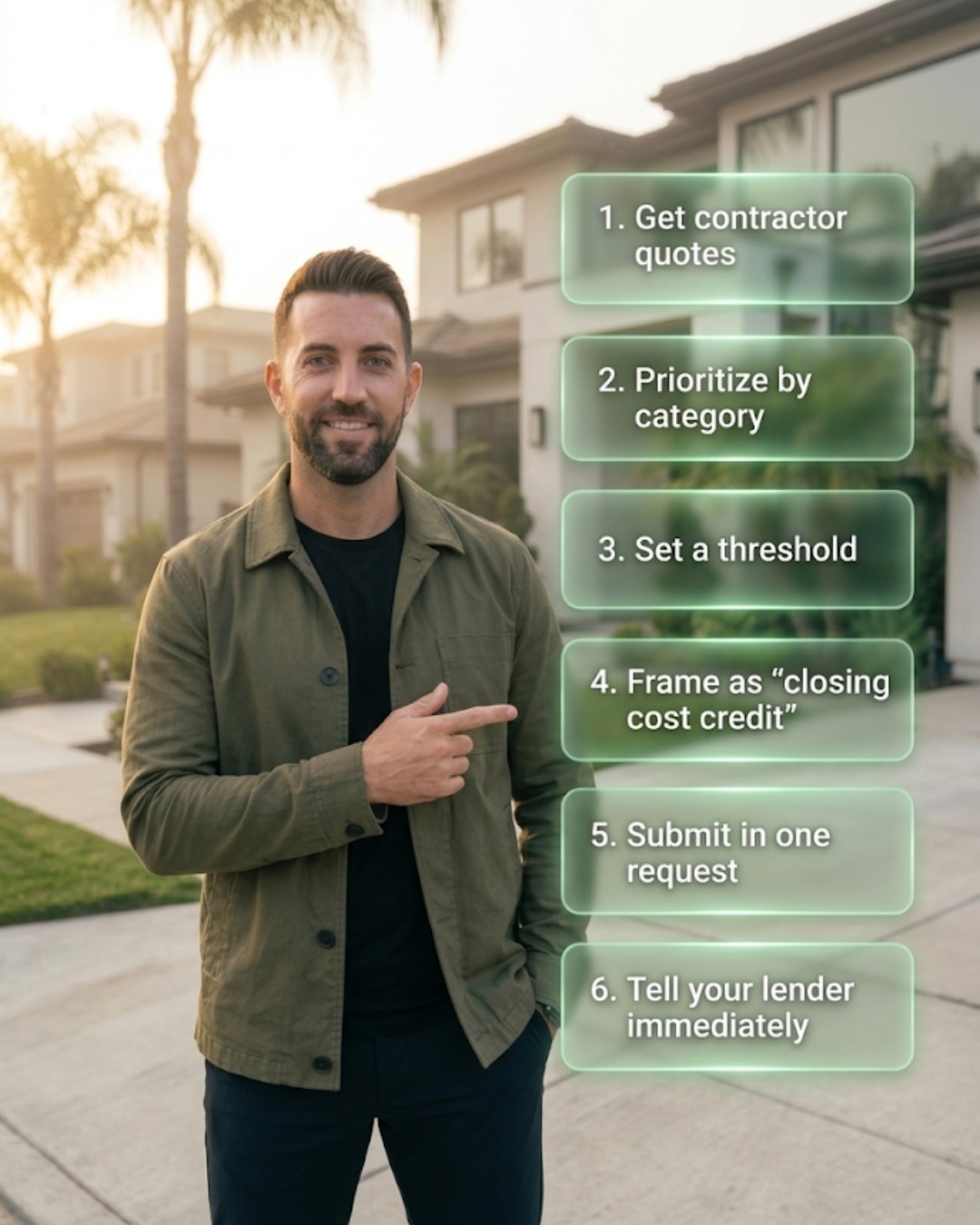
Detailed Steps
Step
Action
Details
1
Get contractor quotes
For each major item, get a written estimate from a licensed California
contractor. Do not rely on the inspector’s rough figures — lenders
require actual quotes for any credit over $1,000.
2
Prioritize by category
Safety/habitability > Structural > Mechanical > Cosmetic. Lead with the
issues the seller cannot reasonably argue against (roof, HVAC, sewer).
Leave cosmetic items off — they weaken your position.
3
Set a threshold
Only request credits for items over $500–$1,000. Nitpicking minor
items signals you are unreasonable and often causes sellers to dig in
on everything.
4
Frame as “closing cost credit”
Never write “credit for roof repairs.” Write “credit toward buyer’s closing
costs.” Repair-labeled credits require the lender to verify completion
before funding — causing delays or denials. [G]
5
Submit in one request
Bundle all items into a single written request. Multiple rounds of
requests signal inexperience and irritate sellers. One clean,
documented ask is more likely to succeed.
6
Tell your lender immediately
Notify your lender as soon as a credit is agreed upon. Late disclosure
can force last-minute restructuring of the entire transaction. Confirm
total credits (seller + lender) don’t exceed your actual closing costs. [G]
What Not to Request and Why
Every item you add to your seller credit request slightly reduces your chances of getting the important ones. Sellers and their agents have seen inspection reports before they know cosmetic issues from real problems. Lead with strength. A seller credit after inspection is strongest when you lead with safety, structural, and major system issues. Just as important, some requests make your position stronger while others make it easier for the seller to say no.
Items that typically weaken your negotiation:
Paint, carpet, and cosmetic flooring — unless severely deteriorated. Sellers view these as buyer taste preferences.
Small plumbing drips and minor leaks under $200 — bundle these into a general credit rather than itemizing.
Items the inspector flagged as “monitor” or “maintenance recommended” — these are not defects.
Things you knew before making your offer — like a 1970s home with original windows. Sellers can reasonably argue this was priced accordingly.
Items that support strong requests:
Active roof leaks or a roof within 5 years of end of life
HVAC systems 15+ years old or showing active failure
Any sewer line issue confirmed by camera inspection
Safety hazards: faulty electrical panels (FPE, Zinsco), exposed wiring, GFCI absent near water
Foundation issues confirmed by a structural engineer (not just the home inspector)
Evidence of prior water intrusion or active moisture
Missing seismic straps on water heater (California requirement [K])
California-Specific Inspection Issues
California homes have unique issues that affect credit requests. These are worth knowing before you go into negotiation:
Earthquake preparedness
Water heater seismic strapping is required by California law (CA Health & Safety Code). A missing strap is a code violation, not just a recommendation, strong grounds for a credit. [K]
Cripple walls (unbraced short foundation walls on older homes) are a seismic risk. Bracing kits cost $1,500–$4,500 and are highly negotiable post-inspection.
Fire risk and roofing
In designated High Fire Hazard Severity Zones (HFHSZ), CA may require fire-resistant roofing materials (Class A). If the current roof doesn’t comply, you can request a credit for the upgrade premium.
Check if the property is in a HFHSZ using the CAL FIRE map before your inspection. This affects insurance availability as well.
Geological hazards (required disclosures)
Sellers must disclose if a property is in a Special Flood Hazard Area, Earthquake Fault Zone, Seismic Hazard Zone, Fire Hazard Severity Zone, or Wildland Urban Interface.
These disclosures don’t automatically justify a credit, but they affect your cost of insurance and future resale. Factor them into your offer analysis.
Older homes
Homes built before 1978 may have lead paint and asbestos. Lead paint disclosure is federally required. Asbestos in floor tiles or insulation may require licensed remediation at $1,500–$10,000+.
Knob-and-tube wiring (pre-1950s) is still common in some Bay Area neighborhoods. Most insurers won’t cover homes with active knob-and-tube; this is a strong credit request.
Example: $1.1M San Jose Home
Here’s how a ficustree buyer can structure their seller credit after inspection on a 1978 San Jose home in CA:
Inspection Finding
Contractor Quote
Age / Proration
Credit Requested
Roof — 22-yr-old asphalt, active minor leak
$19,500
At end of life
$19,500 (full credit)
HVAC — 16-yr-old AC, 14-yr-old furnace
$11,200
Both past 15 yrs
$11,200 (full credit)
Water heater — 11 yrs old, no seismic strap
$1,400
Near end of life + code issue
$1,400 (full credit)
Minor plumbing (2 leaks, 1 fixture)
$650
N/A
$650 (bundled)
Interior paint (seller preference excluded)
$3,200
Cosmetic only
$0 — not requested
TOTAL CREDIT REQUESTED
$32,750
TOTAL CREDIT RECEIVED
(seller countered)
$26,500
The buyer excluded paint, framed the request as a single closing cost credit, and received $26,500, which is enough to cover all closing costs and fund the roof and HVAC replacements in the first year of ownership.
Have a question? Find answers here…
How long do I have to request seller credit after the inspection in California?
Your California Residential Purchase Agreement (RPA) specifies an inspection contingency period which is typically 17 days from acceptance. Within that window, you must request repairs or credits (or remove the contingency). Exact timelines vary by contract version and any addenda. Check your specific agreement or ask your agent.
Can I ask for a credit that exceeds my closing costs?
No. Even if the loan program allows a 6% seller contribution, the credit cannot exceed your actual closing costs. Any excess is forfeited and it does not reduce your loan balance or come back as cash. Structure your request to match your closing costs as closely as possible.
Should I get contractor quotes before submitting the credit request?
Yes, for any item over $1,000. Vague requests based on inspector estimates are easier for sellers to reject. A licensed contractor quote is harder to argue against and is often required by lenders for documentation of larger credits.
What if the seller refuses the credit entirely?
You have three options: accept the home as-is and budget for repairs yourself, negotiate a reduced price instead (which may be more palatable to the seller), or exercise your inspection contingency and exit the contract. Your agent and your risk tolerance should guide this decision. Just as important, some requests strengthen your position while others weaken it.
Can I use the credit to buy down my interest rate?
Yes. If your closing costs are lower than the credit amount, you can constructively increase costs by funding a mortgage rate buydown (discount points). A 1-0 or 2-1 temporary buydown on a $700,000 loan typically costs $6,000–$14,000 and can be funded by a seller credit.
Do seller credits after inspection affect the purchase price?
No. The closing cost credit does not change the purchase price. The home still needs to appraise at the purchase price. If you ask the seller to reduce the price instead, that affects the loan amount and potentially the LTV.
Sources and Data
All repair cost ranges are sourced from published contractor data for California. Individual property repair costs vary significantly based on home size, age, location, material type, and access. Always obtain licensed contractor estimates for your specific home before requesting any credit.
Sources and Data
Ref
Data point
Source
[A]
Roof replacement California average: $18,257 (2,495 sq ft asphalt shingle)
Educational purposes only, please conduct your own due diligence
Repair cost ranges are estimates based on California-wide published data and do not represent quotes for any specific property. Actual repair costs vary significantly by location, home size, material type, contractor, and property condition.
Always obtain written estimates from at least two or three licensed California contractors before submitting any credit request to a seller.
Seller credit caps and contract requirements are based on federal agency guidelines current as of April 2026. Individual lenders may have stricter overlays. The “closing cost credit” vs “repair credit” language distinction is based on standard mortgage industry practice — verify the correct language with your specific lender before submitting your request to the seller.
California inspection timelines and contingency periods are based on the standard California Residential Purchase Agreement (RPA). Your specific contract terms may differ. This article is not legal, financial, mortgage, or real estate advice. Consult a licensed California real estate agent and mortgage professional before making decisions.
Get your personalized negotiation strategy for free
ficustree reviews your inspection report, local comps, and seller motivation signals to generate an exact concession request with documentation.
Most California homebuyers leave money on the table at closing, not because they don’t negotiate, but because they negotiate the wrong thing.
A seller concession is a credit the seller gives you at closing to cover your costs: mortgage buydown, closing fees, prepaid taxes, or repairs. For context, in a market where the average Bay Area home closes at $1.2M, the difference between asking for a 1% price cut and asking for a 1% closing cost credit can be $8,000–$15,000 in real cash savings.
This guide explains exactly how seller concessions in California work, how much you can request based on your loan type, and whether a concession beats a price reduction on your specific purchase.
Try the free calculator first
Enter your purchase price, down payment, and loan type at
SELLER CONCESSION CALCULATOR
to get your personalized maximum concession and comparison in under 30 seconds.
What Is a Seller Concession?
A seller concession, also called a seller credit, interested party contribution (IPC), or seller-paid closing costs, is money the seller agrees to contribute at closing to help cover your expenses as the buyer.
What concessions can cover:
Loan origination fees and lender charges
Escrow and title fees
Prepaid items: property taxes, homeowner’s insurance, HOA dues
Discount points to permanently or temporarily buy down your interest rate
Appraisal fee, inspection fee, and other transaction costs
What concessions cannot cover:
Your down payment. Seller credits cannot be used toward the down payment under any circumstances.
More than your actual closing costs. Even if the limit is higher, the seller cannot give you more than you are actually spending.
Undisclosed contributions. Any undisclosed item of value from the seller must be reported to the lender.
Maximum Seller Concessions in California – by Loan Type (2026)
Federal agencies cap how much sellers can contribute. The limits differ by loan type and, for conventional loans, by how much you put down. These limits exist to prevent artificial home price inflation.
Important: Concessions are capped at your actual closing costs
Even if your loan type allows 6%, you cannot receive more from the seller than you are
actually spending on closing costs. If your closing costs are $18,000 and your cap is
$54,000, you can only ask for $18,000. Source: Fannie Mae Selling Guide B3-4.1-02 [8].
How Common Are Seller Concessions in California? (2025–2026 Data)
Seller concessions in California are not only just permitted, they are now the norm nationally. Here’s what the data shows:
44.4%
of U.S. home sales
included seller
concessions in Q1 2025
California is not one market. Whether you can realistically ask for a concession depends almost entirely on which part of the state you’re buying in. Here’s a detailed stark split:
San Francisco and San Jose have the lowest concession rates of any major U.S. metro because they’re in a fundamentally different supply-demand situation. By late 2025, San Francisco had shifted into a seller’s market which is one of the only seven major metros nationwide in that position.
57.1% of San Francisco homes sold above list price — the highest of any major U.S. metro.
The AI industry boom and return-to-office mandates drove buyer demand sharply higher while Bay Area listings fell.
In competitive multiple-offer situations, asking for concessions at offer can cost you the deal entirely
Bay Area buyers: your window is post-inspection, not at offer
In SF and SJ, concession requests at offer are rare and often deal-breakers in competitive
situations. But post-inspection credits are different, they happen after you’re already under
contract, are tied to specific documented issues, and sellers expect them. This is where Bay
Area buyers recover the most money: not at offer, but in the negotiation window after
inspection. ficustree’s negotiation tool is built specifically for this moment.
Seller Concession vs. Price Reduction: Which Is Worth More?
This is the question most buyers get wrong. Here’s the math, using a $1,200,000 California home at a 7% interest rate with 20% down (a common Bay Area scenario):
Scenario
Price Cut
Concession
Advantage
On $1,200,000 home
$12,000 off price
$12,000 credit
—
Monthly P&I savings (7% rate)
~$57/mo
~$0/mo change
Price cut saves payment
Cash freed at closing
$0
$12,000
✓ Concession wins
5-year savings
$3,420
$12,000 (liquid)
✓ Concession wins
10-year savings
$6,840
$12,000 (liquid)
✓ Concession wins (yr 1–17)
With PMI (<20% down)
May reduce PMI
No PMI effect
Price cut may win — verify
Monthly P&I savings calculated using standard amortization: P&I = L × [r(1+r)ⁿ] / [(1+r)ⁿ−1]. 5-year and 10-year figures are cumulative savings.
Why concessions usually win
A $12,000 price reduction on a $1.2M home reduces your loan balance by about $9,600 (after 20% down). At 7%, that saves you roughly $57/month in principal and interest, which adds up to $3,420 over 5 years.
The same $12,000 as a closing cost credit stays in your pocket as liquid cash on day one. You can use it for reserves, repairs, or simply keep it invested. The concession is worth $12,000 immediately which is more than the 5-year payment savings from a price cut.
The concession’s advantage flips only when you hold the home long enough for accumulated payment savings to exceed the credit amount (roughly 17+ years at these numbers) and that assumes you don’t reinvest or use the cash for anything else.
When a price reduction might win
You’re putting less than 10% down and a lower purchase price reduces your PMI obligation
You’re buying all-cash (no closing costs to cover)
You plan to hold the home for 20+ years and care more about long-term payment reduction
Your closing costs are very low and the gap between concession and 5-year savings is narrow
Run your specific numbers
The calculator at
SELLER CONCESSION CALCULATOR
shows both options side-by-side with your exact price, rate, and down payment. It also shows the break-even year.
What Are Typical Closing Costs in California? (So You Know What to Ask For)
In addition to high property values, California buyers typically pay 2–5% of the purchase price in closing costs, making it one of the highest-cost states in the country.
Typical buyer closing cost components
Loan origination fee: ~1% of the loan amount (varies significantly by lender. So compare at least 3 Loan Estimates)
Lender’s title insurance: ~0.22% of purchase price
Escrow fees: ~0.25% of purchase price (in NorCal, buyer typically pays; SoCal typically splits 50/50)
Appraisal: $300–$1,000 depending on property
Home inspection: $300–$600 typically
Prepaid property taxes and insurance: ~0.75% of purchase price
Recording fees: ~$244 on average in California
⚠ Important: Closing cost customs vary significantly by California county and city. In Northern California, buyers typically pay owner’s title insurance and full escrow fees. In Southern California, sellers typically pay owner’s title and escrow is often split. Charter cities including San Francisco, Los Angeles, Oakland, and others charge additional transfer taxes not included in these estimates. Always request a Loan Estimate from your specific lender for accurate costs.
How to Ask for Seller Concessions in California (Step by Step)
Step 1: Decide whether to ask at offer or post-inspection
You can ask for seller concessions at two points: in your initial offer, or after the home inspection. You should generally choose one, not both.
At offer: Useful in a buyer’s market (LA, San Diego) where you have leverage. In competitive Bay Area markets, asking for concessions upfront can cost you the deal. Nationally, 44.4% of transactions included concessions in Q1 2025, but in SF and SJ, that figure is only ~15%. [9]
Post-inspection: Stronger position in the Bay Area because you have documented justification. A 15-year-old roof or failing HVAC system creates specific, defensible grounds for a credit request.
Step 2: Frame it as a closing cost credit, not a price reduction
Sellers respond better psychologically to “a $12,000 credit toward closing costs” than “reduce your price by $12,000.” The economic effect can be similar, but the framing matters especially if the seller has emotional attachment to their list price.
Step 3: Tie the request to a specific item when possible
A vague concession request is easy to refuse. A specific, documented request is much harder:
“Credit me $14,000 for the HVAC system replacement documented on page 8 of the inspection report” is stronger than “reduce the price by $14,000.”
Get repair cost estimates from licensed contractors to back up your numbers.
Step 4: Know your market
San Francisco / San Jose (seller’s market): Only ~15% of deals include concessions. Focus exclusively on post-inspection leverage. In SF, 57.1% of homes sell above ask.
Los Angeles (buyer’s market): 56.1% of deals included concessions in Q1 2025, up 11 points year-over-year. Asking at offer is reasonable.
San Diego (buyer’s market): 60.7% of deals included concessions in Q1 2025, one of the highest rates nationally. Strong leverage at offer.
Check months of supply in your specific neighborhood. Under 2 months = seller’s market. Over 4 months = buyer’s market.
Step 5: Understand what the seller’s net looks like
Sellers think in net proceeds, not in concessions. A $15,000 concession on a $900,000 sale reduces their net by $15,000. However, if you can show that the concession enables a faster, cleaner close (no repair obligations, no re-inspection), sellers often prefer that to a price reduction.
Post-NAR Settlement: How Concessions Changed in 2025–2026
The 2024 NAR settlement changed buyer agent compensation rules. Starting August 2024, sellers are no longer required to offer buyer agent commissions through the MLS. Consequently, this has made concession strategy more important and more complex.
What this means for your concession ask:
You may have a separate buyer agent fee agreement. Seller concessions can cover this, but it counts against your IPC maximum.
Fannie Mae clarified that customary seller payments to the buyer’s agent do not count toward IPC limits — but this depends on how the transaction is structured.
In practice: work with your agent to structure the request clearly so buyer agent compensation and closing cost credits are treated correctly by your lender.
ficustree can help!
Our platform reviews your specific offer structure, loan type, and inspection report to generate a negotiation package including the exact concession request, documentation, and how to frame it to the seller.
Have a question? Find answers here…
Can I ask for seller concessions in California after the inspection ?
Yes! This is the most common time to request them. The California Residential Purchase Agreement (RPA) includes a request for repairs or credits period after the inspection. The inspection report gives you documented justification for every credit you request.
Do seller concessions affect my offer competitiveness?
During multiple-offer situations, concession requests can weaken your offer. In SF and SJ, where only ~15% of deals include concessions and 57% of homes sell above ask, concession requests at offer are particularly risky. In LA and San Diego where rates exceed 55%, the dynamic is reversed.
Can the seller give me cash back at closing?
No. Lenders require all credits to appear on the Closing Disclosure and to apply only toward legitimate closing costs. As a result, any undisclosed payment from the seller back to the buyer outside of escrow is mortgage fraud.
What if my closing costs are lower than the concession cap?
You can only receive up to your actual closing costs even if the cap is higher. However, you can constructively increase closing costs by using concession funds for a mortgage rate buydown (discount points), prepaying more taxes and insurance, or other lender-approved expenses.
Does a seller concession change the purchase price?
No. The concession is a credit at closing and the purchase price stays the same. This matters for your appraisal (it needs to support the full purchase price) and your loan amount.
Are seller concessions taxable?
Consult a tax professional for your specific situation. Generally, seller concessions reduce the seller’s taxable proceeds and may affect the buyer’s cost basis. ficustree does not provide tax advice.
Sources and Data
All data points in this article are sourced from government guidelines, regulatory filings, or published industry research. California closing cost customs and local transfer tax rates vary by county and city. Redfin concession data is based on transactions recorded by Redfin buyer’s agents across the U.S. and may not reflect all transactions in a given market.
Educational purposes only — please conduct your own due diligence
This article and the accompanying calculator are provided for general educational
purposes only. They do not constitute legal, financial, mortgage, tax, or real estate advice.
Closing costs, seller concession limits, and mortgage terms vary based on your specific
lender, loan program, property type, county, city, and individual transaction details.
California-specific notice
Closing cost customs differ significantly between Northern and Southern California counties,
including who pays escrow and title insurance. Transfer taxes vary substantially by city.
Charter cities including San Francisco, Los Angeles, Oakland, Berkeley, and others charge
additional transfer taxes that may substantially increase your costs. Always verify with a
local licensed professional.
Market data notice
Redfin concession rate data is based on transactions closed by Redfin agents and may not
be representative of all transactions in a given market. Market conditions change rapidly,
and data cited reflects Q1 2025 and late 2025 reports. Verify current conditions with a
licensed local real estate agent before making decisions.
Seller concession rules
Seller concession rules are governed by Fannie Mae/Freddie Mac guidelines, FHA/HUD rules,
VA guidelines, and individual lender overlays. Your lender’s specific requirements may differ
from the maximums shown. Always consult a licensed mortgage professional, California-licensed
real estate agent, and real estate attorney before making financial decisions.
ficustree makes no warranties as to the accuracy, completeness, or timeliness of
information in this article. Data sourced from published guidelines and reports current
as of April 2026.
Get your personalized negotiation strategy for free
ficustree reviews your inspection report, local comps, and seller motivation signals to generate an exact concession request with documentation.
Buying a home is exciting. However, it also comes with one question that almost every buyer worries about: what is the true cost of homeownership, and how much can I actually afford without putting my life under pressure?
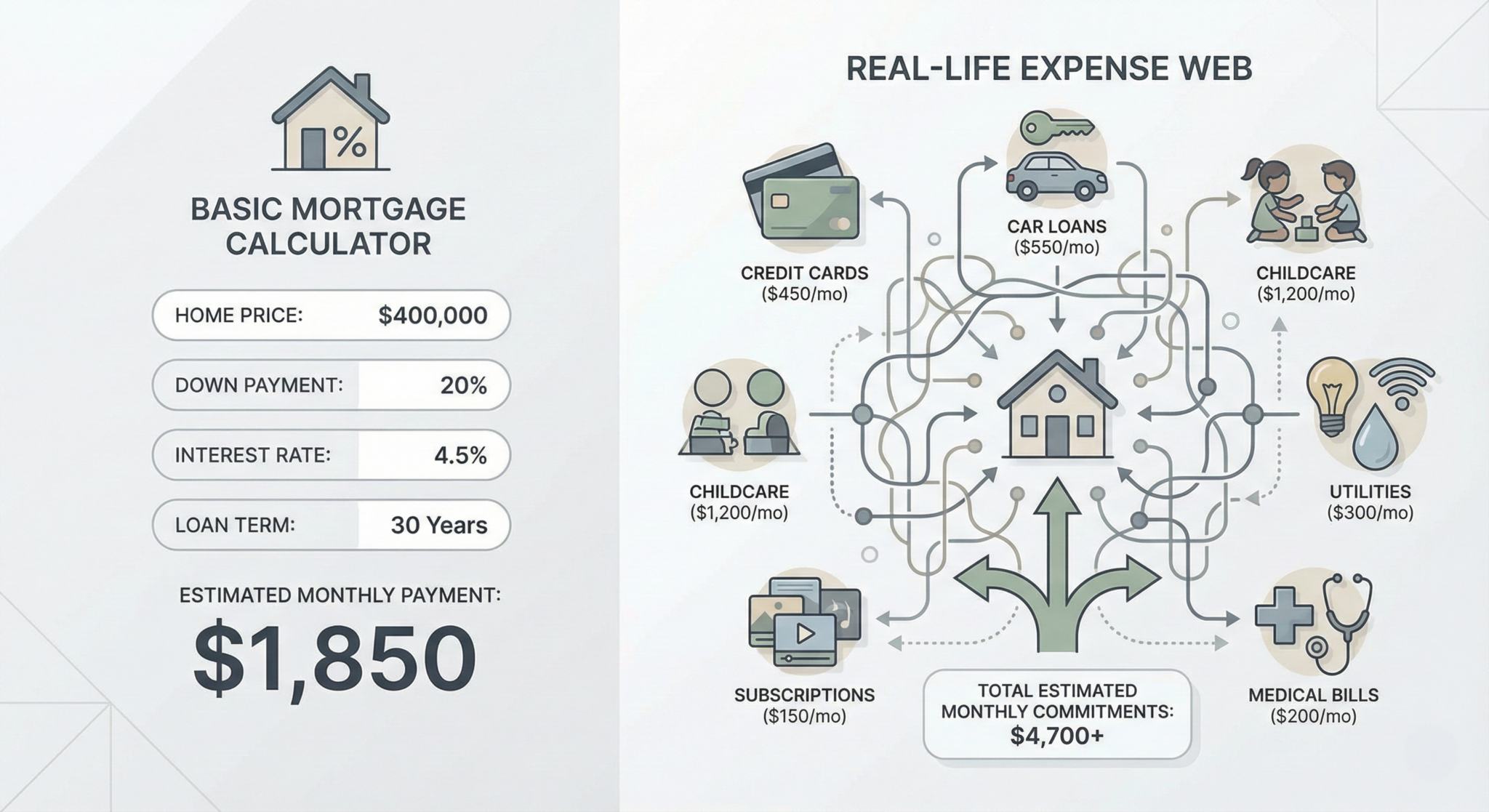
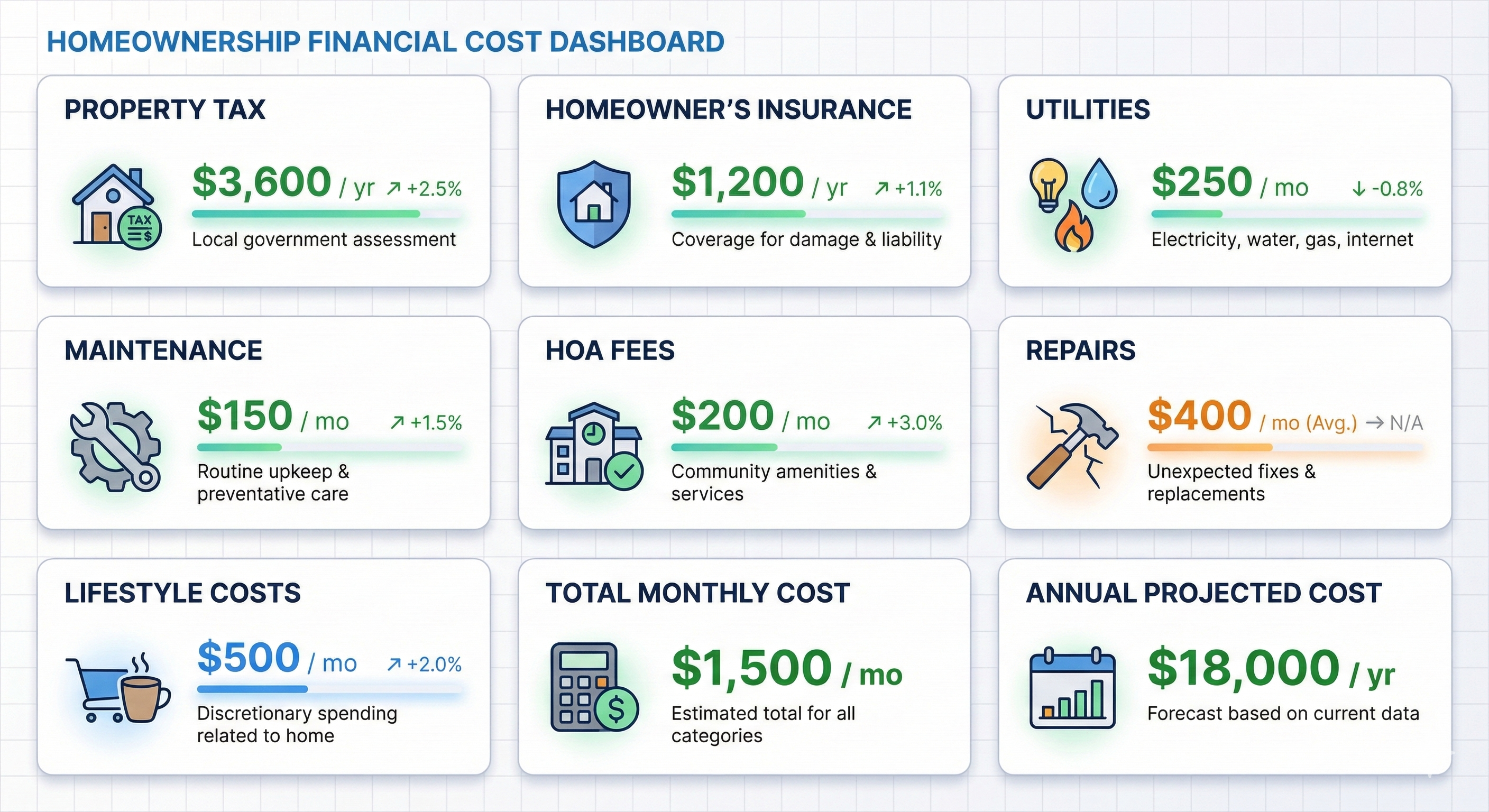
Most buyers begin with a mortgage calculator. It shows a monthly payment, property taxes, and sometimes HOA fees. At first glance, everything seems manageable. Yet real life is never that simple. Your budget is shaped by credit cards, auto loans, family expenses, utilities, repairs, lifestyle costs, and other monthly home expenses that traditional calculators never include.
Because of this gap, many buyers feel confident on paper but stressed after they move in. We built ficustree to avoid such situation to our users. We believe buyers deserve a clear and realistic view of affordability, not a quick math that ignores real life.
Why Simple Affordability Calculators Miss the Real Picture
Traditional affordability calculators focus on the loan. Unfortunately, they ignore the financial commitments you already carry every month.
Most calculators leave out costs such as:
Credit card minimum payments
Auto loans
Student loans
Personal or medical loans
Childcare expenses
Subscriptions and recurring services
Insurance premiums
Monthly lifestyle spending
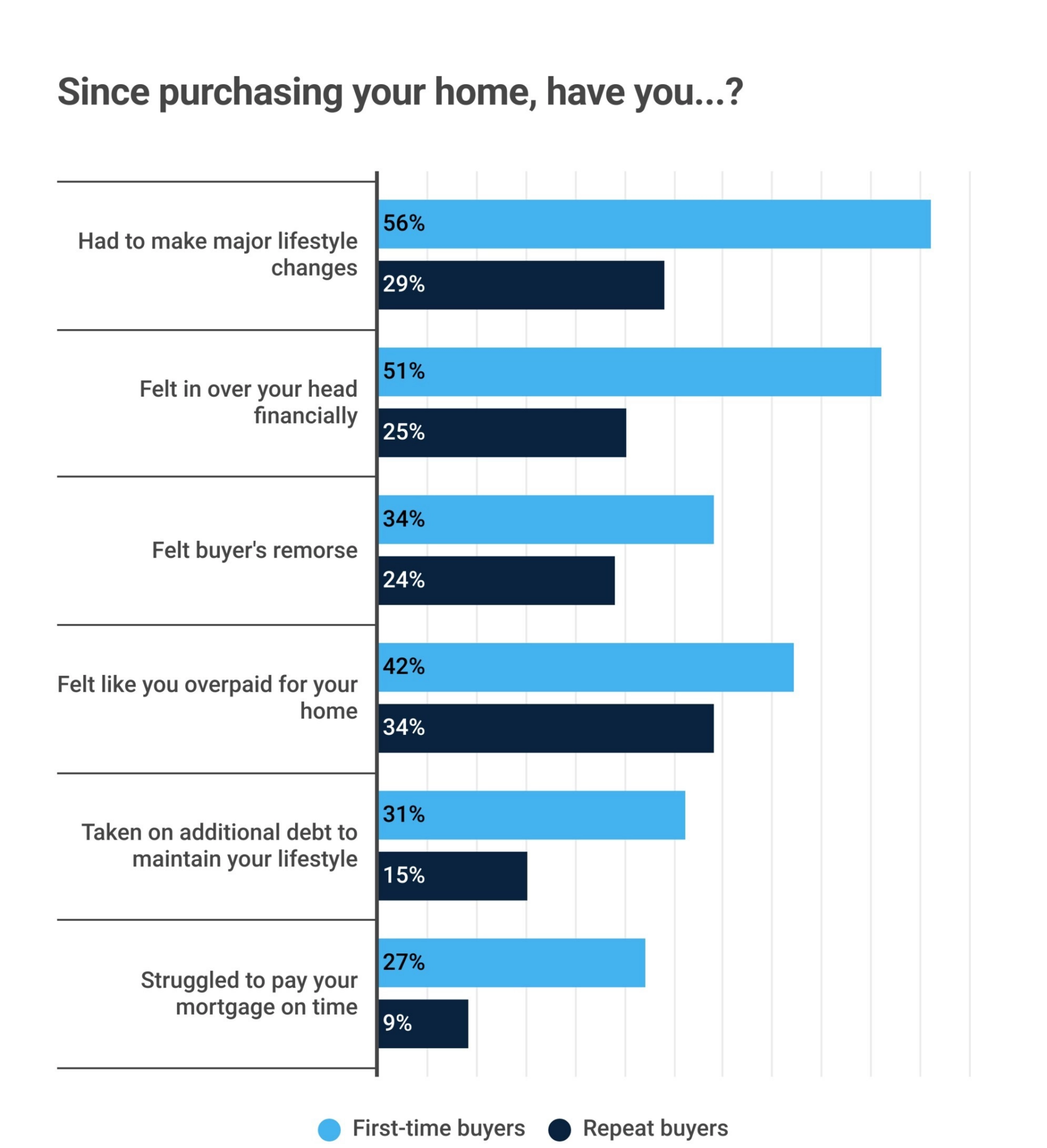
As a result, buyers often believe they can afford a home that technically fits the formula but does not fit their day-to-day life. According to prnewswire 51% of first-time home buyers felt the jolt.
Ficustree helps buyers understand the financial factors that truly affect comfort and stability, not just approval limits.
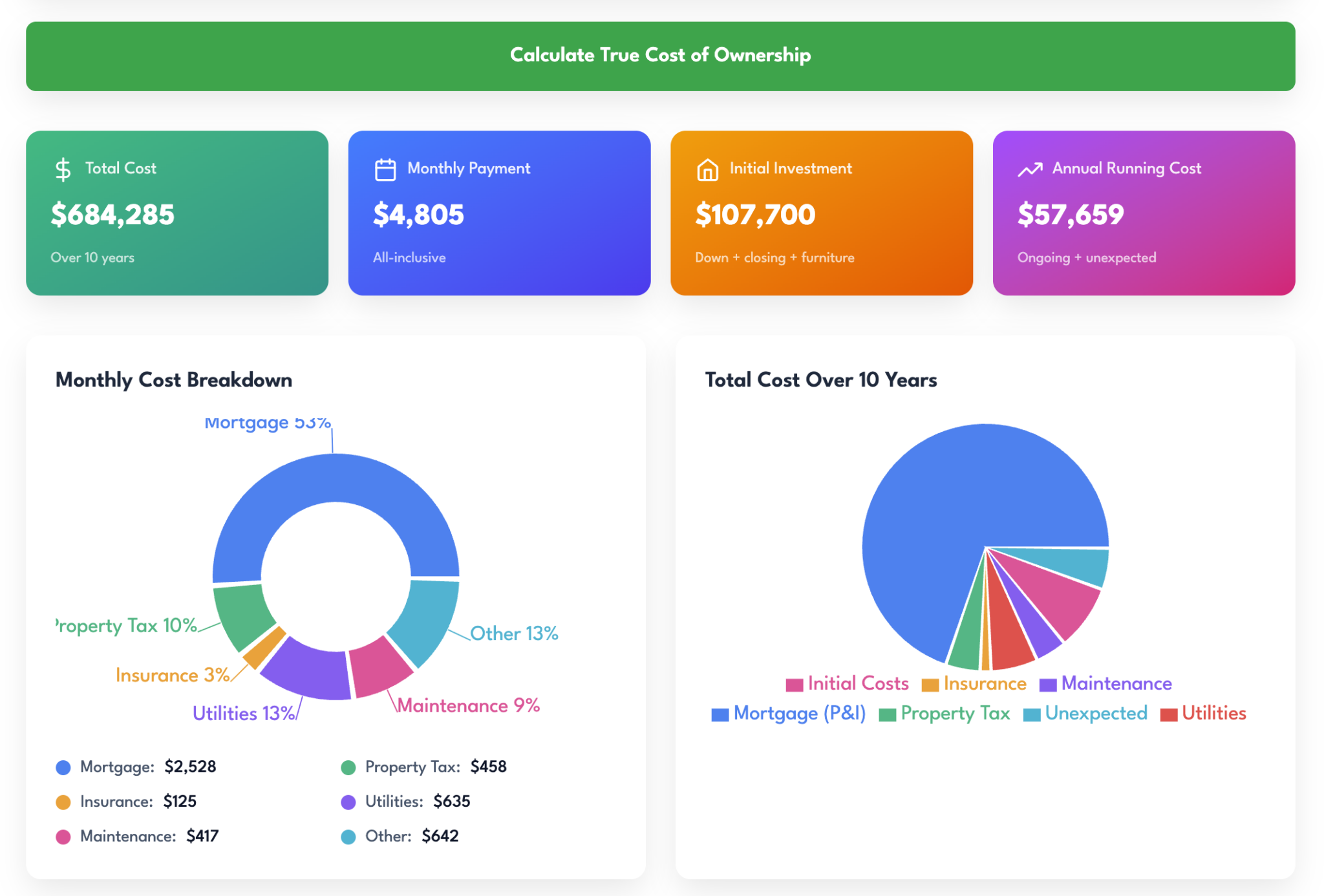
What the True Cost of Homeownership Really Includes
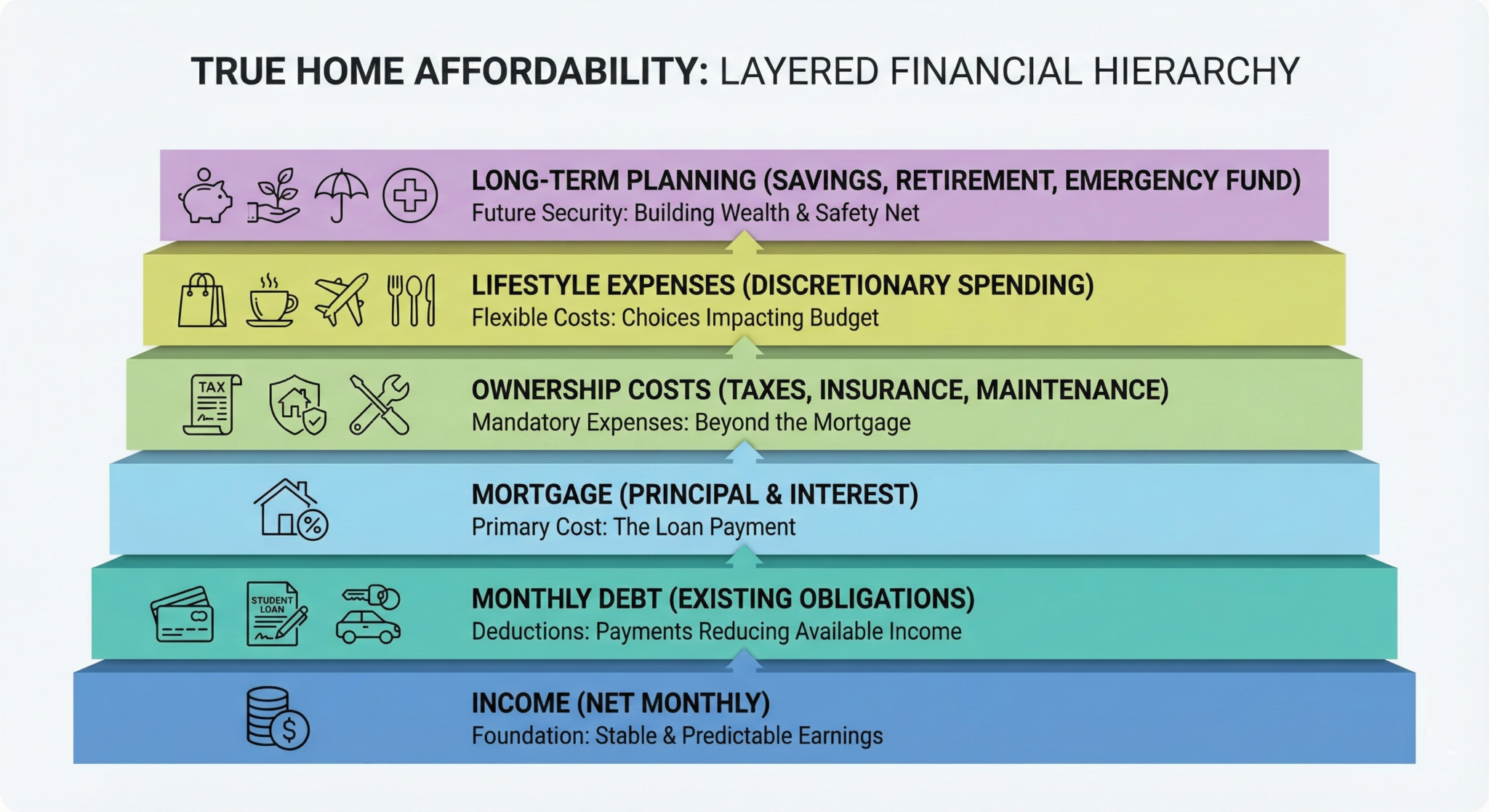
Understanding the true cost of homeownership means looking at the full financial picture, not just the mortgage.
1. Your Total Monthly Debt
A realistic affordability calculation starts with your actual obligations. This includes:
Credit card minimums
Car payments
Student loans
Personal or consolidation loans
Current rent or mortgage
Child support or alimony
Medical payments
Subscriptions and lifestyle expenses
When you account for these first, you see how much room you truly have for a home.
2. Your Future Mortgage, Based on Real Loan Details
Instead of using estimates, buyers should calculate affordability using real loan assumptions, such as:
Loan amount
Type of loan, including Conventional, FHA, or VA
Loan term, such as 15 or 30 years
Interest rate
Discount points, if applicable
Down payment
PMI, when required
This ensures your mortgage estimate reflects your actual plan, not a generic scenario.
3. Real Homeownership Costs Most Buyers Forget
Owning a home comes with ongoing expenses beyond the monthly loan payment. Planning for these costs upfront helps avoid surprises later.
Core monthly and yearly costs
Property taxes
Homeowners insurance
HOA fees
Utilities such as water, electricity, gas, and trash
Internet services
Yard maintenance
Pest control
Maintenance and unexpected repairs
Every home ages. Systems wear out, and appliances eventually fail. Buyers should consider:
Roof age and replacement timelines
HVAC life expectancy
Water heater condition
Appliance age
Plumbing and electrical systems
Flooring and windows
Typical repair costs for the area
Annual maintenance savings
Location and lifestyle factors
Commute expenses
School activities
Community fees
Parking or EV charging
Local cost of essentials
All of these influence whether a home feels comfortable or financially stressful.
4. Closing Costs Many Buyers Overlook
Upfront costs often surprise buyers, especially first-time buyers. These may include:
Lender fees
Title and escrow charges
Appraisal fees
Recording fees
Transfer taxes
Home inspections
Moving expenses
Together, these costs can add thousands to your initial budget.
5. How Your Finances Look After You Buy
Affordability is not about buying the biggest home the bank approves. Instead, it is about living comfortably after closing.
That is why buyers should think about:
Remaining savings after purchase
Emergency funds
Monthly savings potential
Future repairs
Property tax increases
Insurance changes
Utility cost shifts
Long-term resale value
This creates a five to ten year view of affordability, not just the first month.
How ficustree Helps Buyers Understand the True Cost of Homeownership
The ficustree affordability experience starts with you, not the listing. By understanding your financial details, lifestyle needs, and future plans, ficustree helps buyers find homes that are truly affordable.
Buyers work with a personalized AI agent that considers real debt, ownership costs, and long-term impact. This approach helps buyers choose homes they can enjoy for years without financial strain.
Why the True Cost of Homeownership Matters
A complete affordability calculation helps prevent:
Becoming house poor
Unexpected financial pressure
Costly repair shocks
Feeling trapped by a mortgage
Strain on family and lifestyle
Delays in future goals
The right home should feel like freedom, not a burden.
The ficustree Approach to Real Affordability
ficustree is built for buyers, not for selling leads or pushing listings. Our approach focuses on:
A realistic, debt-aware affordability view
A complete breakdown of homeownership costs
Long-term cost forecasting
Personalized guidance based on lifestyle and future needs
We want every buyer to feel confident, informed, and secure in the home they choose.
The only calculator you need
If you are planning to buy a home, give yourself clarity beyond a basic calculator.
Your home should support your life, not limit it.
ficustree helps you understand the true cost of homeownership so you can choose a home that fits your budget, your goals, and your future.
The true cost of homeownership includes far more than your monthly mortgage. It combines your loan payment, property taxes, insurance, utilities, maintenance, repairs, lifestyle expenses, and your existing financial obligations like loans and subscriptions. Understanding this full picture helps buyers avoid financial stress after moving in.
Why do most traditional affordability calculators give misleading results?
Most calculators focus only on mortgage payments and ignore real-life expenses such as credit cards, auto loans, childcare, and lifestyle spending. This creates a gap between what you’re approved for and what you can actually afford comfortably.
How much home can I realistically afford?
Real affordability depends on your total financial picture — income, existing debt, lifestyle costs, and long-term goals. A home is affordable only if you can comfortably manage all expenses after buying, not just qualify for the loan.
What monthly costs should I consider beyond my mortgage?
Beyond your mortgage, you should account for:
Property taxes
Homeowners insurance
Utilities
HOA fees
Internet and services
Maintenance and repairs
These ongoing costs significantly impact your monthly budget.
What hidden costs of buying a home do buyers often miss?
Many buyers overlook:
Closing costs (lender, escrow, appraisal fees)
Moving expenses
Immediate repairs or upgrades
Maintenance reserves
These upfront costs can add thousands to your budget.
Why is it important to consider existing debt before buying a home?
Your current financial commitments such as loans, subscriptions, and childcare directly reduce how much you can comfortably spend on housing. Ignoring these can lead to becoming “house poor.”
What are ongoing homeownership costs that increase over time?
Costs that can rise include:
Property taxes
Insurance premiums
Utility costs
Maintenance and repairs
HOA fees
Planning for increases helps maintain long-term financial stability.
How much should I budget for home maintenance and repairs?
A common rule is to set aside 1–3% of the home value annually, but this varies based on the home’s age and condition. Older systems like roofs, HVAC, and plumbing can significantly increase costs.
What is included in a realistic home affordability calculation?
A realistic calculation includes:
Income and savings
Total monthly debt
Loan details (rate, term, PMI)
Ongoing ownership costs
Lifestyle and future expenses
This gives a complete affordability view, not just approval limits.
Why do some buyers feel financially stressed after buying a home?
Many buyers rely on simplified calculations and underestimate real expenses. As a result, their monthly budget becomes tight, leading to stress, delayed goals, or lifestyle compromises.
How do lifestyle factors impact home affordability?
Factors like commute costs, school needs, community fees, and daily living expenses directly affect your overall budget and long-term comfort in a home.
How should I evaluate affordability over the long term?
Buyers should think beyond the first month and consider:
Savings after purchase
Emergency funds
Future repairs
Cost increases
Resale value
This creates a sustainable 5–10 year financial outlook.
Buying a home is one of the biggest milestones in your life. It is exciting, emotional, and sometimes overwhelming. For years, though, homebuyers have been treated like just another lead in the real estate funnel. Most platforms were built to sell leads to agents, not to guide you through emotionally intelligent home buying that actually understands you.
Traditional search tools overwhelm buyers with endless listings, filters, and noise. You scroll through page after page of homes that loosely match your criteria, often without context, clarity, or guidance. Behind the polished interfaces, there has been one glaring gap: no one built a platform that understands you, your dreams, your priorities, and your lifestyle.
More than Filters: An Intelligent Partner built for you
ficustree is more than a search tool. It is an intelligent partner built with empathy at its core. Our AI doesn’t just process data; it listens. Like a thoughtful realtor, it learns what matters most to you: the life you want to build, how your family grows, and the spaces that help you thrive. This is the heart of emotionally intelligent home buying, a process designed around people, not just properties.
Instead of showing you dozens of loosely relevant listings, ficustree narrows things down to the homes that genuinely fit your story. Your personalized AI agent focuses on one goal: helping you find your next home faster, smarter, and with far less stress.
Emotionally Intelligent Home Buying Starts With Understanding You
Every buyer has a unique story behind their search. For some, it’s about stability. For others, it’s about schools, lifestyle, space, or a shorter commute. When you take a moment to understand your “why,” everything that follows becomes clearer.
Because emotionally intelligent home buying adapts to you, the journey moves at your pace. Whether you are cautious, curious, or ready to act quickly, ficustree stays aligned with your comfort level and helps keep you grounded throughout the process.
Transparency on True Costs
The cost of owning a home goes far beyond the mortgage, HOA fees, and property taxes. It involves many hidden factors that add up over time. With ficustree, you see the complete picture of ownership costs before you buy, including:
Insurance premiums
Utility bills and energy forecasts
Maintenance and warranty estimates
Long-term replacement costs for major systems such as roof, HVAC, windows, and flooring
ficustree gives you the real cost of living so you can plan with clarity instead of facing surprises later.
Simplifying Complex and Tedious Documents
Buying a home means navigating disclosures, inspection reports, loan paperwork, and closing documents. These are often packed with jargon that’s hard to understand without guidance.
ficustree uses AI to summarize documents, highlight red flags, and explain what truly matters in simple, clear language. You avoid missing important details and always know what you are signing. Emotionally intelligent home buying means reducing confusion rather than adding to it.
End-to-End Support from Search to Ownership
ficustree is not just another home search website. It is a complete home buying partner that supports you from start to finish. You can:
Discover homes that fit your life
Understand documents with clarity
Plan your move-in logistics
Manage your home after the purchase
Everything remains in one place, making the entire journey simpler, faster, and less stressful. In fact, many buyers say this brings a sense of calm to the entire process.
Built for First-Time Buyers and anyone who values their time
If you are buying your first home, the process can feel overwhelming. That is why ficustree acts as your coach and partner, guiding you step by step, building your confidence, and supporting you with clear, timely decisions that save money and reduce anxiety.
Repeat buyers appreciate the speed, insight, and peace of mind that comes from having an intelligent, emotionally aware partner by their side. In addition, they often find the process far more predictable and reassuring with consistent guidance.
The ficustree Promise
Traditional home buying often takes weeks or months, and much of that time is spent confused or stuck in research. However, Ficustree changes that.
Our platform brings emotionally intelligent AI, complete transparency, and continuous personalized guidance. As a result, it helps you move from search to ownership in days, not months. We believe home buying should feel human again. Not transactional. Not overwhelming.
At ficustree, we protect your data, respect your privacy, and dedicate our AI agents entirely to you. Most importantly, there are no shared leads, no hidden sales agendas, and no clutter.
In fact, you receive pure, personalized guidance that supports your goals.
Here’s our blog on how AI Home Search is revolutionizing the way buyers find home: AI Home Search for Buyers
The Future of Home Buying Is Here
We built ficustree because every buyer deserves empathy, intelligence, and trust in one place. When you share your dreams, we do more than match listings. We help you find the place where your life fits best.
The way people buy homes has changed dramatically in recent years. What once relied on endless listings, basic filters, and scattered advice is now being reshaped by smarter technology. AI home search for buyers is transforming how homes are discovered, compared, and evaluated long before an offer is written.
Instead of starting with listings and hoping something fits, buyers today can begin with their lifestyle and dream home as a search criteria. AI helps connect affordability, lifestyle match, neighborhoods, and long-term costs into one clearer picture. This shift is especially valuable for first-time buyers who want clarity without pressure.
Here’s how AI is changing the home search experience and how ficustree fits into this new way of buying.
Smarter Affordability Checks Based on Real-Life Numbers
Traditionally, buyers didn’t fully understand a home’s true affordability until after purchase. Recent research by Truework found that 17% of homebuyers realized the true cost of ownership was higher than expected.
AI changes that. Instead of guessing, AI tools evaluate affordability using real-life financial inputs such as:
Income and existing debts
Property taxes by neighborhood
Homeowners insurance
HOA fees
Utility estimates
Commute and lifestyle costs
Long-term ownership expenses
As a result, this approach helps buyers avoid falling in love with homes that stretch their budget too far. AI home search for buyers focuses on what is sustainable, not just what’s sustainable not just what a lender technically approves.
ficustree builds on this by showing the true cost of ownership, including maintenance ranges, utilities, and neighborhood-specific expenses. So this way, Buyers get a realistic sense of what living in a home will feel like month after month.
Why AI Home Search for Buyers Replaces Endless Scrolling
Most traditional platforms rely on filters. Price, Bedrooms, Bathrooms & Zip code. While helpful, filters cannot capture how a home actually fits a buyer’s life.
AI changes this by learning preferences over time, such as:
Home styles
Neighborhood atmosphere
School preferences
Noise tolerance
Commute expectations
Safety
With AI home search for buyers, recommendations become more intentional. Instead of reviewing hundreds of listings, buyers see a smaller set of homes that align with both budget and lifestyle.
ficustree applies this same principle. As a result, it narrows choices thoughtfully, helping buyers spend less time searching and more time evaluating the homes that truly make sense.
AI Home Search for Buyers vs Traditional Listing Platforms
Traditional platforms answer one question:What is available? AI answers a more important one: What actually fits you?
With AI-driven tools, buyers can understand:
Why one neighborhood may cost more long term than another
How lifestyle choices impact monthly expenses
Which homes align with future plans, not just current needs
This comparison gives buyers confidence earlier in the process. Decisions feel informed rather than rushed.
Neighborhood Insights Beyond the Listing Page
Long-term happiness often comes down to the neighborhood, not just the house. AI now helps buyers evaluate areas using data that once required deep local knowledge, including:
School performance trends
Crime patterns
Walkability and transit access
Development and zoning plans
Historical appreciation
AI home search for buyers brings these insights together in one place. Buyers can compare neighborhoods side by side before stepping into a home, saving time and avoiding surprises later.
ficustree organizes these insights so buyers understand not just where a home is located, but what living there may actually feel like.
Predictive Market Insights That Support Smarter Decisions
AI can analyze years of market data to identify trends such as:
Whether prices are rising or stabilizing
Typical negotiation ranges
Seasonal activity patterns
How quickly homes receive offers
These insights help buyers avoid emotional decisions. Instead of guessing, buyers understand market conditions and timing.
When paired with affordability and neighborhood insights, AI home search for buyers creates a more balanced and confident decision-making process.
More Accurate Comparisons When It’s Time to Make an Offer
Determining the right offer price is one of the most stressful parts of buying a home. AI-powered comparison tools help by analyzing:
Recently sold homes
Active listings
Property condition
Neighborhood demand
ficustree complements this by connecting pricing insights with long-term affordability. So this way, buyers can see whether an offer aligns with their future goals, not just the current market.
AI-Driven Virtual Tours and Visualization
AI has also improved how buyers experience homes remotely. Modern tools allow buyers to:
Explore 3D layouts
Visualize staged spaces
Preview renovation possibilities
Measure rooms digitally
This is especially helpful for busy buyers or long-distance moves. Virtual tools help narrow options before scheduling in-person tours.
Instant Guidance When Buyers Need It Most
Questions do not follow business hours. AI-powered guidance helps buyers understand topics like:
Down payments
Mortgage basics
Inspection concerns
Homeownership costs
ficustree simplifies these topics into clear, easy-to-understand guidance. As a result, buyers do not need to be experts. They just need clarity at the right moment.
Final Thoughts
AI is not replacing realtors or human judgment. However, AI home search for buyers is changing how people approach one of the biggest decisions of their lives.
By combining affordability realism, personalized recommendations, neighborhood intelligence, and long-term cost awareness, buyers can move forward with confidence instead of uncertainty.
These reasons are why platforms like ficustree bring these elements together so buyers choose a home that truly fits their lifestyle and have a stress free and peaceful life.
Have a question? Find answers here…
What is AI home search for buyers?
AI home search for buyers uses artificial intelligence to understand preferences, affordability, lifestyle needs, and market data. Instead of relying only on filters, it helps buyers discover homes that truly fit their situation.
How is AI home search different from traditional listing websites?
Traditional platforms rely on manual filters and endless scrolling. AI home search for buyers focuses on context, patterns, and intent. It learns what matters most and reduces noise by showing more relevant options.
Can AI really help buyers choose the right neighborhood?
Yes. AI home search for buyers includes neighborhood insights such as schools, safety trends, commute patterns, development plans, and long-term value. This helps buyers compare areas with more confidence before visiting.
Does AI replace the role of a realtor?
No. AI supports buyers with clarity and preparation, but it does not replace human expertise. Realtors still provide negotiation skills, local knowledge, and guidance. AI simply helps buyers show up more informed.
How does AI help with affordability decisions?
AI tools analyze real-life factors like income, debts, taxes, insurance, utilities, and maintenance. For buyers, this means understanding the true cost of owning a home, not just the mortgage payment.
Is AI home search useful for first-time buyers?
Absolutely. AI home search for buyers is especially helpful for first-time buyers because it explains complex topics, reduces guesswork, and provides structured guidance throughout the process.
What kind of questions can AI answer during a home search?
AI can help buyers understand loan basics, inspections, disclosures, market trends, neighborhood differences, and long-term costs. It offers clarity when questions arise, even outside regular business hours.
How does ficustree use AI for home search?
ficustree uses AI to help buyers understand affordability, compare neighborhoods, analyze costs, and receive personalized guidance. The platform focuses on clarity, not listings alone.
Is AI home search only about speed?
No. Speed is a benefit, but the real value of AI home search for buyers is better decision-making. It helps buyers feel confident, informed, and prepared at every stage.
Will AI make home buying feel less stressful?
When buyers understand what to expect, stress drops. AI home search provides structure, insights, and clarity, which helps buyers move forward with confidence instead of uncertainty.
When you’re buying a home, it’s easy to get caught up in the excitement of finding “the one.” However, behind the scenes, a few essential steps can either save you thousands of dollars or leave you facing unexpected costs. Two of the most important and often misunderstood aspects are the home inspection and the home warranty. Most buyers have heard of them, yet many do not fully understand what they protect or how they work.
Many first-time buyers also ask about home inspection cost, what is included, and how warranties fit into the process.
Here’s our First-time Home buyers blog that has all the key details every first-time home buyers should know.
Before you jump into a home purchase, here is what you need to know in simple, clear terms.
Home Inspection: Why it matters more than you think
A home inspection is not a formality. It is a detailed look at what you are actually buying. Sellers sometimes provide inspection reports upfront, but many do not. Even when reports are provided, it is still wise to understand the property’s condition with your own eyes and through a trusted professional.
From years of working with homebuyers, here are key points to understand.
1. Not all inspections are the same
A standard home inspection covers the basics: structural components, visible systems, plumbing, electrical, roof, foundation, and safety concerns. However, older homes or properties with additions often require extra inspections, such as:
Roof inspection
Sewer line inspection
Chimney inspection
HVAC inspection
Pest inspection
These specialized evaluations are not included in the standard inspection and are paid for by the buyer. Additionally, if a major issue appears later, any costs fall on you, so it is better to uncover those concerns early.
2. Inspections do not guarantee repairs
Many buyers assume that if an inspector finds issues, the seller must fix them. In reality, that is not always how it works. Sellers in competitive markets often list homes in as-is condition. Therefore, while you may use an inspection report to negotiate, it is not a guarantee.
Think of the home inspection as knowledge, not leverage. It tells you exactly what you are stepping into and how much you may need to budget after closing.
3. Inspections help you plan future expenses
Even when a home passes the inspection without major red flags, the report often notes items such as:
A water heater nearing end of life
An older AC unit
A roof with limited remaining years
These are not deal-breakers. Instead, they act as planning signals. They help you prepare financially so you avoid unexpected repair phases shortly after moving in. Ficustree’s AI agents can also summarize inspection reports to highlight items that impact long-term cost of ownership.
Home Warranties: What they cover and what they don’t
Many buyers hear the term “home warranty” and assume it works like full insurance for the house. However, a home warranty functions more like a service contract that helps lower the cost of repairing major systems and appliances.
And similar to insurance, it comes with limitations worth knowing.
1. The seller usually gives you the first year only
Most sellers provide a one-year home warranty to help buyers feel more confident in their purchase. After that initial period, you are responsible for renewing the plan. Some buyers skip renewal, assuming nothing major will happen. Yet issues often surface when systems age.
If your HVAC unit, water heater, or appliances are older, keeping the warranty for the first few years is usually worthwhile.
2. There will always be a service fee or copay
Even with a home warranty, you pay a service call fee which is typically between 75 and 125 dollars. Additionally, not everything is covered. Warranty companies may only cover a portion of the repair depending on age, condition, or available parts.
Think of the home warranty as cost reduction, not full protection.
A warranty’s value depends on its home warranty coverage, which varies widely by provider.
3. Warranties do not replace Home inspection
Some buyers mistakenly believe that having a warranty means they can skip the home inspection. That is a significant misunderstanding.
A warranty company can deny claims for pre-existing issues or problems that were never documented. Inspections officially record the home’s condition at the time of purchase, giving you necessary protection if warranty claims are challenged later.
Home Inspection vs Home Warranty: How they work together
Here is the simplest way to understand how both tools support you:
The home inspection shows you what is wrong today
The home warranty helps with what may break tomorrow
They serve different purposes, and informed buyers rely on both to protect themselves.
Once combined, inspections and warranties provide a clearer picture of what the true cost of owning that home may look like both now and in the years ahead. ficustree helps buyers interpret inspection findings and warranty coverage so they can make well-informed decisions without stress.
Final Thoughts
Buying a home is an exciting milestone, but it is also a serious responsibility. The last thing you want is to move in and immediately face a broken AC, roof leaks, plumbing issues, or an appliance that stops working on day three.
A strong home inspection gives you clarity. A reliable home warranty gives you peace of mind.
With both in place and the right guidance from your agent, you can move into your new home feeling confident, informed, and prepared for the road ahead.
Bay Area home buying exists in one of the most competitive, unique, and fast-moving real estate markets in the country. As a result, buying a home here is different from almost anywhere else in the US, and the more you understand upfront, the fewer surprises you’ll face later. This guide walks you through what you really need to know before you buy in the Bay Area. It is written based on real situations buyers run into every day, and it will be especially helpful if this is your first time entering this market.
What Cities make up the Bay Area?
Many buyers think the Bay Area only includes San Francisco, San Jose, and Oakland. However, the region spans nine counties and dozens of cities. Therefore, each area comes with its own pricing, lifestyle, commute patterns, and levels of competition.
South Bay
San Jose, Santa Clara, Sunnyvale, Cupertino, Mountain View, Milpitas, Los Gatos, Campbell, Saratoga
East Bay
Fremont, Newark, Union City, Hayward, Castro Valley, San Leandro, Berkeley, Oakland, Pleasanton, Dublin, Livermore, Walnut Creek, Concord
Peninsula
Palo Alto, Redwood City, San Mateo, Foster City, Belmont, Burlingame, South San Francisco
San Francisco
Sunset, Richmond, Noe Valley, Mission, SOMA, Pacific Heights
North Bay
Marin, Napa, Sonoma, Vallejo, Benicia, Fairfield
Therefore, understanding these differences is important. first step for successful Bay Area home buying.
Why Different Cities bring Different Buying Challenges
When buyers begin touring homes, they quickly notice how dramatically the experience changes from one city to another. For example:
Some cities consistently have bidding wars on almost every home.
Some have older properties that need major upgrades.
Certain neighborhoods get 15 to 30 offers on one listing
Some neighborhoods have extremely limited inventory.
Newer communities may have higher HOAs or added assessments.
Some zip codes practically require non-contingent offers to even be considered.
Even the age of homes varies significantly:
San Jose, Fremont, Hayward → mostly built during the 1950s–1980s.
Dublin, Mountain House → newer homes with added taxes or assessments.
These variations can lead to unexpected costs and competitive pressure. As a result, researching each city becomes essential.
The Bay Area is Powered by the Tech Industry
One of the biggest reasons the Bay Area behaves differently from the rest of the country is the tech economy. As a result, even when the national market slows, Bay Area demand stays high.
Normal market corrections often don’t reduce prices much here because:
Tech salaries keep the buyer pool strong.
Inventory remains low.
Job opportunities keep people in the region.
International demand is strong in certain cities.
Top school districts push prices up long term.
This consistent demand is why buying a home in the Bay Area often requires strategic planning and financial flexibility.
Property Taxes: What Buyers should expect
California property taxes range from 1.1% to 1.25% depending on the county and city.
Typical yearly costs:
$1M home: $11,000–$12,500
$1.5M home: $16,000–$19,000
Newer construction may include extra assessments, increasing taxes even more. Therefore, long-term affordability should include both mortgage and property taxes.
Insurance Considerations Across the Bay Area
Insurance is becoming a major factor for Bay Area buyers. Homes located near dry grasslands, hills, or wildland zones often face higher premiums or fewer carriers. As a result, these homes may require additional fire protection features or specific roof conditions.
Before choosing a neighborhood, review:
Fire-risk zones
Roof age and material
Distance from dry areas
Insurance quotes from multiple carriers
Because insurance affects monthly expenses, understanding these variables early helps avoid surprises.
Maintenance and Repair Costs are Much Higher
Bay Area labor costs are significantly higher than most places due to:
High cost of living for contractors
Shortage of skilled labor
Expensive permitting processes
Strong demand because many homes are older
Simple projects like water heater replacements, plumbing fixes, bathroom remodels, or roof repairs can cost double compared to other states. If you’re buying an older home, it’s important to budget for ongoing maintenance.
Competition and Bidding Wars are very Common
In high-demand neighborhoods, a well-priced home can receive several offers within days. Because of that, buyers often compete with:
Cash buyers
Offers above asking
Buyers waiving contingencies
Fast closing timelines
Non-contingent offers
This competitive environment is one of the defining experiences of Bay Area home buying process.
Review Disclosures Thoroughly before making an Offer
Strong offers often require reviewing disclosures upfront. These may include:
Roof condition
Pest/termite reports
Sewer line notes
Renovation history
Foundation details
Known defects
HOA documents
Therefore, a thorough review helps you understand risks before drafting your offer.
Understanding Appraisal Gaps
When offers exceed the listing price, the lender bases your loan on the appraised value, not your offer.
Example:
Offer: $1,300,000
Appraisal: $1,200,000
Buyer covers $100,000 difference out-of-pocket
This scenario is common in the Bay Area home buying process. Therefore, discussing appraisal strategies with your lender early is crucial.
Additional things to Consider before Buying a Home in the Bay Area
School rankings influence demand and appreciation
Commute times can vary drastically
Climate conditions shift between cities
Some HOAs restrict pets, rentals, or renovations
Older neighborhoods may have aging infrastructure
Hot markets often go pending within a week
Inventory stays low due to long-term residents
Therefore, understanding these details helps you make thoughtful decisions.
Moving Forward with Confidence
Bay Area home buying requires patience, planning, and a thoughtful approach. Every neighborhood behaves differently, and competition can be intense. ficustree.ai gives buyers clarity about affordability, neighborhood conditions, ongoing costs, and market risks so they can move forward confidently.
Buying your first home is one of the biggest milestones in your life. It is exciting, emotional, and sometimes overwhelming. There is a lot to figure out at once. Between affordability, neighborhoods, disclosures, lenders, and inspections, the process can feel like a puzzle with pieces scattered everywhere.
That is exactly why we created Ficustree.ai. First time home buying need not be overwhelming. It needs clarity with supporting data. Therefore, Ficustree gives you realistic affordability, neighborhood insights, future cost estimates & planning, and guidance that feels genuinely human. Our goal is simple: help you buy your dream home wisely, confidently, and without surprises.
This first time homebuyer guide walks you through every major step, especially if you are searching in competitive California markets like the Bay Area or Los Angeles. With the right preparation and the right tools, the journey becomes easier to navigate and far less stressful.
Every first time homebuyer wonders if they’re making the right move. Clarity helps.
1. Understand exactly what you can afford
Before you take any step as a first time homebuyer, you need a clear view of what you can comfortably afford. This is more than the mortgage payment. It includes the true, ongoing cost of owning a home.
Here’s what matters most:
Monthly income
Current debts
Savings for your down payment and closing costs
Hidden home ownership costs
Long-term plans such as schools, commute, or lifestyle
Many first time buyers overlook one important truth:
Your neighborhood directly affects your affordability.
The same budget looks very different in:
Pleasanton vs. Hayward
San Jose vs. Tracy
Fremont vs. Vallejo
Property taxes, school districts, home styles, and long-term appreciation vary widely between cities. Because of this, combining local expertise with Ficustree insights helps you narrow down the right neighborhoods quickly. The platform’s agentic features allow you to do this with only a few prompts.
Many first time homebuyer clients think they should talk to a lender first. However, your realtor is often the first real step in your journey.
A good realtor helps you:
Identify neighborhoods you may not know
Understand school districts, crime, and appreciation patterns
Match your goals with the right zip codes
Avoid red flags early
Prepare you for the market speed
Build a realistic and informed search strategy
They guide you from the very beginning not just when it’s time to write offers. Ficustree Realtor AI Agent helps you identifying top realtor in the area by going through their reviews, ratings and sentiment from publicly available feedback.
3. Confirm your affordability with a lender
Once you understand your target areas, it’s a good time to talk to a lender and confirm your numbers.
A full financial review and the strongest proof to sellers.
✔ Pre Qualification Letter
A quick estimate based on self-reported information.
If you are buying in California, especially the Bay Area, a pre approval is almost always required. You don’t need to look for another platform to go through the reviews and identify the lender. Ficustree will shortlist the lender who is reliable and understands your needs from day1.
4. Finalize your target neighborhoods
Now your search becomes focused and intentional.
Compare:
School rankings
Crime ratings
Noise and traffic
Walkability
Weather
Commute
Type of homes available
Pro tip:
Look slightly outside your initial preferred area. Many buyers find great opportunities this way.
This is where Ficustree really shines, its neighborhood comparator AI Agent shows you the comparison of neighborhoods side by side with real data and future growth, and cost of ownership projections.
5. Start touring homes
For most first time homebuyers, this is the most exciting part.
During each tour, pay close attention to:
Layout and natural light
Backyard usability
Noise levels
Roof age and overall condition
Windows, Flooring, Bathroom and Kitchen conditions
HVAC and water heater
The feel of the street and neighborhood
Most first time homebuyer clients know quickly if a home feels right. Ficustree’s Scheduler AI Agent keeps your tours and calls organized so the day feels easier.
6. Review disclosures carefully as a first time homebuyer
Disclosures give you the real story of the home. They matter more than most first time home buyers realize.
Review details about:
Termite reports
Roof repairs or leaks
Plumbing condition
Foundation notes
Renovations
Age of major systems
HOA rules and fees
A good realtor helps you understand what is normal and what deserves more attention. Since disclosures can be long and detailed, Ficustree’s AI Agent summarizes them fast and highlights areas that need your attention.
7. Choose the right offer price
Good realtor will pull recent comparable sales so you can make an informed decision.
You will consider:
Days on market
Current market trend
Seller motivation
Competing offers
Price reductions
Appraisal risks
However offer creation requires more research then the above list. Our Offer predictor AI Agent goes beyond by analyzing the disclosures, condition of home, appliances, Roof, HVAC, Backyard etc based on true cost of ownership. Research current conditions of the market in the county, state and country and project the offer with reasoning.
8. Contingent vs non contingent offers
Contingent offer
You are committing to buy only if certain conditions are met.
Common contingencies:
Loan
Appraisal
Inspections
Sale of your current home
And home condition handover as per agreement at final walk through
Non Contingent Offer
You are committing to buy the home with no conditions attached.
This is stronger for sellers but riskier for first-time buyers.
Your realtor will help you choose the safest and smartest option.
9. Offer accepted. You are in contract
Once the seller signs your offer, the home is officially in contract. From here, the process follows a predictable timeline.
This triggers timelines for:
Appraisal
Inspections
Loan processing
Title and escrow
Home insurance
This stage is structured, and each part moves in order.
10. Escrow and closing process
Your escrow officer becomes the neutral coordinator between:
You
Your realtor
Seller and seller’s agent
Your lender
Title company
They handle:
Earnest money
Title insurance
Loan documents
Closing instructions
Final signing appointment
Once documents are signed and recorded, the home is yours.
11. After you get the keys
Before moving in, complete these important tasks:
Change all locks
Reset smart devices and WiFi
Deep clean
Replace HVAC filters
Check smoke and CO detectors
Set up utilities
Document move in condition
Locate water and electrical shutoffs
Review irrigation systems
ficustree helps you not only with the discovery, showings and offer process, it goes beyond by assisting after move through its AI Agents for home ownership.
Why Ficustree.ai is the Right Choice
Buying your first home does not need to feel confusing. It becomes a clear, structured process when you have the right information and the right team.
That is why we built ficustree.
We want buyers to have clarity, realistic expectations, and the confidence to make a smart and informed decision they will be proud of. If you are ready to understand your true affordability, compare neighborhoods clearly, and start your home search with confidence, ficustree.ai is here to help.
Have a question? Find answers here…
What should a first time homebuyer focus on first?
A first time homebuyer should start with affordability, not listings. Understanding your full monthly budget, existing debts, and long-term comfort level helps you avoid buying a home that feels stressful later.
How much can a first time homebuyer really afford?
Affordability is more than a mortgage payment. A first time homebuyer should include property taxes, insurance, HOA fees, utilities, maintenance, and lifestyle costs to understand what owning a home will truly feel like month to month.
Should a first time homebuyer talk to a realtor or lender first?
In most cases, a first time homebuyer benefits from speaking with a local realtor early. A realtor helps identify the right neighborhoods, market conditions, and realistic price ranges before a lender confirms loan details.
Why does neighborhood choice matter so much for first time homebuyers?
Neighborhoods directly affect affordability, taxes, schools, commute, and long-term value. For a first time homebuyer, choosing the right area can make the same budget feel either comfortable or restrictive.
What mistakes do first time homebuyers often make?
Common mistakes include focusing only on the list price, skipping deeper affordability planning, underestimating closing and maintenance costs, and rushing offers without understanding disclosures.
How important are disclosures for a first time homebuyer?
Disclosures are critical. They reveal the condition, history, and risks of a home. A first time homebuyer should always review them carefully to avoid surprises after closing.
What is the difference between a contingent and non-contingent offer?
A contingent offer protects the buyer with conditions like inspections or loan approval. A non-contingent offer is stronger for sellers but riskier for a first time homebuyer. Your realtor helps decide what is safe.
How can a first time homebuyer avoid feeling overwhelmed?
Clarity reduces stress. When a first time homebuyer understands affordability, neighborhoods, timelines, and next steps, the process feels structured instead of confusing.
How does Ficustree help first time homebuyers?
Ficustree helps first time homebuyers understand true affordability, compare neighborhoods, review disclosures, plan offers, and stay organized throughout the journey using personalized AI guidance.
Is buying a first home always stressful?
It does not have to be. With the right preparation, tools, and support, a first time homebuyer can move forward confidently and avoid unnecessary pressure.