Author: Anand

  • How to Make a Competitive Home Offer in 2026

    How to Make a Competitive Home Offer in 2026

    A competitive home offer is a bid that combines financial credibility, strategic pricing, and seller-friendly terms to stand out in a crowded field. For first-time buyers in California and Texas, knowing how to make a competitive home offer is the difference between getting the keys and getting outbid. The good news: price alone rarely wins in 2026. Clean terms, strong pre-approval, and the right assistance programs now carry as much weight as the number at the top of the page.


    What financial preparation does your offer actually need?

    Financial strength is the foundation of every winning bid. Sellers want certainty, and the clearest signal you can send is a fully underwritten pre-approval letter, not just a standard one.

    Hands holding pre-approval letter and calculator on desk

    The difference matters. A standard pre-approval is a lender’s estimate based on self-reported income and a credit check. An underwritten pre-approval means a mortgage underwriter has reviewed your full financial file before you ever tour a home. That distinction tells a seller your financing is near-guaranteed, not just probable. In a multiple-offer situation, that letter alone can move you to the top of the stack.

    Earnest money also signals seriousness. A deposit of 1%–3% of the purchase price is standard in most California and Texas markets. Going higher, say 3%–5%, tells the seller you are committed and financially prepared to follow through.

    Here is what your financial package should include before you submit any offer:

    • A fully underwritten pre-approval letter from your lender
    • Proof of funds for your down payment and earnest money
    • A pre-approval amount that matches or exceeds the listing price range you are targeting
    • A lender who can close on a compressed timeline (21–25 days is competitive in California)
    • Documentation of any gift funds, if applicable, already sourced and seasoned

    Pro Tip: Ask your lender specifically for a “credit-approved” or “DU approved” pre-approval. This is the underwritten version. Many lenders offer it but do not advertise it unless you ask.


    How do you price your offer in California and Texas markets?

    Pricing your offer correctly requires reading the local market, not just the listing price. California and Texas are not one market. They are dozens of micro-markets with very different conditions right now.
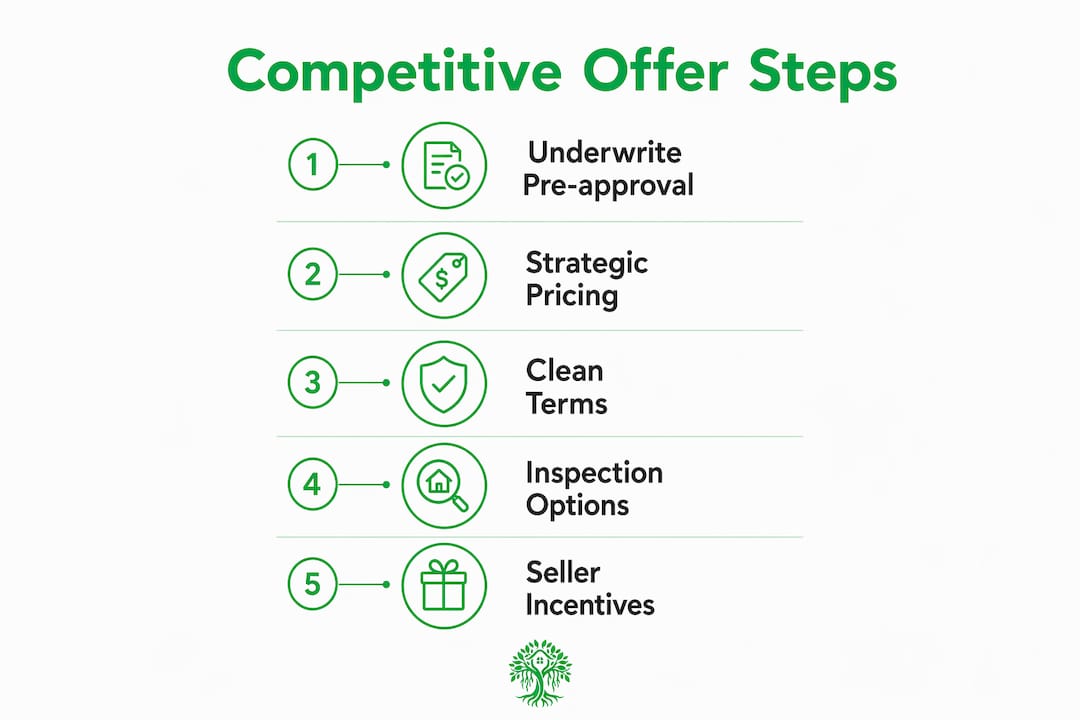
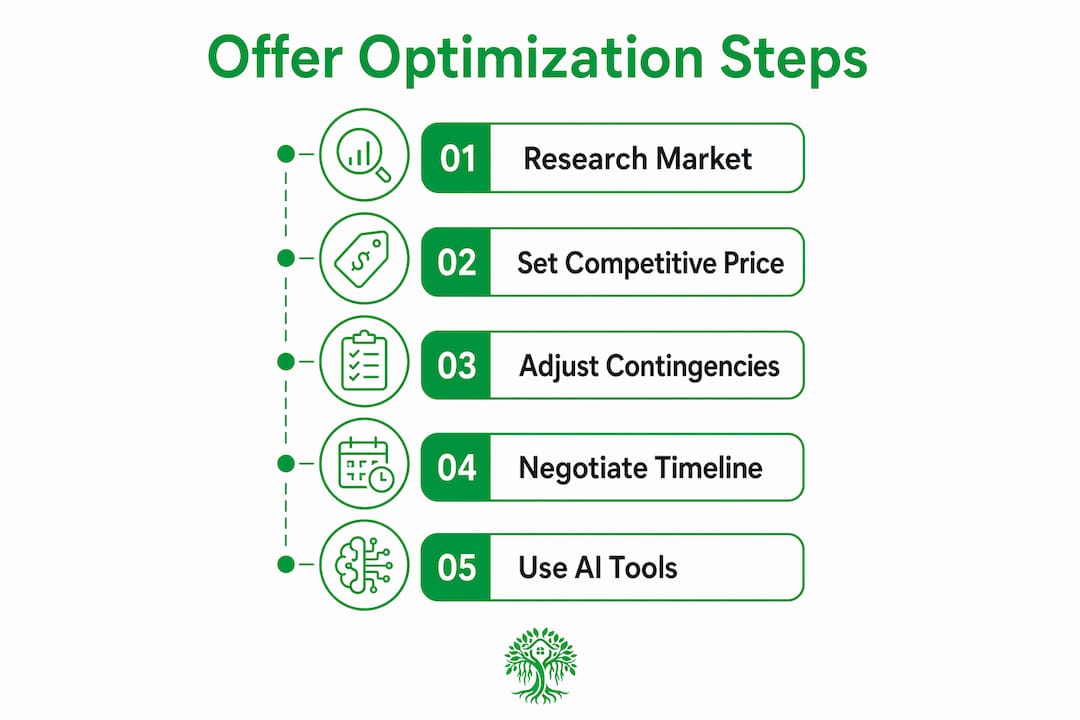
    Infographic showing steps to make a competitive home offer in 2026

    In Texas, buyers have real leverage in several cities. Austin homes average 96 days on market as of march 2026. That extended time on market means sellers are more open to negotiation than they were two years ago. In Dallas, 29% of listings have cut prices recently. Those price reductions are an invitation to negotiate, not a warning sign. In California, the picture is more mixed. Los Angeles builders have dropped prices by about 6% to attract buyers, but resale inventory in coastal cities remains tight.

    Use this four-step process to set your offer price:

    1. Pull recent comparable sales (comps). Look at homes that closed within the last 60–90 days, within a half-mile radius, with similar square footage and condition. This is your pricing anchor.
    2. Check days on market. If a home has been listed for more than 30 days, you have room to negotiate. If it listed within the last week, expect competition.
    3. Assess price reductions. A home that has dropped its price once or twice is a seller who is motivated. Factor that into your opening number.
    4. Decide on an escalation clause. If you expect multiple offers, an escalation clause automatically raises your bid above competing offers. Use increments of $5,000–$10,000 and set a firm maximum ceiling you are genuinely comfortable paying.
    Market condition Suggested pricing approach
    Home listed under 7 days, no reductions At or above asking price
    Home listed 15–30 days, no reductions At asking price or slight premium
    Home listed 30+ days with price cuts 2%–5% below current asking price
    New construction with builder incentives Negotiate on upgrades and closing costs, not just price

    Pro Tip: An escalation clause reveals your maximum to the seller. Only use one when you are confident there are competing offers and when your ceiling is a number you can genuinely afford.


    What offer terms actually appeal to sellers?

    Competitive offers in 2026 are won through clean terms more than price alone. Sellers care about certainty, speed, and convenience. Your terms can deliver all three.

    The inspection contingency is the most negotiated term in California and Texas offers right now. Waiving it entirely carries real risk. A smarter approach is converting it to an “informational only” inspection, where you complete the inspection but agree not to request repairs. This protects you from buying a structurally compromised home while signaling to the seller that you will not renegotiate after the fact.

    Appraisal gaps are another lever. If you offer above the appraised value, your lender will only finance up to the appraised amount. You cover the difference in cash. Offering to cover a gap of $10,000–$20,000 can make your offer stand out without raising the headline price. Full appraisal waivers are aggressive and generally only appropriate when you have significant cash reserves.

    Flexible closing dates and rent-back options can tip a seller’s preference when price is equal. A seller who needs 60 days to find their next home will favor a buyer who offers a rent-back period over one who demands a 30-day close.

    • Informational-only inspection: You inspect but do not request repairs. Reduces seller anxiety about renegotiation.
    • Appraisal gap coverage: You commit to covering a defined dollar amount above appraised value in cash.
    • Flexible close date: Match the seller’s preferred timeline, even if it means a longer escrow.
    • Rent-back agreement: Let the seller stay in the home after closing for a defined period, often 30–60 days.
    • Seller closing cost coverage: Covering the seller’s closing costs adds real value without raising your offer price.

    Pro Tip: Before you offer a rent-back, confirm with your lender that it is allowed under your loan type. FHA and VA loans have specific rules about occupancy that can conflict with rent-back agreements.


    What assistance programs help first-time buyers in California and Texas?

    Down payment assistance programs do not just help you afford a home. They free up cash reserves that make your overall offer stronger. Both California and Texas offer programs specifically designed for first-time buyers.

    In California, the CalHFA MyHome Assistance Program provides a deferred-payment junior loan covering up to 3.5% of the purchase price for down payment or closing costs. It is available year-round, which matters because it does not require you to wait for a lottery or a funding cycle. First-time buyers in California should pursue MyHome proactively rather than waiting on lottery-based alternatives. The CalHFA ZIP loan can also cover closing costs as a silent second mortgage.

    In Texas, the Texas State Affordable Housing Corporation (TSAHC) offers grants or forgivable loans up to 5% of the loan amount through its Home Sweet Texas program. Forgivable loans require no repayment if you stay in the home for a defined period. Grants require no repayment at all.

    Program State Benefit Repayment
    CalHFA MyHome California Up to 3.5% down payment assistance Deferred, due at sale or refi
    CalHFA ZIP California Closing cost assistance Deferred, silent second
    TSAHC Home Sweet Texas Texas Up to 5% grant or forgivable loan None (grant) or forgiven after term

    Both programs require you to work with an approved lender. Confirm your lender is on the program’s approved list before you start the application. Stacking a state program with an FHA loan is a common and effective combination for buyers with limited cash reserves. For a full breakdown of California options, the California buyer programs guide at Ficustree covers eligibility and application steps in detail.


    What mistakes cost first-time buyers the most in competitive markets?

    The most expensive mistakes in competitive markets are not about price. They are about timing, preparation, and misreading local conditions.

    1. Waiting on assistance lotteries instead of acting. Some buyers stall their search waiting for a specific program’s funding window. The better approach is to qualify for a year-round program like CalHFA MyHome and keep your search active in parallel.
    2. Ignoring local comps and relying on list price. List price is a starting point, not a market value. Buyers who skip the comp analysis routinely overbid in slow markets and underbid in hot ones.
    3. Submitting offers slowly. In competitive California markets, a 24-hour delay can cost you the home. Have your pre-approval, proof of funds, and offer template ready before you tour.
    4. Underestimating the agent relationship. Listing agents talk to buyer’s agents before they talk to buyers. An agent with a strong local reputation can get you information, access, and goodwill that no offer letter can buy. Learn more about how agent relationships affect offers and what to expect from representation.
    5. Ignoring your true maximum. Escalation clauses and bidding wars create pressure to go higher. Know your PITI (principal, interest, taxes, and insurance) ceiling before you enter any negotiation, and do not cross it.

    Pro Tip: Review common negotiation mistakes before you submit your first offer. Most first-time buyers repeat the same five errors. Knowing them in advance costs nothing.


    Key Takeaways

    A competitive home offer wins on financial credibility, strategic pricing, and seller-friendly terms, not price alone.

    Point Details
    Get underwritten pre-approval A fully underwritten letter signals near-guaranteed financing and outranks standard pre-approvals.
    Price from comps, not list price Use recent sales, days on market, and price reductions to set a number grounded in actual market value.
    Use terms to stand out Informational-only inspections, appraisal gap coverage, and flexible closing dates often matter more than price.
    Stack assistance programs CalHFA MyHome and TSAHC Home Sweet Texas free up cash reserves and strengthen your overall financial position.
    Move fast and stay within budget Speed and preparation win in competitive markets. Know your PITI ceiling and never exceed it under pressure.

    What I have learned about winning offers in California and Texas

    After working with first-time buyers across both states, the pattern I see most often is this: buyers spend months getting ready financially, then lose homes because they hesitate on terms.

    The buyers who win are not always the ones with the most money. They are the ones who show up prepared, move quickly, and make the seller’s life easier. A clean offer with a flexible close date and an informational-only inspection can beat a higher offer that comes loaded with contingencies and demands. I have seen it happen in Sacramento, in Austin, and in the Inland Empire.

    The other thing I want to be direct about: do not let the fear of overpaying push you into a lowball strategy in a market that does not support it. In Dallas right now, with 29% of listings showing price cuts, you have real room to negotiate. In San Jose or coastal Orange County, you do not. Treating every market the same is how buyers lose months of time and miss homes they could have had.

    Local nuance is everything. The offer strategy that works in Houston is not the same one that works in the Bay Area. Spend time understanding your specific submarket, not just the state-level headlines. And if you are stacking an assistance program with your offer, make sure your lender has closed that program before. A lender who has never used CalHFA MyHome will slow you down at exactly the wrong moment.

    Preparedness is not just about documents. It is about knowing your number, trusting your comps, and being ready to move the day the right home appears.

    — Anand


    How Ficustree helps you submit stronger offers, faster

    First-time buyers in California and Texas face a real problem: the information they need to make a confident offer is scattered across lenders, agents, county records, and state program websites.

    https://ficustree.ai

    Ficustree pulls that together in one place. The AI-powered buyer platform matches you to homes based on your actual criteria, tracks market conditions in your target neighborhoods, and helps you understand what a competitive offer looks like before you write one. Buyers pay $1,000 at closing plus 1% commission and keep a rebate of roughly 2% where legally permitted. You get hourly showing agents on demand and the full platform free. For buyers who want to manage the offer process with less confusion and more clarity, ficustree.ai is built for exactly that.


    FAQ

    What makes a home offer competitive in 2026?

    A competitive offer combines a fully underwritten pre-approval, strategic pricing based on recent comps, and clean terms like informational-only inspections and flexible closing dates. Price matters, but clean terms often decide close calls between similar bids.

    Should first-time buyers waive the inspection contingency?

    Waiving it entirely is risky. Converting it to an informational-only inspection is a safer middle ground. You complete the inspection but agree not to request repairs, which reduces seller anxiety without eliminating your ability to walk away from a seriously defective property.

    How does an escalation clause work when bidding on a house?

    An escalation clause automatically raises your offer above competing bids by a set increment, up to a maximum you define. Use increments of $5,000–$10,000 and set a ceiling you can genuinely afford, because the seller will see your maximum.

    What assistance programs are available for first-time buyers in California?

    CalHFA MyHome offers a deferred-payment junior loan covering up to 3.5% of the purchase price for down payment or closing costs. It is available year-round and does not require a lottery application.

    What assistance programs are available for first-time buyers in Texas?

    TSAHC’s Home Sweet Texas program offers grants or forgivable loans up to 5% of the loan amount. Grants require no repayment. Forgivable loans are forgiven after you meet the program’s occupancy requirement.


  • First Time Home Buyer Tax Credit: 2026 Guide

    First Time Home Buyer Tax Credit: 2026 Guide

    The first time home buyer tax credit today primarily refers to the Mortgage Credit Certificate (MCC), a federal tax credit available through state housing finance agencies that directly reduces your tax bill based on mortgage interest paid. The original federal program that offered up to $8,000 expired in 2010 and is no longer available. What remains is a layered system of credits, deductions, and state programs that can still save you thousands. Knowing the difference between a credit and a deduction is the single most important thing you can do before filing.

    What is the first time home buyer tax credit in 2026?

    The Mortgage Credit Certificate is the primary federal-level tax benefit currently available to first-time buyers. A tax credit reduces your tax bill dollar for dollar. A deduction only reduces your taxable income, which saves you less depending on your tax bracket. That distinction matters more than most buyers realize.

    The MCC is not a refund check. It is a credit you claim each year on your federal return for as long as you hold the mortgage and live in the home. The credit is calculated as a percentage of the mortgage interest you paid that year. Most programs set that percentage between 20% and 25%.

    Loan officer discussing MCC benefits with client

    The MCC credit is capped at $2,000 per year when the credit rate exceeds 20%. Any unused credit can carry forward for up to three years. That means a buyer who qualifies but owes less than $2,000 in taxes does not lose the full benefit. The carryforward provision makes the MCC especially useful in years when your tax liability is low.

    How does the Mortgage Credit Certificate work?

    The MCC program works through your state or local housing finance agency, not directly through the IRS. You apply before closing, and the agency issues a certificate that you attach to your annual tax filing. Missing the pre-closing window means losing the credit entirely. Applications cannot be made retroactively after the sale is finalized.

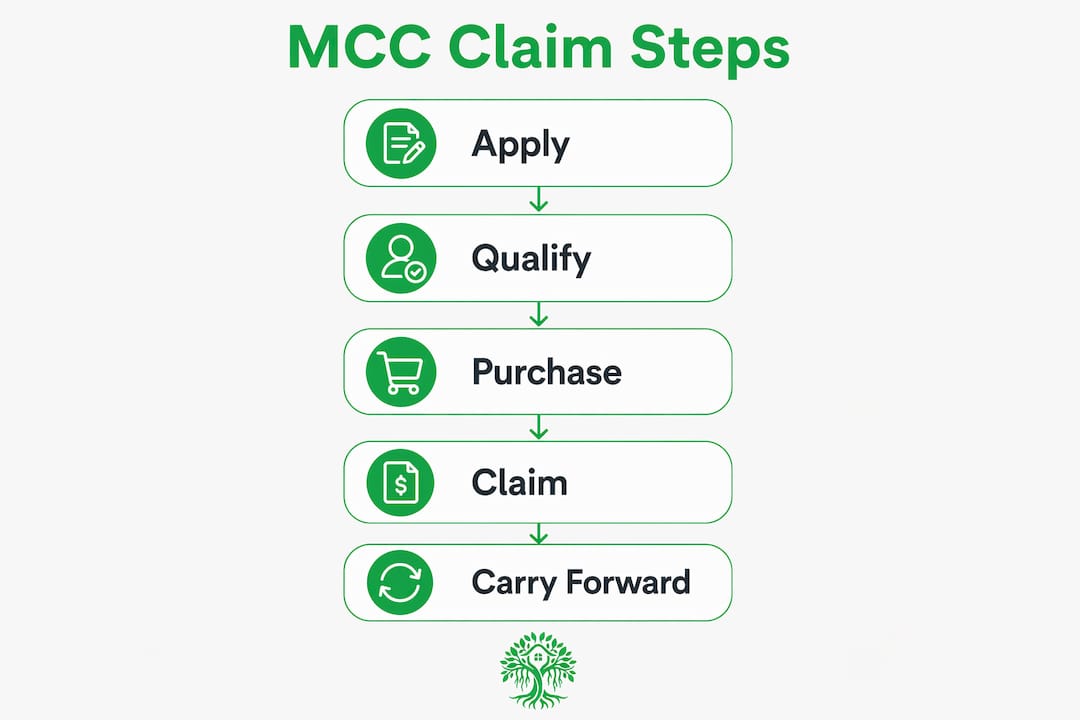
    Here is what the MCC process looks like from start to finish:

    • Confirm eligibility. Most programs define a first-time buyer as someone who has not owned a primary residence in the past three years. Income limits apply and are set by your state agency.
    • Apply through your lender. Your loan officer coordinates with the state housing finance agency. Start this conversation early, ideally before you go under contract.
    • Receive your certificate. The agency issues the MCC before or at closing. Keep this document. You will need it every year you claim the credit.
    • File IRS Form 8396. This form calculates your annual credit based on mortgage interest paid. Attach it to your federal return each year.
    • Adjust your mortgage interest deduction. If you itemize, you must reduce your deduction by the amount of MCC credit claimed. Failing to do this can trigger an IRS audit.

    Pro Tip: Ask your loan officer about MCC availability on your first call, not after you find a house. Some state programs have limited funding and close when the money runs out.

    The credit rate and income limits vary by state. California’s CalHFA MCC program, for example, sets specific income and purchase price limits that differ from those in Texas. Always verify current terms with your state housing finance agency before assuming you qualify.

    Infographic illustrating steps to claim MCC tax credit

    What other federal tax benefits can first-time buyers claim?

    Beyond the MCC, several federal tax deductions reduce the cost of homeownership. These are not credits. They reduce your taxable income, which means the actual savings depend on your marginal tax rate. Still, for buyers who itemize, they add up quickly.

    1. Mortgage interest deduction. You can deduct interest paid on up to $750,000 of mortgage debt if you itemize. For most first-time buyers, this is the largest annual deduction available.
    2. Property tax deduction. State and local property taxes are deductible, subject to the $10,000 SALT cap. If you live in a high-tax state like California or New York, this cap limits your benefit significantly.
    3. Mortgage discount points. Points paid at closing are typically deductible in full in the year of purchase. One point equals 1% of the loan amount, so on a $500,000 loan, two points equals $10,000 in deductible costs.
    4. IRA withdrawal for home purchase. First-time buyers can withdraw up to $10,000 from a traditional IRA without the standard 10% early withdrawal penalty. You still owe income tax on the amount withdrawn, but avoiding the penalty saves money.

    Understanding the true cost of homeownership means factoring in these deductions from day one, not as an afterthought at tax time. Buyers who plan their purchase around the full tax picture make better decisions about loan size, points, and timing.

    What state and local programs are available?

    State programs are where first-time buyers often find the most immediate financial relief. These programs vary widely by location, funding level, and eligibility rules. Some offer tax credits. Others offer grants or interest-free loans for down payments.

    Maryland waives the buyer’s share of state transfer taxes for qualifying first-time buyers. Massachusetts offers interest-free down payment assistance up to $25,000 as of 2026. California’s CalHFA program combines down payment assistance with MCC access. Texas offers programs through the Texas State Affordable Housing Corporation (TSAHC) that include both mortgage assistance and tax credit certificates.

    State Program Type Key Benefit
    Maryland Transfer tax waiver Buyer’s share of state transfer tax eliminated
    Massachusetts Down payment assistance Up to $25,000 interest-free loan
    California MCC + down payment Combined credit certificate and assistance
    Texas MCC + mortgage assistance Tax credit certificate with loan support
    South Carolina MCC (sunsetting) Program ends june 30, 2026

    Income limits for these programs are adjusted annually based on HUD’s Area Median Income data. That means a household that qualified last year may not qualify this year if AMI limits shifted. Always verify current eligibility at the time you apply, not when you start your search.

    Some states have phased out MCC programs entirely. South Carolina’s MCC program sunsets on june 30, 2026 due to funding constraints. Buyers in states with limited program availability should check their state housing finance agency website before assuming a program exists.

    Pro Tip: California buyers should review the California first-time buyer programs page at Ficustree for a current breakdown of CalHFA and local assistance options. Programs change faster than most buyers expect.

    If you are buying in Arizona, the first-time Sedona home buyers guide at OwnInAZ covers local program availability and regional considerations worth reviewing before you close.

    How do you qualify for and claim these credits?

    Qualifying for the MCC and related programs requires meeting three core criteria: first-time buyer status, income limits, and purchase price limits. Most programs define first-time buyer as no primary residence ownership in the past three years. That definition includes buyers who owned a home previously but have rented for three or more years.

    Here is what you need to gather and do:

    • Confirm your first-time buyer status. Pull your tax returns from the past three years. If you claimed a mortgage interest deduction during that period, you likely do not qualify.
    • Apply for the MCC before you close. Coordinate with your lender and the state housing finance agency early. The MCC must be obtained before closing. No exceptions.
    • Collect your tax documents. You need IRS Form 1098 from your lender showing mortgage interest paid, your MCC certificate, and IRS Form 8396 to calculate the credit.
    • File Schedule A if itemizing. To claim the mortgage interest deduction, you must itemize. If your standard deduction exceeds your itemized total, skip Schedule A and take the standard deduction instead.
    • Reduce your mortgage interest deduction by the MCC credit. This step trips up many buyers. IRS Form 8396 filing requires you to subtract the MCC credit from your itemized mortgage interest deduction. Missing this step risks IRS penalties.
    • Work with a tax professional. The interaction between the MCC credit and the mortgage interest deduction is one of the most commonly mishandled items in first-time buyer tax returns. A CPA familiar with real estate transactions is worth the cost.

    The home buying timeline matters here. Buyers who wait until they are under contract to ask about MCC programs often find the application window too tight. Start the conversation at pre-approval.

    Key Takeaways

    The Mortgage Credit Certificate is the primary federal tax credit available to first-time buyers in 2026, and missing the pre-closing application window eliminates your eligibility permanently.

    Point Details
    MCC is the main credit The MCC reduces your federal tax bill by up to $2,000 per year based on mortgage interest paid.
    Credits beat deductions A $2,000 tax credit saves $2,000 in taxes; a $2,000 deduction saves far less depending on your rate.
    Apply before closing MCC applications cannot be submitted after closing, so coordinate with your lender early.
    State programs vary widely Maryland, Massachusetts, California, and Texas each offer distinct programs with different income limits.
    Income limits change annually HUD adjusts AMI-based income limits each year, so verify eligibility at application time, not search time.

    Why most buyers leave money on the table

    The biggest mistake I see first-time buyers make is treating tax benefits as an afterthought. They focus entirely on the mortgage rate and down payment, then scramble at tax time to figure out what they missed. By then, the MCC window is closed and the state program funding is gone.

    The second mistake is confusing deductions with credits. A deduction is not a refund. It reduces your taxable income, which means the actual savings depend on your tax bracket. A buyer in the 22% bracket saves $440 on a $2,000 deduction. That same buyer saves $2,000 on a $2,000 credit. The math is not subtle.

    Federal tax credits for first-time buyers are limited right now. The MCC is the primary tool, and not every state offers it. That makes state and local programs more important than ever. Maryland’s transfer tax waiver, Massachusetts’ down payment assistance, and California’s CalHFA MCC are real money. But they require you to ask for them before you close, not after.

    My honest advice: build your tax strategy before you build your offer strategy. Know your MCC eligibility, know your state’s income limits, and bring a tax professional into the conversation at pre-approval, not at filing. Buyers who plan this way consistently capture benefits that others leave behind.

    — Anand

    How Ficustree helps you capture every first-time buyer benefit

    Ficustree is built for buyers who want clarity, not confusion. The platform walks you through the full financial picture of a home purchase, including the tax credits and deductions that most buyers miss.

    https://ficustree.ai

    Ficustree’s home affordability tools factor in PITI, HOA, insurance, and maintenance so you see the real cost before you commit. The platform also connects you with resources on MCC programs, state assistance, and home buying workflow steps that keep you on track from pre-approval to closing. Buyers in California and Texas pay $1,000 at closing plus 1% commission and keep a rebate of roughly 2% where permitted. Visit Ficustree to see how the platform compresses months of confusion into a clear, confident purchase.

    FAQ

    What is the first time home buyer tax credit in 2026?

    The primary federal tax credit available to first-time buyers in 2026 is the Mortgage Credit Certificate (MCC), which reduces your tax bill by up to $2,000 per year based on mortgage interest paid. The original $8,000 federal credit expired in 2010 and is no longer available.

    How do I qualify for the MCC tax credit?

    You must meet your state housing finance agency’s income and purchase price limits, have not owned a primary residence in the past three years, and apply for the MCC before your closing date. Post-closing applications are not accepted.

    What forms do I need to claim the MCC?

    You need IRS Form 8396 to calculate the annual credit, Form 1098 from your lender showing mortgage interest paid, and your MCC certificate issued by the state agency. If you also itemize deductions, you must reduce your mortgage interest deduction by the MCC credit amount on Schedule A.

    Are state first-time buyer programs available everywhere?

    No. State MCC programs and down payment assistance vary by location and funding. Some states, including South Carolina, have sunset their MCC programs as of mid-2026. Check your state housing finance agency’s website for current availability before assuming a program exists.

    What is the difference between a tax credit and a tax deduction for home buyers?

    A tax credit reduces your tax bill dollar for dollar, while a deduction only reduces your taxable income. A $2,000 MCC credit saves you $2,000 in taxes. A $2,000 mortgage interest deduction saves you a fraction of that amount depending on your tax bracket.

  • California Closing Costs Breakdown for First-Time Buyers

    California Closing Costs Breakdown for First-Time Buyers

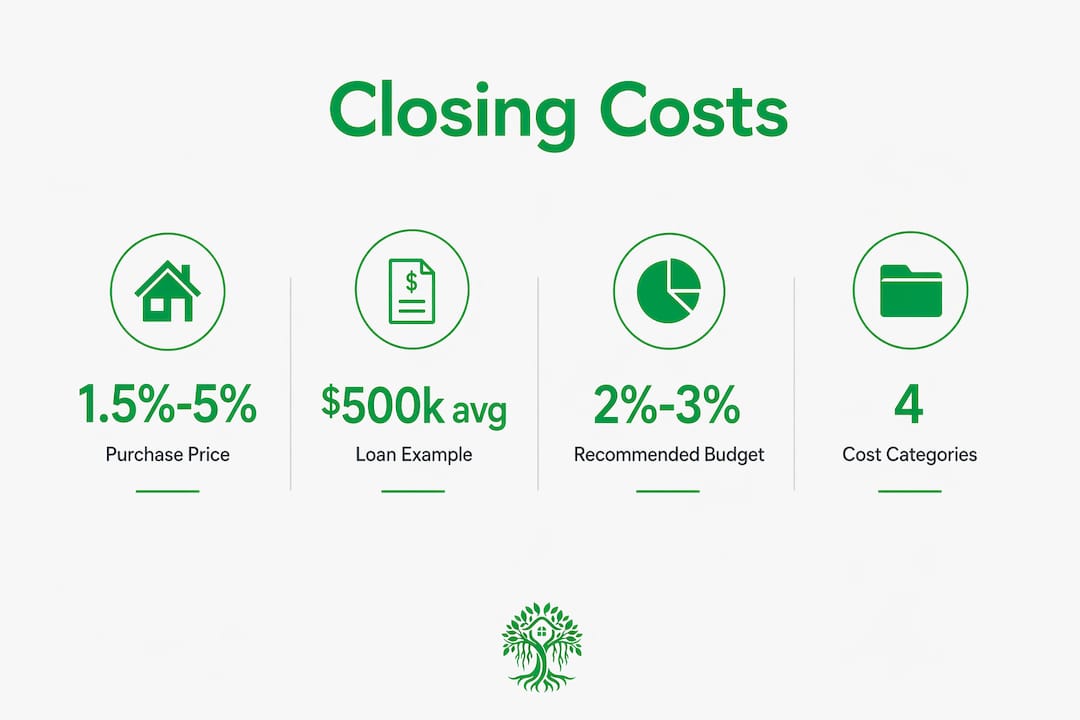
    Closing costs in California are the fees and charges you pay at the end of a home purchase, separate from your down payment. California buyers should budget between 1.5% and 5% of the purchase price for these costs. On a median-priced $905,000 home, that translates to roughly $13,575 to $45,250 in additional cash you need at the table. For a $500,000 home, expect $7,500 to $25,000. Understanding this closing costs breakdown for California before you make an offer is the difference between a smooth closing and a last-minute scramble for cash.

    What types of closing costs do California buyers pay?

    The four main buckets of California closing costs are lender fees, title and escrow fees, prepaid expenses, and government fees. Knowing which bucket each charge falls into tells you immediately whether you can negotiate it or not. Fixed government fees are non-negotiable. Lender and service fees often are.

    Lender fees

    Lender fees cover the cost of processing and approving your mortgage. The median total loan cost in California reached $7,820 in 2025, which is 84.3% higher than the national median of $4,242. That gap reflects California’s high loan balances and the concentration of expensive markets. Common lender fees include origination fees (typically 0.5%–1% of the loan), underwriting fees, processing fees, and appraisal costs.

    Hands working on lender fee documents with calculator

    Title and escrow fees

    Title insurance protects you and your lender if ownership disputes arise after closing. Escrow fees pay the neutral third party that manages the transaction funds and documents. Both fees scale with the purchase price, so they get expensive fast in California. These fees vary by provider, which means you have real room to shop around.

    Prepaid expenses

    Prepaid expenses are not junk fees. They are real costs you pay upfront to fund your escrow impound account and cover the gap between closing and your first mortgage payment. Expect to prepay homeowners insurance (typically 12 months), property taxes (2–6 months), and prepaid mortgage interest for the days remaining in the closing month.

    Government fees and transfer taxes

    Recording fees and transfer taxes are set by the county and city. California’s state transfer tax is $1.10 per $1,000 of the sale price. Several cities, including Los Angeles and San Francisco, add their own transfer taxes on top of that. These costs are fixed. No amount of negotiation changes them.

    Infographic summarizing California closing costs percentages and categories

    Fee category Typical range Negotiable?
    Lender origination fee 0.5%–1% of loan Yes
    Title insurance $1,000–$3,500+ Sometimes
    Escrow fee $1,500–$3,000+ Sometimes
    Prepaid expenses 1–3 months of costs No
    Government/transfer taxes Fixed by county/city No

    Pro Tip: Ask your lender for a Loan Estimate within three business days of your application. Federal law requires it. That document lists every fee by category so you can compare lenders line by line.

    How can first-time California buyers budget for closing costs?

    Closing costs do not exist in isolation. You need to plan for them alongside your down payment, moving costs, and the cash reserves your lender will require. Careful financial planning is critical in California because high home prices mean every percentage point translates into thousands of dollars. Running short on cash at closing is a real risk if you only budget for the down payment.

    Here is a practical budgeting sequence to follow:

    1. Calculate your target purchase price. Use your pre-approval amount as a ceiling, not a goal. Your true budget includes the down payment plus closing costs plus reserves.
    2. Estimate closing costs at 2%–3% of the purchase price. This is a conservative midpoint that works for most California purchases. Adjust up if you are buying in San Francisco or Los Angeles, where city transfer taxes add to the total.
    3. Add your reserve requirement. Most lenders require 2 to 6 months of mortgage payments in cash reserves after closing. Jumbo loans typically require six months. Standard conforming loans require two. These reserves must sit in your account at closing. They are not spent, but they must be there.
    4. Build a cash buffer beyond reserves. Moving costs, immediate repairs, and utility deposits add up fast. Budget an extra $3,000–$5,000 as a cushion.
    5. Verify your numbers with a closing cost calculator. Many lenders and real estate platforms offer free calculators. Plug in your purchase price, loan type, and county to get a sharper estimate.

    Pro Tip: Get your closing cost estimate before you fall in love with a specific home. Knowing your full cash requirement upfront keeps you from making an offer you cannot actually close.

    You can also review the types of California homeownership costs beyond closing to build a complete picture of what owning a home in this state actually costs month to month.

    What state programs help first-time buyers with closing costs in California?

    California offers several programs specifically designed to reduce the out-of-pocket burden for first-time buyers. These programs do not eliminate closing costs, but they can cover a significant portion of them so you do not have to drain your savings.

    • CalHFA MyHome Assistance Program. This program provides deferred-payment junior loans of up to 3.5% of the home’s purchase price for FHA loans, or 3% for conventional loans. The funds can cover both down payment and closing costs. You repay the loan when you sell, refinance, or pay off the first mortgage.
    • California Dream For All. This shared-appreciation program can provide up to 20% of the purchase price to qualified first-time buyers. In exchange, the state receives a share of the home’s appreciation when you sell. It is a powerful tool for buyers who are cash-constrained but have stable income.
    • Local city and county programs. Many California cities run their own assistance programs with grants or forgivable loans. Los Angeles, San Jose, and Oakland each have active programs. Eligibility typically depends on income limits and the property being your primary residence.
    • Nonprofit and employer-assisted programs. Some nonprofits and large employers offer closing cost grants or matched savings programs. These are worth researching if you work in education, healthcare, or government.

    Combining a CalHFA first mortgage with the MyHome junior loan is one of the most common strategies for first-time buyers in California. You can explore the full range of California buyer assistance programs to find what you qualify for based on income, county, and loan type.

    How do you negotiate and reduce closing costs in California?

    Negotiation is possible on more line items than most first-time buyers realize. The key is knowing which fees are fixed and which are flexible before you sit down with a lender or sign a purchase agreement.

    • Shop lenders aggressively. The gap between the highest- and lowest-cost lenders on similar California loans exceeds $10,000. That is not a rounding error. Getting Loan Estimates from three or more lenders is the single highest-return action you can take before closing.
    • Negotiate origination and processing fees. Lender fees like origination, underwriting, and processing are negotiable in many cases. Ask directly. The worst answer is no.
    • Shop title and escrow providers. In California, buyers can choose their own title and escrow companies. Rates vary. Calling two or three providers and comparing quotes takes less than an hour and can save several hundred to over a thousand dollars.
    • Request seller concessions. In a buyer-friendly market, sellers sometimes agree to cover a portion of your closing costs. This is called a seller concession or seller credit. Learn how to ask for seller concessions effectively so you do not leave money on the table.
    • Evaluate discount points carefully. Discount points appear on 46% of California mortgage loans with a median cost of $3,208. Paying points buys a lower interest rate, but only makes financial sense if you stay in the home long enough to recoup the upfront cost. Calculate your break-even point before agreeing to any points.

    Pro Tip: Never accept the first Loan Estimate as final. After you receive competing offers, go back to your preferred lender and ask them to match or beat the best quote. Lenders expect this.

    Key takeaways

    California closing costs range from 1.5% to 5% of the purchase price, and first-time buyers who plan for all four fee categories, reserve requirements, and available assistance programs close with far less stress and more money in their pocket.

    Point Details
    Budget 2%–3% as a baseline Plan for 1.5%–5% of the purchase price; use 2%–3% as a conservative starting estimate.
    Four fee buckets matter Lender, title/escrow, prepaid, and government fees each behave differently for negotiation.
    Reserves are required Most lenders require 2–6 months of mortgage payments in cash beyond closing costs.
    State programs reduce the burden CalHFA MyHome and California Dream For All can cover down payment and closing costs for eligible buyers.
    Shopping lenders saves thousands The cost gap between lenders on similar California loans exceeds $10,000.

    What I have learned about closing costs the hard way

    By Anand

    Most first-time buyers I talk to have done the math on their down payment. Almost none of them have done the math on reserves. That is the number that catches people off guard. You can have your down payment and closing costs ready, then find out your lender requires six months of mortgage payments sitting in your account on top of that. On a $600,000 loan, six months of payments can easily be $20,000 or more. That is a real number that real buyers have to scramble to find.

    The second mistake I see constantly is treating the Loan Estimate as a formality. It is not. It is a negotiating document. The buyers who read it line by line and push back on fees they do not recognize almost always close for less than buyers who sign and move on. The common mistakes first-time buyers make around closing costs are almost always about passivity, not ignorance.

    My honest advice: start your closing cost planning the same week you start your home search. Not the week before closing. The buyers who do this show up to the table confident. The ones who do not show up stressed and sometimes unable to close.

    — Anand

    How Ficustree helps you plan for closing costs

    https://ficustree.ai

    Ficustree is built for exactly this moment. When you are trying to figure out what you can actually afford, the platform gives you a clear picture of your full cash requirement, not just the purchase price. That means down payment, estimated closing costs, and reserve requirements in one place.

    Ficustree represents buyers directly, with a fee of $1,000 at closing plus 1% commission, and passes a rebate of roughly 2% back to you where legally permitted. That rebate can offset a meaningful portion of your closing costs. The Ficustree buyer platform walks you through each step of the purchase process so nothing catches you off guard at the table.

    FAQ

    What is the average closing cost for a buyer in California?

    California buyers typically pay 1.5% to 5% of the home’s purchase price in closing costs. On a $500,000 home, that means budgeting $7,500 to $25,000 beyond the down payment.

    Can closing costs be rolled into the mortgage in California?

    Most conventional loans do not allow buyers to roll closing costs into the loan balance. However, seller concessions and lender credits can reduce the cash you need to bring to closing.

    What are the biggest closing cost fees for California buyers?

    Lender fees and title and escrow fees are typically the largest line items. The median total loan cost in California was $7,820 in 2025, well above the national median of $4,242.

    Does California have programs to help with closing costs?

    Yes. The CalHFA MyHome Assistance Program offers deferred junior loans of up to 3.5% of the purchase price. California Dream For All can provide up to 20% of the purchase price for eligible first-time buyers.

    Are closing costs negotiable in California?

    Lender origination, processing, and underwriting fees are negotiable. Title and escrow fees vary by provider and can be reduced by shopping around. Government transfer taxes and recording fees are fixed and cannot be negotiated.

  • Why Are Home Prices So High in California?

    Why Are Home Prices So High in California?

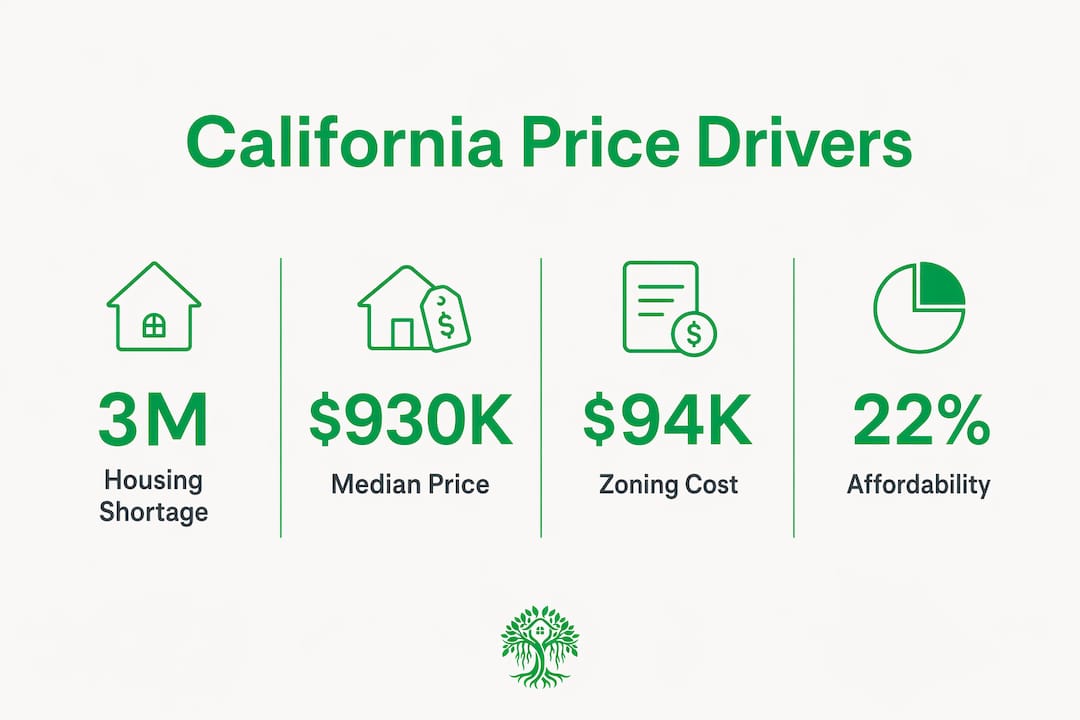
    California home prices are defined by artificial scarcity, not just demand. The median home price hit $930,260 in may 2026, a 3.1% jump from the year before. Only 22% of California households could afford a median-priced home in Q1 2026. That means nearly 80% of residents are priced out of the typical home. Understanding why home prices are high in California starts with one core fact: the state has not built nearly enough homes for decades, and regulations make building harder every year.

    Why home prices are high in California: the supply shortage

    California’s housing crisis is, at its core, a supply problem. The state faces a shortage of 2.7 to 3.5 million housing units. That gap did not appear overnight. Since the 1970s, growth controls and exclusionary zoning have steadily choked off new construction.

    Community members discussing housing model overhead view

    Home prices in California doubled the national median by 2015, and the divergence traces directly to those early regulatory choices. Prices rise when supply cannot keep pace with demand. That is not a market failure. It is the market doing exactly what markets do when supply is constrained.

    Here is what the supply gap looks like in practice:

    • California adds roughly 100,000 to 120,000 new homes per year, well below the estimated 180,000 needed annually to close the gap.
    • Coastal metros like San Francisco and Los Angeles face the most acute shortages, where land is scarce and regulations are strictest.
    • The state’s population grew for decades while housing production stalled, compounding the deficit year after year.
    • 38.5% of all California home sales in may 2026 were million-dollar-plus transactions, pulling the median price higher.
    Factor Impact on prices
    2.7–3.5 million unit shortage Drives prices up as buyers compete for limited stock
    Below-target annual construction Widens the gap between supply and demand each year
    Coastal concentration of jobs Concentrates demand in the least-buildable areas
    Million-dollar sales share at 38.5% Skews the median price upward statewide

    The supply gap is the foundation of every other pricing problem in California. Fix supply, and prices moderate. Leave it unaddressed, and every other policy lever produces only marginal relief.

    Infographic illustrating key California housing price factors

    How do zoning laws and land-use regulations drive up costs?

    Regulation is the single biggest non-market force inflating California home prices. Local zoning and land-use rules add roughly $94,000 in regulatory costs to every new home built in the state. That figure includes height limits, parking minimums, setback requirements, impact fees, and litigation delays. Builders pass every dollar of that cost directly to buyers.

    The regulatory burden works through several specific mechanisms:

    1. Height limits and density caps. Most California cities restrict buildings to two or three stories in residential zones. That forces builders to spread homes across more land, raising per-unit land costs.
    2. Parking minimums. Requirements for two or more parking spaces per unit add tens of thousands of dollars to construction costs, especially in urban areas where land is expensive.
    3. Setback and lot-coverage rules. These rules shrink the buildable footprint of each parcel, reducing the number of units a developer can place on a given lot.
    4. Impact fees. Cities charge developers fees for schools, parks, and infrastructure. In some California cities, these fees exceed $50,000 per unit before a single nail is driven.
    5. Permitting delays. A project that takes six months to permit in Texas can take two to three years in California. Every month of delay adds carrying costs that builders fold into sale prices.

    Houston, Texas, offers a useful contrast. The city has no traditional zoning code. It builds homes at a fraction of California’s regulatory cost, and its median home price reflects that difference. California’s property values are not high because homes are inherently more expensive to build. They are high because regulations make building artificially expensive.

    Pro Tip: If you are buying in California, ask your agent for the permit history on any new construction. Long permitting timelines often signal a market where supply will stay tight, which affects your resale value years down the road.

    What economic forces keep California housing unaffordable?

    Regulation explains the supply side. Economic dynamics explain why demand stays intense even at record prices. The most underappreciated force is the mortgage lock-in effect. Most California homeowners hold mortgages below 5%. Selling and rebuying at current rates would raise their monthly payment by roughly 11%. So they stay put.

    That decision makes sense for individual homeowners. For the market, it is devastating. Resale inventory stays thin because existing owners will not sell. Buyers compete for a smaller pool of homes, which pushes prices higher. The lock-in effect turns a supply shortage into a double shortage: not enough new homes, and not enough existing homes coming to market.

    Income inequality compounds the problem. California’s economy produces enormous wealth at the top and stagnant wages in the middle. High earners can absorb $930,000 median prices. Middle-income buyers cannot. The result is a market that functions well for high earners and shuts out everyone else. That is why only 22% of households can afford the median-priced home, even as the market technically “clears” at those prices.

    • Buyers who locked in sub-3% rates in 2020 and 2021 face a painful trade-off: move and pay far more each month, or stay and reduce available inventory.
    • Investor activity in high-demand metros adds another layer of competition, particularly for entry-level homes that first-time buyers target.
    • True affordability includes property taxes, HOA fees, insurance, and maintenance. In California, those costs routinely add $1,500 to $2,500 per month on top of a mortgage payment.

    Understanding your real monthly cost is the first step toward making a confident decision in this market. Use a full-cost calculator, not just a mortgage estimator, before you set your budget.

    How do environmental laws and community opposition raise home prices?

    California’s Environmental Quality Act, known as CEQA, was signed in 1970 to protect air, water, and wildlife. Over 54 years, it has become one of the most powerful tools for blocking new housing. CEQA litigation raises project costs and delays construction timelines, contributing directly to higher rents and sale prices. The law requires environmental review for nearly every new housing project, and any individual or group can file a lawsuit to challenge that review.

    The practical effect is that CEQA functions as a veto for neighbors who oppose new housing. Homeowners use it to block apartments, condos, and infill projects near their properties. The litigation does not produce better environmental outcomes. It produces delays, cost overruns, and abandoned projects.

    “CEQA’s centralized review process raises prices rather than deliver better outcomes. The law has become the nation’s most powerful anti-housing weapon, used primarily by current homeowners to protect property values at the expense of everyone who needs a place to live.”

    Fragmented local control makes the problem worse. California has hundreds of cities and counties, each with its own planning department and political incentives. Local elected officials answer to existing homeowners, who vote in higher numbers and benefit from rising property values. Approving new housing rarely wins votes. Blocking it often does. The result is a system where the political incentives consistently favor less housing, not more.

    What steps can actually lower California home prices?

    No single policy fixes a shortage built over five decades. But several approaches have clear evidence behind them.

    • Streamline permitting. California has passed laws like SB 9 and SB 10 to speed approvals for duplexes and small multifamily buildings. Consistent enforcement at the local level is the missing piece.
    • Reform CEQA for housing. Exempting infill housing projects from CEQA review would remove the most common litigation tool used to block new supply. Several proposals have stalled in Sacramento, but the policy logic is sound.
    • Eliminate parking minimums near transit. Cities like San Jose and Sacramento have already done this. Removing parking requirements near bus and rail lines cuts construction costs and allows more units per parcel.
    • Increase density in job-rich areas. Allowing four to six story buildings within a half mile of major employment centers would add significant housing supply where demand is highest.
    • Fund infrastructure for dense development. Dense urban construction carries higher infrastructure costs than greenfield development. State funding for water, sewer, and transit upgrades in infill zones makes dense projects financially viable for builders.

    Pro Tip: First-time buyers in California should research state and local buyer programs before assuming they cannot afford to buy. CalHFA and several county programs offer down payment assistance that can meaningfully change your math.

    The state has the tools. The barrier is political will at the local level, where homeowners with the most to lose from falling prices hold the most influence.

    Key Takeaways

    California home prices are high because decades of regulatory restrictions created a housing shortage of 2.7 to 3.5 million units, and that shortage will not resolve without sustained policy reform at both the state and local level.

    Point Details
    Supply shortage is the root cause California is short 2.7 to 3.5 million homes, driving prices up through basic scarcity.
    Zoning adds $94,000 per home Regulatory costs from height limits, parking rules, and fees inflate every new home’s price.
    Mortgage lock-in shrinks inventory Homeowners with sub-5% rates stay put, reducing resale supply and intensifying competition.
    CEQA enables housing opposition Environmental review litigation blocks infill projects and raises costs without improving outcomes.
    Reform requires local cooperation State laws exist, but local political incentives consistently favor existing homeowners over new supply.

    California’s housing crisis is a policy choice, not a natural disaster

    I have spent years watching people frame California’s housing affordability problem as a demand story. Too many people want to live here. Too much tech money. Too many investors. Those factors exist, but they are not the cause. The cause is supply. Prices rise to ration scarce housing when supply is constrained. That is not a controversial economic claim. It is how markets work.

    What frustrates me is how clearly the evidence points to regulatory reform, and how little changes. CEQA reform has been debated for a decade. Zoning changes pass in Sacramento and get quietly ignored by cities. The political economy of housing is brutal: the people who benefit most from high prices vote in every election, and the people who are priced out often do not yet live in the jurisdiction making the decisions.

    The path forward requires state government to override local obstruction more aggressively. California has done it before, with SB 9 and the builder’s remedy provision. But enforcement is inconsistent, and cities find workarounds. Until the state closes those loopholes and funds the infrastructure that makes density viable, the shortage will persist.

    If you are a first-time buyer in California right now, understanding these dynamics matters for your decision. Prices are not going to collapse. The shortage is too deep and the political barriers to reform are too high for that. But knowing common first-time buyer mistakes and understanding true affordability can still put you in a position to buy well, even in this market.

    — Anand

    How Ficustree helps buyers navigate California’s high-price market

    California’s housing market rewards buyers who come prepared. Ficustree is an AI-powered platform built specifically for first-time buyers in California who want clarity, not confusion.

    https://ficustree.ai

    Ficustree gives you decision intelligence at every step: real affordability analysis that includes PITI, HOA, insurance, and maintenance costs, not just a mortgage number. You pay $1,000 at closing plus 1% commission, and where legally permitted, you keep a rebate of roughly 2%. That rebate matters when prices sit near $930,000. Start your California home search with tools built to cut through the noise and get you to a confident decision faster. You can also browse homes across 467 California cities to find where your budget actually works.

    FAQ

    Why are California home prices so much higher than the national average?

    California home prices diverged from the national average starting in the 1970s, when growth controls and exclusionary zoning began restricting new construction. The state now faces a shortage of 2.7 to 3.5 million housing units, which pushes prices up as buyers compete for limited supply.

    What percentage of California households can afford a median-priced home?

    Only 22% of California households could afford the median-priced home in Q1 2026, according to the California Association of Realtors. That figure represents a four-year high, meaning affordability has been even worse in recent years.

    How much do zoning regulations add to the cost of a new home in California?

    Local zoning and land-use regulations add roughly $94,000 in compliance costs to every new home built in California. That total includes height limits, parking requirements, setback rules, impact fees, and litigation-related delays.

    Will California home prices drop anytime soon?

    A significant price drop is unlikely without a major increase in housing supply. The shortage is structural, built over decades of restricted construction, and political barriers to reform remain strong at the local level. Prices may moderate, but a broad decline requires policy changes that have not yet materialized.

    What is CEQA and how does it affect housing costs?

    CEQA is California’s Environmental Quality Act, a 1970 law that requires environmental review for most new development. Neighbors and advocacy groups use CEQA litigation to delay or block housing projects, raising costs and reducing supply without producing measurable environmental benefits.

  • California Climate Zones: Home Buying Guide for 2026

    California Climate Zones: Home Buying Guide for 2026

    California’s 16 official climate zones are legally defined regions that determine home energy efficiency standards under Title 24, the state’s building code. For first-time buyers, california climate zones home buying decisions are inseparable from long-term energy costs, comfort, and code compliance. The 2025 Energy Code, effective january 1, 2026, is projected to save nearly $5 billion in energy costs over 30 years. That number represents real money in your pocket, or a costly surprise if you buy without understanding your zone.

    1. How do California’s 16 climate zones differ?

    California’s 16 Title 24 climate zones carry legal weight. They affect building permits, insulation requirements, heating systems, and window standards. They are not the same as USDA gardening zones or planting maps, and confusing the two can mislead you on a home’s true operating costs.

    The zones divide the state by temperature, humidity, elevation, and proximity to the coast. Here is a quick geographic overview:

    • Coastal zones (CZ 1, CZ 2, CZ 4, CZ 5): Northern California coast, Eureka, and the foggy Bay Area fringe. Cool summers, mild winters, high humidity.
    • Mild Bay Area and Central Coast zones (CZ 3, CZ 6, CZ 7): San Francisco, Oakland, Santa Barbara, and San Diego coastal areas. Year-round moderate temperatures with minimal heating and cooling demand.
    • Inland valley zones (CZ 9, CZ 10, CZ 11, CZ 12, CZ 13): Sacramento Valley, Fresno, and the San Bernardino inland areas. Hot summers, cold winters, high energy demand for both heating and cooling.
    • Desert zones (CZ 14, CZ 15): Palm Springs and the Coachella Valley. Extreme summer heat drives very high cooling loads.
    • Mountain zones (CZ 16): Tahoe and the Sierra Nevada. Severe winters require the heaviest insulation requirements in the state.
    Zone Representative Region Climate Character
    CZ 3 San Francisco Bay Area Mild, marine-influenced, low energy demand
    CZ 6 Los Angeles coastal Warm and dry, minimal heating needed
    CZ 7 San Diego coastal Near-perfect year-round, lowest energy demand
    CZ 12 Sacramento Valley Hot summers, cold winters, high dual demand
    CZ 15 Palm Springs / Coachella Extreme heat, very high cooling load
    CZ 16 Lake Tahoe / Sierra Nevada Severe cold, highest insulation requirements

    Microclimates add another layer of complexity. Homes on the same street can fall under different zones. The CEC climate zone lookup tool lets you enter an exact property address to confirm the correct zone before you make an offer.

    Couple consulting expert on home energy upgrades

    2. What the 2025 Title 24 energy code requires by zone

    The 2025 Energy Code sets prescriptive standards for insulation, heating systems, windows, and ventilation. These standards vary significantly by zone, and they apply to all new permits issued from january 1, 2026 onward.

    Insulation requirements show the widest variation. Wall insulation R-values range from R-13 in mild coastal zones like CZ 6, CZ 7, CZ 8, and CZ 9, up to R-21 plus continuous insulation in mountain zone CZ 16. Ceiling insulation ranges from R-30 in the mildest zones to R-60 in the coldest. That gap translates directly into construction cost and retrofit expense.

    Heat pumps are now the prescriptive baseline for both space heating and water heating across all 16 climate zones. This is a major shift from gas systems. Buyers purchasing new construction should expect heat pump systems as the default. Buyers looking at older homes should budget for potential upgrades.

    Window and ventilation standards also shift by zone. Coastal zones allow higher window-to-wall ratios because passive ventilation is effective. Inland and desert zones require tighter envelopes and lower solar heat gain coefficients to control cooling loads.

    Feature Mild Coastal (CZ 6, CZ 7) Inland Valley (CZ 12) Mountain (CZ 16)
    Wall insulation R-13 R-15 to R-19 R-21 + continuous
    Ceiling insulation R-30 R-38 R-60
    Heating system Heat pump (baseline) Heat pump (baseline) Heat pump (baseline)
    Cooling demand Low High Moderate

    Pro Tip: Ask your agent or inspector to confirm the home’s Title 24 compliance certificate. New construction must have one. For older homes, request an energy audit to identify gaps before closing.

    3. How climate zones affect your long-term energy costs

    The zone your home sits in directly determines how much you spend on heating, cooling, and water heating every year. A home in CZ 7 near San Diego’s coast may need almost no mechanical heating. The same square footage in CZ 15 near Palm Springs runs air conditioning for eight or more months a year.

    The 2025 code introduces the Long-term System Cost efficiency metric, known as LSCe. LSCe replaces older multi-score systems with a single number that captures a home’s total energy operating cost, including heating, cooling, and water heating. Buyers can use LSCe to compare two homes in different zones on equal footing, without needing an engineering degree.

    A home that meets code in San Francisco can fail compliance in Palm Springs or Tahoe. Zone-specific standards exist because California’s climate diversity is genuinely extreme, and a one-size-fits-all rule would either overspend in mild zones or underbuild in severe ones.

    Older homes carry a specific risk. Pre-code homes typically have 20–40% lower insulation efficiency than current Title 24 requirements. That gap costs you money every month. In a hot inland zone, the gap is larger and the annual penalty is higher.

    Key cost factors to evaluate by zone:

    • Heating load: High in CZ 16, low in CZ 6 and CZ 7
    • Cooling load: Extreme in CZ 15, minimal in CZ 3 and CZ 7
    • Water heating: Heat pump water heaters save the most in zones with moderate temperatures
    • Retrofit cost: Older homes in severe zones face the highest upgrade bills

    4. Practical tips for buying with climate zones in mind

    Zone awareness is a concrete buying skill, not just background knowledge. These steps give you a real advantage before you make an offer.

    Start with the CEC lookup tool. Enter the property address at the California Energy Commission website to confirm the exact zone. Do not rely on a zip code or county estimate. Microclimates mean the zone can change within a single neighborhood.

    Verify Title 24 compliance for new construction. Every permitted new build must carry a compliance certificate. Ask for it. If the seller cannot produce one, treat that as a red flag and request an explanation before proceeding.

    Hire an energy auditor familiar with the zone. A general home inspector checks structure and systems. An energy auditor checks insulation levels, air sealing, and HVAC performance against zone-specific standards. In CZ 12 or CZ 16, this step can save you from a five-figure retrofit surprise.

    • Check the home’s insulation R-values against the zone requirement
    • Confirm the heating and cooling system type and age
    • Ask whether the water heater is a heat pump model or gas
    • Review any past utility bills to benchmark actual energy use
    • Factor retrofit costs into your total ownership budget

    Pro Tip: If the home needs insulation upgrades, use that as a negotiation point. Seller concessions for energy retrofits are a legitimate ask, especially in zones with strict requirements. Learn how to frame that conversation in the seller concessions guide.

    5. Which California climate zones offer the mildest living conditions?

    For buyers prioritizing comfort and lower energy costs, the coastal and near-coastal zones consistently outperform the rest of the state. CZ 3, CZ 6, and CZ 7 are the clearest examples.

    CZ 7 (San Diego coastal) carries the lowest energy demand of any zone in California. Temperatures rarely exceed 85°F in summer or drop below 45°F in winter. Insulation requirements are the least intensive, and mechanical heating is minimal. The trade-off is home prices that reflect that desirability.

    CZ 6 (Los Angeles coastal) covers Santa Monica, Malibu, and the beach communities. It shares many of CZ 7’s advantages with slightly more variation in temperature. Energy bills stay low, and the code requirements are manageable for both new builds and older homes.

    CZ 3 (Bay Area inland) covers areas like Walnut Creek and parts of the East Bay. It sits between the marine-influenced CZ 5 and the hotter inland zones. Summers are warmer than the coast but still moderate. Buyers in this zone get a balance of mild climate and relative affordability compared to San Francisco proper.

    Zone Climate Trait Energy Code Intensity Typical Trade-off
    CZ 3 Mild, warm summers Moderate Higher prices near SF
    CZ 6 Warm, dry, low humidity Low to moderate Premium coastal pricing
    CZ 7 Near-perfect year-round Lowest in state High demand, limited supply
    CZ 12 Hot summers, cold winters High More affordable, higher bills
    CZ 16 Cold winters, heavy snow Highest in state Lower prices, high retrofit cost

    Buyers drawn to Bay Area properties should note that even within a mild zone, microclimates create real differences. A home in the Oakland hills sits in a different thermal environment than one in the flatlands two miles away.

    6. How to factor climate zones into your overall home evaluation

    Climate zone data belongs in your home evaluation from the first showing, not as an afterthought during inspection. The zone tells you what the home should have been built to, and the inspection tells you whether it actually was.

    For first-time buyers in California, the zone lookup is a five-minute step that can change your offer strategy entirely. A home in CZ 16 priced attractively may carry $30,000 or more in insulation and heating system upgrades to meet current standards. That cost belongs in your affordability math before you fall in love with the listing.

    Sustainable home features like solar panels, heat pump systems, and upgraded insulation add value in every zone, but they add the most value in zones where energy demand is highest. In CZ 15 or CZ 12, a fully compliant, well-insulated home commands a real premium because the operating cost savings are measurable and ongoing.

    Key Takeaways

    California’s 16 climate zones legally determine insulation, heating, and energy standards that directly shape what a home costs to own and operate long-term.

    Point Details
    Zones carry legal weight Title 24 climate zones affect building permits and code compliance, not just comfort.
    Heat pumps are now standard The 2025 Energy Code requires heat pump systems for space and water heating in all 16 zones.
    Older homes carry retrofit risk Pre-code homes have 20–40% lower insulation efficiency, creating real upgrade costs by zone.
    Mild zones cost less to operate CZ 7, CZ 6, and CZ 3 offer the lowest energy demand and the most manageable code requirements.
    LSCe simplifies comparisons The Long-term System Cost efficiency metric lets buyers compare total energy costs across zones.

    Why climate zones changed how I advise first-time buyers

    I used to watch buyers focus entirely on price per square foot and commute time. Climate zone never came up until inspection, and by then it was too late to renegotiate cleanly.

    The turning point was a buyer who fell in love with a 1970s ranch home in an inland valley zone. The price looked right. The neighborhood was solid. But the insulation was original, the furnace was gas, and the 2026 code was months away from taking effect. The retrofit estimate came in at $28,000. The buyer had not budgeted for it, and the seller would not move on price. The deal fell apart.

    That experience made me treat zone lookup as step one, not step ten. Before you tour a home, know its zone. Before you make an offer, know whether the insulation and heating system meet current standards. Before you close, get an energy auditor into the property if there is any doubt.

    The buyers who do this work upfront are the ones who close without surprises. They also negotiate better, because they know exactly what a non-compliant home should cost them versus a compliant one. Zone awareness is not a technical detail. It is a financial protection.

    — Anand

    Buying a home in California without understanding your climate zone is like buying a car without checking fuel economy. The sticker price is only part of the story.

    https://ficustree.ai

    Ficustree is built for first-time buyers who want the full picture before they commit. The platform integrates energy efficiency data and climate zone context into your home search, so you are not piecing together information from five different sources. Ficustree represents you directly, with a flat fee of $1,000 at closing plus 1% commission, and a rebate of roughly 2% where legally permitted. Start your search with climate zone insights already built in, and spend your energy on the decision, not the research.

    FAQ

    What are California’s 16 climate zones?

    California’s 16 climate zones are legally defined regions established by the California Energy Commission to set zone-specific energy efficiency standards under Title 24. They are distinct from USDA gardening zones and carry direct implications for building permits and home energy costs.

    Which California climate zone has the mildest conditions for homebuyers?

    CZ 7, covering San Diego’s coastal areas, has the lowest energy demand in the state, with minimal heating and cooling requirements year-round. CZ 6 and CZ 3 are close alternatives with similarly moderate climates.

    How does the 2025 Energy Code affect homes I buy in 2026?

    The 2025 Energy Code, effective january 1, 2026, applies to all new permits and requires heat pump systems for heating and water heating, plus zone-specific insulation R-values. Older homes are not automatically required to comply, but buyers should budget for upgrades if the home falls short.

    What is LSCe and why does it matter for buyers?

    LSCe stands for Long-term System Cost efficiency, a single metric introduced in the 2025 Energy Code that captures a home’s total energy operating cost across heating, cooling, and water heating. It lets buyers compare homes in different climate zones on a consistent, apples-to-apples basis.

    How do I find out which climate zone a specific property is in?

    Use the CEC climate zone lookup tool and enter the exact property address. Zip code or county estimates are not reliable because microclimates can place neighboring homes in different zones.

  • Types of Contingencies in Home Offers: 2026 Buyer Guide

    Types of Contingencies in Home Offers: 2026 Buyer Guide

    Contingency clauses in a home purchase contract are specific conditions that must be met before the sale becomes final. If a condition fails, you can legally exit the deal or renegotiate without losing your deposit. For first-time buyers in California and Texas, understanding the types of contingencies in home offers is the difference between a protected purchase and a costly mistake. The most common contingency clauses cover inspection, financing, and appraisal, and each one addresses a distinct risk. Knowing how they work, and when they expire, puts you in control from offer to closing.

    1. What are the most common types of contingencies in home offers?

    Real estate contingencies fall into several clear categories, each protecting a different part of your transaction. Here is a quick reference for the most common ones:

    • Inspection contingency: Gives you the right to inspect the property and exit or negotiate if problems are found. Inspection windows typically run 7–14 days after mutual acceptance.
    • Financing contingency: Protects your deposit if your mortgage falls through. Buyers generally have 21–30 days to secure a loan.
    • Appraisal contingency: Lets you renegotiate or exit if the home appraises below the purchase price.
    • Home sale contingency: Conditions your purchase on selling your current home first. These periods typically run 30–60 days.
    • Title contingency: Protects against undisclosed liens, ownership disputes, or legal encumbrances on the property.
    • HOA contingency: Gives you time to review homeowners association documents, rules, and financials before committing.
    • Home insurance contingency: Allows you to exit if you cannot obtain affordable homeowners insurance, which matters most in high-risk California fire zones.
    • Kick-out clause: A seller protection that lets the seller keep marketing the home while you have a home sale contingency active.

    Timing is everything with these clauses. California buyers work within a combined 17-day contingency period covering inspection, appraisal, and financing together. Texas buyers use a separate Option Period of 5–10 days. Missing a deadline in either state can cost you your earnest money deposit.

    2. How does the home inspection contingency protect you?

    Hands holding home inspection report

    The inspection contingency is the most widely used buyer protection in real estate. Approximately 75% of homebuyers include a home inspection contingency to guard against undisclosed defects. That number reflects how much financial risk a property can hide behind fresh paint and staged furniture.

    How the timeline works

    In California, the inspection contingency runs inside the standard 17-day combined window. You must complete your inspection and either remove the contingency in writing or formally object before the deadline. In Texas, the Option Period (typically 5–10 days) gives you an unrestricted right to terminate for any reason, but you pay a non-refundable fee directly to the seller, usually between $100 and $500.

    Inspector licensing requirements differ by state. California requires home inspectors to carry errors and omissions insurance, while Texas licenses inspectors through the Texas Real Estate Commission (TREC). Both states have professional standards, but the enforcement mechanisms differ. Always verify your inspector’s credentials before booking.

    Missing the inspection deadline is one of the most common and expensive mistakes first-time buyers make. Once the window closes without a formal written objection, you lose the right to exit based on inspection findings.

    Pro Tip: Use the inspection contingency to negotiate seller credits, not just to cancel the deal. If the inspector finds $8,000 in needed repairs, requesting a credit at closing often gets you further than threatening to walk away. You can read more about this approach in this guide on getting seller credits after inspection.

    3. What are financing and appraisal contingencies and why do they matter?

    The financing contingency protects your earnest money if your mortgage does not come through. Financing contingencies generally allow 21–30 days to secure a loan, and if your lender denies the loan within that window, you can cancel and recover your deposit. Earnest money typically equals 1–3% of the purchase price. On a $600,000 California home, that is $6,000 to $18,000 at risk.

    The appraisal gap problem

    The appraisal contingency addresses a different risk entirely. If the lender’s appraiser values the home below your offer price, you face an appraisal gap. Without a contingency, you must either pay the difference in cash, renegotiate the price with the seller, or lose your deposit if you walk away. With the contingency in place, you have a legal exit.

    Waiving an appraisal contingency does not protect you from a loan denial. These two contingencies cover separate risks, and confusing them is one of the most common ways first-time buyers lose their deposits. A buyer who waives the appraisal contingency but keeps the financing contingency can still exit if the lender refuses the loan. But if the lender approves the loan at a lower amount due to the appraisal, the buyer must cover the gap out of pocket.

    Pro Tip: Never waive your financing contingency to make your offer look more competitive unless you have verified cash reserves to cover the full purchase price. The common offer negotiation mistakes buyers make most often involve misunderstanding what each contingency actually protects.

    In Texas, financing contingency timelines are negotiated directly in the contract. In California, the standard California Residential Purchase Agreement (CAR RPA) sets the default at 21 days for loan approval. Both states allow buyers and sellers to negotiate different timelines, but shorter windows increase your risk if your lender moves slowly.

    4. What unique contingencies should California and Texas buyers know?

    California and Texas handle contingency periods in fundamentally different ways, and knowing the distinction protects your deposit.

    California’s combined 17-day window

    California’s 17-day combined contingency period bundles inspection, appraisal, and financing into a single deadline. Buyers must remove contingencies in writing before the deadline expires. If you miss it, the seller can issue a Notice to Perform, giving you two business days to act before they can cancel the contract and potentially keep your earnest money. This system rewards organized buyers who track deadlines carefully.

    Texas’s Option Period

    Texas uses a legally distinct mechanism. The Texas Option Period provides an unrestricted right to terminate within the agreed window, typically 5–10 days, in exchange for a non-refundable fee paid directly to the seller. You do not need a reason to exit during this period. After the Option Period ends, you move into separate financing and appraisal contingency windows negotiated in the contract.

    Feature California Texas
    Inspection window 17 days (combined) 5–10 day Option Period
    Termination fee None Non-refundable option fee ($100–$500)
    Contingency removal Written removal required Automatic after Option Period ends
    Seller’s remedy Notice to Perform Retains option fee only
    Financing window 21 days (default) Negotiated separately

    Home sale and HOA contingencies

    Home sale contingencies allow buyers to condition offers on selling their current home first, with typical periods running 30–60 days. Sellers who accept these offers often insist on a kick-out clause, which lets them keep showing the home and accept a better offer if one arrives. If the seller triggers the kick-out, you usually have 72 hours to remove the home sale contingency or lose the deal.

    HOA contingencies matter most in California communities with strict rules or financial problems. You get a set window, typically 5 days after receiving HOA documents, to review CC&Rs, meeting minutes, reserve fund balances, and pending litigation. A poorly funded HOA can mean special assessments of thousands of dollars after you close.

    Pro Tip: Always review HOA financials, not just the rules. A reserve fund below 70% of the recommended level signals future special assessments. This is especially relevant in California condo markets.

    5. How can you use contingencies to negotiate and protect your deposit?

    Contingencies are negotiation tools, not just exit doors. Inspection results give buyers leverage to request seller credits instead of canceling the deal outright. Sellers often prefer to credit a buyer at closing rather than relist the property and start over with a new buyer who will likely find the same issues.

    Here are the most effective ways to use contingencies to your advantage:

    • Document everything in writing. Verbal agreements about repairs or credits have no legal weight. Every request and response must go through your agent in writing.
    • Meet every deadline. Missed contingency deadlines can result in losing your right to terminate and forfeiting your earnest money. Set calendar alerts for every contingency expiration date.
    • Request credits, not repairs. Seller-completed repairs are often done at the lowest possible cost. A credit lets you hire your own contractor after closing.
    • Keep your lender moving. Financing contingency deadlines are real. If your lender is slow, your contingency window can expire before you have loan approval.
    • Never waive the title contingency. Title issues, including undisclosed liens or ownership disputes, can make a property legally unsellable. This is the one contingency that buyers should never waive regardless of competitive pressure.

    First-time buyers in California should also review the California buyer disclosure process carefully, since disclosures often reveal issues that affect your contingency decisions. Understanding what sellers must disclose helps you know what to look for during the inspection window.

    Key takeaways

    The most reliable way to protect your deposit and negotiate from strength is to understand every contingency clause before you sign an offer.

    Point Details
    Inspection contingency Covers 7–14 days and gives you the right to negotiate credits or exit based on findings.
    Financing and appraisal are separate Waiving one does not protect you under the other; each covers a distinct risk.
    California vs. Texas timelines California uses a combined 17-day window; Texas uses a 5–10 day Option Period with a non-refundable fee.
    Never waive the title contingency Title defects can make a property legally unsellable, and no competitive market justifies that risk.
    Missed deadlines cost money Failing to act in writing before a contingency expires can forfeit your earnest money deposit.

    What I’ve learned about contingencies that most buyers find out too late

    First-time buyers tend to treat contingencies as formalities, something to check off the list. That mindset is expensive. The buyers I see struggle most are the ones who waive contingencies to look competitive without understanding what they are giving up.

    The Texas Option Period is genuinely underrated. Paying $200 to $400 for an unrestricted exit right during the first 5–10 days of a transaction is one of the best deals in real estate. California’s combined 17-day window is more protective on paper, but it requires active management. If you miss the written removal deadline, the seller holds the leverage.

    Title contingencies are the one I feel most strongly about. I have seen buyers waive them in hot markets and then spend months in legal disputes over liens the previous owner never disclosed. No offer price justifies that exposure. The first-time buyer mistakes that hurt people most are almost always about contingencies, not price.

    My practical advice: treat your contingency deadlines like bill payment dates. Put them in your calendar the day you go under contract. Use your inspection not just to decide whether to buy, but to build a negotiation case. And if a seller or agent pressures you to waive your financing contingency, ask yourself whether you have the cash to close without a loan. If the answer is no, the answer to waiving is also no.

    Understanding contingencies does not make buying a home less stressful. It makes the stress productive, because you know exactly what you are protected against and what you need to do next.

    — Anand

    How Ficustree helps you track contingencies and buy with confidence

    Ficustree is an AI-powered home buying platform built specifically for first-time buyers in California and Texas. The platform gives you decision intelligence at every step, from offer strategy to contingency tracking, so you are never guessing about deadlines or next steps.

    https://ficustree.ai

    When you use Ficustree’s buyer platform, you get AI-powered insights on properties, offer strategy support, and direct buyer representation at $1,000 at closing plus 1% commission. Where legally permitted, you keep a rebate of roughly 2%. You also get hourly showing agents on demand and the full platform at no cost. Contingency management is one of the most stressful parts of buying a home. Ficustree is built to make it clear. Start your search at ficustree.ai.

    FAQ

    What are the main types of contingencies in a home offer?

    The main types are inspection, financing, appraisal, home sale, title, and HOA contingencies. Each one protects a different part of your transaction and has its own deadline window.

    Can I waive contingencies to make my offer more competitive?

    You can waive contingencies, but doing so puts your earnest money at risk. Waiving the financing contingency without cash reserves is one of the most common ways first-time buyers lose their deposits.

    How long does a home inspection contingency last?

    Inspection contingency windows typically run 7–14 days after mutual acceptance. In California, this falls within the combined 17-day contingency period. In Texas, the Option Period covers 5–10 days.

    What happens if I miss a contingency deadline?

    Missed contingency deadlines can result in losing your right to exit the contract and forfeiting your earnest money deposit. In California, the seller can issue a Notice to Perform within two business days.

    Is the Texas Option Period the same as an inspection contingency?

    No. The Texas Option Period is legally distinct. It provides an unrestricted right to terminate for any reason within the agreed window, in exchange for a non-refundable fee paid to the seller. A standard inspection contingency requires a specific finding to justify termination.

  • Offer Optimization in Real Estate: A First-Time Buyer’s Guide

    Offer Optimization in Real Estate: A First-Time Buyer’s Guide

    Offer optimization in real estate is defined as the strategic, data-driven process of structuring a purchase offer to maximize acceptance by balancing price with non-monetary terms. Most first-time buyers assume the highest bid wins. The reality is that sellers weigh certainty, speed, and simplicity just as heavily as the number on the page. A well-structured offer addresses all three. Understanding what does offer optimization mean in real estate gives you a real edge in the real estate bidding process, especially in competitive California and Texas markets where multiple offers arrive within days of listing.

    What does offer optimization mean in real estate?

    Offer optimization is the practice of adjusting every lever in a purchase offer, not just price, to reduce a seller’s perceived risk and increase the likelihood of acceptance. The industry term for this broader practice is offer strategy, and the two phrases describe the same discipline. Offer optimization strategies involve balancing earnest money deposits, contingency timelines of 7–14 days, and closing speed to signal buyer seriousness without overexposing yourself financially.

    Typical closing timelines run 30–45 days, but a well-structured offer can close in 21 days. That speed alone can tip a seller’s decision. Earnest money above 1% of the purchase price adds buyer risk, so the goal is to hit the right amount, not the highest amount.

    Agent explaining closing timeline to first-time buyer using tablet

    The core insight is this: sellers are not just evaluating your price. They are evaluating how likely the deal is to close without drama. Every element of your offer either adds or removes that uncertainty.

    What are the main elements of an optimized real estate offer?

    Six components determine whether your offer stands out or gets passed over.

    • Earnest money deposit. The standard is roughly 1% of the purchase price. Going higher signals commitment but increases your financial exposure if the deal falls apart. Match the local norm unless your agent has a specific reason to go above it.
    • Contingency type and timeline. Inspection contingencies typically run 7–10 days. Appraisal contingencies run 10–14 days. Shorter windows signal confidence. A pass/fail inspection clause lets you keep protection while showing the seller you are not looking for minor repair credits.
    • Closing date flexibility. A seller moving out of a family home may need 45 days. A seller who has already bought elsewhere may need 21. Matching their timeline costs you nothing and can be worth thousands in goodwill.
    • Escalation clauses. These automatically raise your offer by a set increment above competing bids, up to a cap you define. AI tools now calibrate escalation caps at the 75th percentile of winning premiums in a target zip code, using the last 90 days of data.
    • Appraisal gap coverage. If the home appraises below your offer price, an appraisal gap guarantee commits you to covering the shortfall out of pocket. Appraisal gap guarantees typically cover $5,000–$15,000 and remove one of the most common reasons deals collapse.
    • Temporary rate buydowns. A 2-1 buydown reduces your mortgage payment in the first two years without changing the purchase price. Rate buydowns and seller credits make your monthly payment more manageable while keeping the headline number competitive.

    Pro Tip: Ask your agent to run a pre-inspection before submitting your offer. You can then waive the inspection contingency with full knowledge of the home’s condition, which reads as a clean offer without the blind risk.

    How do sellers evaluate offers beyond the price?

    Infographic outlining steps to optimize real estate offers

    Sellers prioritize certainty. A slightly lower offer with fewer contingencies and a faster close will beat a higher offer loaded with conditions in most competitive markets. Understanding this changes how you approach enhancing property offers entirely.

    Here is how sellers typically rank what matters to them:

    1. Likelihood of closing. Sellers fear the deal falling through after they have taken the home off the market. Fewer contingencies and a strong pre-approval letter reduce that fear directly.
    2. Simplicity of terms. Overcomplicated offers confuse sellers and their agents. When a seller has three to six competing bids, a clean offer with standard terms is easier to say yes to than a creative one that requires explanation.
    3. Closing timeline alignment. Sellers have lives outside the transaction. A lease expiring, a school year starting, or a new job beginning all affect when they need to move. Offering to match their preferred date shows you did your homework.
    4. Flexibility on possession. A rent-back agreement lets the seller stay in the home for a set period after closing, often 30–60 days. Understanding seller timing needs like lease expirations or school schedules, then offering a rent-back agreement, can decisively influence which offer gets chosen.
    5. Financial strength signals. A larger down payment, a verified pre-approval rather than a pre-qualification, and a reputable lender all reduce the seller’s anxiety about financing falling through.

    Pro Tip: Have your agent call the listing agent before submitting. Ask one direct question: “Is there anything beyond price that matters to the seller?” You will be surprised how often you get a useful answer.

    How do technology and data shape offer strategies today?

    AI has changed what a well-informed offer looks like. Buyers who work with agents using AI tools enter negotiations with a level of precision that was unavailable five years ago.

    AI-powered tools now analyze market velocity and appraisal risk in under 60 seconds. That speed matters when a listing goes live on a Thursday and offers are due by Sunday. The tool pulls sold-above-list data from the past 90 days in a specific zip code and calculates where your escalation cap should sit to be competitive without overpaying.

    Data input What AI analyzes Offer output
    Recent sold prices Days on market and list-to-sale ratio Recommended offer price range
    Appraisal history Gap between list price and appraised value Appraisal gap coverage amount
    Competing offer patterns Escalation premiums in the zip code Escalation clause cap
    Seller listing history Days listed, price reductions Seller motivation score

    The buyer’s agent role has evolved alongside these tools. Agents now act as data-driven strategists, probing seller motivations and aligning offer terms to specific needs, not just submitting a price and hoping. For first-time buyers who lack experience reading a market, this combination of agent judgment and AI analysis removes a significant amount of guesswork. Ficustree’s platform is built around exactly this model, giving buyers access to AI-powered offer analysis alongside direct buyer representation.

    Practical steps to optimize your offer as a first-time buyer

    Knowing the theory is one thing. Applying it under time pressure is another. These steps give you a clear process to follow when you are ready to submit.

    • Define your true maximum before you tour. Know the highest price you would pay with no regrets, then set your opening offer below it. This gives you room to escalate without panic.
    • Get a first-time buyer guide before your first offer. Understanding the full process, from pre-approval through escrow, prevents surprises that slow down your offer response time.
    • Ask your agent to profile the seller. How long has the home been listed? Has the price been reduced? Is the seller already under contract on another home? Each answer shapes which terms to adjust.
    • Shorten contingency windows, not eliminate them. Waiving an inspection entirely is high risk for a first-time buyer. A 7-day inspection window with a pass/fail clause gives you protection while signaling speed.
    • Keep the offer document clean. One page of terms is better than three. Every extra condition is a reason for the seller to hesitate. Work with your agent to strip out anything that is not necessary.
    • Consider an appraisal gap guarantee on tight inventory. In markets where homes routinely sell above list price, an appraisal gap guarantee of $5,000–$10,000 can be the difference between winning and losing. Know your limit before you write it in.
    • Use AI tools to check your offer before submitting. Platforms like Ficustree analyze comparable sales and flag whether your offer price and terms are competitive for that specific zip code. That check takes minutes and can save you from a weak offer or an overpay.

    Understanding how AI changes home search also helps you move faster. When you already know a neighborhood’s price trends, you can submit a confident offer the same day you tour, which sellers notice.

    Key takeaways

    Offer optimization in real estate means structuring every term of your purchase offer, not just the price, to reduce seller risk and maximize your chances of acceptance.

    Point Details
    Price is one lever, not the only one Earnest money, contingency timelines, and closing speed all influence seller decisions.
    Sellers choose certainty over maximum price A clean, simple offer with fewer conditions often beats a higher, complicated one.
    AI tools sharpen offer precision Data from the last 90 days of sales helps calibrate escalation caps and appraisal gap amounts.
    Contingency modifications beat waivers Pass/fail inspection clauses protect buyers while signaling confidence to sellers.
    Agent intelligence is still the edge Agents who probe seller motivations and align terms to specific needs win more offers.

    What I’ve learned about offer optimization that most guides skip

    Most articles on offer strategy focus on the mechanics. Earnest money percentages, contingency timelines, escalation clauses. That information is useful, but it misses the human layer that actually decides most deals.

    I have watched buyers lose homes they could have won because they treated the offer like a form to fill out rather than a message to send. Every term you include or exclude communicates something to the seller. A 21-day close says, “I am organized and ready.” A 14-day inspection window says, “I am not going to drag this out.” A rent-back offer says, “I did my homework on your situation.”

    The buyers who win in competitive markets are not always the ones with the most money. They are the ones whose agents asked the right questions before submitting. What does the seller need beyond price? What would make them nervous about your offer? What would make them feel safe?

    The second thing most guides miss is the risk of over-engineering. I have seen buyers add appraisal gap guarantees, escalation clauses, pre-inspection waivers, and rent-back offers all at once, and lose to a buyer who submitted a clean offer at a fair price with a 30-day close. Sellers read complexity as risk. When in doubt, simplify.

    Work with a buyer’s agent who treats offer strategy as a problem to solve, not a template to complete. The data tools available today are genuinely useful, but they work best when paired with someone who can read the room.

    — Anand

    How Ficustree helps first-time buyers craft stronger offers

    First-time buyers in California and Texas face some of the most competitive markets in the country. Ficustree is built to give you the same data-driven offer intelligence that experienced buyers and agents use, without the traditional commission structure that eats into your budget.

    https://ficustree.ai

    Ficustree’s AI platform analyzes market velocity, recent sold-above-list data, and appraisal risk for your target zip code. You get clear guidance on offer price, escalation caps, and term adjustments before you submit. Buyers pay $1,000 at closing plus 1% commission and keep a rebate of roughly 2% where legally permitted. You also get hourly showing agents on demand and the full platform free. Start building your offer strategy at Ficustree and see what a data-backed offer looks like for your market.

    FAQ

    What does offer optimization mean in real estate?

    Offer optimization is the process of structuring a purchase offer to balance price with non-monetary terms like earnest money, contingency timelines, and closing speed to maximize the seller’s likelihood of accepting.

    Is the highest offer always the winning offer?

    No. Sellers prioritize certainty and simplicity. A slightly lower offer with fewer contingencies and a faster close regularly beats a higher offer with complex conditions in competitive markets.

    What is an escalation clause and when should I use one?

    An escalation clause automatically raises your offer above competing bids by a set increment, up to a cap you define. Use one when you expect multiple offers and want to stay competitive without guessing the final price.

    Should first-time buyers waive the inspection contingency?

    Waiving the inspection entirely carries significant risk. A better approach is a pass/fail inspection clause or a pre-inspection, which signals confidence to the seller while keeping your core protections intact.

    How does AI help with real estate offer strategies?

    AI tools analyze recent sold-above-list data, appraisal history, and market velocity to recommend offer price ranges, escalation caps, and appraisal gap amounts, giving buyers data-backed precision in under 60 seconds.

  • Real Estate Data Aggregation: What Buyers Must Know

    Real Estate Data Aggregation: What Buyers Must Know

    Real estate data aggregation is defined as the systematic process of collecting, standardizing, and deduplicating property data from thousands of sources into a single, consistent dataset. This process pulls from MLS feeds, county assessor records, public deeds, parcel data, and building permits to create what practitioners call a “single property truth.” For anyone exploring property valuation or market analysis, understanding data aggregation is the difference between making decisions on reliable intelligence and acting on fragmented, conflicting information. Ficustree is built on this foundation, using aggregated property data to give first-time buyers in California and Texas a clear, confident path to purchase.

    What is real estate data aggregation and how does it work?

    Real estate data aggregation is a systematic process that collects, standardizes, and deduplicates property data from thousands of sources into one consistent dataset. The result is a unified property record that analysts, lenders, and buyers can trust for valuation and market analysis.

    The pipeline runs in four stages. First, data ingestion pulls raw feeds from MLS associations, county assessor offices, recorder databases, and public permit filings. Second, cleaning removes duplicate entries, corrects formatting errors, and flags missing fields. Third, normalization converts inconsistent formats into a standard schema. For example, one source might record square footage as “1,450 sq ft” while another uses “1450.” Normalization makes both read the same way. Fourth, deduplication merges records that refer to the same property across different sources.

    Woman uploading real estate data on laptop

    The table below shows the practical difference between raw source data and what aggregation produces.

    Data type Raw source data Aggregated data
    Square footage Varies by source, inconsistent units Single standardized value
    Ownership name Multiple spellings, abbreviations Canonical legal name
    Sale price Listed differently across MLS and deed Verified, deduplicated figure
    Property tax Annual county file, often delayed Normalized with recency flag
    Permit history Scattered across jurisdictions Unified timeline per parcel

    A critical detail most buyers overlook: aggregators apply resolution policies that prioritize source reliability, validation rules, and recency windows to select the canonical property record. High-confidence values often come from older government sources rather than recent but unverified MLS listings. The most recent data is not always the most accurate data.

    Pro Tip: When reviewing a property report, check which source each key field comes from. A square footage figure sourced from a county assessor survey carries more legal weight than one entered by a listing agent.

    MLS feeds update every 5–15 minutes. Tax records update annually. That gap matters enormously when you are trying to assess a property’s current condition versus its legal record.

    Why is data aggregation critical for property valuation and market analysis?

    Aggregation replaces manual, error-prone record retrieval with automated, standardized data. That shift enables faster underwriting and real-time market insights across a global real estate market worth an estimated $700 trillion. The scale of that market makes reliable data infrastructure not optional but required.

    Infographic illustrating benefits of data aggregation

    For property valuation specifically, aggregated data removes the guesswork from comparable sales analysis. Instead of a human researcher pulling records from three different county websites, a standardized dataset delivers verified sale prices, lot sizes, and permit histories in one query. Appraisers and underwriters can run models faster and with fewer manual corrections.

    For market analysis, the benefits are equally direct:

    • Submarket heatmaps. Aggregated data lets analysts map price trends, days on market, and inventory levels at the zip code or census tract level, not just the city level.
    • Portfolio scoring. Investors managing multiple properties can benchmark each asset against current market conditions without manually pulling data for each address.
    • Real-time shift detection. When a neighborhood’s median days on market drops from 30 to 12 in a single month, aggregated feeds catch that signal immediately.
    • Underwriting speed. Lenders using unified property datasets can analyze occupancy rates, lease expirations, and capital expenditure needs without manual data merging.

    Pro Tip: If you are analyzing a specific submarket in California, cross-reference MLS price trends against county permit data. A spike in renovation permits often predicts price appreciation six to twelve months out.

    The importance of data aggregation compounds when you are making a six-figure decision. A first-time buyer relying on a single listing site sees one snapshot. A buyer working with aggregated data sees the full picture: tax history, permit records, prior sale prices, and neighborhood price velocity all in one place.

    What are the limitations and pitfalls of real estate data aggregation?

    Aggregated data carries real risks that buyers and investors must understand before acting on it. The most dangerous assumption is that all data in an aggregated dataset is equally reliable.

    Marketing claims and legal records are often stored in the same data fields without differentiation. A listing agent enters “4 bedrooms” as a marketing claim. The county assessor’s permit record shows 3 permitted bedrooms. Both values can appear in the same aggregated field, with no label indicating which is which. Aggregators do not conduct primary research, so they propagate original data errors forward.

    The four most common pitfalls are:

    1. Confusing marketing data with legal records. County records derive from official building permits and surveys. MLS data is agent-entered. Treating both as equally authoritative leads to valuation errors.
    2. Ignoring data latency. Disparate update frequencies create asynchronous snapshots. MLS data may update multiple times daily while tax and parcel records update yearly. Assuming all fields reflect the same moment in time is a common and costly mistake.
    3. Trusting precision without verification. A dataset showing a property’s square footage to the exact foot feels authoritative. That figure may trace back to a 1987 assessor sketch that was never corrected after a renovation.
    4. Building proprietary pipelines without the resources to maintain them. Thousands of jurisdictions change their data formats regularly. Organizations that build their own aggregation infrastructure often find the maintenance burden exceeds the initial build cost.

    Pro Tip: Before using any aggregated data field for a purchase decision, ask: “What is the original source of this value, and when was it last verified?” If the platform cannot answer that question, treat the field as unverified.

    The best practice is to verify data lineage for every critical field. Square footage, bedroom count, and zoning classification should always be confirmed against the original county source before closing.

    How can you leverage aggregated real estate data for smarter decisions?

    Aggregated data is most valuable when it drives a specific workflow rather than sitting in a dashboard. The main value of aggregation lies in data that is actionable, enabling alerts and decisions rather than passive reporting.

    For buyers, the practical applications include:

    • Automated alerts. Set triggers on price reductions, new permits, or ownership changes for target addresses or neighborhoods. You stop manually checking and start receiving signals.
    • Valuation benchmarking. Compare a specific property’s price per square foot against the median for its zip code, school district, or census tract using standardized comparable data.
    • Acquisition screening. Filter thousands of properties by verified criteria such as lot size, year built, and permit history before scheduling a single showing.
    • Market timing. Track days-on-market trends and list-to-sale price ratios across a submarket to identify whether conditions favor buyers or sellers.

    For investors managing portfolios, unified datasets allow analysis of occupancy, lease expirations, and capital expenditure needs across every asset simultaneously. That replaces a spreadsheet-and-phone-call workflow with a query.

    API access is the most direct way to integrate aggregated data into your own tools. Most enterprise-grade real estate data platforms deliver property records, ownership history, and market metrics through standardized API endpoints. That means you can pull verified data directly into underwriting models, CRM systems, or custom dashboards without manual exports.

    The shift aggregation enables is from reactive to proactive. Instead of looking up a property after you find it interesting, you define your criteria and let the data surface the properties that match. Buyers’ agents who use data-driven search strategies report finding better-fit properties faster precisely because they screen on verified data before investing time in showings.

    Key Takeaways

    Real estate data aggregation is the foundation of accurate property valuation: without standardized, deduplicated data from verified sources, every downstream analysis carries compounding error risk.

    Point Details
    Definition is specific Aggregation collects, standardizes, and deduplicates data from MLS feeds, tax records, and permits into one dataset.
    Resolution policies matter Aggregators select canonical records by source priority and validation rules, not simply by recency.
    Data latency is a real risk MLS data updates every 5–15 minutes; tax records update annually, creating asynchronous and potentially misleading snapshots.
    Source type determines reliability Government-verified legal records and agent-entered marketing claims often occupy the same data fields without labels.
    Actionable data beats passive dashboards Aggregation’s true value appears in alerts, benchmarking, and automated screening workflows, not static reports.

    Why I think most buyers misread aggregated data

    The biggest mistake I see is treating an aggregated dataset as a finished product. It is not. It is a starting point. The aggregation process is genuinely impressive engineering. Pulling MLS feeds, county assessor files, deed records, and permit histories into a single normalized schema is hard work. But the output is only as trustworthy as the weakest source feeding into it.

    What concerns me most is the false confidence that a clean-looking interface creates. When data is presented in a polished table with consistent formatting, buyers assume it has been verified. It has been standardized, which is different. Standardization means the fields look the same. Verification means someone confirmed the underlying fact against an authoritative source.

    The distinction matters most for bedroom and bathroom counts, square footage, and zoning classification. These are the fields most likely to contain agent-entered marketing claims rather than permit-verified facts. I have seen buyers make offers based on a “4-bedroom” count that traced back to an agent who counted a finished basement as a bedroom. The county record showed 3 permitted bedrooms. That gap affected the appraisal.

    My advice: use aggregated data to screen and shortlist aggressively. Use primary sources, specifically county assessor records and permit databases, to verify before you commit. The common mistakes first-time buyers make in California often trace back to trusting a listing’s data fields without checking the underlying county record. Aggregation is a powerful tool. It is not a substitute for due diligence.

    — Anand

    How Ficustree puts aggregated data to work for you

    Ficustree is built on the principle that buyers deserve the same data quality that institutional investors use. The platform aggregates and standardizes property information across California and Texas, then layers AI-driven matching on top of that verified data to surface homes that genuinely fit your criteria.

    https://ficustree.ai

    You get AI-powered home search backed by high-confidence property records, not just listing descriptions. Ficustree represents you directly as a buyer, with a flat $1,000 fee at closing plus 1% commission, and a rebate of roughly 2% where California law permits. You also get on-demand showing agents by the hour. The platform is free to use. If you are ready to search with real data behind every result, start your search at ficustree.ai or learn how the platform works before your first showing.

    FAQ

    What is real estate data aggregation in simple terms?

    Real estate data aggregation is the process of pulling property data from multiple sources, such as MLS feeds, tax records, and permit filings, and combining them into one clean, standardized dataset. The goal is a single reliable record for each property.

    How often does aggregated real estate data update?

    Update frequency depends on the source. MLS data can refresh every 5–15 minutes, while county tax and parcel records typically update once a year. This means different fields in the same property record may reflect very different points in time.

    Can aggregated data replace a title search or appraisal?

    No. Aggregated data supports analysis and screening but does not replace a title search or licensed appraisal. Legal ownership, liens, and encumbrances require verification against official county records and title insurance.

    Why do aggregated datasets sometimes contain errors?

    Aggregators do not conduct primary research. They collect and standardize data from original sources, so any error in the source, such as an agent-entered bedroom count or an outdated assessor sketch, carries forward into the aggregated record.

    What is the difference between MLS data and county assessor data?

    MLS data is entered by listing agents and reflects marketing claims about a property. County assessor data derives from official permits, surveys, and legal filings. Both appear in aggregated datasets, but only county records carry legal authority.

  • Types of California Home Ownership Costs: 2026 Guide

    Types of California Home Ownership Costs: 2026 Guide

    California home ownership costs fall into six distinct categories: mortgage principal and interest, property taxes, homeowners insurance, private mortgage insurance, HOA fees, and closing costs. Each one hits your budget differently, and first-time buyers who plan for all six avoid the most common financial surprises. Monthly ownership costs in California metros run 60% or more above comparable rent, which means the types of California home ownership costs you budget for today directly determine whether you can sustain the purchase long term.

    1. What are PITI costs and how do they shape your monthly payment?

    PITI stands for Principal, Interest, Taxes, and Insurance. These four components make up the core of your monthly mortgage payment and are collected together by your lender each month.

    Hands calculating mortgage payment components

    Your lender splits each payment into two buckets. The principal and interest go toward repaying the loan. The taxes and insurance go into an escrow account, which your lender uses to pay those bills on your behalf when they come due.

    Understanding how each piece moves is critical:

    • Principal: The portion that reduces your loan balance each month.
    • Interest: The cost of borrowing, calculated on your remaining balance.
    • Property taxes: Collected monthly via escrow, based on your assessed value.
    • Homeowners insurance: Collected monthly via escrow, paid annually to your insurer.

    Homeowners insurance premiums in California rose 16% in 2026, compared to roughly 4% nationally. Wildfire exposure drives that gap, and your ZIP code determines how aggressively your insurer reprices your policy.

    Pro Tip: Ask your lender for an escrow analysis before closing. It shows exactly what your monthly tax and insurance contributions will be, so you are not surprised by an escrow shortage adjustment in year two.

    PITI Component How it’s collected Can it change?
    Principal Monthly payment No (fixed-rate loan)
    Interest Monthly payment No (fixed-rate loan)
    Property taxes Escrow account Yes, annually
    Homeowners insurance Escrow account Yes, at renewal

    2. How California property taxes work under Proposition 13

    California property taxes start at 1% of your purchase price under Proposition 13, passed in 1978. The assessed value is locked in at the price you pay, and it can only increase by a maximum of 2% per year until you sell.

    That sounds stable, but there is a critical trap for first-time buyers. The seller’s tax bill reflects their original purchase price, which could be decades old. Your tax bill resets to your purchase price the day you close. Never use the seller’s tax bill to estimate your costs.

    Local bonds and Mello-Roos districts add to the base 1% rate. These special assessments typically add 0.5%–0.8% on top, depending on your city and school district. Effective property tax rates for new buyers in California commonly land between 1.0% and 1.25% of purchase price, plus local assessments.

    Pro Tip: Search your county assessor’s website for the parcel’s tax rate area before making an offer. It takes five minutes and shows you exactly which local bonds apply to that address.

    3. How HOA fees affect your total housing cost in California

    HOA fees in California average around $278 per month statewide, based on 2024 American Community Survey data. Condominiums and newer planned developments often run $300–$400 or more monthly. That number sits entirely outside your PITI payment and outside your lender’s escrow account.

    Your lender does not collect HOA dues. You pay them directly to the association, typically on a monthly or quarterly schedule. This means your true housing cost is PITI plus HOA, and lenders qualify you on both when calculating your debt-to-income ratio.

    HOA fees cover shared expenses like exterior maintenance, landscaping, pools, and building insurance for common areas. What they do not cover is special assessments. When a roof needs replacing or a reserve fund runs short, the association can levy a one-time charge against every unit owner. These assessments can run into the thousands with little warning.

    Before you make an offer on any HOA property, request these documents:

    • The current budget and reserve study
    • Meeting minutes from the past 12 months
    • Any pending litigation or special assessment notices
    • The CC&Rs (Covenants, Conditions, and Restrictions)

    Pro Tip: A reserve study below 70% funded is a red flag. It signals the HOA may not have enough cash to cover major repairs without a special assessment.

    4. What maintenance and utility costs should you budget for?

    Annual maintenance costs for California homeowners are typically budgeted at 1% of the home’s value per year. On a $700,000 home, that is $7,000 annually, or about $583 per month. Older homes often exceed that figure.

    Maintenance is not optional. Deferred repairs compound. A $500 roof repair ignored for two years can become a $12,000 replacement. The 1% rule is a floor, not a ceiling.

    Common maintenance categories to plan for include:

    • Roof: Inspections every 3–5 years; replacement every 20–30 years.
    • HVAC: Annual servicing; replacement every 15–20 years.
    • Plumbing and electrical: Older homes may need panel upgrades or repiping.
    • Landscaping: Ongoing cost in California’s drought conditions.
    • Pest control: Termite inspections are standard in California disclosures.

    Utilities add another layer. Water, electricity, gas, and trash vary by region and home size. A larger home in the Central Valley will run higher cooling costs than a coastal condo. Budget utilities separately from your maintenance reserve.

    Pro Tip: Build a dedicated savings account for home maintenance. Automate a monthly transfer equal to 1% of your home value divided by 12. Treat it like a fixed bill.

    5. What closing costs and prepaid expenses do California buyers pay?

    Closing costs in California average about $17,581, which represents roughly 3%–6% of the loan amount. California’s high home values push these figures well above the national average. This is a one-time expense paid at closing, separate from your down payment.

    Typical closing cost line items include:

    • Loan origination fee: Charged by your lender for processing the loan.
    • Appraisal fee: Required by the lender to confirm the home’s value.
    • Title insurance: Protects you and your lender against title defects.
    • Escrow fee: Paid to the escrow company managing the transaction.
    • Recording fees: Charged by the county to record the deed transfer.

    Beyond fees, you also pay prepaid expenses at closing. These include the first year of homeowners insurance, several months of property taxes, and initial escrow funding. The closer your closing date falls to a property tax due date, the more prepaid taxes you will owe upfront.

    The most common mistake first-time buyers make is planning only for the down payment. Your total cash to close equals the down payment plus closing costs plus prepaids. On a $700,000 purchase with 10% down, you might need $70,000 for the down payment and another $25,000–$35,000 for closing costs and prepaids. Review the California first-time buyer programs available in 2026, as some offer closing cost assistance.

    Pro Tip: Request a Loan Estimate from your lender within three days of application. Federal law requires it. Compare the Closing Disclosure you receive three days before closing against that original estimate line by line.

    6. How private mortgage insurance (PMI) works and when you pay it

    PMI is required when your down payment is less than 20% of the purchase price. It protects the lender, not you, against default risk. You pay it monthly as part of your mortgage payment.

    PMI adds a meaningful cost to your monthly budget. Once your loan balance drops to 80% of the original home value, you can request cancellation. Your lender must automatically cancel it when the balance reaches 78% based on the original amortization schedule.

    Key facts about PMI for California buyers:

    • PMI is separate from homeowners insurance.
    • It does not build equity or provide you any direct benefit.
    • Government-backed loans like FHA loans carry their own mortgage insurance, structured differently from conventional PMI.
    • Budgeting for PMI upfront helps you qualify accurately and avoid payment shock.

    The practical move is to factor PMI into your affordability calculation from day one. Use a home affordability calculator that includes PMI, PITI, and HOA together for a realistic monthly payment figure.

    Key takeaways

    California home ownership costs include six distinct expense types, and budgeting for all six, not just the mortgage, determines whether you can afford the home long term.

    Point Details
    PITI is your base payment Principal, interest, taxes, and insurance form the core monthly cost collected by your lender.
    Prop 13 resets at purchase Your tax bill is based on your purchase price, not the seller’s, so never use their tax bill to estimate costs.
    HOA fees sit outside escrow Average $278 per month statewide; special assessments can spike costs without warning.
    Closing costs exceed the down payment California buyers average $17,581 in closing costs, plus prepaids that add thousands more.
    Maintenance requires a dedicated reserve Budget 1% of home value annually for upkeep; older homes often cost more.

    What I’ve learned about budgeting California ownership costs the right way

    Most first-time buyers I talk to focus almost entirely on the mortgage rate. That is the wrong place to start. The rate matters, but it is one variable inside a much larger cost structure.

    The buyers who get into trouble are the ones who calculate affordability based on PITI alone. They close, move in, and then discover the HOA has a pending special assessment, the insurance premium jumped 16% at renewal, and the water heater failed six months in. None of those were surprises. They were predictable costs that did not make it into the original budget.

    Proposition 13 creates a specific trap I see repeatedly. A seller who bought in 2005 might pay $4,000 a year in property taxes on a home now worth $900,000. You will pay $9,000 or more. That $5,000 annual gap is $417 per month. It changes your qualification and your cash flow, and it is invisible if you rely on the listing’s tax history.

    The other underestimated cost is the cash-to-close gap. Buyers plan for the down payment and forget that closing costs, prepaids, and escrow funding can add $25,000–$40,000 on top. That cash has to come from somewhere, and it cannot come from the loan.

    My honest advice: build your budget from the outside in. Start with the total monthly number you can sustain, then work backward through PITI, HOA, maintenance, and utilities to find the purchase price that fits. The true cost of homeownership is always higher than the mortgage payment alone.

    — Anand

    How Ficustree helps you plan every cost before you commit

    Buying your first home in California means managing six cost categories at once, and most buyers do not have a clear picture of all of them until after they close.

    https://ficustree.ai

    Ficustree is built specifically for this problem. The platform’s AI-powered tools cover PITI, PMI, HOA dues, maintenance reserves, and closing cost estimates in one place, so you see your real monthly number before you make an offer. Ficustree represents buyers directly, with buyers paying $1,000 at closing plus 1% commission and keeping a rebate of roughly 2% where legally permitted. That rebate can offset a significant portion of your closing costs. Start building your full cost picture at ficustree.ai/buyer and get to a confident decision faster.

    FAQ

    What does PITI stand for in a California mortgage?

    PITI stands for Principal, Interest, Taxes, and Insurance. These four components form the core of your monthly mortgage payment, with taxes and insurance collected through a lender escrow account.

    How much are closing costs for California home buyers?

    Closing costs in California average about $17,581, roughly 3%–6% of the loan amount. This figure does not include prepaid expenses like property taxes and homeowners insurance, which add to your total cash to close.

    What is Proposition 13 and how does it affect my property taxes?

    Proposition 13 sets your property tax at 1% of your purchase price and caps annual increases at 2%. Your assessed value resets to your purchase price when you buy, so the seller’s tax bill does not reflect what you will owe.

    When does PMI go away on a California home loan?

    PMI cancels when your loan balance reaches 80% of the original home value, which you can request. Lenders must automatically cancel it at 78% based on the original amortization schedule.

    Are HOA fees included in my mortgage payment?

    HOA fees are not included in your mortgage payment or escrow account. You pay them directly to the homeowners association, typically monthly or quarterly, on top of your PITI payment.

  • Home Buying Workflow Automation Tips for First-Time Buyers

    Home Buying Workflow Automation Tips for First-Time Buyers

    Home buying workflow automation tips give first-time buyers in California and Texas a real edge. The process of purchasing a home involves dozens of moving parts: contract intake, document generation, deadline tracking, offer submission, and stakeholder communication. Without a system, those steps pile up fast and errors creep in. Automation, in the real estate context, means using digital tools and AI-powered workflows to handle repetitive tasks so you can focus on decisions that actually require your judgment. Done right, it can compress months of confusion into weeks of clarity.

    What key home buying tasks can you automate to save time?

    The home purchase process contains several tasks that repeat in a predictable sequence. That predictability makes them ideal candidates for automation.

    Contract intake and deadline management is where most buyers lose the most time. Manual contract intake typically takes 30–60 minutes per transaction. Automation eliminates that step entirely and calculates contingency deadlines from the contract date without any manual math. For a first-time buyer juggling a job and a home search, that time savings is real and immediate.

    Man reviewing contract and managing deadlines

    Document generation is another area where automation pays off fast. Tech-forward buyers now generate Letters of Intent in under 45 seconds using pre-configured AI prompt threads. That same approach works for purchase offer drafts, inspection request letters, and repair addenda. You set up the template once, and the AI fills in the property-specific details on demand.

    Here are the core tasks worth automating early in your process:

    • Deadline tracking. Set automated reminders for inspection contingency deadlines, loan commitment dates, and closing day. Missing one of these in California or Texas can cost you your earnest money deposit.
    • Milestone progress updates. Buyer hubs now track four key milestones automatically: budget setting, home search, offer submission, and closing progress. Each step triggers the next task without you having to remember it.
    • Stakeholder communications. Template-based messages sent to your agent, lender, and escrow officer at key trigger points keep everyone aligned without a single manual email.
    • Offer generation. A saved AI prompt thread with your buyer profile and preferred offer structure lets you draft a competitive offer in under a minute when a good listing appears.

    Pro Tip: Build your document templates before you start touring homes. When you find the right property in a competitive California or Texas market, speed matters. Having your offer template ready can mean the difference between submitting in 10 minutes or 90.

    Which tools are essential for home buying automation?

    The right tools depend on where you are in the process. Three categories cover most of what a first-time buyer needs.

    Transaction management platforms handle file creation, task lists, and deadline tracking automatically. When a new contract is signed, these platforms create a file, populate key dates, and assign tasks to each party. You stop managing a spreadsheet and start managing decisions.

    Infographic comparing entry-level vs full-platform home buying automation tools

    AI language models like ChatGPT and Claude handle document drafting and research. You can use them to draft offer letters, summarize disclosure documents, research neighborhood permit histories, and generate repair cost questions for your inspector. The key is saving your prompt threads so you are not starting from scratch each time.

    Personalized buyer hubs sit at the intersection of both categories. These platforms guide buyers through budgets, offers, and closings with real-time updates and automated task triggers. Ficustree’s platform functions as this kind of decision intelligence layer, connecting your search, offer strategy, and closing milestones in one place rather than scattering them across email threads and sticky notes.

    The table below compares automation approaches by feature category, so you can match tools to your actual needs.

    Feature category Entry-level approach Full-platform approach
    Deadline tracking Calendar reminders set manually Automated alerts triggered by contract dates
    Document generation AI prompt with manual copy-paste Saved template thread with auto-fill fields
    Milestone updates Buyer checks in manually Hub pushes updates at each stage automatically
    Stakeholder communication Manual emails drafted per event Triggered templates sent on key actions
    Offer drafting Generic AI prompt from scratch Pre-configured buyer profile thread, ready in seconds

    Pro Tip: Start with one AI tool and one transaction platform. Buyers who try to adopt five tools at once usually abandon all of them within two weeks. Pick the combination that covers deadline tracking and document drafting first, then add layers.

    Checking off a solid mortgage shopping checklist before you automate your offer workflow also matters. Your pre-approval terms directly affect what your offer templates should say.

    How do you implement home buying automation step by step?

    Setting up automation without a plan creates new problems. Automation accelerates existing gaps in your workflow rather than fixing them. Fix the process first, then automate it.

    Before you automate a single step, write down every task you currently do manually, in the order you do it. If a step is broken or redundant, automation will not fix it. It will just make the broken step happen faster.

    Follow this sequence to set up your automation correctly:

    1. Map your current process. List every task from pre-approval to closing. Note which ones repeat, which ones require a decision, and which ones are purely mechanical. Mechanical tasks are your automation targets.

    2. Set up automated contract intake. When your agent sends a signed contract, your transaction platform should automatically create a file, pull the key dates, and calculate your contingency deadlines. You should never calculate an inspection deadline by hand.

    3. Create saved AI prompt threads. Open a new chat in your preferred AI tool and paste in your buyer profile: name, pre-approval amount, preferred contingencies, and offer structure. Save that thread. A saved LLM prompt thread lets you generate a full purchase offer in under one minute when you need it.

    4. Configure milestone notifications. Set your platform to alert you and your agent when each milestone is reached or when a deadline is approaching. In Texas, option period deadlines are short. In California, contingency windows require active management. Automated alerts prevent both from slipping.

    5. Build communication templates. Write one template for each key event: offer submitted, inspection scheduled, repair request sent, clear to close received. When the event happens, the message goes out automatically. Triggered communications reduce the risk of missing a critical update to your lender or escrow officer.

    6. Test before you go live. Run a mock transaction through your setup using a past listing. Confirm that deadlines calculate correctly and that templates pull the right information.

    Two mistakes first-time buyers make most often: automating a process they have not documented, and forgetting to recalculate deadlines after a contract amendment. Both are avoidable with the steps above.

    What are best practices for combining AI with human expertise?

    AI handles research and document work well. It does not handle negotiation, relationship access, or real-time market judgment. AI excels at data-driven research but human negotiation and local knowledge remain critical in competitive markets like the Bay Area or Austin.

    Here is where the line falls in practice:

    • Use AI for. Disclosure document summaries, permit history research, neighborhood comparison reports, offer letter drafts, and inspection question lists.
    • Use a human agent for. Negotiation strategy, off-market access, reading a seller’s motivation, and responding to a competing offer in real time.
    • Verify AI repair estimates locally. AI-generated repair cost estimates often use stale or generic data that does not reflect current labor and material costs in your specific market. Always confirm with a local contractor before using a number in a negotiation.
    • Run AI due diligence before tours, not during. Conducting AI analysis the night before a property tour keeps you focused and present during the walkthrough. Buyers who scroll AI reports during a tour miss physical details that matter.

    Pro Tip: Ask your AI tool to generate a list of questions for your home inspector based on the property’s age, location, and disclosed conditions. Then hand that list to your inspector before the inspection begins. You get a more thorough report without adding time to the process.

    The negotiation mistakes that cost buyers the most money almost always happen when they rely on automated data without a human sanity check. Automation is a research accelerator, not a decision-maker.

    Key Takeaways

    Automating your home purchase process saves the most time when you fix your manual workflow first, then layer in tools for contract intake, document generation, and deadline tracking.

    Point Details
    Fix the process first Document every manual step before automating to avoid amplifying existing errors.
    Automate contract intake Eliminating manual file creation saves 30–60 minutes per transaction and prevents deadline errors.
    Use saved AI prompt threads Pre-configured offer templates let you draft a purchase offer in under one minute.
    Automate milestone alerts Triggered notifications prevent missed contingency deadlines in California and Texas markets.
    Keep humans in the loop AI handles research and drafts; agents handle negotiation, access, and real-time market response.

    Why automation alone will not make you a confident buyer

    I have watched first-time buyers in California and Texas fall into the same trap: they discover automation tools, get excited, and try to replace the entire buying process with software. Then a competing offer lands, the seller counters at 6 PM on a Friday, and the buyer freezes because no AI told them what to do next.

    Automation is genuinely powerful for the mechanical parts of buying a home. The home buying timeline has dozens of steps that repeat in a predictable order, and those steps should absolutely be handled by tools rather than memory. But the moments that determine whether you get the house, and at what price, require judgment that no prompt thread can replicate.

    My honest advice: adopt automation incrementally. Start with deadline tracking and one document template. Measure the time you save. Then add the next layer. Buyers who build their automation stack gradually actually use it. Buyers who try to set up everything at once usually revert to email and spreadsheets within a month.

    The best outcome is a process where the tools handle the paperwork and the humans handle the decisions. That balance is what actually gets first-time buyers to closing without regret.

    — Anand

    How Ficustree supports your home buying automation

    Ficustree is built specifically for first-time buyers in California and Texas who want the efficiency of automation without losing the guidance of real representation.

    https://ficustree.ai

    The platform functions as your decision intelligence layer across the full purchase process. Ficustree’s buyer hub tracks your milestones automatically, from budget confirmation through closing, and surfaces the right task at the right time. AI-assisted offer tools help you move fast when a listing fits your criteria. And because Ficustree represents buyers directly, you pay $1,000 at closing plus 1% commission and keep a rebate of roughly 2% where permitted. You get the automation, the representation, and the savings in one place. Start your search at ficustree.ai and see how far along you already are.

    FAQ

    What is home buying workflow automation?

    Home buying workflow automation is the use of digital tools and AI to handle repetitive tasks like contract intake, deadline tracking, document drafting, and stakeholder communication automatically. It reduces manual work and prevents errors across the purchase process.

    How much time can automation save in a home purchase?

    Manual contract intake alone takes 30–60 minutes per transaction. Automating that step plus document generation can save several hours across a full transaction.

    Can AI replace a real estate agent for first-time buyers?

    AI handles research, document drafts, and process guidance well, but it cannot replace an agent’s negotiation skill, local market knowledge, or relationship access in competitive California and Texas markets.

    What should I automate first as a first-time homebuyer?

    Start with deadline tracking and one offer document template. These two automations cover the highest-risk manual tasks and take the least time to set up correctly.

    Is it safe to use AI-generated repair estimates in negotiations?

    AI repair estimates are a starting point only. Verify them with a local contractor before using any number in a negotiation, since AI data often does not reflect current local labor and material costs.