
Real estate data aggregation is defined as the systematic process of collecting, standardizing, and deduplicating property data from thousands of sources into a single, consistent dataset. This process pulls from MLS feeds, county assessor records, public deeds, parcel data, and building permits to create what practitioners call a “single property truth.” For anyone exploring property valuation or market analysis, understanding data aggregation is the difference between making decisions on reliable intelligence and acting on fragmented, conflicting information. Ficustree is built on this foundation, using aggregated property data to give first-time buyers in California and Texas a clear, confident path to purchase.
What is real estate data aggregation and how does it work?
Real estate data aggregation is a systematic process that collects, standardizes, and deduplicates property data from thousands of sources into one consistent dataset. The result is a unified property record that analysts, lenders, and buyers can trust for valuation and market analysis.
The pipeline runs in four stages. First, data ingestion pulls raw feeds from MLS associations, county assessor offices, recorder databases, and public permit filings. Second, cleaning removes duplicate entries, corrects formatting errors, and flags missing fields. Third, normalization converts inconsistent formats into a standard schema. For example, one source might record square footage as “1,450 sq ft” while another uses “1450.” Normalization makes both read the same way. Fourth, deduplication merges records that refer to the same property across different sources.

The table below shows the practical difference between raw source data and what aggregation produces.
| Data type | Raw source data | Aggregated data |
|---|---|---|
| Square footage | Varies by source, inconsistent units | Single standardized value |
| Ownership name | Multiple spellings, abbreviations | Canonical legal name |
| Sale price | Listed differently across MLS and deed | Verified, deduplicated figure |
| Property tax | Annual county file, often delayed | Normalized with recency flag |
| Permit history | Scattered across jurisdictions | Unified timeline per parcel |
A critical detail most buyers overlook: aggregators apply resolution policies that prioritize source reliability, validation rules, and recency windows to select the canonical property record. High-confidence values often come from older government sources rather than recent but unverified MLS listings. The most recent data is not always the most accurate data.
Pro Tip: When reviewing a property report, check which source each key field comes from. A square footage figure sourced from a county assessor survey carries more legal weight than one entered by a listing agent.
MLS feeds update every 5–15 minutes. Tax records update annually. That gap matters enormously when you are trying to assess a property’s current condition versus its legal record.
Why is data aggregation critical for property valuation and market analysis?
Aggregation replaces manual, error-prone record retrieval with automated, standardized data. That shift enables faster underwriting and real-time market insights across a global real estate market worth an estimated $700 trillion. The scale of that market makes reliable data infrastructure not optional but required.
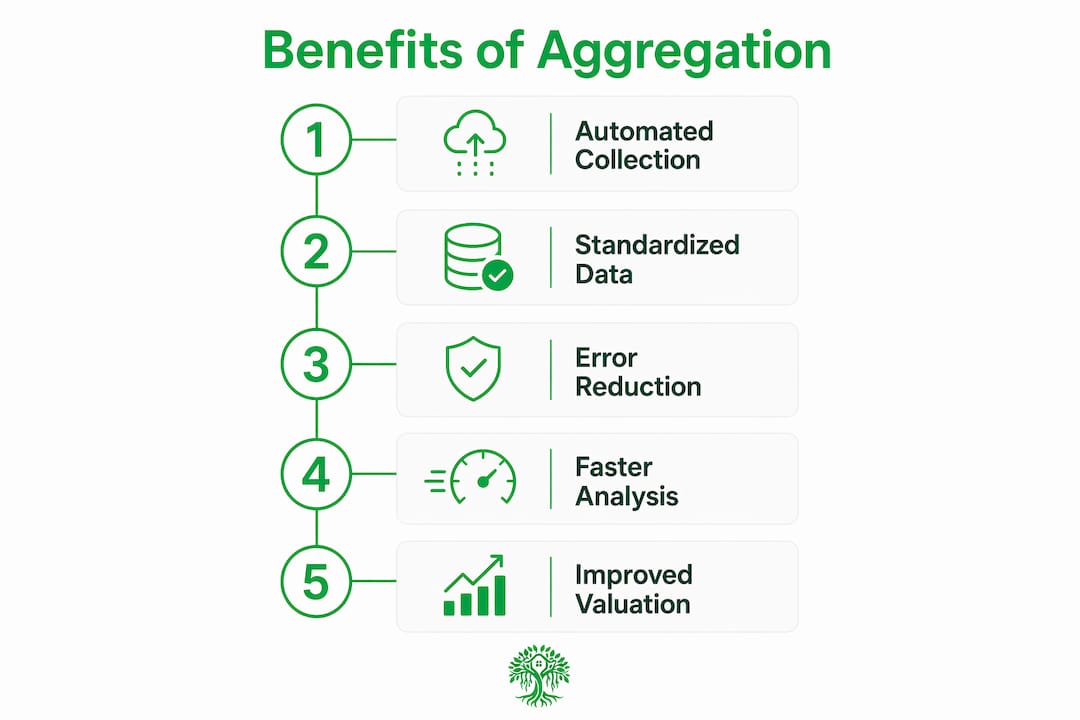
For property valuation specifically, aggregated data removes the guesswork from comparable sales analysis. Instead of a human researcher pulling records from three different county websites, a standardized dataset delivers verified sale prices, lot sizes, and permit histories in one query. Appraisers and underwriters can run models faster and with fewer manual corrections.
For market analysis, the benefits are equally direct:
- Submarket heatmaps. Aggregated data lets analysts map price trends, days on market, and inventory levels at the zip code or census tract level, not just the city level.
- Portfolio scoring. Investors managing multiple properties can benchmark each asset against current market conditions without manually pulling data for each address.
- Real-time shift detection. When a neighborhood’s median days on market drops from 30 to 12 in a single month, aggregated feeds catch that signal immediately.
- Underwriting speed. Lenders using unified property datasets can analyze occupancy rates, lease expirations, and capital expenditure needs without manual data merging.
Pro Tip: If you are analyzing a specific submarket in California, cross-reference MLS price trends against county permit data. A spike in renovation permits often predicts price appreciation six to twelve months out.
The importance of data aggregation compounds when you are making a six-figure decision. A first-time buyer relying on a single listing site sees one snapshot. A buyer working with aggregated data sees the full picture: tax history, permit records, prior sale prices, and neighborhood price velocity all in one place.
What are the limitations and pitfalls of real estate data aggregation?
Aggregated data carries real risks that buyers and investors must understand before acting on it. The most dangerous assumption is that all data in an aggregated dataset is equally reliable.
Marketing claims and legal records are often stored in the same data fields without differentiation. A listing agent enters “4 bedrooms” as a marketing claim. The county assessor’s permit record shows 3 permitted bedrooms. Both values can appear in the same aggregated field, with no label indicating which is which. Aggregators do not conduct primary research, so they propagate original data errors forward.
The four most common pitfalls are:
- Confusing marketing data with legal records. County records derive from official building permits and surveys. MLS data is agent-entered. Treating both as equally authoritative leads to valuation errors.
- Ignoring data latency. Disparate update frequencies create asynchronous snapshots. MLS data may update multiple times daily while tax and parcel records update yearly. Assuming all fields reflect the same moment in time is a common and costly mistake.
- Trusting precision without verification. A dataset showing a property’s square footage to the exact foot feels authoritative. That figure may trace back to a 1987 assessor sketch that was never corrected after a renovation.
- Building proprietary pipelines without the resources to maintain them. Thousands of jurisdictions change their data formats regularly. Organizations that build their own aggregation infrastructure often find the maintenance burden exceeds the initial build cost.
Pro Tip: Before using any aggregated data field for a purchase decision, ask: “What is the original source of this value, and when was it last verified?” If the platform cannot answer that question, treat the field as unverified.
The best practice is to verify data lineage for every critical field. Square footage, bedroom count, and zoning classification should always be confirmed against the original county source before closing.
How can you leverage aggregated real estate data for smarter decisions?
Aggregated data is most valuable when it drives a specific workflow rather than sitting in a dashboard. The main value of aggregation lies in data that is actionable, enabling alerts and decisions rather than passive reporting.
For buyers, the practical applications include:
- Automated alerts. Set triggers on price reductions, new permits, or ownership changes for target addresses or neighborhoods. You stop manually checking and start receiving signals.
- Valuation benchmarking. Compare a specific property’s price per square foot against the median for its zip code, school district, or census tract using standardized comparable data.
- Acquisition screening. Filter thousands of properties by verified criteria such as lot size, year built, and permit history before scheduling a single showing.
- Market timing. Track days-on-market trends and list-to-sale price ratios across a submarket to identify whether conditions favor buyers or sellers.
For investors managing portfolios, unified datasets allow analysis of occupancy, lease expirations, and capital expenditure needs across every asset simultaneously. That replaces a spreadsheet-and-phone-call workflow with a query.
API access is the most direct way to integrate aggregated data into your own tools. Most enterprise-grade real estate data platforms deliver property records, ownership history, and market metrics through standardized API endpoints. That means you can pull verified data directly into underwriting models, CRM systems, or custom dashboards without manual exports.
The shift aggregation enables is from reactive to proactive. Instead of looking up a property after you find it interesting, you define your criteria and let the data surface the properties that match. Buyers’ agents who use data-driven search strategies report finding better-fit properties faster precisely because they screen on verified data before investing time in showings.
Key Takeaways
Real estate data aggregation is the foundation of accurate property valuation: without standardized, deduplicated data from verified sources, every downstream analysis carries compounding error risk.
| Point | Details |
|---|---|
| Definition is specific | Aggregation collects, standardizes, and deduplicates data from MLS feeds, tax records, and permits into one dataset. |
| Resolution policies matter | Aggregators select canonical records by source priority and validation rules, not simply by recency. |
| Data latency is a real risk | MLS data updates every 5–15 minutes; tax records update annually, creating asynchronous and potentially misleading snapshots. |
| Source type determines reliability | Government-verified legal records and agent-entered marketing claims often occupy the same data fields without labels. |
| Actionable data beats passive dashboards | Aggregation’s true value appears in alerts, benchmarking, and automated screening workflows, not static reports. |
Why I think most buyers misread aggregated data
The biggest mistake I see is treating an aggregated dataset as a finished product. It is not. It is a starting point. The aggregation process is genuinely impressive engineering. Pulling MLS feeds, county assessor files, deed records, and permit histories into a single normalized schema is hard work. But the output is only as trustworthy as the weakest source feeding into it.
What concerns me most is the false confidence that a clean-looking interface creates. When data is presented in a polished table with consistent formatting, buyers assume it has been verified. It has been standardized, which is different. Standardization means the fields look the same. Verification means someone confirmed the underlying fact against an authoritative source.
The distinction matters most for bedroom and bathroom counts, square footage, and zoning classification. These are the fields most likely to contain agent-entered marketing claims rather than permit-verified facts. I have seen buyers make offers based on a “4-bedroom” count that traced back to an agent who counted a finished basement as a bedroom. The county record showed 3 permitted bedrooms. That gap affected the appraisal.
My advice: use aggregated data to screen and shortlist aggressively. Use primary sources, specifically county assessor records and permit databases, to verify before you commit. The common mistakes first-time buyers make in California often trace back to trusting a listing’s data fields without checking the underlying county record. Aggregation is a powerful tool. It is not a substitute for due diligence.
— Anand
How Ficustree puts aggregated data to work for you
Ficustree is built on the principle that buyers deserve the same data quality that institutional investors use. The platform aggregates and standardizes property information across California and Texas, then layers AI-driven matching on top of that verified data to surface homes that genuinely fit your criteria.

You get AI-powered home search backed by high-confidence property records, not just listing descriptions. Ficustree represents you directly as a buyer, with a flat $1,000 fee at closing plus 1% commission, and a rebate of roughly 2% where California law permits. You also get on-demand showing agents by the hour. The platform is free to use. If you are ready to search with real data behind every result, start your search at ficustree.ai or learn how the platform works before your first showing.
FAQ
What is real estate data aggregation in simple terms?
Real estate data aggregation is the process of pulling property data from multiple sources, such as MLS feeds, tax records, and permit filings, and combining them into one clean, standardized dataset. The goal is a single reliable record for each property.
How often does aggregated real estate data update?
Update frequency depends on the source. MLS data can refresh every 5–15 minutes, while county tax and parcel records typically update once a year. This means different fields in the same property record may reflect very different points in time.
Can aggregated data replace a title search or appraisal?
No. Aggregated data supports analysis and screening but does not replace a title search or licensed appraisal. Legal ownership, liens, and encumbrances require verification against official county records and title insurance.
Why do aggregated datasets sometimes contain errors?
Aggregators do not conduct primary research. They collect and standardize data from original sources, so any error in the source, such as an agent-entered bedroom count or an outdated assessor sketch, carries forward into the aggregated record.
What is the difference between MLS data and county assessor data?
MLS data is entered by listing agents and reflects marketing claims about a property. County assessor data derives from official permits, surveys, and legal filings. Both appear in aggregated datasets, but only county records carry legal authority.
Recommended
- AI Home Search for Buyers: What Changes Now
- How Real Estate Commission Works for Buyers and Sellers – ficustree.ai
- First Time Homebuyer Guide: Simple Steps for Your First Home
- Blog Post

Leave a Reply