
A balloon mortgage is a home loan with small payments for a few years, followed by one large final payment that pays off whatever principal is left. Terms generally run between several and about ten years, and the final “balloon payment” can be more than double a regular monthly payment. If you take one out, you need a concrete plan to refinance, sell, or pay cash before that date arrives.
TL;DR:
- Most balloon mortgages have terms of 5 to 10 years, with the final payment often exceeding twice the typical monthly installment.
- These loans are mainly offered by specialized lenders such as hard-money lenders and small regional banks, not major national banks.
- Without a solid exit plan like refinancing or selling, balloon loans pose significant foreclosure risks due to large lump-sum payments at maturity.
- Borrowers should carefully project the balloon amount using amortization tools and assess their ability to refinance, sell, or pay the balance before committing.
- Fixed-rate or adjustable-rate mortgages generally offer better long-term stability and equity-building for most buyers compared to balloon structures.
Table of Contents
- How Does a Balloon Mortgage Work?
- What Terms and Lenders Are Common for Balloon Loans?
- What Are the Real Advantages and Risks?
- What Happens When the Balloon Payment Comes Due?
- Who Should Actually Consider a Balloon Mortgage?
- How Do Ficustree’s Tools Help You Model a Balloon Scenario?
- Are There Tax Implications to a Balloon Mortgage?
- How Does Your Credit Score Affect Balloon Mortgage Eligibility?
- Balloon Mortgage vs. Fixed Mortgage: What’s the Real Cost Difference?
- Are Balloon Mortgages Common Today?
- What Contract Terms Should You Watch For?
- Where Conservative Financing Wins for First-Time Buyers
- Model Your Balloon Scenario Before You Sign With Ficustree
- Sources
- FAQ
How Does a Balloon Mortgage Work?
A standard 30-year fixed loan amortizes fully. Every payment chips away at principal and interest until the balance hits zero on schedule. A balloon mortgage breaks that pattern on purpose. You make smaller payments for a set period, then owe the remaining balance in one lump sum.
Lenders structure these three main ways. Interest-only balloons have you paying just the interest each month, so the full principal is due at maturity. Partial-amortization balloons, more common in practice, use a 30-year amortization schedule but call the loan due after 5 to 10 years, leaving a large chunk of principal unpaid. A smaller category has no payments at all until the balloon date, though this structure is rare in residential lending.
Here’s a real number to anchor it. Your monthly payment (principal and interest) is roughly $1,896. After 7 years of payments, you’d still owe approximately $267,000 as a single balloon payment, because 30-year amortization barely dents principal in the first decade.
- Interest-only: entire principal due at maturity, lowest monthly payment
- Partial amortization: smaller monthly payment than a standard loan, but most of the balance remains
- No-payment structures: rare, all principal and interest deferred to maturity
Run your own numbers through an amortization calculator before assuming a balloon saves you money long term.
What Terms and Lenders Are Common for Balloon Loans?
Balloon mortgage terms cluster tightly around 5, 7, or 10 years, almost always paired with a 15 or 30 year amortization schedule for calculating the monthly payment. That combination keeps payments low while pushing the real cost to the maturity date.
You won’t find many balloon loans at major national banks anymore. Since the 2008 mortgage crisis, most consumer balloon lending has shifted to hard-money lenders, boutique regional lenders, and private financing, largely because qualified mortgage rules restrict balloon features on standard owner-occupied loans. Big banks generally avoid the compliance complexity and the default risk.
- Term lengths: 5 to 10 years is standard, with 7 years the most common sweet spot
- Amortization basis: usually calculated as if it were a 15 or 30 year loan
- Lender types: hard-money lenders, small local banks, portfolio lenders, and seller-financed deals
- Regulatory backdrop: post crisis rules limit balloon features on qualified mortgages, per Investopedia’s explainer
If a mainstream lender offers you one, ask directly why, and get the qualified-mortgage status in writing.
What Are the Real Advantages and Risks?
The pitch sounds good on paper: lower monthly payments now, more house for less cash flow, and a shot at refinancing later once your income or the property’s value improves. Investors flipping a property in under two years, or buyers expecting a bonus, inheritance, or business sale, sometimes use balloon structures deliberately.
The risk side is where most first-time buyers get into trouble.
- Lower initial payments: interest-only or partial-amortization structures free up monthly cash flow
- Short-term flexibility: useful if you know you’re selling or refinancing within the term
- Investor fit: flippers and short-term holders can exploit the low carrying cost
- Large lump-sum risk: the balloon payment is often more than twice your regular monthly payment
- Refinancing dependency: your exit plan assumes future approval, which isn’t guaranteed
- Minimal equity buildup: partial-amortization structures leave most of the principal untouched, so Business Insider notes many borrowers end up relying on home-price appreciation just to qualify for a refinance
- Foreclosure exposure: the CFPB is direct about this: if you can’t pay the balloon or refinance because of falling values or a changed financial picture, foreclosure becomes a real possibility
Pro Tip: Before you sign anything, calculate the balloon amount at year 5, 7, and 10 using an amortization tool. Compare that number to your realistic savings trajectory, not your hopeful one.
What Happens When the Balloon Payment Comes Due?
You have four real paths when the balloon date arrives, and the earlier you start working one, the more leverage you keep.
- Refinance into a new loan. Lenders will look at your updated credit score, income, and the home’s current appraised value. Start this process 6 to 12 months before maturity, since underwriting takes time and a denial late in the game leaves no room to pivot.
- Sell the property. This works if the home has appreciated and the market is liquid, but factor in agent commissions, closing costs, and the real risk that your sale takes longer than expected in a slow market.
- Pay cash from savings or a windfall. This is the cleanest exit, but it requires disciplined saving from day one of the loan, not a hope that a bonus materializes on schedule.
- Negotiate with your lender. Some lenders will extend the term, reset the rate, or offer a short bridge loan, but this depends entirely on their portfolio policy and your payment history. Don’t assume it’s available.
The Investopedia analysis is blunt about this: buyers who assume they’ll “just refinance later” without a fallback plan are the ones who end up in foreclosure court.
Who Should Actually Consider a Balloon Mortgage?
Balloon mortgages fit a narrow set of buyers well. If none of these describes you, a balloon loan is probably the wrong tool.
- House flippers planning to sell within the balloon term, where low carrying costs matter more than long-term equity
- Short-term occupants who know with certainty they’re relocating or upsizing before maturity
- Windfall recipients with a documented, near-certain influx of cash, such as a vesting stock grant or a pending inheritance
- Investors using the structure as a bridge to permanent financing on a rental property
For nearly everyone else, a 30-year fixed loan, an adjustable-rate mortgage, or an interest-only loan with a longer horizon carries far less maturity risk. A fixed loan costs more month to month but builds real equity and never forces a lump-sum reckoning. NAR’s coverage of balloon affordability makes the same point: the short-term savings rarely outweigh the long-term exposure for a typical first-time buyer.
How Do Ficustree’s Tools Help You Model a Balloon Scenario?
You shouldn’t sign a balloon mortgage based on a lender’s optimistic pitch. Run the numbers yourself first. Ficustree’s amortization calculator shows exactly how much principal remains at any point in a balloon term, and the mortgage calculator with taxes and insurance lets you compare that balloon structure against a standard 30-year fixed payment, including PITI.
Ficustree’s decision-intelligence layer takes this further by letting you test refinance-versus-sell scenarios side by side, using your actual income and the property’s likely appreciation path, instead of guessing.
Before agreeing to a balloon clause, ask your lender or agent:
- What is the exact balloon amount at maturity, in dollars?
- What happens if I can’t refinance or sell in time?
- Are there prepayment penalties if I pay it off early?
- Is there a reset or extension option, and under what conditions?
Are There Tax Implications to a Balloon Mortgage?
Mortgage interest on a balloon loan is deductible under the same rules as any other qualified home loan, up to the current mortgage interest limits set by the IRS for acquisition debt. There’s no special balloon carve-out that increases or restricts your deduction just because the loan has a shorter term.
Where it gets trickier is at the exit. If you sell the property to cover the balloon, capital gains rules apply exactly as they would with any home sale. You can typically exclude up to $250,000 of gain ($500,000 for married couples filing jointly) if you owned and lived in the home for at least two of the five years before the sale, under the standard primary-residence exclusion. A balloon loan’s shorter horizon can work against you here: if you’re forced to sell in year 3 or 4 to avoid a payment you can’t make, you may not have met that two-year residency threshold, which means the full gain becomes taxable.
If you refinance instead of selling, refinancing itself isn’t a taxable event, but any cash-out portion used for something other than the home isn’t tax-deductible on the interest, per standard IRS rules on acquisition versus home-equity debt. Work through these scenarios with a tax professional before you assume a balloon exit is tax-neutral. It often isn’t.
How Does Your Credit Score Affect Balloon Mortgage Eligibility?
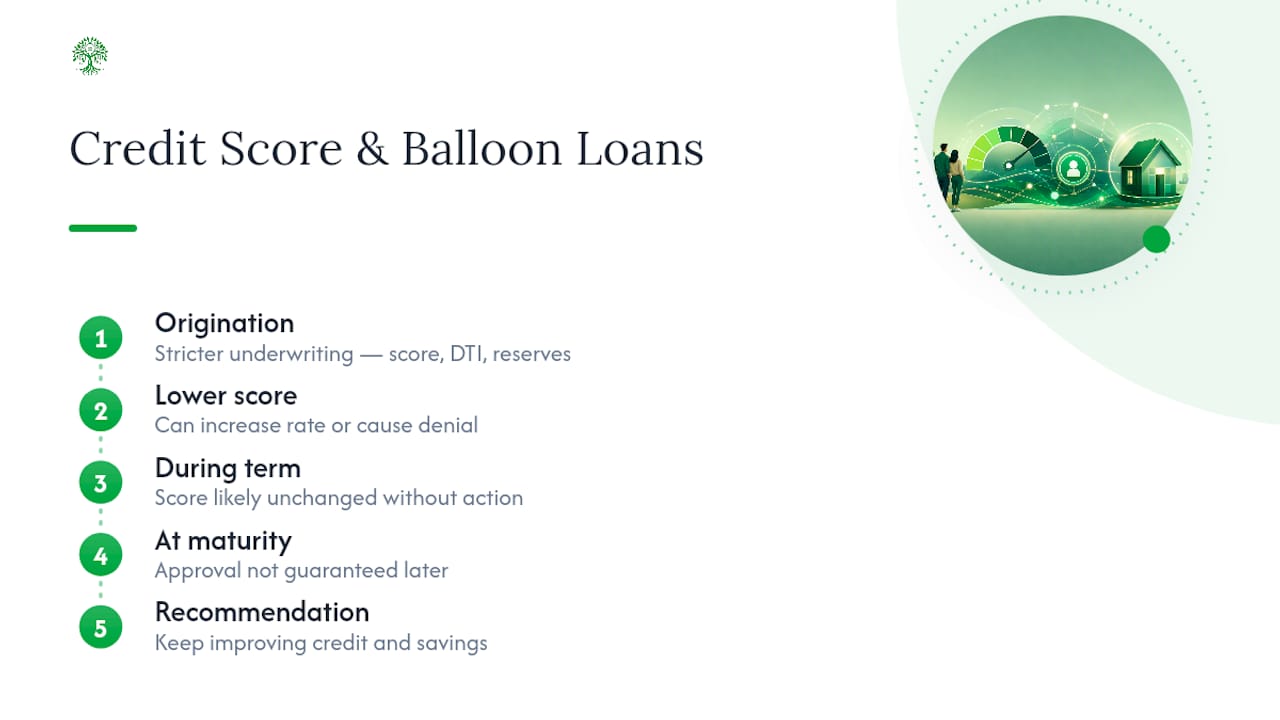
Balloon mortgages tend to carry stricter underwriting than they get credit for. Because niche and portfolio lenders hold these loans on their own books rather than selling them to Fannie Mae or Freddie Mac, they often compensate for that risk by demanding stronger borrower profiles upfront.
Expect lenders to look closely at your credit score, debt-to-income ratio, and cash reserves, sometimes more closely than a conventional lender would for a standard 30-year loan. A lower credit score doesn’t just mean a higher rate here. It can mean outright denial, since the lender is betting on your ability to refinance or sell successfully at maturity, and a weak credit profile now suggests a weak one later too.
This creates a real trap. If your credit is borderline today, it will likely still be borderline in 5 to 7 years unless you actively work to improve it, which makes your refinance exit less certain, not more. A strong credit profile at origination doesn’t guarantee approval at maturity either, since your score, income, and the home’s value can all move against you before the balloon comes due. Treat the qualification bar for a balloon mortgage as a floor, not a ceiling, and keep building your credit and savings throughout the term regardless of how easy the initial approval felt.
Balloon Mortgage vs. Fixed Mortgage: What’s the Real Cost Difference?
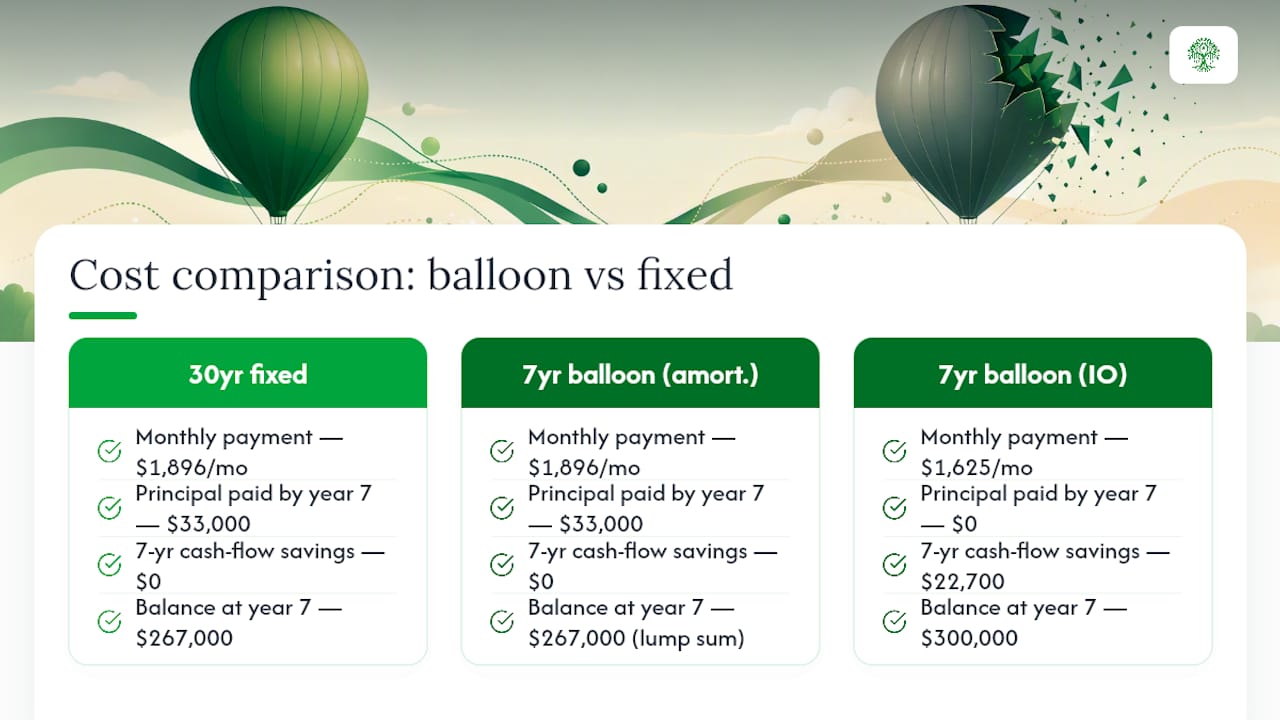
Numbers make this comparison clearer than any general warning. Take that same $300,000 loan at 6.5%. A 30-year fixed mortgage costs about $1,896 a month for the full term, and by year 7 you’ve paid down roughly $33,000 of principal.
A 7-year balloon loan calculated on the same 30-year amortization schedule has an identical monthly payment of $1,896, but at the end of year 7 you owe a lump sum of approximately $267,000. You haven’t saved a dime monthly. What you’ve actually done is defer a $267,000 obligation while betting on future refinancing or a sale.
Where balloons genuinely save money is in interest-only variants, where the monthly payment might drop to around $1,625 on the same loan amount, a real monthly savings of roughly $271. Over 7 years, that’s about $22,700 saved in cash flow, against a full $300,000 balance still owed at maturity, since none of it amortized.
The trade-off is stark once you lay it out: a fixed loan trades higher monthly cost for predictability and steadily growing equity. A balloon loan trades short-term cash flow relief for a hard deadline and zero guarantee that refinancing terms will be favorable when you need them.
Are Balloon Mortgages Common Today?
Balloon mortgages were far more common before the 2008 financial crisis, when looser underwriting let borrowers stack risky features, including balloons, adjustable rates, and low documentation, into the same loan. That combination contributed heavily to the wave of defaults that followed.
Post-crisis reforms changed the landscape substantially. Qualified mortgage standards now restrict balloon features on most conventional, owner-occupied loans, which is why you rarely see them advertised by major banks today. What remains is a smaller, more specialized market: hard-money lenders, portfolio lenders holding loans on their own books, and seller-financed deals, most often serving real estate investors rather than typical first-time buyers.
The current environment of elevated interest rates has renewed some interest in balloon structures among borrowers hoping to “buy now, refinance later” if rates drop. Financial advisors have pushed back hard on this reasoning, since it hinges entirely on a rate forecast nobody can guarantee. If you’re considering a balloon mortgage in today’s market specifically to bet on falling rates, understand you’re making two speculative bets at once: on rates and on your own future qualification.
What Contract Terms Should You Watch For?
Balloon mortgage contracts carry a few clauses that don’t show up in standard fixed-rate paperwork, and missing them can cost you thousands.
Prepayment penalties are more common in balloon loans than in conventional mortgages, especially with hard-money and portfolio lenders. If you plan to refinance or sell early to avoid balloon risk, a prepayment penalty can erase much of the benefit of moving fast. Always ask for the exact penalty schedule in writing.
Balloon reset options let some lenders extend the loan or reset the rate at maturity instead of demanding full payment immediately, but this is a lender courtesy, not a borrower right, unless it’s explicitly written into your note. Never assume a reset will be offered just because a loan officer mentioned it was “usually” available.
Due-on-sale clauses are standard, meaning the balloon becomes immediately payable if you sell or transfer the property, which matters if your exit strategy involves adding a co-owner or transferring title for estate planning.
Rate adjustment triggers in hybrid balloon-ARM products can change your payment before the balloon date even arrives, so read the initial rate period carefully. Get every one of these clauses explained line by line before signing, and if a lender is vague about any of them, treat that vagueness as a warning sign.
Where Conservative Financing Wins for First-Time Buyers
Conservative financing wins for most first-time buyers because a fixed payment and a foreclosure date are two very different kinds of stress, and the balloon structure trades one for the other at the exact moment you have the least room to absorb a shock.
If you’re weighing a balloon loan, hold yourself to two guardrails: a documented exit plan you’d trust with someone else’s money, and enough equity cushion that a stalled refinance doesn’t force a fire sale.
— Anand
Model Your Balloon Scenario Before You Sign With Ficustree
Most buyers who look into a balloon mortgage are really trying to solve one problem: making the monthly number work today without getting trapped tomorrow. Ficustree gives you a way to test that trade-off before you’re locked into a contract, instead of discovering the real cost at closing.

A decision-intelligence platform can let you run a balloon structure against a standard 30-year fixed or an ARM side by side, using your real income, target neighborhood, and the actual property you’re eyeing, not a generic rate-sheet example. If the numbers suggest a balloon is genuinely your best fit, on-demand showing agents and direct buyer representation can help you negotiate the terms, including reset options and prepayment penalties. Head to Ficustree and run your own numbers before you talk to a lender.
Sources
The CFPB’s balloon payment guide is the clearest regulatory explanation of foreclosure risk. Investopedia and NAR cover structure and affordability, while Law.Cornell’s Wex entry gives a precise legal definition.
- What is a balloon payment? When is one allowed? | Consumer Financial Protection Bureau
- Balloon Mortgage | Investopedia
- The Impact of Balloon Mortgages on Home Affordability | NAR
- Balloon mortgage: Definition, benefits, and risks | Business Insider
FAQ
Is a Balloon Loan a Good Idea?
For most first-time buyers, no. The CFPB warns that inability to pay the lump sum or refinance can lead to foreclosure, so it only makes sense with a firm exit plan and financial cushion.
What Is a 30-Year Mortgage With a 5-Year Balloon?
It’s a loan calculated on a 30-year amortization schedule for a low monthly payment, but the entire remaining balance becomes due after 5 years instead of continuing for the full 30.
Do Banks Still Offer Balloon Mortgages?
Major national banks rarely offer them today because qualified mortgage rules restrict balloon features on most conventional loans; most current balloon lending comes from hard-money and portfolio lenders serving investors.
How Can I Get Out of a Balloon Mortgage?
You typically refinance into a new loan, sell the property, pay the balance in cash, or negotiate an extension or reset with your lender, and starting that process 6 to 12 months before maturity gives you the most options.
Recommended
- How to Avoid PMI as a First-Time Buyer in California
- First Time Buyer Down Payment Calculator: 2026 Guide
- How FHA Loans Work for First-Time Buyers in 2026
- 3.5% Down or 20% Equity: FHA vs Conventional for First Time Buyers

Leave a Reply