
The best mortgage lenders in Texas for first-time buyers combine local underwriting, transparent fees, and real experience with programs like TDHCA down payment assistance. For most first-time buyers, working with a lender who partners well with a buyer representation platform like Ficustree solves the two hardest parts of this process at once: finding the right loan and finding the right home. If your credit is under 620, self-employment complicates your income, or you’re set on a niche program a specific lender doesn’t offer, you’ll want to shop beyond the obvious names. Either way, start by pulling Loan Estimates from two or three lenders before you fall in love with a house.
TL;DR:
- Shopping for multiple Loan Estimates within a 14-day window ensures accurate APR comparisons and prevents hidden origination fees from eroding your savings.
- Prioritizing closing reliability is crucial, especially in Texas’s competitive market, as in-house underwriting speeds up the process and reduces the risk of losing your purchase.
- Confirm that your lender is approved for Texas-specific programs like TDHCA and TSAHC, as program availability varies and affects your ability to access down payment assistance.
- Texas property taxes and homeowner insurance costs significantly impact monthly payments, regardless of the mortgage rate or loan type, so budget accordingly before making an offer.
- Using a platform like Ficustree helps coordinate lender selection, program eligibility, and closing timelines, which can improve your chances of closing smoothly on your first home.
Table of Contents
- How to Choose a Mortgage Lender in Texas
- Texas-Specific Programs and Down Payment Assistance Explained
- How Do You Compare Loan Estimates Line by Line?
- What Documents Do You Need for Preapproval in Texas?
- What Are Average Mortgage Rates and Fees in Texas Right Now?
- How Does Your Credit Score Affect Your Texas Mortgage Offer?
- What Mortgage Types Are Available to Texas Buyers?
- How Do Texas Lenders Compare on Reputation and Service?
- What’s the Timeline From Application to Closing in Texas?
- What First-Time Texas Buyers Consistently Get Wrong
- How Ficustree Helps You Choose Lenders and Close Reliably
- Sources
- FAQ
How to Choose a Mortgage Lender in Texas
Rate is the number everyone fixates on, but it’s rarely the reason a deal falls apart. Closing reliability is. A lender who can’t fund on time in a hot Texas market, where competing offers often close in under 30 days, can cost you the house even if their rate was a quarter point lower.
Here’s the order that actually matters when you’re comparing options:
- Closing reliability. Ask directly whether underwriting happens in-house or gets sent to a centralized processing center. In-house underwriting tends to move faster and gives you a real person to call when a document goes missing three days before closing.
- Fees and APR. The interest rate alone hides origination charges, discount points, and lender fees. Compare the annual percentage rate, not just the headline number.
- Program availability. Confirm the lender actually offers FHA, VA, and Texas-specific programs like those through TDHCA and TSAHC, not just conventional loans.
- Communication speed. How fast do they respond to a pre-approval request? That pace usually predicts how they’ll handle your file once you’re under contract.
- Licensing and complaint history. Every legitimate lender and loan officer carries an NMLS Consumer Access record you can check in minutes.
When you talk to a loan officer, ask pointed questions:
- “Do you underwrite in-house, or is this sent out?”
- “Have you closed loans using TDHCA or TSAHC down payment assistance before?”
- “What’s your average time from application to clear-to-close?”
- “Can you lock my rate today, and for how long?”
Watch for red flags: vague answers about fees, reluctance to put anything in writing, or pressure to sign disclosures you haven’t read. Getting three Loan Estimates is the sweet spot, enough to compare meaningfully without drowning in paperwork. Submit those applications within a 14-day window. Credit scoring models generally treat multiple mortgage inquiries in a short period as a single inquiry, so shopping around doesn’t tank your score the way people assume.
Texas-Specific Programs and Down Payment Assistance Explained
Texas gives first-time buyers more assistance options than most states, but the programs only work through lenders who are actually approved to close them. That distinction trips up more buyers than any rate comparison ever will.
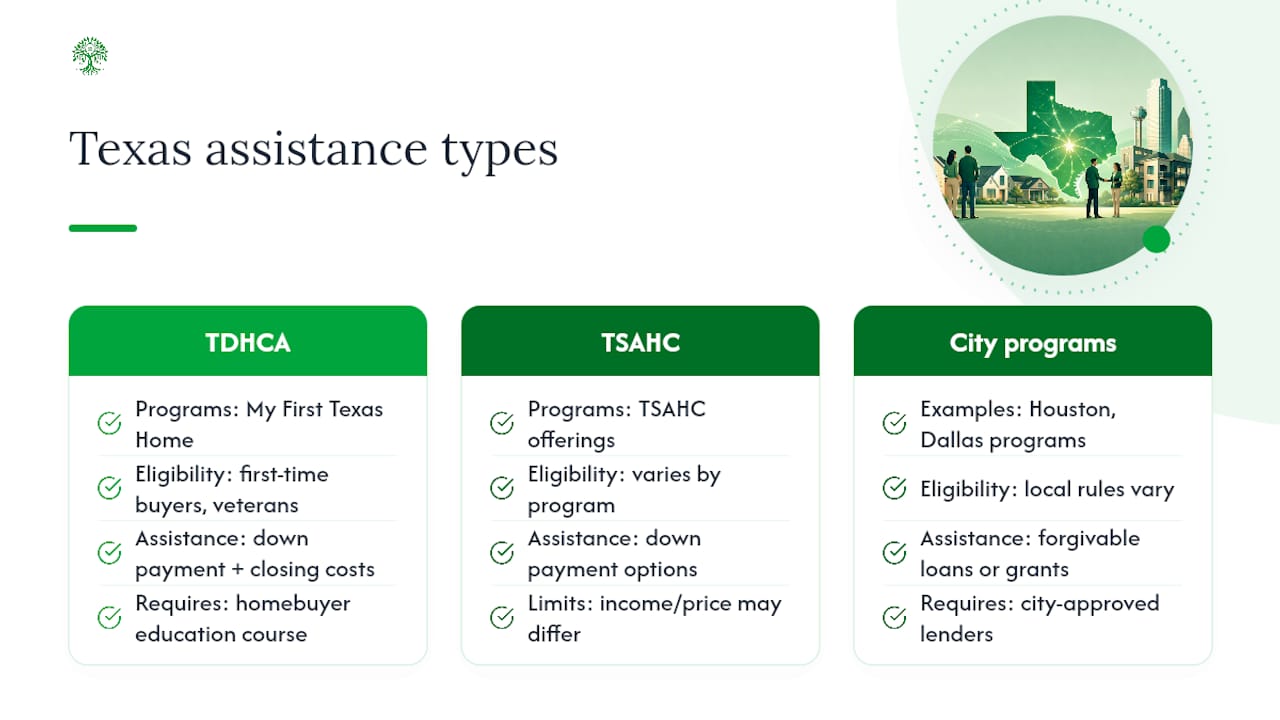
TDHCA runs two flagship programs worth knowing by name. My First Texas Home pairs a low-interest mortgage with down payment and closing cost assistance for eligible first-time buyers and veterans. My Choice Texas Home opens that same assistance to repeat buyers too, which matters if you’ve owned a home before but haven’t in the last three years, a common qualifying window for “first-time buyer” programs. Both require a homebuyer education course and compliance with income and purchase price limits that vary by county.
Down payment assistance isn’t universal across lenders. Some national lenders decline to close loans that carry program-specific second liens or subordinate financing structures, according to guidance from TDHCA. That means the lender with the lowest advertised rate might not be able to close your assistance loan at all.
The Texas State Affordable Housing Corporation, TSAHC, runs a parallel set of programs with its own approved-lender network and its own income limits, which sometimes differ from TDHCA’s. Confirming your lender sits on both approved lists before you get emotionally attached to a rate quote saves real heartache later.
City-level programs add another layer. Houston and Dallas both run homebuyer assistance programs that can offer forgivable loans or grants toward down payment and closing costs, and these often come with their own approved-lender requirements. A lender who’s never closed a City of Houston assistance loan may need extra time to get up to speed, or may not participate at all.
The practical takeaway: before you fall for a rate quote, ask your lender directly which state and city programs they’re approved for. Cross-reference the answer against the program’s own portal. A lender who’s vague about this, or who tries to steer you into conventional financing you didn’t ask about, isn’t the right fit for a first-time buyer trying to minimize cash to close.
If reducing your upfront cash is the priority, it’s worth reading through the full range of low and no down payment paths available to Texas buyers before you commit to one lender’s product lineup.
How Do You Compare Loan Estimates Line by Line?
Every lender is federally required to send you a standardized three-page Loan Estimate within three business days of a completed application, and that standardization is exactly what makes side-by-side comparison possible. The document looks the same regardless of who issues it, so you’re comparing numbers, not marketing language.
Start with the APR, not the interest rate printed at the top. Comparing APR instead of the headline rate exposes offers where a lender bought down the rate with points and fees you’d pay for upfront, sometimes wiping out any savings over the years you’ll actually hold the loan.
Work through the Loan Estimate in this order:
- Loan terms section (page 1). Confirm the loan amount, rate, and whether the rate can change. This is where adjustable-rate features hide if you weren’t expecting them.
- Projected payments. Check whether property taxes, insurance, and any mortgage insurance premium are included in the estimated monthly payment. Texas property taxes run high, and a lender who lowballs this estimate is setting you up for a surprise.
- Origination charges (page 2, section A). This is the lender’s own fee for processing your loan. Compare this dollar figure directly across offers.
- Services you cannot shop for and services you can. Some third-party costs, like the appraisal, are fixed. Others, like the title company, you can shop separately.
- Rate-lock terms. Confirm how many days the lock lasts and what happens if closing slips past that window.
Pro Tip: Print all three Loan Estimates and lay them side by side on a table. Circle the origination charges and the “cash to close” figure on each one. Those two numbers, more than the rate, tell you which lender is actually cheaper.
Once you have competing Loan Estimates in hand, use them. Tell your preferred lender what a competitor quoted and give them a chance to match or beat it. Loan officers have more flexibility on fees than most buyers realize, especially in a market where they’re competing for your business against two or three other lenders.
What Documents Do You Need for Preapproval in Texas?
A reliable preapproval takes about one to three business days once you’ve submitted a complete file, and the documents rarely change from lender to lender. Gather these before you start:
- Two most recent pay stubs and W2s, or two years of tax returns if you’re self-employed
- Two months of bank statements for every account you’ll use for the down payment
- A government-issued photo ID
- Documentation for any additional assets, including retirement accounts or gift funds
- Recent statements for existing debts, like auto loans or student loans
From preapproval to closing, expect somewhere between 30 and 45 days once you’re under contract, though the exact pace depends heavily on who’s underwriting your file. Local lenders and credit unions with in-house underwriting often close faster than lenders who send files to a centralized processing hub out of state, because there’s no queue to wait behind and the underwriter can pick up the phone and ask you directly if something’s unclear.
Texas closings happen at a title company with an escrow officer present, and the rules around funding your closing differ from what buyers in other states might expect. Wire transfers are the standard method for delivering your cash to close; personal checks are frequently refused outright because they can’t be verified in time. Confirm your title company’s wiring instructions directly with them by phone, never by email alone, since wire fraud targeting home buyers has become a real and costly problem nationally.
If your income situation includes student loan debt, it’s worth understanding how that debt factors into your approval before you submit your documents, since debt-to-income calculations catch many first-time buyers off guard.
What Are Average Mortgage Rates and Fees in Texas Right Now?
Texas mortgage rates generally track close to the national average rather than running meaningfully higher or lower, since rates are driven primarily by national bond markets rather than state-specific risk. Where Texas does stand apart is in fees tied to state-specific closing customs and, more significantly, property taxes.
Texas has no state income tax, which is part of why property tax rates run well above the national average in many counties. That gap shows up directly in your monthly payment through the escrow portion covering taxes and insurance, even when your rate and principal are identical to what a buyer in a lower-tax state would pay. Homeowners insurance in Texas also tends to run higher than the national average because of hurricane and severe weather risk along the coast and in parts of North Texas.
Origination fees and third-party closing costs vary more by lender than by state, which is exactly why comparing Loan Estimates matters more than chasing headline rate advertisements. Bankrate’s analysis of Texas lenders weighs affordability, program availability, and borrower experience together, rather than rate alone, because a lender advertising the lowest rate in Texas often makes it up elsewhere in points or fees. Ask any lender for their full fee breakdown before you compare their advertised rate to anyone else’s.
How Does Your Credit Score Affect Your Texas Mortgage Offer?
Your credit score doesn’t just determine whether you qualify. It determines what rate, what loan programs, and what down payment requirement you’ll be offered, sometimes shifting your monthly payment by hundreds of dollars for the exact same loan amount.
Conventional loans generally require a minimum score around 620, though the best rates go to borrowers well above 740. FHA loans open the door much wider, allowing scores as low as 580 with a 3.5% down payment, and some lenders will go even lower with a larger down payment. VA loans, available to eligible veterans and service members, don’t set a hard minimum score federally, though individual lenders often apply their own floor, commonly around 580 to 620.
A lower score doesn’t just mean a higher rate. It can also limit which lenders will work with you at all. Some lenders specialize in serving borrowers with credit challenges and structure their underwriting accordingly, while others simply decline applications below their internal cutoff without much explanation. This is one more reason lender shopping matters more for buyers with imperfect credit, not less. If your score sits below 620, it’s worth reading through specific strategies for buying with a lower credit score before you assume you’re stuck waiting.
Improving your score even 20 to 30 points before you apply can meaningfully change your rate offer, so paying down revolving balances in the months before you shop is rarely wasted effort.
What Mortgage Types Are Available to Texas Buyers?
Texas buyers have access to the full range of federal loan programs, and the right one depends heavily on your down payment, service history, and where you’re buying.
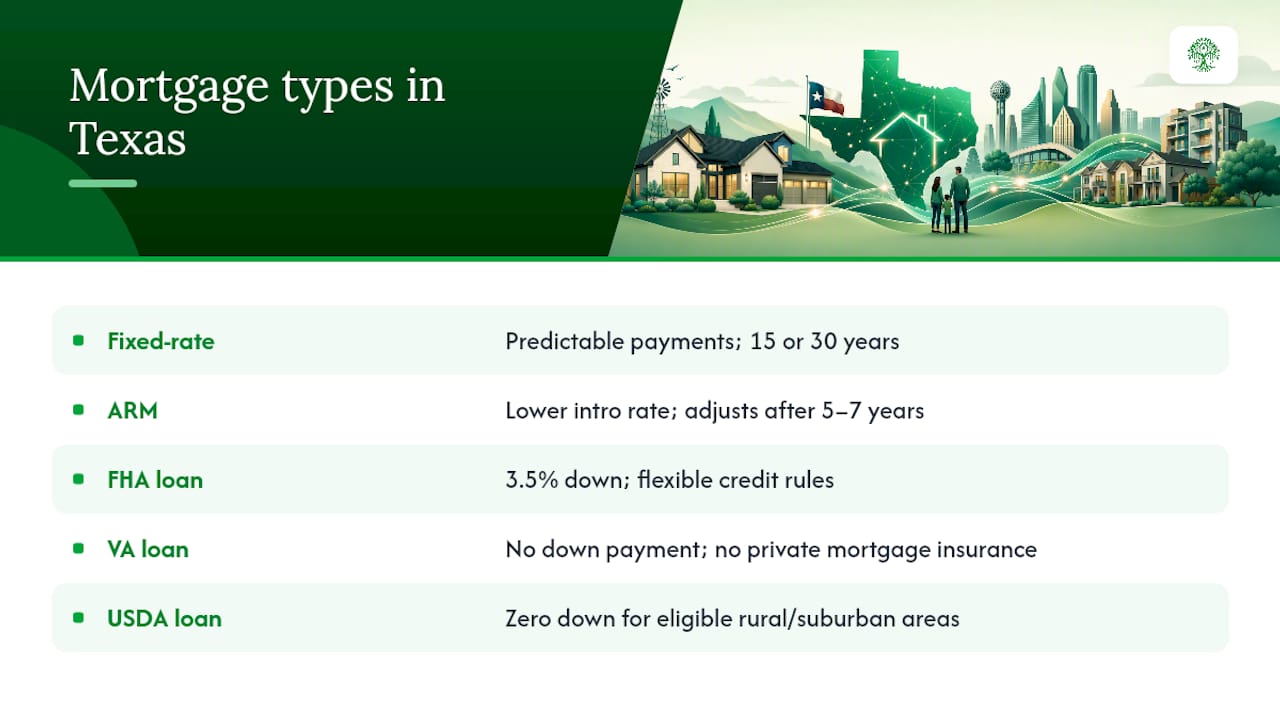
Fixed-rate mortgages, typically in 15 or 30-year terms, keep your principal and interest payment identical for the life of the loan. This is the default choice for most first-time buyers who want predictability.
Adjustable-rate mortgages, or ARMs, start with a lower fixed rate for a set period, often five or seven years, before adjusting based on market conditions. These make sense for buyers who know they’ll sell or refinance before the adjustment period hits.
FHA loans, backed by the Federal Housing Administration, allow down payments as low as 3.5% with more flexible credit requirements, making them one of the most common entry points for first-time Texas buyers. Reading through how FHA compares to conventional financing helps clarify which one fits your specific credit and down payment situation.
VA loans offer eligible veterans and active-duty service members financing with no down payment requirement and no private mortgage insurance, making them one of the strongest benefits available to those who qualify.
USDA loans support buyers purchasing in eligible rural and some suburban areas outside major Texas metros, offering zero down payment for qualifying income levels. Given how much of Texas outside Austin, Dallas, Houston, and San Antonio qualifies as USDA-eligible, this program deserves a look for buyers open to smaller communities.
How Do Texas Lenders Compare on Reputation and Service?
Lender reputation in Texas comes down to two things buyers can actually measure: complaint history and how lenders perform on independent rankings built from real loan data.
Bankrate’s Texas lender rankings draw on Home Mortgage Disclosure Act data to identify which lenders originate the highest volume of Texas mortgages, then layer in affordability and borrower experience scoring on top. U.S. News takes a similar approach, publishing lender detail pages that let buyers compare program availability side by side. Neither ranking is a substitute for getting your own Loan Estimate, but both are useful starting points for narrowing a list of lenders worth calling.
Scotsman Guide takes a different angle, ranking lenders industry-wide by production volume and requiring NMLS documentation to verify the numbers. A lender with high production volume isn’t automatically the best fit for your situation, but consistent volume over multiple years suggests a stable operation that isn’t likely to disappear mid-transaction.
The most useful reputation signal for a first-time buyer, though, rarely shows up in a ranking article. It’s how fast a loan officer returns your call after you ask a hard question. Pay attention to that during your first conversation, before you’ve signed anything. It tends to predict exactly how responsive they’ll be three weeks later when your closing date is on the line.
What’s the Timeline From Application to Closing in Texas?
A Texas mortgage typically moves through five stages, and knowing the expected duration at each one helps you spot delays before they become a crisis.
- Preapproval (1 to 3 business days): Submit your documents and get a conditional approval letter you can use when making offers.
- Application to processing (3 to 5 business days): Once you’re under contract, your loan officer submits your full file for processing and orders the appraisal.
- Underwriting (1 to 2 weeks): The underwriter reviews income, assets, and the appraisal, then issues conditions you’ll need to satisfy.
- Clear to close (a few days to a week): Once conditions are cleared, you get your Closing Disclosure at least three business days before signing, a federally mandated waiting period.
- Closing (1 day): You sign at the title company, wire your funds, and get your keys.
Total time from application to closing generally runs 30 to 45 days. Lenders with in-house underwriting tend to land at the shorter end of that range, since there’s no external queue slowing down the review. National lenders that outsource underwriting to a centralized hub sometimes stretch closer to 45 or even 60 days, particularly during high-volume periods like spring and early summer when Texas home sales peak.
What First-Time Texas Buyers Consistently Get Wrong
Most first-time buyers I talk to compare interest rates and stop there. They never actually lay three Loan Estimates side by side, which means they never catch the origination fee that quietly erased their rate advantage. That’s the single most expensive mistake in this entire process, and it’s completely avoidable.
The second mistake is treating underwriting speed as an afterthought instead of a closing risk. And the third is forgetting that Texas property taxes will reshape their monthly payment regardless of what rate they lock. Ficustree’s affordability tools surface all three of these before you’re emotionally attached to a house, which is exactly when buyers stop thinking clearly. Pull your Loan Estimates early. Compare them line by line. Then negotiate.
— Anand
How Ficustree Helps You Choose Lenders and Close Reliably
Ficustree is the alternative to hiring a traditional buyer’s agent for Texas first-time buyers who want a partner in both the loan shopping and the home search, not two separate headaches running on two separate timelines. As your direct buyer representative, Ficustree charges $1,000 at closing plus 1% commission, with a rebate of roughly 2% passed back to you where Texas law permits, so the financial incentive is aligned with helping you close a deal that actually fits your budget.

In practice, that means Ficustree helps you request Loan Estimates from multiple lenders, cross-reference which ones are approved for TDHCA and TSAHC assistance, and coordinate the closing timeline so your preapproval, your offer, and your lender’s underwriting all move in sync. Add in on-demand showing agents you can book by the hour and affordability calculators that factor in Texas property taxes from day one, and you get a clearer picture of what you can actually afford before you ever submit an offer. If you’re ready to see how this works for your search, start on the Ficustree buyer platform and get matched with next steps today.
Sources
FAQ
Who Are the Top 5 Mortgage Lenders in the US?
National rankings shift year to year, and the “top” lender for you depends more on your credit profile, down payment, and desired program than on overall origination volume. Rather than chasing a fixed national top five, compare Loan Estimates from lenders active in Texas, including those approved for TDHCA and TSAHC programs.
What Is the Best Mortgage Rate in Texas Right Now?
There’s no single “best” rate in Texas since pricing depends on your credit score, loan type, and how many points you choose to pay upfront. The only reliable way to find your best available rate is comparing APRs across multiple Loan Estimates within the same short shopping window.
How Much Does a Mortgage Broker Make on a $500,000 Loan?
Mortgage broker compensation varies by lender agreement and state, typically running 1% to 2% of the loan amount, paid either by the borrower or the lender. On a $500,000 loan, that generally translates to a range of $5,000 to $10,000, though the exact figure should always be disclosed on your Loan Estimate.
Who Are the Big Five Mortgage Lenders?
The largest mortgage lenders by national volume typically include a mix of major banks and dedicated mortgage companies, though rankings shift annually based on origination data. For Texas-specific comparisons, Bankrate’s HMDA-based analysis offers a more useful starting point than a generic national list.
Is Ficustree a Mortgage Lender?
No. Ficustree is a buyer representation platform, not a mortgage lender, and it works alongside the lender you choose to help you shop Loan Estimates, navigate Texas assistance programs, and coordinate your closing timeline.
Recommended

Leave a Reply