Category: Market Guides

  • Neighborhood Research for First-Time Buyers in California

    Neighborhood Research for First-Time Buyers in California

    Neighborhood research for first-time buyers is the structured process of evaluating schools, safety, commute, amenities, and community values before committing to a home purchase. In California, where coastal metro prices and intense competition leave little room for costly mistakes, getting this process right matters more than in almost any other U.S. market. The difference between a neighborhood that fits your life and one that frustrates you daily comes down to how thoroughly you research before you sign. This guide gives you a practical, California-focused framework to do exactly that.

    What tools should first-time buyers use to research neighborhoods?

    The best neighborhood research combines government data, real estate platforms, and on-the-ground observation. No single tool gives you the full picture, but the right combination gets you close.

    Online data sources worth bookmarking

    Start with California-specific public resources. The California Department of Education’s School Finder tool lets you look up exact school assignments by street address, which matters because school boundaries rarely align with neighborhood names on a map. For safety data, local police department open-data portals, such as the Los Angeles Police Department’s crime mapping tool or the San Francisco Police Department’s public incident reports, show crime patterns by type and location. These are more granular than third-party aggregators and reflect actual reported incidents in your target area.

    For real estate market context, platforms like Ficustree layer neighborhood-level data directly onto property searches, so you can evaluate listings and community attributes at the same time rather than toggling between a dozen tabs. For region-specific context, resources like the San Diego neighborhoods guide from local specialists add qualitative color that raw data cannot.

    Research Category Recommended Tool What It Tells You
    School boundaries CA Dept. of Education School Finder Exact school assignment by address
    Crime patterns Local PD open-data portals Incident type, frequency, and location
    Commute times Google Maps “Depart at” feature Rush-hour travel time by mode
    Community vibe Nextdoor, local Facebook groups Resident concerns, events, and culture
    Zoning and land use County assessor or planning portal Future development risk near your address

    Pro Tip: Set Google Maps to “Depart at” with a Monday morning timestamp to simulate your actual commute. A route that takes 22 minutes at noon can take 55 minutes at 8 a.m. in the Bay Area or Los Angeles.

    Commute testing during rush hour consistently produces more accurate estimates than single casual checks, and that accuracy directly shapes whether a neighborhood actually fits your daily life.

    For community values, check HOA websites if applicable, browse local event calendars on city government pages, and spend time in neighborhood-specific Facebook groups or Nextdoor. Residents discuss everything from parking frustrations to school fundraiser culture, and those conversations tell you more about a neighborhood’s character than any data set.

    Infographic outlining five neighborhood research steps

    Agent and buyer reviewing neighborhood checklist

    How to evaluate key neighborhood factors step by step

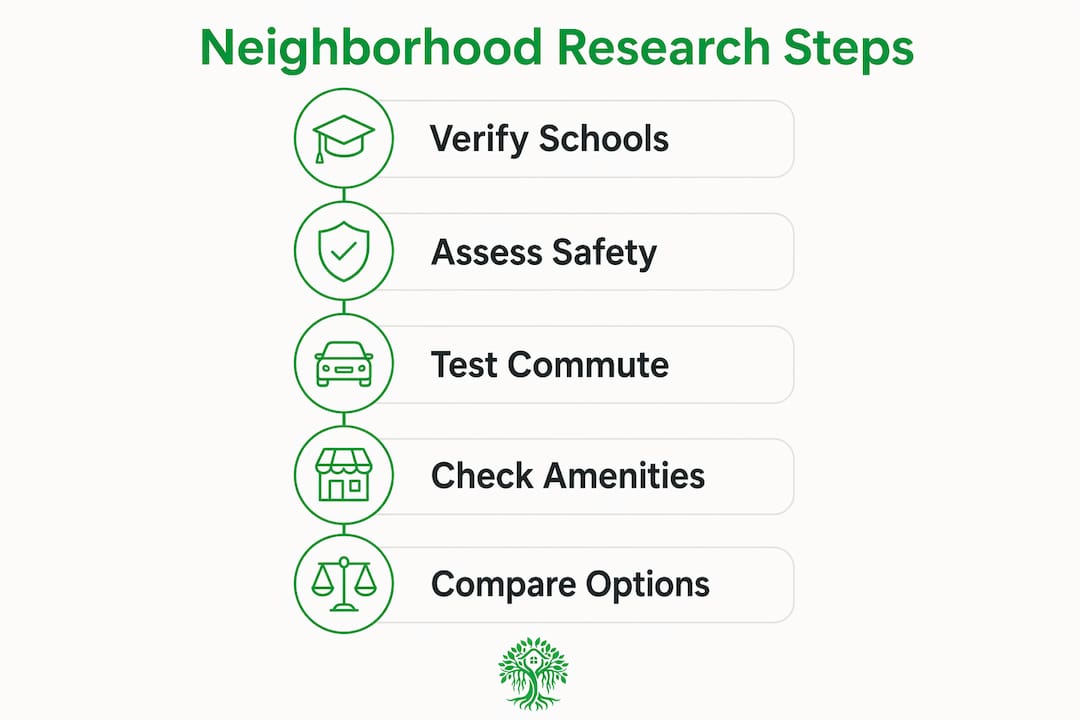
    A structured approach prevents you from missing factors that only surface after you move in. Work through these six steps for every neighborhood you seriously consider.

    1. Confirm school boundaries at the address level. Do not rely on neighborhood-level school ratings. School rating aggregators are useful for initial screening, but boundaries shift and catchment zones are specific. Enter the exact property address into the California Department of Education’s School Finder to confirm which schools serve that home. A house one block outside a sought-after boundary is a fundamentally different purchase than one inside it.

    2. Review crime data across multiple time frames. Pull at least 12 months of incident data from the local police department’s open portal. Look for trends rather than snapshots. Crime maps show patterns and hotspots, but reported incidents also reflect local reporting practices, so cross-reference with community-police meeting notes and neighborhood watch group activity for a balanced read.

    3. Visit the neighborhood at different times and days. A Saturday afternoon visit tells you almost nothing about Tuesday morning traffic or Friday night noise levels. Multiple visits at varied times reveal the real rhythm of a neighborhood. Walk the streets at 7 a.m. on a weekday, return on a weekend evening, and note parking availability, foot traffic, and ambient noise each time.

    4. Assess local amenities with maps and in-person checks. Use Google Maps to identify grocery stores, parks, urgent care clinics, and transit stops within a mile of the property. Then visit them. A park that looks green on a satellite image may be poorly maintained. A transit stop may have a 45-minute headway that makes it impractical for daily use.

    5. Test your commute personally during peak hours. Drive or take transit on a typical workday morning. Apps give estimates; your body gives you the real answer about whether 45 minutes in stop-and-go traffic is something you can sustain five days a week. For California buyers considering the Bay Area housing market, this step is non-negotiable given the region’s notorious congestion.

    6. Talk to current residents. Neighbors share specific insights that no data source captures. Ask about noise, parking, HOA management, and how the neighborhood has changed over the past three years. Most people are willing to talk, especially if you approach them during a weekend visit when they are outside.

    Pro Tip: Bring a printed checklist for each neighborhood visit. Rate each factor on a 1 to 5 scale so you can compare three neighborhoods objectively when you sit down to decide.

    Common mistakes buyers make during neighborhood research

    Most first-time buyer regrets trace back to a handful of avoidable errors. Knowing them in advance puts you ahead of the majority of buyers entering the California market.

    • Trusting headline school ratings without boundary verification. Buyers frequently lack clarity on which schools actually serve a specific address, leading to surprises after closing. A neighborhood may be associated with a top-rated school, but the property you are buying could fall in a different catchment zone entirely.

    • Ignoring zoning changes and nearby land use. Zoning shifts from residential to commercial or multi-family can fundamentally alter a neighborhood’s character within a few years. Check the county planning portal for any pending “Change of Use” permits or rezoning applications near your target address before you make an offer.

    • Running a single commute test at the wrong time. One midday drive does not represent your actual commute. California traffic is notoriously variable, and a route that feels manageable on a Tuesday at noon can add 30 to 40 minutes during peak hours.

    • Skipping nighttime and weekend visits. A neighborhood that feels calm at 2 p.m. on a Wednesday may have a very different character on a Friday night. Noise from nearby bars, weekend market traffic, or late-night parking congestion are factors you will only discover by showing up at those times.

    • Not engaging with HOA members or neighbors. First-time buyers often under-collect contextual information about community dynamics before touring homes. HOA meeting minutes, available on request, reveal recurring disputes, deferred maintenance, and financial health of the association.

    “Digital neighborhood data is a starting point. The best homebuyers combine it with on-the-ground visits and conversations to gain a complete view.” — homeonyourown.com

    How to interpret your research and make a confident decision

    Gathering data is only half the work. Synthesizing it into a clear decision is where most buyers struggle.

    Balancing numbers with what you actually observed

    Quantitative data, including school scores, crime statistics, and walkability indexes, gives you a foundation. Qualitative observations, including what residents told you and what you felt during your visits, fill in what the numbers miss. A neighborhood with a moderate crime index but an active neighborhood watch program and strong community cohesion may feel safer in practice than one with a lower index but no social infrastructure.

    Weight your priorities before you start scoring neighborhoods. If you have school-age children, school boundary confirmation carries more weight than proximity to a farmers market. If you work remotely, commute time matters less than walkability and access to parks. Write your top three priorities down before you begin comparing, and use them as your filter.

    Pro Tip: Build a simple comparison table in Google Sheets with your top three to five neighborhoods as columns and your priority factors as rows. Score each factor from 1 to 5 and total the columns. The numbers will not make the decision for you, but they will clarify which tradeoffs you are actually making.

    Recognizing address-level nuances

    California neighborhoods are rarely uniform. A single zip code in Los Angeles or San Jose can span multiple school districts, noise zones, and flood risk areas. Always research the specific address, not the neighborhood name. Tools that let you search California homes by precise location rather than broad area boundaries give you a much more accurate picture of what you are actually buying into.

    Factor Data Source What to Look For
    School quality CA Dept. of Education School Finder Confirmed assignment for exact address
    Safety Local PD open-data portal 12-month trend, not single-month snapshot
    Commute Google Maps “Depart at” Peak-hour travel time, multiple days
    Community values Nextdoor, HOA minutes Recurring issues, resident engagement level
    Future character County planning portal Pending rezoning or commercial permits

    The goal is not to find a perfect neighborhood. The goal is to find the neighborhood where the tradeoffs match your priorities and your lifestyle. That clarity only comes from combining spatial crime data with qualitative sources and your own direct observation.

    Key takeaways

    Effective neighborhood research for first-time buyers in California requires verifying school boundaries at the address level, testing commute routes during peak hours, and combining data with direct resident conversations to make a confident, well-informed purchase decision.

    Point Details
    Verify school boundaries precisely Use the CA Dept. of Education School Finder for the exact address, not neighborhood averages.
    Test commute during rush hour Drive or transit your route on a real workday morning to get an accurate time estimate.
    Visit at multiple times Return on weekday mornings, weekend evenings, and nights to observe the full neighborhood rhythm.
    Cross-reference safety data Combine police open-data maps with community-police meeting notes for a balanced safety picture.
    Check zoning before you offer Review county planning portals for pending rezoning or commercial permits near your target address.

    What I’ve learned from watching California buyers get this wrong

    By Anand

    After working with hundreds of first-time buyers across California, the pattern I see most often is this: buyers spend weeks comparing listing photos and square footage, then spend about 90 minutes total researching the neighborhood. That imbalance is where regret comes from.

    The buyers who feel best about their purchases a year later are the ones who treated neighborhood research as a separate project from home shopping. They built a shortlist of three to five neighborhoods first, researched each one methodically over two to three weeks, and only then started touring homes within their preferred areas. That sequence matters. When you fall in love with a specific house before you have vetted its neighborhood, your objectivity is compromised.

    The other thing I have noticed is that California buyers often over-index on school ratings from aggregate platforms and under-invest in actually calling the school district to confirm enrollment eligibility for a specific address. I have seen buyers close on a home assuming their child would attend a particular school, only to discover the property sits in a different catchment zone. That is a painful and entirely preventable surprise.

    My honest advice: spend at least as much time researching neighborhoods as you spend touring homes. Visit each finalist neighborhood three times at different hours. Talk to at least two residents. Pull the zoning records. The upfront investment in research protects every dollar you put into the purchase.

    — Anand

    How Ficustree helps you research California neighborhoods faster

    Ficustree is an AI-powered platform built specifically for first-time buyers, and neighborhood research is central to how it works. Instead of bouncing between a school lookup tool, a crime map, a commute app, and a listings site, you get neighborhood-level context layered directly onto your property search.

    https://ficustree.ai

    You can explore California neighborhoods by the factors that matter most to you, whether that is school quality, commute distance, or community character, and see matching listings in the same view. Ficustree’s AI matches your priorities to neighborhoods and homes, so your search starts focused rather than overwhelming. If you are ready to move from research to action, start your search on Ficustree and see how a hyper-personalized approach changes the experience.

    FAQ

    What does neighborhood research for first-time buyers include?

    Neighborhood research covers school boundary verification, safety data review, commute testing, amenity assessment, and community value evaluation. The goal is to confirm that a specific address fits your lifestyle before you commit to a purchase.

    How do I verify school zones in California?

    Use the California Department of Education’s School Finder tool and enter the exact property address. School rating aggregators are useful for screening but should never replace address-level district confirmation.

    How many times should I visit a neighborhood before buying?

    Visit at least three times: once on a weekday morning, once on a weekend afternoon, and once in the evening. Multiple visits at varied times reveal traffic, noise, and community patterns that a single visit will miss.

    What is the biggest mistake first-time buyers make in neighborhood research?

    The most common mistake is relying on neighborhood-level school ratings without confirming the exact school assignment for the specific address. Buyers frequently discover this mismatch only after closing.

    How do I find affordable neighborhoods as a first-time buyer in California?

    Start with the Ficustree California neighborhood search to filter by price range and community factors simultaneously. California’s inland markets, including parts of the Central Valley and Inland Empire, consistently offer more inventory and lower entry prices than coastal metros.


  • How FHA Loans Work for First-Time Buyers in 2026

    How FHA Loans Work for First-Time Buyers in 2026

    An FHA loan is a government-insured mortgage that lets first-time homebuyers qualify for home financing with a down payment as low as 3.5% and a credit score around 580. The Federal Housing Administration does not lend money directly. Instead, it insures private lenders against default, which is exactly why those lenders can offer more flexible terms than a standard conventional loan. If you have been told your credit is not strong enough or your savings are too thin, understanding how FHA loans work for first-time buyers may change that picture entirely.

    What are the FHA loan eligibility requirements for first-time buyers?

    FHA loan guidelines for new buyers center on four main factors: credit score, down payment, debt-to-income ratio, and how you plan to use the property.

    Credit score and down payment tiers

    The FHA sets two clear credit tiers. Borrowers with a credit score of 580 or higher qualify for the 3.5% minimum down payment. Borrowers with scores between 500 and 579 can still qualify, but the required down payment rises to 10%. Individual lenders often set their own minimums above the FHA floor, so a score of 580 may not be enough at every institution. Always confirm the specific lender’s cutoff before you apply.

    Homebuyer checking credit score on laptop at home desk

    Debt-to-income ratio

    FHA guidelines generally allow a debt-to-income ratio up to 43%, and some lenders approve borrowers above that threshold with compensating factors like strong cash reserves. This is notably more flexible than most conventional loan programs, which cap DTI closer to 36% to 45% with stricter conditions. Your total monthly debt payments, including the new mortgage, are divided by your gross monthly income to produce this number.

    Owner-occupancy and income requirements

    The FHA requires the home to be your primary residence. You cannot use an FHA loan to buy a vacation property or a rental investment. Lenders will also verify steady employment and consistent income through pay stubs, W-2s, and tax returns, typically covering the past two years.

    Pro Tip: If your credit score sits between 560 and 579, spending three to six months paying down revolving balances could push you above 580 and cut your required down payment by more than half.

    How do mortgage insurance premiums affect FHA loans?

    Mortgage insurance is the trade-off for FHA’s flexible entry requirements, and it affects your monthly payment more than most first-time buyers expect.

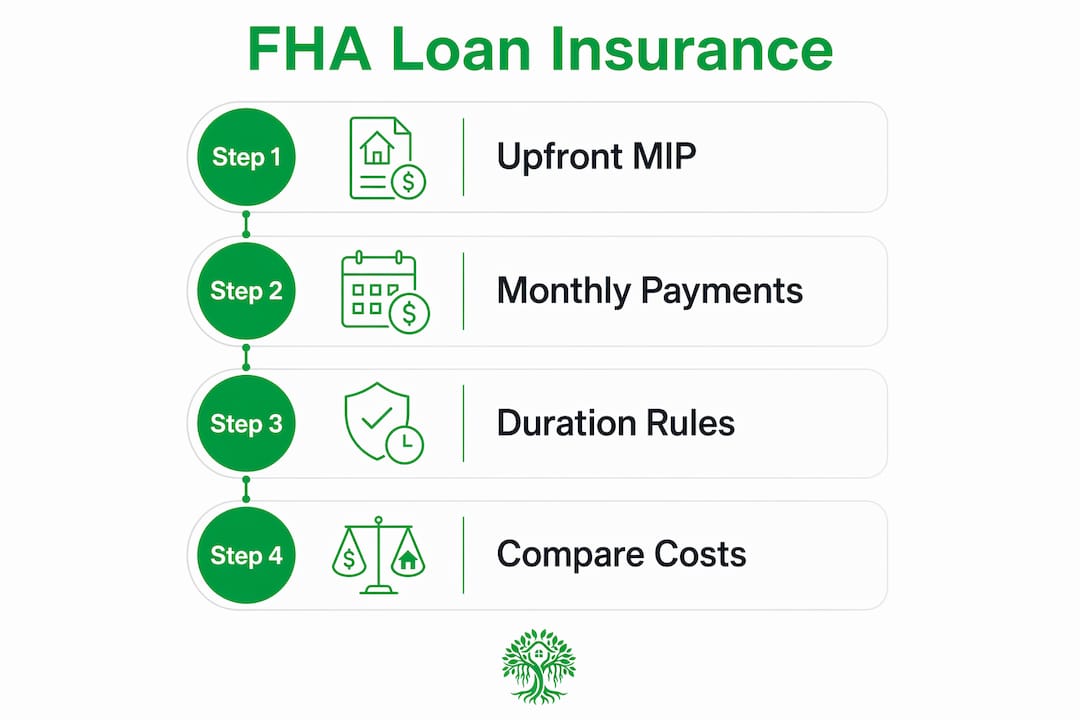
    Every FHA loan carries an upfront mortgage insurance premium of 1.75% of the loan amount, which is typically rolled into the loan balance rather than paid at closing. On a $300,000 loan, that adds $5,250 to what you owe from day one. Beyond that, you pay an annual MIP ranging from 0.40% to 0.85% of the loan balance, divided across your monthly payments.

    Infographic illustrating FHA loan mortgage insurance steps

    The duration of MIP is where FHA loans diverge sharply from conventional mortgages. If your down payment is under 10%, MIP lasts for the life of the loan. Put down 10% or more, and MIP cancels after approximately 11 years. Conventional loans with private mortgage insurance (PMI) automatically cancel once you reach 20% equity, which can make conventional financing cheaper over a long horizon even if the entry bar is higher.

    Feature FHA loan Conventional loan
    Upfront insurance cost 1.75% of loan amount None
    Annual insurance rate 0.40% to 0.85% 0.20% to 1.50% (varies)
    Insurance cancellation Life of loan (under 10% down) At 20% equity automatically
    Minimum credit score ~500 to 580 Typically 620+
    Minimum down payment 3.5% 3% to 5% (varies by program)

    The total monthly payment on an FHA loan includes principal, interest, MIP, property taxes, and homeowner’s insurance. Focusing only on the down payment misses the real affordability picture. Use a mortgage calculator with taxes and insurance to model the full monthly cost before you commit.

    Pro Tip: If you plan to stay in the home long-term, run a side-by-side comparison of FHA vs. conventional total costs over seven years using the payment differences between both loan types. The lower FHA entry cost sometimes loses to conventional savings on insurance over time.

    What is the FHA loan application and home buying process?

    The first-time homebuyer FHA loan process follows a clear sequence. Knowing each step in advance prevents surprises that delay closing.

    1. Find an FHA-approved lender. Not every bank or mortgage company participates in the FHA program. The U.S. Department of Housing and Urban Development (HUD) maintains a searchable lender list. Compare at least three Loan Estimates, focusing on the APR and total monthly payment rather than just the interest rate.

    2. Get pre-approved. Submit your income documents, bank statements, tax returns, and authorization for a credit pull. Pre-approval tells you exactly how much you can borrow and signals to sellers that you are a serious buyer.

    3. Make an offer and open escrow. Once a seller accepts your offer, the transaction moves into escrow and your lender orders an FHA appraisal.

    4. Pass the FHA appraisal. This is the step that surprises most first-time buyers. The FHA appraisal checks both market value and HUD Minimum Property Requirements (MPRs). Common issues that trigger required repairs include electrical hazards, roof damage, missing handrails, and structural problems. The home must meet safety, security, and soundness standards before the loan can close.

    5. Complete underwriting. Your lender reviews all documents, verifies the source of your down payment, and confirms the property meets FHA standards. If your down payment includes gift funds or down payment assistance, proper documentation such as a gift letter and bank transfer records is mandatory. Missing paperwork at this stage is one of the most common causes of closing delays.

    6. Close on the home. Once underwriting issues a clear-to-close, you sign final documents, pay closing costs, and receive the keys.

    Pro Tip: Ask your real estate agent to include an FHA repair addendum in your offer. This gives you and the seller a clear framework for handling appraisal-required repairs without renegotiating the entire contract.

    The full process from pre-approval to closing typically runs 30 to 60 days. FHA appraisal repairs can extend that timeline, so build in buffer time if you have a firm move-in date. For a broader look at every step involved, the first-time homebuyer guide from Ficustree walks through the full process in plain language.

    Are FHA loans only for first-time buyers?

    This is one of the most persistent myths in residential lending. FHA loans are not limited to first-time buyers. They are heavily marketed to first-time buyers because the low down payment and flexible credit requirements align with where many new buyers start financially. Eligibility, however, is based entirely on your financial profile and the property you are buying, not on whether you have owned a home before.

    A repeat buyer who sold their previous home, has a credit score of 600, and wants to put down 3.5% on a new primary residence qualifies for an FHA loan. The key restrictions are:

    • The property must be your primary residence, not a second home or investment property.
    • You must meet the credit, income, and DTI requirements at the time of application.
    • The property must meet HUD’s Minimum Property Requirements.
    • You generally cannot carry two FHA loans simultaneously unless specific exceptions apply, such as relocating for work.

    Understanding this distinction matters if you are planning a repeat purchase or transitioning from renting to owning after a period of homeownership. The FHA program rewards financial readiness, not first-time status.

    What are the most important tips for first-time FHA loan borrowers?

    Knowing the rules is one thing. Applying them to your specific situation is where most buyers need practical guidance.

    • Document every dollar of your down payment. Whether your funds come from savings, a family gift, or a state down payment assistance program, your lender needs a paper trail. Gift funds require a gift letter and bank records showing the transfer. Down payment assistance programs require their own documentation package. Start gathering this early.

    • Factor MIP into your budget from day one. FHA loans carry higher monthly costs than conventional loans due to ongoing mortgage insurance. Use the home affordability calculator at Ficustree to model your real monthly payment including MIP, taxes, and insurance before you set your price range.

    • Compare multiple lenders. FHA sets the floor on rates and requirements, but lenders set their own pricing above that floor. Two lenders offering the same FHA loan can have meaningfully different APRs. Request Loan Estimates from at least three lenders and compare them line by line.

    • Negotiate repair costs with the seller. If the FHA appraisal flags required repairs, you have options. You can ask the seller to complete the repairs before closing, request a price reduction to cover your repair costs, or in some cases use an FHA 203(k) rehabilitation loan to finance repairs into the mortgage.

    • Plan your refinance exit. If you put down less than 10%, MIP stays with your loan permanently unless you refinance into a conventional mortgage after building equity. Many buyers refinance once they reach 20% equity to eliminate the insurance cost entirely. Build this into your long-term financial plan from the start.

    Pro Tip: Check your state’s housing finance agency website before you apply. Most states offer down payment assistance programs specifically for FHA borrowers that can cover part or all of the 3.5% requirement. Many buyers leave this money on the table simply because they did not know to look.

    For a full picture of what homeownership actually costs beyond the mortgage, the true cost of homeownership breakdown from Ficustree is worth reading before you finalize your budget.

    Key takeaways

    FHA loans give first-time buyers access to affordable mortgages by trading flexible entry requirements for mandatory mortgage insurance that can last the life of the loan.

    Point Details
    Government insurance enables access FHA insures lenders against default, allowing lower credit and down payment thresholds than conventional loans.
    Two credit tiers determine your down payment A score of 580 or higher means 3.5% down; scores from 500 to 579 require 10% down.
    MIP adds real monthly cost Upfront MIP of 1.75% plus annual premiums of 0.40% to 0.85% increase your total payment significantly.
    Appraisal standards can affect closing FHA appraisals check HUD safety and soundness requirements; required repairs can delay your timeline.
    FHA is not exclusive to first-time buyers Any qualified borrower buying a primary residence can use an FHA loan, regardless of prior ownership history.

    Why FHA loans still make sense in 2026, even with the MIP trade-off

    By Anand

    After working with hundreds of first-time buyers, the single biggest misconception I see is that FHA loans are a consolation prize for buyers who cannot qualify for anything better. That framing is wrong, and it costs people money.

    FHA’s government backing is a genuine structural advantage. It opens the door to homeownership years earlier than waiting to save a 20% conventional down payment would allow. For buyers in markets where rents are rising faster than savings can accumulate, that time advantage is real and measurable.

    That said, two things consistently catch buyers off guard. First, the MIP duration. Most buyers assume mortgage insurance works like PMI on a conventional loan and cancels automatically at 20% equity. It does not on FHA loans with under 10% down. I have seen buyers five years into a loan still paying MIP they thought would be gone by year three. Know this going in, and plan your refinance timeline accordingly.

    Second, the appraisal repair requirement. FHA appraisers are not just valuing the property. They are inspecting it against HUD’s safety and soundness standards. A seller who has deferred maintenance on the roof or electrical panel may not be willing to fix it before closing. This is where having a knowledgeable FHA lender and a buyer’s agent who has closed FHA deals before makes a real difference. They know how to structure the repair negotiation without blowing up the deal.

    My honest advice: use FHA to get in, build equity, then refinance to conventional when you hit 20%. That sequence works. What does not work is treating FHA as a permanent mortgage without a plan to exit the MIP.

    — Anand

    How Ficustree helps you navigate FHA home buying

    https://ficustree.ai

    Ficustree is an AI-powered platform built specifically for first-time buyers, and it covers the full path from home search to closing in one place. When you are comparing FHA loan options, Ficustree matches you with lenders, helps you model total monthly costs including MIP, and guides you through every document and decision point along the way. You do not need to piece together advice from a dozen different websites. The platform gives you a personalized experience that adapts to your credit profile, budget, and timeline. Explore what Ficustree can do for your FHA home search and see how much clearer the process gets when everything is in one place. Learn more about the platform at ficustree.ai.

    FAQ

    What credit score do I need for an FHA loan?

    You need a minimum credit score of 580 to qualify for the 3.5% down payment option, or a score between 500 and 579 with a 10% down payment. Individual lenders may set higher minimums, so confirm requirements directly with your lender.

    How long does FHA mortgage insurance last?

    If your down payment is under 10%, FHA mortgage insurance lasts for the life of the loan. A down payment of 10% or more reduces MIP to approximately 11 years. Refinancing into a conventional loan after reaching 20% equity is the most common way to eliminate it early.

    Can I use gift money for my FHA down payment?

    Yes. FHA allows gift funds from family members and down payment assistance programs, but your lender requires a gift letter and documentation of the bank transfer. Missing paperwork is one of the most common causes of underwriting delays.

    What does an FHA appraisal check?

    An FHA appraisal evaluates both the market value of the home and HUD’s Minimum Property Requirements covering safety, security, and soundness. Common issues that require repair before closing include electrical hazards and roof damage, as well as structural problems.

    Are FHA loans only available to first-time buyers?

    No. FHA loans are available to any qualified borrower purchasing a primary residence, including repeat buyers who qualify. The program is popular with first-time buyers because of its flexible requirements, but ownership history is not part of the eligibility criteria. For more on FHA eligibility details, the FHA loan FAQs resource covers credit, down payment, and qualification questions in depth.

  • First-Time Homebuyer Mistakes California Buyers Must Avoid

    First-Time Homebuyer Mistakes California Buyers Must Avoid

    First-time homebuyer mistakes in California are defined as preventable errors in contract management, financing, and budgeting that cost buyers thousands of dollars or their dream home entirely. California’s real estate market operates under state-specific rules, including the California Residential Purchase Agreement, CalHFA down payment assistance programs, and mandatory Loan Estimate disclosures, that create unique traps for unprepared buyers. Miss a contingency deadline and you forfeit your earnest money deposit. Underestimate closing costs and you arrive at the table short on cash. This guide covers the most common first home buying mistakes so you can close with confidence, not regret.

    1. Mismanaging contingency deadlines in California

    Contingency management is the single most misunderstood area for first-time buyers in California, and the financial consequences are severe. The California Residential Purchase Agreement sets specific deadlines for inspection, appraisal, and loan contingencies, and missing them does not just delay your purchase. It can cost you your deposit.

    Here is what each contingency covers and when it typically expires:

    • Inspection contingency: You must complete your home inspection and submit a written removal form, typically by day 17 after acceptance. Completing the inspection is not the same as removing the contingency in writing.
    • Appraisal contingency: Protects you if the home appraises below the purchase price. Removal deadlines usually align with or follow the inspection window.
    • Loan contingency: Gives you an exit if your financing falls through. This typically expires around day 21, though your contract may vary.

    The critical trap here is assuming that doing the inspection automatically satisfies the contingency. It does not. Contingency removal requires a signed form submitted to escrow before the deadline. Buyers who skip this step can find themselves in default, with sellers legally entitled to cancel the contract and keep the deposit.

    California also requires sellers to deliver disclosures like the Transfer Disclosure Statement (TDS) and Natural Hazard Disclosure (NHD) early in the transaction. Late disclosure delivery actually gives you the right to cancel or extend your contingency period, but only if you know to exercise that right.

    Checklist with contingency deadlines and home disclosure

    One more risk that surprises buyers: wire fraud. California Civil Code Section 1057.3 requires you to independently verify escrow wiring instructions by phone before sending any funds. Never wire money based solely on an email, even one that looks official.

    Pro Tip: Set calendar reminders for every contingency deadline the day you open escrow. Confirm with your escrow officer in writing that each removal form was received.

    2. Underestimating cash needed to close

    Most first-time buyers budget for the down payment and nothing else. That is a costly mistake in California’s high-price market. Closing costs in California average 3% to 6% of the loan amount and can exceed $17,581 depending on the purchase price. On a $700,000 home, that means you could owe an additional $21,000 to $42,000 at closing beyond your down payment.

    California closing costs typically include:

    1. Lender fees: Origination charges, underwriting fees, and discount points
    2. Title and escrow fees: Title insurance, escrow service charges, and notary costs
    3. Prepaid items: Homeowners insurance premium, prepaid interest, and property tax reserves
    4. HOA fees: Transfer fees and any prorated dues if the property has a homeowners association
    5. Government fees: County recording fees and transfer taxes

    A mistake many buyers make is comparing lenders only by interest rate. Full loan cost comparison including fees, points, and total cash to close is what actually determines which lender saves you money. Two lenders offering the same rate can differ by thousands in fees.

    To reduce your cash-to-close burden, ask about seller concessions during negotiation. In a balanced or buyer-friendly market, sellers will sometimes credit you a portion of closing costs. CalHFA programs also offer down payment and closing cost assistance for qualifying first-time buyers, which can meaningfully reduce what you need to bring to the table.

    Pro Tip: Request a Loan Estimate from at least three lenders and compare the “Closing Cost Details” section line by line, not just the interest rate.

    3. Shopping for homes without a pre-approval

    Pre-approval and pre-qualification are not the same thing, and confusing them is one of the most common first-time buyer pitfalls in California’s competitive market. Pre-qualification is an informal estimate based on self-reported income and assets. Pre-approval is a verified commitment from a lender based on your actual credit report, tax returns, pay stubs, and bank statements.

    Lacking pre-approval weakens your offer significantly. California sellers, especially in markets like the Bay Area, Los Angeles, and San Diego, routinely receive multiple offers. A pre-qualified buyer looks uncertain next to a pre-approved buyer. In many cases, listing agents will advise their sellers to reject or deprioritize offers without a pre-approval letter.

    What pre-approval requires from you:

    • Two years of W-2s or tax returns (three years if self-employed)
    • Recent pay stubs covering the last 30 days
    • Two to three months of bank and investment account statements
    • A hard credit pull, which temporarily affects your score by a few points
    • Explanation letters for any large deposits or credit inquiries

    Pro Tip: If you are exploring CalHFA or other assistance programs, confirm your lender is an approved CalHFA lender before starting the pre-approval process. Not every lender participates, and switching mid-process delays your timeline.

    4. Assuming you need 20% down

    The 20% down payment requirement is a myth that stops many first-time buyers from even starting their search. FHA loans and other programs allow significantly smaller down payments, and California has several state-specific options that make homeownership accessible at lower entry points.

    Your actual options as a California first-time buyer include:

    • FHA loans: 3.5% down with a credit score of 580 or higher; 10% down with scores between 500 and 579
    • Conventional 97 loans: 3% down for qualifying borrowers through Fannie Mae or Freddie Mac programs
    • CalHFA MyHome Assistance Program: Provides a deferred-payment junior loan to cover down payment or closing costs
    • VA loans: 0% down for eligible veterans and active-duty service members
    • USDA loans: 0% down for properties in designated rural areas of California

    The trade-off with smaller down payments is mortgage insurance. FHA loans require both an upfront mortgage insurance premium and an annual premium. Conventional loans with less than 20% down require private mortgage insurance (PMI), which cancels once you reach 20% equity. Understanding these costs upfront prevents sticker shock on your monthly payment.

    Your credit score and debt-to-income ratio determine which programs you qualify for, so reviewing both before you apply gives you a clearer picture of your real options.

    5. Ignoring the full monthly housing cost

    Budgeting only for principal and interest is one of the most persistent common homebuyer errors in California. True monthly housing costs include property taxes, homeowners insurance, mortgage insurance, HOA dues, and sometimes special assessments. In California, these additions can push your actual monthly payment 30% to 50% above the mortgage payment alone.

    Cost component What to expect in California
    Property taxes Roughly 1.1% to 1.25% of assessed value annually under Proposition 13
    Homeowners insurance Rising sharply due to wildfire risk; some insurers have exited the state entirely
    HOA dues Range from $200 to over $1,000 per month depending on community
    Special assessments One-time charges for major repairs or improvements in HOA communities
    Mortgage insurance Required on FHA loans and conventional loans with less than 20% down

    California’s wildfire insurance crisis deserves specific attention. Insurers including State Farm and Allstate have paused or restricted new policies in high-risk ZIP codes. Before making an offer, verify that the property is insurable and get an actual insurance quote, not an estimate. Some buyers have closed on homes only to discover their insurance costs were two to three times what they expected.

    Use a mortgage payment calculator that includes taxes and insurance to model your real monthly obligation before you fall in love with a listing.

    Pro Tip: Ask the listing agent for the current HOA budget and reserve study. A low HOA fee backed by an underfunded reserve often means a special assessment is coming.

    6. Skipping a thorough review of seller disclosures

    California requires sellers to provide more disclosures than almost any other state, and first-time buyers often skim them or skip them entirely. That is a serious mistake. The Transfer Disclosure Statement, Natural Hazard Disclosure, and supplemental disclosures cover everything from past water damage and unpermitted additions to flood zones and seismic hazards.

    Early receipt and review of seller disclosures protects your right to cancel or renegotiate before contingency deadlines expire. If disclosures arrive late, California law gives you the right to extend your contingency period or cancel without penalty. But you can only exercise that right if you know it exists and act within the proper timeframe.

    Read the full California buyer disclosure guide before you open escrow. Pay particular attention to any items the seller marks as “unknown” rather than “no.” Unknown responses on a TDS often signal issues the seller suspects but cannot confirm, and those are worth investigating further during your inspection period.

    Key takeaways

    Avoiding first-time homebuyer mistakes in California requires mastering contingency deadlines, budgeting for full closing costs, securing pre-approval before you search, and understanding every component of your monthly payment.

    Point Details
    Contingency deadlines are binding Submit signed removal forms before each deadline or risk losing your deposit.
    Closing costs exceed expectations Budget 3% to 6% of the loan amount on top of your down payment in California.
    Pre-approval beats pre-qualification Only a verified pre-approval letter strengthens your offer in competitive markets.
    20% down is not required FHA, CalHFA, and conventional programs allow 3% to 3.5% down for qualified buyers.
    Full monthly costs matter Factor in property taxes, insurance, HOA dues, and PMI before committing to a price.

    What I’ve learned watching buyers navigate California real estate

    I have seen buyers lose $15,000 deposits not because they were careless, but because nobody told them that completing an inspection and removing an inspection contingency are two completely different actions. California’s purchase agreement is detailed and unforgiving, and the pressure to compete in a fast-moving market pushes buyers to waive protections they do not fully understand.

    The 20% down myth is equally damaging. I have watched qualified buyers sit on the sidelines for years, saving toward a threshold they did not need to hit, while home prices moved further out of reach. CalHFA and FHA programs exist precisely for this situation, and most buyers I talk to have never heard of them until they are already deep into the process.

    My honest advice: treat your contingency calendar like a legal obligation, because it is one. Get your full Loan Estimate before you commit to a lender, not after. And before you make an offer on any property, get an actual insurance quote for that specific address. In California’s current insurance market, that single step can save you from a very expensive surprise.

    The buyers who close successfully are not the ones with the most money. They are the ones who asked the right questions early and had a clear picture of what they were signing. Use the first-time homebuyer guide from Ficustree to build that foundation before you start touring homes.

    — Anand

    How Ficustree helps you avoid these mistakes from day one

    Ficustree is an AI-powered real estate platform built specifically for first-time California homebuyers. It guides you from your first search to closing on a single platform, with tools designed to prevent the exact mistakes covered in this article.

    https://ficustree.ai

    Use Ficustree’s home affordability calculator to model your true monthly payment including taxes, insurance, and HOA dues before you fall for a listing. The platform surfaces CalHFA-approved lenders, flags contingency deadlines, and connects you with educational resources on every step of the California purchase process. Whether you are trying to understand closing costs or figure out how much you actually need to bring to the table, Ficustree gives you the clarity to move forward with confidence. Start your search and see how much easier buying your first home can be.

    FAQ

    What are the most common first-time homebuyer mistakes in California?

    The most common mistakes include missing contingency removal deadlines, underestimating closing costs, shopping without a pre-approval letter, assuming a 20% down payment is required, and failing to budget for property taxes, insurance, and HOA dues.

    How much should I budget for closing costs in California?

    Closing costs in California average 3% to 6% of the loan amount, which can exceed $17,581 on higher-priced homes. Budget for this separately from your down payment.

    What happens if I miss a contingency deadline in California?

    Missing a contingency deadline without submitting a signed removal form can put you in default under the California Residential Purchase Agreement. The seller may have the right to cancel the contract and keep your earnest money deposit.

    Do I need 20% down to buy a home in California?

    No. FHA loans require as little as 3.5% down, and CalHFA programs offer additional assistance for qualifying first-time buyers. Conventional loan programs through Fannie Mae and Freddie Mac also allow 3% down.

    Why is pre-approval more important than pre-qualification in California?

    Pre-approval is based on verified financial documents and a hard credit check, which makes your offer credible to sellers. Pre-qualification is an informal estimate that carries little weight in California’s competitive markets where sellers routinely compare multiple offers.

    Article generated by BabyLoveGrowth

  • Why Title Search Matters When Buying a Home

    Why Title Search Matters When Buying a Home

    A title search is a detailed examination of public records confirming the legal ownership and any existing claims on a property, giving buyers proof they will receive clear title free of liens or disputes. For first-time homebuyers in California, understanding why title search matters when buying a home is the difference between a clean closing and a legal nightmare that can surface months or years after you move in. Nearly 35% of real estate transactions encounter title-related issues before closing. That number means your deal has a one-in-three chance of hitting a problem that could delay or kill the sale. Knowing what a title search does, how it works in California, and how it pairs with title insurance puts you in control from day one.

    Why title search matters when buying a home

    A title search confirms the seller’s legal right to sell and reveals any liens, unpaid taxes, easements, or ownership disputes attached to the property. Think of it as a background check on the home itself, not just the seller. Without it, you could close on a house only to discover a contractor placed a lien on it two years ago for unpaid work, and that debt is now yours to resolve.

    Close-up hands examining title search report

    The industry term for what you are verifying is a marketable title. A marketable title is one free from reasonable doubt or adverse claims, and uncovering issues before closing avoids costly post-sale litigation. California’s real estate market moves fast, and escrow periods can be as short as 21 days in competitive areas like the Bay Area or Los Angeles. That compressed timeline makes early title review non-negotiable.

    Your lender will almost always require a title search before approving your mortgage. But the importance of title search goes beyond satisfying the bank. It protects your equity, your ownership rights, and your ability to sell or refinance the home in the future.

    How does a title search work in California home purchases?

    Title searches in California are conducted by licensed title companies such as Fidelity National Title, First American Title, or Old Republic Title. These companies work alongside escrow agents to review public records before your closing date. The process follows a clear sequence.

    1. Order the search. Your escrow officer or real estate agent orders the title search shortly after your offer is accepted. In California, this typically happens within the first few days of opening escrow.
    2. Public records review. The title examiner searches county recorder records, court judgments, tax records, and federal and state tax liens. They look at every deed, mortgage, and legal action tied to the property’s chain of ownership.
    3. Preliminary title report. The title company issues a preliminary report listing all findings. Your escrow officer reviews this with you and flags any items that need to be resolved before closing.
    4. Clearing exceptions. If the report shows an old lien or an unresolved easement, the seller must address it before the transaction can proceed. This step is where deals can slow down.
    5. Title insurance issued. Once the title is cleared, the title company issues insurance policies at closing.

    In 2026, a standard title search costs between $75 and $300 and takes anywhere from a few days to two weeks. That timeline matters because a delayed search can push your closing date past your mortgage rate lock, potentially costing you thousands in higher interest. Digital title search platforms can reduce search time from days to minutes by cross-referencing multiple records simultaneously, cutting the risk of delays that threaten your rate lock.

    Pro Tip: Ask your escrow officer on day one whether they use a digital title search platform. If they rely on manual county records, factor in extra buffer time before your rate lock expires.

    Infographic comparing title search and title insurance

    What common issues can title searches uncover?

    Title defects range from minor paperwork errors to serious ownership disputes. Each one has the potential to cloud your ownership rights if left unresolved. Here are the most common problems a title search surfaces:

    • Unpaid liens. Contractors, subcontractors, or suppliers who were never paid can file mechanic’s liens against a property. The average lien discovered during a title search is valued at $4,900. That is a debt you would inherit at closing if the search missed it.
    • Unpaid property taxes. Delinquent tax bills attach to the property, not the owner. California counties can initiate tax default proceedings if taxes go unpaid long enough, putting your ownership at risk.
    • Easements and deed restrictions. A neighbor may have a legal right to cross your property, or a deed restriction from 1952 may prohibit adding a second unit. These do not block the sale but directly affect how you can use the land.
    • Ownership disputes. Divorces, probate cases, and family disagreements can leave competing claims on a property. If a deceased prior owner’s heir was never properly bought out, that heir may have a legal claim to your home.
    • Forged or fraudulent documents. Deed fraud is a real and growing problem. A forged deed in the chain of title can invalidate the seller’s ownership entirely.
    • Judgment liens. If a prior owner lost a lawsuit and never paid the judgment, that creditor may have filed a lien against the property.

    “Title problems often arise from decades-old issues like unpaid taxes or disputed heirs attached to the property, not the seller, becoming the buyer’s responsibility if unresolved.” — Rocket Mortgage

    The consequences of missing these issues are severe. You could face a lawsuit from an unknown heir, lose the ability to refinance because the title is clouded, or spend tens of thousands in legal fees clearing a lien you did not know existed. Reviewing your California buyer disclosures alongside the preliminary title report gives you the fullest picture of what you are actually buying.

    Title search vs. title insurance: how they complement each other

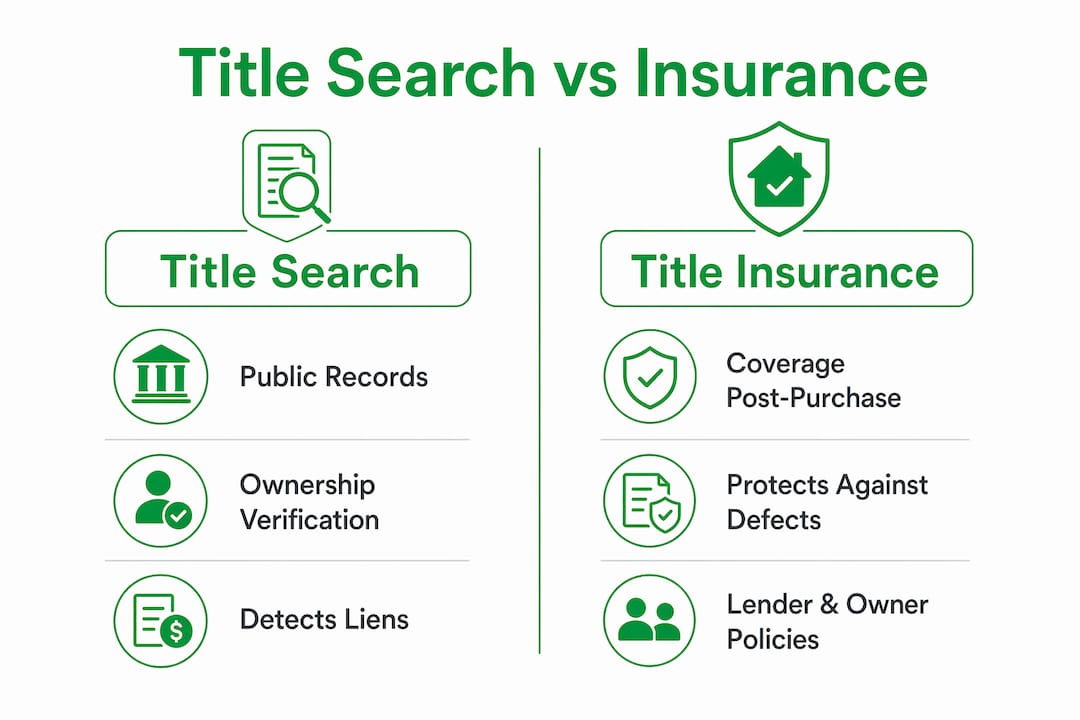
    A title search and title insurance are not the same thing, and you need both. The search looks backward through history to find known problems. Title insurance protects you forward against problems the search may have missed.

    Feature Title search Title insurance
    What it does Reviews public records for existing claims Covers losses from defects not found in the search
    When it happens Before closing Purchased at closing
    Duration of protection One-time review Lifetime of ownership (owner’s policy)
    Cost $75 to $300 0.4% to 0.7% of purchase price
    Who it protects Informs buyer and lender Buyer (owner’s policy) or lender (lender’s policy)

    Title insurance protects buyers from ownership defects discovered after purchase, such as forged deeds or undisclosed heirs that the search may have missed. The owner’s policy is a one-time fee paid at closing and remains effective for as long as you or your heirs own the home. That is a significant benefit for a relatively modest cost.

    Lender’s title insurance protects only the lender. Your mortgage lender will require their own policy, but that policy covers the bank’s investment, not yours. If a title defect surfaces after closing, the lender’s policy pays the bank. You are left to fight the legal battle on your own without an owner’s policy. This distinction is one of the most misunderstood aspects of the home buying process, and it catches first-time buyers off guard regularly.

    Pro Tip: In California, the seller traditionally pays for the owner’s title insurance policy in many counties, but this is negotiable. Confirm who pays during your offer negotiations so there are no surprises at closing.

    The true cost of homeownership includes title insurance as a line item you should plan for. On a $700,000 home in California, an owner’s policy runs roughly $2,800 to $4,900. That is a small price compared to the cost of defending your ownership in court.

    Practical tips for California first-time homebuyers on title searches

    Knowing the process is one thing. Executing it well under the pressure of a live transaction is another. These steps will help you stay ahead of title issues from offer to close.

    1. Order the search immediately after acceptance. Do not wait for your lender to prompt you. Ask your real estate agent or escrow officer to initiate the title search the same day your offer is accepted.
    2. Read the preliminary title report carefully. This document lists every exception to clear title. Ask your escrow officer to walk you through each item in plain language.
    3. Verify the chain of title goes back at least 40 years. California courts generally require a 40-year search to establish marketable title. Confirm your title company meets this standard.
    4. Ask specifically about easements. Easements in California can affect your ability to build an ADU (accessory dwelling unit), add a fence, or expand the home. These are legal and binding even if the seller was unaware of them.
    5. Do not skip the owner’s title insurance policy. Even if your lender does not require it, purchase an owner’s policy. Skipping title searches or insurance can mean inheriting unpaid taxes, liens, or competing ownership claims with no recourse.

    If the preliminary report reveals a problem, here is what to do:

    • Request that the seller resolve the issue before closing. Most purchase contracts in California require the seller to deliver clear title.
    • Ask your escrow officer for a timeline. Clearing a lien or resolving a probate issue can take days or weeks.
    • Consult a real estate attorney if the issue involves a disputed ownership claim or a forged document.
    • Use a first-time homebuyer guide to understand how title issues fit into the broader closing timeline.

    Cash buyers face a specific risk worth calling out. Buyers using cash or owner financing may skip the title search entirely because no lender is requiring it. This is one of the costliest mistakes a buyer can make. Without a lender’s requirement as a safety net, the responsibility to order the search falls entirely on you.

    Key takeaways

    A title search is the single most important due diligence step in a California home purchase because it verifies legal ownership and surfaces liens, disputes, and defects that become the buyer’s problem at closing.

    Point Details
    Title search is non-negotiable It confirms the seller’s legal right to sell and protects your ownership from day one.
    California searches follow a clear process Escrow opens, public records are reviewed, a preliminary report is issued, and exceptions must be cleared before closing.
    Common defects include liens and disputes The average lien found is $4,900; ownership disputes and forged deeds can invalidate your purchase entirely.
    Owner’s title insurance fills the gaps The search finds known issues; the owner’s policy covers defects the search missed, for the life of your ownership.
    Cash buyers must self-initiate Without a lender requirement, cash buyers must order the search themselves or accept all historical risks.

    Why I think most first-time buyers underestimate title risk

    Most buyers I have seen go through the process treat the title search as a formality, something the escrow officer handles in the background while they focus on inspections and loan approvals. That mindset is a mistake.

    The cases that stick with me are the ones involving decades-old problems. A buyer in the East Bay purchased a home only to discover a mechanic’s lien from a remodel done 11 years prior. The contractor had gone out of business, but the lien was still valid and recorded. The seller had no idea it existed. Clearing it added three weeks to the closing timeline and nearly blew up the rate lock.

    Technology is genuinely changing this. Digital title platforms that cross-reference county records, court judgments, and tax databases in minutes are reducing the window for human error. But the technology only helps if your escrow team is using it. Ask the question directly.

    My honest advice: treat the preliminary title report like a home inspection report. Read every line. Ask about every exception. Do not assume your escrow officer will flag everything that matters to you personally, because their job is to clear the title for closing, not to advise you on how an easement affects your renovation plans.

    The cost of an owner’s title insurance policy is one of the best dollars you will spend in the entire transaction. The search finds what is known. The insurance covers what is not.

    — Anand

    Start your home search with title clarity built in

    https://ficustree.ai

    Ficustree is an AI-powered platform built specifically for first-time homebuyers in California, guiding you from your first search through closing on a single platform. When you find a property you love, Ficustree surfaces key property data and flags potential title-related considerations so you walk into escrow informed, not surprised. You get hyper-personalized guidance at every step, including help understanding what your preliminary title report means and what questions to ask your escrow officer. Start your search with confidence at ficustree.ai and let the platform do the heavy lifting so you can focus on finding your dream home.

    FAQ

    What is a title search when buying a home?

    A title search is a review of public records, including deeds, court judgments, tax records, and liens, to confirm the seller legally owns the property and that no claims exist that could affect the buyer’s ownership.

    How long does a title search take in California?

    A standard title search takes a few days to two weeks, though digital platforms can complete the process in minutes. Delays in the search can push your closing date past your mortgage rate lock.

    Do I need title insurance if a title search was already done?

    Yes. A title search finds known issues in public records, but title insurance covers defects that the search missed, such as forged deeds or undisclosed heirs. The owner’s policy protects you for the entire time you own the home.

    What happens if a title search finds a problem?

    Your escrow officer will list the issue as an exception on the preliminary title report. In California, the seller is typically required to resolve title defects before closing. If the issue is complex, a real estate attorney should be consulted.

    Can I skip the title search if I am paying cash?

    You can, but it is a serious risk. Cash buyers who skip the title search accept all historical claims on the property, including unpaid taxes, liens, and competing ownership disputes, with no lender requirement to catch them.

    Article generated by BabyLoveGrowth

  • Escrow Process for First-Time Buyers: California Guide

    Escrow Process for First-Time Buyers: California Guide

    Escrow is defined as a neutral third-party arrangement where a licensed escrow officer holds your funds, documents, and deed until every condition of your purchase contract is satisfied. For first-time buyers in California, understanding the escrow process is the difference between a confident closing and a stressful scramble. This guide walks you through every step, clarifies who does what, and prepares you for the surprises most buyers never see coming, including escrow shortages and fluctuating monthly payments.

    How does the escrow process work step by step for first-time buyers?

    The escrow process for first-time buyers in California follows a clear sequence once your offer is accepted. Knowing each phase in advance removes the anxiety of waiting for news you don’t understand.

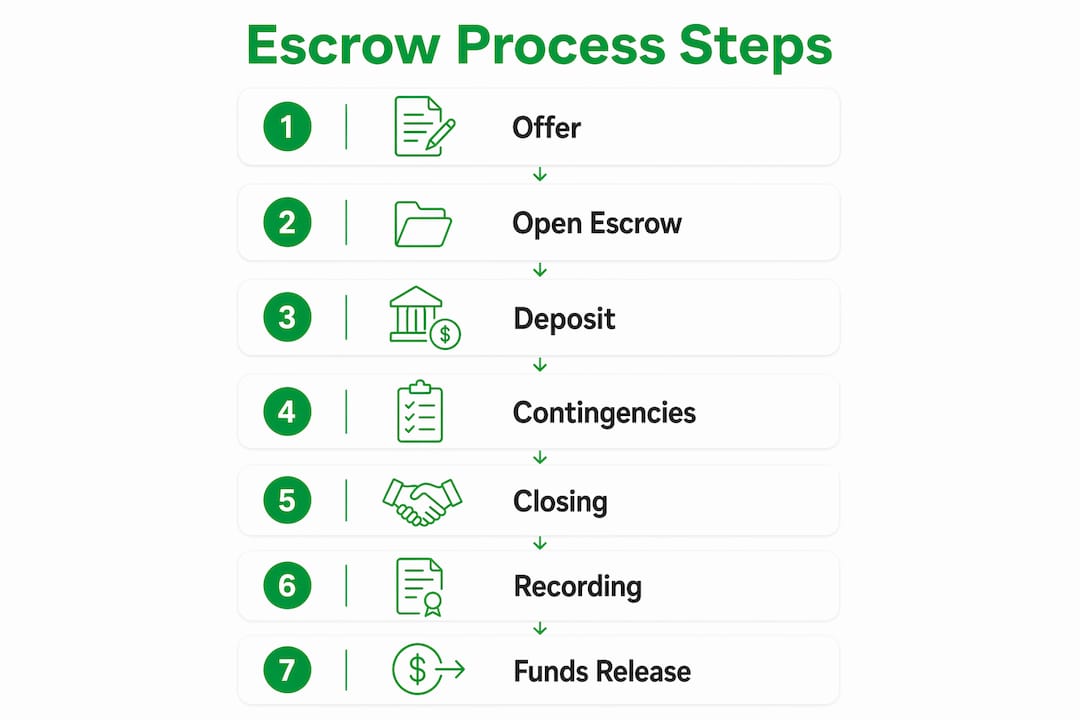
    1. Open escrow. Your real estate agent or the seller’s agent contacts a licensed escrow company, such as First American or Fidelity National Title, to open escrow. The escrow officer receives a copy of the signed purchase agreement and begins coordinating all parties.

    2. Deposit earnest money. You wire your earnest money deposit, typically 1% to 3% of the purchase price, into the escrow account within three business days of acceptance. On a $750,000 California home, that means $7,500 to $22,500 held securely until closing.

    3. Complete inspections and disclosures. Your agent schedules a home inspection, and the seller delivers required California disclosures, including the Transfer Disclosure Statement and Natural Hazard Disclosure. You review these carefully and decide whether to request repairs or credits.

    4. Title search and insurance. The escrow officer orders a title search to confirm the seller has clear ownership and no undisclosed liens exist. You then purchase a title insurance policy to protect against any future claims.

    5. Lender coordination. Your mortgage lender orders an appraisal, processes your loan, and sends loan instructions directly to the escrow officer. You provide any additional documents your lender requests, such as updated pay stubs or bank statements.

    6. Remove contingencies. Once inspections, financing, and appraisal are resolved, you sign contingency removal forms. This is a critical moment: removing contingencies means your earnest money is at risk if you back out without cause.

    7. Sign closing documents and fund. You visit the escrow office or use a remote online notary to sign your loan documents. Your lender wires the loan funds, and you wire your down payment and closing costs to escrow.

    8. Recording and possession. The escrow officer sends the deed to the county recorder. Once recorded, escrow closes and you receive your keys.

    The standard escrow period runs 30 to 60 days in California, though cash purchases can close in as few as 10 days. Budget your schedule accordingly, especially if you are coordinating a lease end date.

    Pro Tip: Set a calendar reminder for every escrow deadline in your purchase contract. Missing a contingency removal date by even one day can put your earnest money at risk.

    Escrow officer managing contracts and deadlines

    What roles do escrow officers, lenders, and agents play?

    Three distinct parties manage your transaction during escrow, and each has a specific lane. Confusing their roles leads to misplaced expectations and unnecessary stress.

    • Escrow officer. The escrow officer is a neutral referee who enforces the purchase agreement instructions exactly as written. They collect documents, coordinate the title report, and disburse funds only when all conditions are met. They do not advocate for you, offer legal advice, or negotiate on your behalf.

    • Mortgage lender. Your lender, whether a bank like Wells Fargo, a credit union, or a mortgage broker, funds the loan and sends binding instructions to the escrow officer. After closing, your lender also manages your ongoing mortgage escrow account, collecting monthly amounts for property taxes and homeowners insurance.

    • Real estate agent. Your buyer’s agent coordinates communication between all parties, tracks deadlines, and troubleshoots problems. They are your primary advocate and the person you call when something feels off.

    • Title company. Often working alongside the escrow company, the title company confirms clean ownership and issues title insurance. In California, the buyer typically selects the title and escrow company.

    Pro Tip: If you have a legal question about contract terms, do not ask your escrow officer. Hire a real estate attorney or ask your agent to clarify. Escrow officers cannot advise on contract strategy.

    Why do monthly mortgage payments change after you close?

    Infographic showing escrow process steps from offer to funds release

    Many first-time buyers assume a fixed-rate mortgage means a fixed monthly payment forever. That assumption is wrong, and it catches people off guard within the first year of ownership.

    A fixed-rate mortgage does not guarantee a fixed total monthly payment because the escrow portion of your payment covers property taxes and homeowners insurance, both of which fluctuate every year. Your principal and interest payment stays constant, but the escrow portion adjusts annually based on actual tax bills and insurance premiums.

    Around 80% of mortgage holders use escrow accounts to spread these costs over 12 months rather than paying large lump sums twice a year. This protects both you and your lender, but it also means your payment is a moving target.

    What is an escrow shortage and how does it happen?

    An escrow shortage occurs when your lender’s estimate of taxes and insurance at closing turns out to be lower than the actual bills. This is especially common in California, where property taxes are reassessed after a sale at the new purchase price, often significantly higher than the previous owner’s bill.

    Scenario What happens
    Property taxes increase after reassessment Your escrow account runs short; lender sends a shortage notice
    Homeowners insurance premium rises Monthly escrow payment increases at next annual review
    Lender underestimates at closing Shortage appears within first 12 months
    You pay lump sum to cover shortage Monthly payment resets to correct amount going forward

    Escrow shortages are common in the first 12 to 24 months and can be resolved by paying a lump sum or spreading the deficit over the next 12 monthly payments. Neither option is a penalty. It is simply a correction.

    Use a mortgage calculator that includes taxes and insurance to model realistic monthly payment scenarios before you close.

    How can first-time buyers prepare for escrow challenges in California?

    Preparation is the single most effective way to avoid delays and surprises. California’s escrow process has specific requirements that differ from other states, and knowing them in advance puts you ahead.

    1. Read every disclosure carefully. California requires sellers to deliver more disclosures than almost any other state. Review your California buyer disclosures line by line before removing your inspection contingency. Disclosures reveal material defects, HOA issues, and neighborhood hazards that affect your decision.

    2. Monitor all escrow communications. Respond to emails and document requests from your escrow officer within 24 hours. Delays in returning signed forms are one of the top causes of escrow extensions in California.

    3. Clarify your payment estimate with your lender. Ask your lender to show you the escrow analysis worksheet before closing. This document shows the estimated annual tax and insurance amounts and the resulting monthly escrow payment. Compare it against the county assessor’s current tax rate for your target property.

    4. Set aside a cash reserve. Budget at least $1,500 to $3,000 beyond your down payment and closing costs for potential escrow shortages in year one. California’s post-sale tax reassessment often creates a shortage notice within the first 12 months.

    5. Understand what causes delays. The most common escrow delays in California include appraisal gaps, lender underwriting conditions, title issues from unpermitted work, and slow HOA document delivery. Your agent should flag any of these risks early in the process.

    Pro Tip: Ask your agent to request the HOA documents and any permit history from the seller in the first week of escrow. These items take the longest to collect and are the most common source of last-minute delays.

    Staying organized throughout escrow also means keeping a folder, physical or digital, with every signed document, wire confirmation, and lender communication. If a dispute arises, your paper trail is your protection. The true cost of homeownership extends well beyond the purchase price, and escrow is where many of those costs first become real.

    Key takeaways

    The escrow process for first-time buyers in California protects your earnest money, coordinates all parties, and closes your transaction only when every condition is fully satisfied.

    Point Details
    Escrow timeline California escrow typically runs 30 to 60 days from accepted offer to recorded deed.
    Earnest money protection Your deposit of 1% to 3% is held securely and applied to closing costs at the end.
    Escrow officer’s role They enforce contract terms impartially and cannot offer legal advice or negotiate for you.
    Payment fluctuations Fixed-rate loans still have variable monthly payments due to annual tax and insurance adjustments.
    Shortage readiness Budget a cash reserve for year-one escrow shortages caused by California’s post-sale tax reassessment.

    What I’ve learned from watching buyers navigate escrow for the first time

    The buyers who sail through escrow are not the ones with the most money or the best credit. They are the ones who asked questions early and stayed organized throughout.

    The single biggest surprise I see first-time buyers face is the escrow shortage notice that arrives about 10 months after closing. They locked in a fixed-rate mortgage, they budgeted carefully, and then their monthly payment jumps by $150 or $200. They feel misled. They are not. California reassesses property taxes at the new purchase price after every sale, and that reassessment almost always produces a higher bill than the lender estimated at closing. Receiving a shortage notice is routine, not a failure. The lender gives you options, and you move forward.

    The second thing I would tell every first-time buyer is this: your escrow officer is not your advisor. They are a neutral administrator. If you receive a document you do not understand, call your agent or a real estate attorney. Do not expect the escrow officer to explain what something means for your situation. That is not their job, and asking them to play that role creates confusion.

    Finally, treat every deadline in your purchase contract as non-negotiable. Contingency removal dates, loan approval deadlines, and closing dates all have real financial consequences if missed. Put them in your calendar the day you open escrow. Your agent should be tracking them too, but you are the one with the most at stake.

    Escrow is not complicated once you understand the structure. It is a system designed to protect you. Work with it, not around it.

    — Anand

    Start your home search with Ficustree

    https://ficustree.ai

    Ficustree is an AI-powered real estate platform built specifically for first-time homebuyers in California. From your first property search to the day you get your keys, Ficustree guides you through every step on a single platform, including understanding disclosures, tracking deadlines, and knowing what to expect during escrow. You get hyper-personalized guidance without the overwhelm. Explore the Ficustree buyer platform to see how AI-powered tools can match you with the right home and keep your transaction on track from offer to close.

    FAQ

    What is escrow in a home purchase?

    Escrow is a neutral third-party arrangement where a licensed officer holds your funds and documents until all purchase conditions are met. It protects both the buyer and seller throughout the transaction.

    How long does escrow take in California?

    The standard escrow period in California runs 30 to 60 days, though cash deals can close faster. Complex transactions involving HOA approvals or title issues may take longer.

    What happens to my earnest money during escrow?

    Your earnest money deposit is held securely in the escrow account and applied toward your down payment or closing costs at closing. If you cancel within a contingency period, you typically receive it back.

    Why did my mortgage payment change after closing?

    Your payment changed because the escrow portion, which covers property taxes and homeowners insurance, was adjusted at your annual escrow review. A fixed-rate mortgage keeps your principal and interest constant, but taxes and insurance fluctuate.

    What should I do if I receive an escrow shortage notice?

    Contact your lender to review your options. You can pay the shortage as a lump sum or spread it across your next 12 monthly payments. Escrow shortages are common in the first two years and are a routine correction, not a penalty.

    Article generated by BabyLoveGrowth