
Debt-to-income ratio, or DTI, is the percentage of your gross monthly income that goes toward debt payments, and it is one of the biggest factors deciding whether a lender approves your mortgage. Lenders care most about your “back-end” DTI, which counts every recurring debt plus your future housing payment. The general target is under 36%, though automated underwriting can approve borrowers up to 50% in the right circumstances, according to Fannie Mae’s guidance.
Your first move should be math, not guessing. Before you talk to a lender, add up your monthly debts and run your own numbers.
- Gather your last two pay stubs and a list of every recurring debt payment.
- Divide total monthly debt by gross monthly income, then multiply by 100.
- Run your numbers through Ficustree’s debt-to-income ratio calculator to see where you stand before you apply.
Quick benchmark: Manually underwritten loans typically have a maximum total DTI around 36%, with possible exceptions up to 45% if the borrower meets certain credit and reserve requirements, while Fannie Mae’s automated Desktop Underwriter can approve loans with DTI ratios as high as 50%, according to Fannie Mae’s B3-6-02 guidance.
Key Takeaways
Lowering your minimum monthly debt payments before applying does more to improve your mortgage eligibility than almost any other single action a first-time buyer can take.
| Point | Details |
|---|---|
| Back-end DTI drives approval | Lenders weigh total debt plus housing costs, not just your future mortgage payment alone. |
| Know your program’s ceiling | Manual underwriting typically caps at 36% (up to 45% with strong credit); Desktop Underwriter can allow 50%. |
| Minimum payments matter most | Paying down revolving balances lowers your DTI faster than paying off installment loans with fixed terms. |
| Don’t change your finances late | New debt or income shifts between pre-approval and closing can trigger re-underwriting and delay your loan. |
| Use Ficustree’s calculators first | Run your numbers through Ficustree’s DTI, mortgage, and affordability tools before talking to a lender. |
Table of Contents
- What Debt-to-Income Ratio Measures for a Mortgage
- How to Calculate Your DTI (With a Real Example)
- How Lenders Actually Use DTI to Approve Loans
- How to Lower Your DTI Before You Apply
- Turning DTI Into a Real Affordability Plan
- What Happens if Your Income or Debt Changes After Approval
- Common Myths About DTI That Trip Up Buyers
- The Advice Nobody Gives First-Time Buyers About DTI
- Sources
- FAQ
What Debt-to-Income Ratio Measures for a Mortgage
DTI is a simple fraction with a big impact: total monthly recurring debt payments divided by gross monthly income, multiplied by 100. Chase’s explainer breaks this into two versions that lenders track separately, and mixing them up is one of the most common points of confusion for first-time buyers.
- Front-end DTI covers only housing costs: principal, interest, taxes, insurance (PITI), and any HOA dues.
- Back-end DTI covers everything: your future PITI payment plus credit cards, auto loans, student loans, child support, and any other recurring obligation that shows up on your credit report.
Lenders lean on back-end DTI as the real test of whether you can handle a mortgage payment on top of your existing life. Bankrate notes that when a lender says “your DTI,” they almost always mean the back-end number. That distinction trips people up during prequalification conversations. Telling a loan officer you have a “low DTI” without specifying which one can send the wrong signal and slow down your file.
How to Calculate Your DTI (With a Real Example)
Start by listing every debt that shows up on your credit report or gets paid monthly: minimum credit card payments, auto loans, student loans, child support or alimony, and the future mortgage payment including taxes, insurance, and HOA fees. Skip your grocery bill, utilities, and subscriptions. Those don’t count toward DTI even though they hit your bank account every month.
Here’s the method, step by step:
- Add up all monthly debt payments, excluding housing, to get your non-housing debt total.
- Estimate your future PITI payment, including property taxes, homeowner’s insurance, and any HOA dues.
- Find your gross monthly income (before taxes) from pay stubs or tax returns if you’re self-employed.
- Divide non-housing debt plus future PITI by gross monthly income, then multiply by 100 for back-end DTI.
- Divide just the future PITI by gross monthly income for front-end DTI.
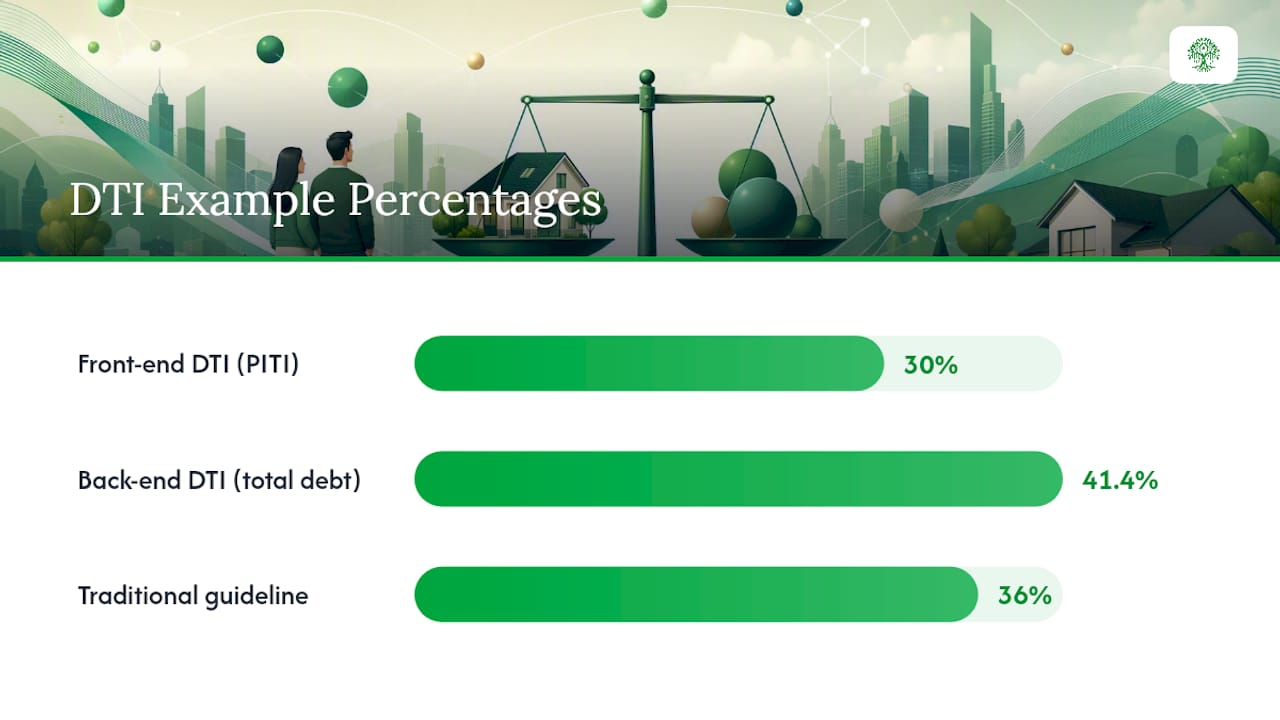
Say you earn $7,000 a month before taxes. You have a $400 car payment, a $250 student loan payment, and $150 in minimum credit card payments, totaling $800. Your estimated future mortgage payment, including taxes and insurance, is $2,100. Your back-end DTI is ($800 + $2,100) / $7,000 = 41.4%. Your front-end DTI is $2,100 / $7,000 = 30%.
That back-end number sits above the traditional 36% target but could still work depending on the loan program and your credit profile. Plug your own figures into Ficustree’s DTI calculator to see exactly where you land before you fill out an application.
How Lenders Actually Use DTI to Approve Loans
Lenders don’t apply one universal DTI cutoff. They work within program limits, and those limits shift depending on how your loan gets underwritten. Fannie Mae’s B3-6-02 guidance sets a 36% ceiling for manually underwritten loans, though that can stretch to 45% if you bring strong compensating factors. Loans run through Desktop Underwriter, Fannie Mae’s automated system, can be approved with DTI as high as 50%.
A borrower with a 41% back-end DTI might get flagged for manual review at one lender and sail through automated underwriting at another. The math doesn’t change. The underwriting path does.
Compensating factors are what push a marginal DTI into approval territory. Lenders weigh:
- A higher credit score, often 700 or above.
- Larger cash reserves after closing, sometimes two to six months of payments.
- A bigger down payment that lowers the loan-to-value ratio.
- Residual income well above minimum guidelines.
Every lender also layers its own overlays on top of Fannie Mae’s baseline rules, meaning one bank might reject a 47% DTI while another approves it with documentation. Fannie Mae’s guidance itself acknowledges that automated underwriting allows more flexibility, but individual lenders still apply their own risk tolerance on top. Talking to two or three lenders before committing to one is not extra work. It’s how you find out which DTI ceiling actually applies to you.
How to Lower Your DTI Before You Apply
Not all debt payoff strategies move the needle equally. Focus your effort where it counts.
- Pay down revolving balances with the highest minimum payments first. DTI calculations use minimum payments, not current balances, so reducing a card’s minimum by paying down the balance can shift your ratio meaningfully even without paying the debt off entirely.
- Avoid new credit and delay big purchases. A new auto loan or furniture financing plan adds a fresh monthly obligation right when you need your ratio as low as possible.
- Document debts close to payoff. Installment loans with fewer than ten payments remaining may be excluded from your DTI calculation entirely, according to Homebuyer.com. Ask your loan officer to confirm this in writing.
- Consider a qualified co-borrower. Adding a co-borrower combines both incomes and both debt loads, which helps only if their financial profile is stronger than the added debt they bring.
- Build a larger down payment instead. This doesn’t lower your DTI directly, but it can qualify you as a stronger applicant with fewer strings attached to income ratios.
Auto loans deserve a specific look here, since loan-to-value ratios on auto financing directly shape your monthly payment size and, by extension, your DTI.
Pro Tip: Call your credit card issuer and ask for a lower interest rate before applying for a mortgage. A lower rate can shrink your minimum payment enough to nudge your DTI down a full percentage point, and it costs you nothing to ask.
Turning DTI Into a Real Affordability Plan
A DTI percentage tells you what a lender will approve. It doesn’t tell you what you’ll actually be comfortable paying once maintenance, utilities, and surprise repairs enter the picture. Front-end DTI only means something once you’ve built out the full PITI number, including realistic property tax and insurance estimates for the actual neighborhood you’re considering.
Ficustree built three tools specifically to close that gap. Start with the DTI calculator to see your qualifying ratio. Then run your numbers through the mortgage calculator with taxes and insurance to convert a monthly payment ceiling into an actual loan amount. Finally, use the home affordability calculator to translate that loan amount into a realistic price range based on your full financial picture, not just your credit report.
| Step | Tool |
|---|---|
| Check your qualifying ratio | Debt-to-Income Ratio Calculator |
| Convert payment into loan amount | Mortgage Calculator with Taxes and Insurance |
| Set your real price range | Home Affordability Calculator |
Once those three numbers line up, you’re ready to talk to a lender and start touring homes with a figure you can actually defend.
What Happens if Your Income or Debt Changes After Approval
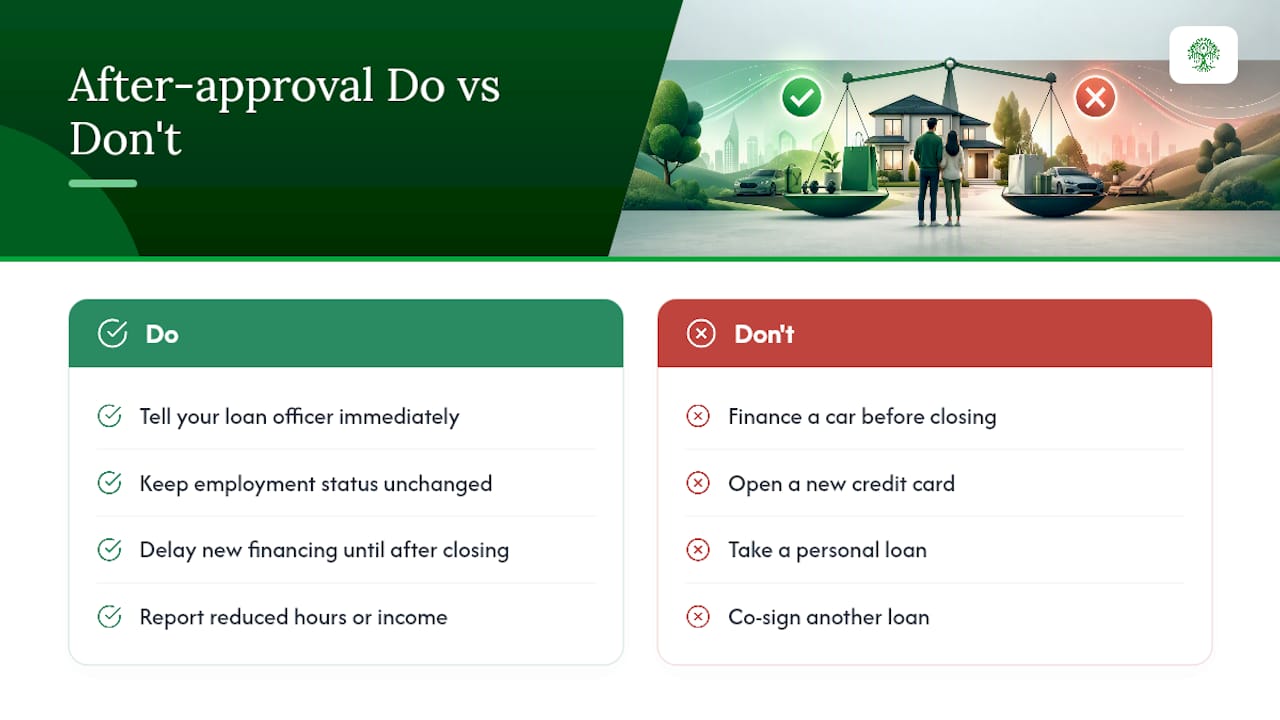
Your DTI isn’t locked in the moment you get pre-approved. Lenders re-check your financial picture again before closing, and sometimes a second time right before funding. If you finance a car, open a new credit card, or take on a personal loan between pre-approval and closing, your back-end DTI can climb past what your loan program allows.
Fannie Mae’s underwriting guidance requires lenders to re-underwrite a loan when new debt pushes DTI beyond program tolerances, and a loan that no longer fits those tolerances can become ineligible for delivery. That’s mortgage-industry language for: your closing gets delayed or your loan falls through entirely.
A job loss or reduced income between approval and closing creates the same problem from the other direction. Even a temporary reduction in hours or a switch from salary to commission-based pay can shrink your qualifying income enough to push your DTI over the line.
The safest move between approval and closing is to change nothing. Don’t finance furniture for the new place. Don’t quit your job for a better one, even if the new offer looks great on paper, since lenders often want a documented history at a new position. Don’t co-sign a loan for a family member. If your circumstances do shift, tell your loan officer immediately rather than letting it surface during final underwriting. A heads-up gives them room to work around it. A surprise at the closing table usually doesn’t.
Common Myths About DTI That Trip Up Buyers
It isn’t. Automated underwriting through Desktop Underwriter can approve DTIs up to 50% with the right compensating factors, per Fannie Mae’s own guidance. Treating any single percentage as an absolute cutoff means you might rule yourself out of a loan you’d actually qualify for.
Another common misconception: that all debt counts equally. It doesn’t. A car loan with eight payments left might be excluded from your calculation entirely. Some lenders will exclude a co-signed loan if you can document twelve months of someone else making the payments, though this varies by lender and requires solid paperwork.
Buyers also assume a good DTI guarantees a good interest rate. It doesn’t work that way. DTI affects approval odds far more directly than it affects your rate, which is driven mainly by credit score, loan type, and market conditions.
Finally, plenty of buyers think DTI is the only number that matters. It’s one of several. Credit score, which you can review here, down payment size, and cash reserves all factor into the final decision.
The Advice Nobody Gives First-Time Buyers About DTI
That framing does first-time buyers a disservice. The real story is that DTI is a negotiation between your financial profile and the underwriting path your lender chooses, and Fannie Mae’s own rules make that flexibility explicit rather than hiding it in fine print.
Where conventional advice falls short is treating DTI reduction as an afterthought instead of the first move. Buyers spend months browsing listings before they’ve even calculated their real ratio, then get blindsided during pre-approval. Flip that order. Calculate your DTI first, using real numbers, before you fall in love with a price range you can’t support.
What I’d prioritize differently: stop fixating on the percentage and start fixating on your minimum payments. Paying down a credit card balance by a few hundred dollars can lower a minimum payment enough to shift your qualifying ratio meaningfully, often faster than waiting for a raise or bonus. That’s the lever most buyers ignore because it feels too small to matter. It isn’t.
— Anand
How Ficustree Turns Your DTI Number Into a Home You Can Actually Buy
Knowing your DTI is step one. Knowing what that number means for the specific homes on the market in your area is a different problem entirely, and it’s the one Ficustree was built to solve. Instead of bouncing between a lender’s pre-approval letter, a separate mortgage calculator, and a spreadsheet of your own, Ficustree’s decision intelligence platform connects your DTI directly to real listings and a realistic price range, so you’re not guessing which homes actually fit your numbers.

You get an on-demand showing agent, step-by-step guidance through offers and closing, and the full premium platform free while you search. Start by running your numbers through the affordability tools and see what price range actually fits your DTI today.
Sources
- Debt-to-Income Ratios | Fannie Mae
- Debt-to-Income Ratio (DTI): What is it & How to Calculate it | Chase
FAQ
What Is a Good DTI for a Mortgage?
A back-end DTI under 36% is a widely cited target, though Fannie Mae’s automated underwriting can approve borrowers with DTIs up to 50% given strong compensating factors.
What’s the Difference Between Front-End and Back-End DTI?
Front-end DTI counts only your future housing payment (PITI plus HOA), while back-end DTI adds every other recurring debt on top of housing, according to Chase.
What Is the Max DTI for an FHA Loan?
FHA loans often allow higher back-end DTI than conventional loans, sometimes up to 45%, when compensating factors like strong credit or reserves are documented.
Does DTI Affect My Mortgage Interest Rate?
DTI mainly affects your approval odds and loan amount, not your rate directly. Your interest rate is driven more by credit score, loan type, and current market rates.
Can My DTI Change After I’m Pre-Approved?
Yes. New debt or reduced income between pre-approval and closing can push your DTI past your loan program’s limit, forcing lenders to re-underwrite the loan or delay closing.
Recommended
- Debt-to-Income Ratio Calculator: Know Your DTI and Limit
- 3 Percent Down Mortgage for First-Time Buyers – ficustree.ai
- First Time Home Buyer Tax Credit: 2026 Guide – ficustree.ai
- Buying a House With Student Loans: Your 2026 Guide – ficustree.ai

Leave a Reply