
AI buyer-listing matching is the process where algorithms analyze your stated preferences, browsing behavior, and purchase patterns to surface properties you are most likely to buy, not just properties that fit your filters. For first-time buyers, this shift matters enormously. Traditional search tools make you do all the work. AI property recommendation systems flip that equation. Real estate agencies using AI report 25–40% higher click-through rates and shorter time-to-enquiry compared to filter-based search. That gap reflects a fundamental difference in how the technology understands what you actually want.
How does AI learn and infer buyer preferences?
AI matching starts with what you tell it, then goes much further. When you set up a search, you enter explicit preferences: price range, bedrooms, zip code, school district. That is the easy part. The more powerful layer is what the system infers from your behavior over time.

Every listing you click, every photo you linger on, every home you save or skip teaches the algorithm something. AI platforms combine explicit onboarding data with behavioral tracking to produce the most accurate personalized matches. Stated preferences alone are a weak signal. Behavior is a much stronger one.
Natural language processing adds another dimension. Instead of checking boxes, you can describe what you want in plain English: “a bright kitchen with open space” or “a quiet street with mature trees.” AI’s natural language ability identifies nuanced preferences that rigid filter systems simply cannot capture. Architectural style, natural light, neighborhood ambiance, and even the feeling of a space become part of the match criteria.
Here is where it gets counterintuitive. Buyers often end up purchasing homes that differ from their stated criteria. AI models learn these discrepancies by studying what buyers actually choose, not just what they say they want. The system builds a profile based on real decisions, not aspirational ones. That is why AI recommendations often feel more accurate than your own search filters.
The three main data inputs AI uses to build your buyer profile:
- Explicit preferences: price, size, location, and features you enter directly
- Behavioral signals: click patterns, time spent on listings, saves, and skips
- Comparative profiles: what buyers with similar behavior ultimately purchased
Pro Tip: When you first use an AI-powered search tool, interact with listings even if you are not serious about them. Every click and skip trains the algorithm faster, so your recommendations improve within days, not weeks.
What advantages does AI have over traditional filter-based search?
Traditional filter-based search is a blunt instrument. You set parameters, the database returns matches, and you scroll through hundreds of listings that technically qualify but feel completely wrong. AI in real estate search solves this by ranking results based on predicted fit, not just technical compliance.
The performance difference is measurable. Automated delivery within 15 minutes of a listing going live reduces lead time-to-enquiry by 40–60%. Speed matters in competitive markets like California, where good homes receive multiple offers within days of listing. Getting there first is not luck. It is a system advantage.
AI also handles the emotional and lifestyle dimensions of a home purchase that filters ignore entirely. A filter can match “3 bedrooms in Austin under $500,000.” It cannot match “feels like a place where I can raise kids and work from home comfortably.” AI-powered tools shift the buyer experience from listing search to full journey navigation, addressing affordability questions, commute tradeoffs, and neighborhood fit before you ever schedule a showing.
| Feature | Filter-based search | AI-powered matching |
|---|---|---|
| Preference input | Checkboxes and sliders | Natural language plus behavior |
| Result ranking | Technical compliance | Predicted buyer fit |
| Alert speed | Manual refresh | Automated, within minutes |
| Lifestyle matching | Not available | Neighborhood and ambiance scoring |
| Learning over time | None | Continuous improvement |
“AI acts as a pre-search discovery tool, helping buyers answer affordability, commute, and tradeoff questions before they ever open a listing.” — Realtor.com research, 2026
How do AI-driven property matching tools work in practice?
The practical experience of using an AI matching tool is simpler than the technology behind it. Here is how the process typically unfolds for a first-time buyer.
1. Onboarding and preference capture. You answer a structured questionnaire covering budget, location priorities, must-have features, and lifestyle needs. Some platforms also ask about commute destinations, school preferences, and deal-breakers. This initial data seeds your buyer profile. The more honest and specific you are here, the faster the system calibrates.
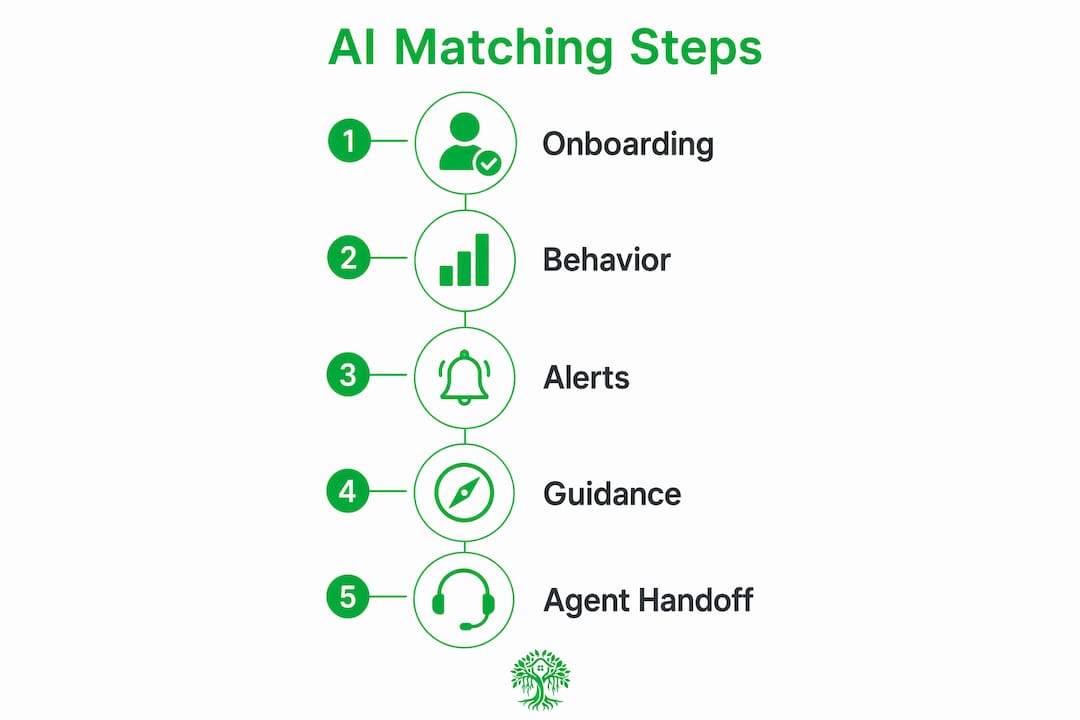
2. Behavioral refinement. As you browse, the AI watches what you engage with and what you skip. A buyer who consistently clicks on homes with large backyards but skips homes with small lots will see that preference weighted heavily, even if they never stated it explicitly. AI matches are most accurate when they reflect actual purchase behavior, not just stated criteria.
3. Automated alerts. When a new listing matches your profile, the system notifies you automatically. 85% of buyers prefer receiving notifications about new listings automatically and quickly. Speed is the point. In a fast market, a 15-minute head start on a new listing is a real competitive edge.
4. Pre-search guidance. Good AI tools do not just surface listings. They help you answer the questions that come before listings: What can I actually afford? Which neighborhoods fit my commute? What am I trading off between location and size? Ficustree is built around this exact idea. The platform functions as a decision intelligence layer for the entire purchase, not just a search box.
5. Agent handoff. When you find listings worth seeing, AI tools connect you with agents for showings and negotiation. The technology handles discovery and analysis. The human handles trust, local knowledge, and the final push to close.
Pro Tip: Do not treat your first round of AI recommendations as final. Spend a week clicking through results, saving homes you like, and dismissing ones you do not. Your second week of recommendations will be noticeably sharper.
What are the real limitations of AI matching in home search?
AI matching is genuinely useful. It is not magic. First-time buyers who understand its limits use it better.
The biggest misconception is that AI replaces the need for a good agent. It does not. 82% of American homebuyers use AI tools to navigate their purchase, but 66% still trust human agents most. AI is excellent at discovery and filtering. Agents are essential for negotiation, disclosure review, and reading a local market that no algorithm fully captures.
A few honest limitations to keep in mind:
- Optimization bias. Some AI systems are tuned to maximize time-to-enquiry, meaning they surface listings you are likely to click quickly, not necessarily listings that are the best long-term fit. Ask how the system ranks results.
- Data quality dependency. AI recommendations are only as good as the listing data feeding them. Incomplete or outdated listings produce weaker matches.
- Cold start problem. A brand-new profile with no behavioral data produces generic recommendations. The system needs time to learn your actual preferences.
- No substitute for in-person judgment. A listing can look perfect on paper and feel wrong the moment you walk in. AI cannot replicate the experience of standing in a space.
The right frame is to treat AI as a very capable research assistant. It narrows the field, surfaces options you might have missed, and alerts you fast. You and your agent make the final call. That combination, AI plus human judgment, consistently outperforms either one alone. Ficustree’s AI home search approach is built on exactly this principle.
Key takeaways
AI matches buyers to listings most accurately when it combines stated preferences with behavioral data and rapid automated alerts to surface properties buyers will actually purchase.
| Point | Details |
|---|---|
| Behavior beats stated preferences | AI learns more from what you click and skip than from the filters you set. |
| Speed is a real advantage | Automated alerts within 15 minutes of a listing going live cut time-to-enquiry by 40–60%. |
| Natural language expands matching | Describing preferences in plain English captures style and ambiance that checkboxes miss. |
| AI complements agents, not replaces them | 66% of buyers still trust agents most; AI handles discovery while agents handle negotiation. |
| Engagement improves accuracy | The more you interact with recommendations, the faster your profile calibrates. |
Why AI matching changed how I think about first-time buyer search
I have spent years watching first-time buyers burn weeks on search tools that were never designed for them. Filter-based search assumes you already know exactly what you want. Most first-time buyers do not. They have a rough idea, a budget ceiling, and a lot of anxiety. Dropping them into a database of 10,000 listings and telling them to filter their way to a home is not a process. It is a stress test.
What AI matching gets right is that it meets buyers where they actually are. You do not need to know you want a craftsman bungalow with a south-facing yard. You just need to click on a few homes that feel right, and the system figures out the pattern. That is a fundamentally more honest way to search.
The part I find most underappreciated is the pre-search layer. The anxiety first-time buyers feel is rarely about finding listings. It is about not knowing what they can afford, which neighborhoods are realistic, and what they are giving up by choosing one option over another. AI tools that address those questions before surfacing listings are doing something genuinely useful. They are compressing the confusion phase, which is exactly what Ficustree is built to do.
My honest advice: use AI tools aggressively in the first two weeks of your search. Interact with everything. Let the system learn. Then bring your shortlist to an agent who knows the local market. That sequence, AI first, human expertise second, produces better outcomes than either approach alone. You can read more about how this plays out in practice in Ficustree’s guide to emotionally intelligent home buying.
— Anand
How Ficustree puts AI matching to work for first-time buyers
Ficustree is an AI-powered home buying platform built specifically for first-time buyers in California and Texas. The platform goes beyond listing search. It functions as a decision layer, helping you understand what you can afford, which neighborhoods fit your life, and which listings are worth your time before you ever schedule a showing.

Ficustree combines behavioral matching, natural language preference capture, and automated alerts with on-demand showing agents and direct buyer representation. Buyers pay $1,000 at closing plus 1% commission and keep a rebate of roughly 2% where legally permitted. The premium platform is free to use. If you are ready to search smarter, start your home search with Ficustree and let the house find you.
FAQ
How does AI match buyers to listings?
AI analyzes both your stated preferences and your browsing behavior, then ranks listings by predicted fit rather than technical filter compliance. The more you interact with the system, the more accurate your matches become.
Can AI replace a real estate agent?
AI cannot replace an agent for negotiation, disclosure review, or local market knowledge. Research shows 66% of buyers still trust agents most, even when using AI tools throughout their search.
How fast does AI send listing alerts?
The best AI property recommendation systems deliver alerts within 15 minutes of a listing going live. That speed reduces time-to-enquiry by 40–60% compared to manual search methods.
What data does AI use to build a buyer profile?
AI uses your onboarding questionnaire answers, your click and save behavior, and patterns from buyers with similar profiles. Behavioral data typically produces more accurate matches than stated preferences alone.
Is AI matching useful for first-time buyers specifically?
AI matching is especially useful for first-time buyers because it does not require you to know exactly what you want upfront. The system learns your preferences from your behavior and surfaces options you might not have found through manual filtering.
Recommended
- AI Home Search for Buyers: What Changes Now
- How AI Personalized Home Search Works in 2026 – ficustree.ai
- AI Home Search Tools Walkthrough for First-Time Buyers – ficustree.ai

Leave a Reply