
AI personalized home search is the process where machine learning and natural language processing analyze your behavior, preferences, and lifestyle signals to deliver property recommendations that evolve with you. Unlike a static filter on Zillow or Redfin, this technology builds a living profile of what you actually want, not just what you typed. 82% of Americans now use AI in their real estate research, while still relying on agents for final decisions. That split tells you exactly where AI earns its place: in the messy, time-consuming discovery phase that exhausts most first-time buyers in California and Texas before they ever see a house in person.
How behavioral data personalizes home search results
Behavioral data is the engine behind every hyper-personalized home search. When you browse listings, the AI does not just record what you clicked. It tracks how long you paused on a kitchen photo, which floor plans you scrolled past in two seconds, and which listings you revisited three days later.
AI platforms analyze subtle behavioral signals including time hesitation, revisit frequency, and photo interaction order to refine match accuracy. A buyer who says they want a three-bedroom home but spends twice as long on four-bedroom listings is sending a clear signal. The AI reads that signal and adjusts recommendations accordingly, even when the stated filter never changes.

This behavioral profiling produces results that feel almost intuitive. AI-driven recommendation systems improved property match relevance by over 30%. That improvement comes directly from replacing rigid keyword matching with a dynamic model that weighs dozens of micro-interactions simultaneously.
The practical benefits for buyers are significant:
- Expanded discovery: Buyers using AI-personalized tools are twice as likely to expand their search criteria, finding options they would have manually excluded.
- Reduced overload: AI delivers fewer listings ranked by predicted relevance, so you spend less time sorting and more time evaluating real contenders.
- Preference detection: The system catches subtle preferences, like a consistent attraction to homes with natural light or open layouts, before you consciously articulate them.
- Adaptive filtering: As your priorities shift, the behavioral model updates without requiring you to manually reset every filter.
Pro Tip: When you start using an AI-powered search platform, spend the first few sessions browsing broadly. Click on listings that interest you even slightly. The more behavioral data you generate early, the faster the system calibrates to your real preferences.
How does conversational AI change the home search experience?
Conversational AI lets you search the way you actually think, not the way a database is organized. Instead of selecting “3 beds, 2 baths, $650,000 max” from dropdown menus, you can type or say: “I need a home with a quiet home office, a 30-minute commute to downtown Austin, and a backyard big enough for a dog.” The system interprets that as a structured query and returns results that match the lifestyle, not just the specs.
Conversational AI interprets lifestyle needs beyond explicit filters, including commute times and room functionality. This matters enormously for first-time buyers who do not yet know the right real estate vocabulary. You do not need to know what “ADU” means or how to filter by lot size. You describe your life, and the AI translates it.
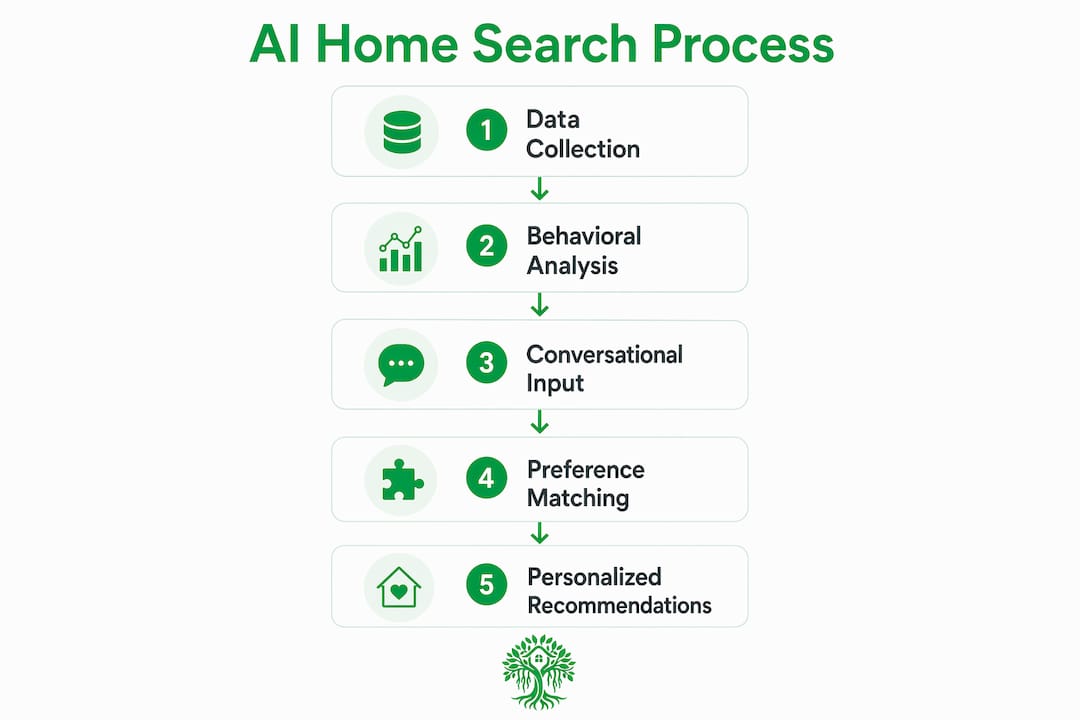
The experience also improves across sessions. AI search contexts persist across sessions, remembering buyer preferences and avoiding redundant input. You do not re-explain your priorities every time you log back in. The system picks up where you left off, which is a meaningful quality-of-life improvement during a search that can span weeks or months.
Here is how a conversational AI session typically unfolds for a first-time buyer:
- Initial query: You describe your situation in plain language, including budget, location preferences, and lifestyle needs.
- Clarifying exchange: The AI asks follow-up questions, such as whether you prioritize school district ratings or proximity to transit.
- Curated results: The system returns a ranked list of listings matched to your full profile, not just your typed keywords.
- Feedback loop: You react to results, and the AI refines its model based on what you engage with or dismiss.
- Session memory: When you return the next day, your preferences and prior feedback are already loaded.
Pro Tip: Treat the AI like a knowledgeable friend, not a search bar. The more specific and conversational you are about your daily life, the better it matches your real needs. Mention your commute, your hobbies, and what bothered you about your last apartment.
Traditional filter search vs. AI-powered personalized search
The core difference between traditional and AI-powered search is static versus dynamic criteria. A traditional search engine applies your filters exactly as entered and returns every listing that technically qualifies. An AI-powered system applies your filters, then layers in behavioral data, lifestyle signals, and predictive modeling to rank results by actual fit.
| Feature | Traditional filter search | AI-powered personalized search |
|---|---|---|
| Criteria application | Static, exact match | Dynamic, weighted by behavior |
| Preference detection | Manual input only | Inferred from micro-interactions |
| Session memory | Resets each visit | Persists and evolves over time |
| Result volume | High, unranked | Curated, ranked by predicted fit |
| Lifestyle alignment | Limited to listed specs | Includes commute, neighborhood, lifestyle |
| Human agent role | Separate from search | Informed by AI search history |
The limitations of AI search are real and worth naming. The system cannot inspect a foundation, read a seller’s disclosure, or negotiate a counteroffer. Machine learning models reduce errors by up to 25%, but no model eliminates the need for professional judgment at the offer stage. AI handles discovery well. Humans handle decisions best.
How does AI personalized search improve the agent-buyer relationship?
AI does not replace your agent. It makes your agent dramatically more useful from the first meeting. When you arrive at a consultation having already spent weeks interacting with an AI-powered platform, your agent has access to a detailed picture of what you actually responded to, not just what you said you wanted.
Agents use AI search histories as consultation tools to identify true buyer motivations before meetings. That means less time spent on mismatched showings and more time focused on homes that genuinely fit. For buyers in competitive California markets like the Bay Area or San Diego, that efficiency is not a convenience. It is a competitive advantage.
The shift in how agents and buyers interact looks like this:
- Pre-search handled by AI: Discovery, filtering, and preference mapping happen before the agent gets involved, saving hours of back-and-forth.
- Smarter showing prep: Agents review your AI search history to understand which features you consistently engaged with, so showings are targeted and purposeful.
- Better offer strategy: When an agent understands your true priorities, they can advise more precisely on which concessions matter and which do not.
- Higher-quality conversations: AI complements human agents by shifting them toward higher-value advisory roles, handling pre-search discovery so agents focus on negotiation and closing.
The result is a buyer who walks into a showing prepared, and an agent who already understands what that buyer needs. That combination closes deals faster and with fewer regrets. For first-time buyers in Texas markets like Austin or Houston, where inventory moves quickly, that preparation gap matters.
Key Takeaways
AI personalized home search works by combining behavioral data, conversational input, and machine learning to deliver ranked, lifestyle-matched listings that improve with every session.
| Point | Details |
|---|---|
| Behavioral data drives matching | AI tracks micro-interactions like revisit frequency and photo time to infer real preferences. |
| Conversational input replaces filters | Natural language queries let buyers describe lifestyle needs instead of selecting dropdown specs. |
| Session memory reduces friction | AI remembers your priorities across visits, so you never start from scratch. |
| AI expands buyer discovery | Buyers using AI tools are twice as likely to find options outside their original criteria. |
| Agents become more effective | AI search histories give agents a clear picture of buyer motivations before the first meeting. |
What I have learned watching buyers use AI search in California and Texas
The buyers who get the most out of AI-powered search are the ones who treat it like a conversation, not a form. I have watched first-time buyers in the Bay Area spend 20 minutes setting up perfect filters and then wonder why the results feel generic. The filters are not the product. The behavior is.
The most underused feature on every AI platform I have tested is the feedback loop. When you dismiss a listing, tell the system why. When you save one, note what caught your attention. That explicit feedback, layered on top of your behavioral data, accelerates the calibration process by days. Most buyers skip it entirely.
One thing I want to be direct about: AI search is not a shortcut to skipping your agent. The buyers who treat it that way end up with a great list of homes and a weak offer strategy. The technology is genuinely good at discovery. It is not good at reading a seller’s disclosure packet or knowing that a neighborhood in Sacramento has a deferred infrastructure problem. Use AI to find the right homes faster. Use your agent to close the right one well.
For tech-savvy buyers in Texas and California, my practical advice is to start your AI search early, before you feel ready. The system needs time to learn your preferences. Buyers who start browsing two months before they plan to make an offer arrive at that moment with a calibrated profile and a much shorter list of genuine contenders.
— Anand
Ficustree puts AI personalized search to work for you
Ficustree is built specifically for first-time buyers in California and Texas who want the benefits of AI-powered search without the confusion of a traditional listings site.

The platform uses conversational AI and behavioral matching to surface homes that fit your life, not just your filter settings. You describe your priorities in plain language, and Ficustree builds a ranked, evolving list of properties matched to your actual preferences. When you are ready to see a home, hourly showing agents are available on demand. When you are ready to make an offer, you have a full picture of your true priorities. Buyers pay $1,000 at closing plus 1% commission and keep a rebate of roughly 2% where legally permitted. Start your personalized search and let the house find you.
FAQ
What is AI personalized home search?
AI personalized home search is a property discovery method that uses machine learning and natural language processing to match listings to a buyer’s behavior, lifestyle, and stated preferences. It produces ranked results that improve over time as the system learns from your interactions.
How does behavioral data improve home search results?
AI tracks micro-interactions like photo viewing time, revisit frequency, and scroll behavior to build a preference profile that goes beyond what you type into a filter. This behavioral profiling improves match relevance by over 30% compared to traditional keyword-based search.
Does AI search replace a real estate agent?
No. AI handles pre-search discovery and preference mapping, while agents focus on showings, negotiations, and closing. The two work best together, with AI search histories giving agents a clearer picture of buyer priorities before the first consultation.
Can I use conversational AI to search for homes in California or Texas?
Yes. Platforms like Ficustree and Realtor.com’s RealAssist AI accept natural language queries, so you can describe commute needs, lifestyle preferences, and home features in plain English. The system translates your description into a structured search and returns curated results.
How long does it take for AI to learn my home preferences?
The calibration timeline varies by platform and usage frequency, but most AI systems produce noticeably better results after several sessions of active browsing and feedback. Starting your search two months before you plan to make an offer gives the system enough time to build an accurate profile.
Recommended
- AI Home Search for Buyers: What Changes Now
- Blog Post
- Home – AI-Powered Real Estate Search
- Home – AI-Powered Real Estate Search

Leave a Reply