
Buying a house takes 3–6 months from the first serious step to closing day. That range covers financial preparation, house hunting, offer negotiation, and the mortgage closing process. The exact timeframe for purchasing a house depends on your financing type, how competitive your market is, and how organized your paperwork is before you start. First-time buyers who understand each phase avoid the most common delays and close with far less stress.
How long does it take to buy a house, start to finish?
The complete home-buying process typically runs 3–6 months, but that clock does not always start where buyers expect. Most people count from the day they begin touring homes. The real starting line is financial readiness, and that phase alone can add 2–6 months if you need to repair credit or save for closing costs beyond the down payment.
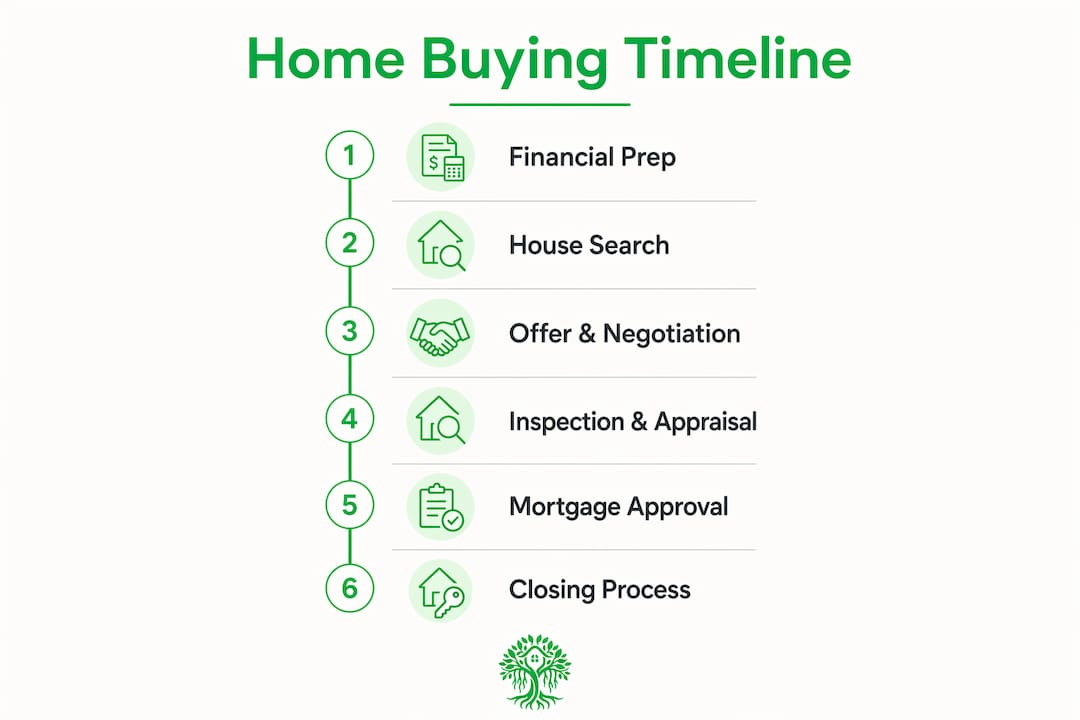
Breaking the process into phases makes the timeline concrete:
- Financial preparation: 1–6 months (credit repair, savings, pre-approval)
- House hunting: 2 weeks to 4 months
- Offer to closing: 30–60 days for conventional loans, 7–14 days for cash buyers
Each phase feeds the next. A buyer who enters the search without a pre-approval letter loses days or weeks every time a seller declines to negotiate seriously. Getting financially ready first compresses the overall buying a house timeline significantly.
How long does mortgage pre-approval and financing take?

Pre-approval is the fastest part of the mortgage process. Lenders issue pre-approval letters within 24–72 hours after you submit a complete application. Those letters stay valid for 60–90 days, which gives you a real window to shop without reapplying.
The heavier lift comes after your offer is accepted. Underwriting typically takes 2–3 weeks, and the total closing timeline depends heavily on your loan type:
- Cash purchase: 7–14 days, no appraisal or underwriting required
- Conventional loan: averages 42–43 days to close after offer acceptance
- FHA or VA loan: 45–60 days, with additional documentation requirements
- USDA loan: 60–70 days or more, due to extra agency review steps
The CFPB requires lenders to provide a Loan Estimate within 3 business days of your application. Use that document to compare total cash-to-close costs across lenders, not just interest rates. The rate you see advertised rarely tells the full story.
Pro Tip: Request your Loan Estimate from at least two lenders on the same day. Comparing them side by side on identical terms is the only way to know which offer actually costs less.
What is the typical duration of the home search and offer stage?
House hunting is the most variable phase in the entire home buying process duration. The range is wide: some buyers find a home in two weeks, others search for four months. Your timeline depends on how specific your criteria are, how much inventory exists in your target area, and how quickly you can move when the right property appears.
Here is how the search and offer stage typically unfolds:
- Define your criteria. Buyers who enter the search with a clear list of non-negotiables, location, size, school district, commute, move faster than those who refine preferences on the fly.
- Tour homes actively. Plan to see 10–15 homes before making an offer. In competitive California markets, that number can be higher because multiple-offer situations require more attempts.
- Submit an offer. Writing and submitting an offer takes one day. Seller review and response typically happens within 24–72 hours.
- Negotiate terms. Straightforward negotiations close in 2–3 days. Contested repairs or price adjustments can stretch negotiation to a week or more.
- Reach mutual acceptance. Once both parties sign, the escrow clock starts and the closing phase begins.
Market conditions shift this timeline more than almost any other factor. In a low-inventory market, buyers often lose multiple offers before one is accepted. Each failed offer adds weeks to the overall search. Staying flexible on minor preferences, like finishes or lot size, shortens the search without compromising what matters most.
What happens after an offer is accepted?
Once a seller accepts your offer, the escrow process begins and a predictable sequence of steps follows. Each step has its own timeline, and delays in one phase push back everything that follows.
| Phase | Typical Duration | Key Notes |
|---|---|---|
| Home inspection | 1–2 weeks | Scheduling depends on inspector availability |
| Appraisal | 7–14 days | Appraiser shortages add delays in many markets |
| Underwriting review | 2–3 weeks | Faster with clean, complete documentation |
| Closing Disclosure delivery | 1 day | Triggers mandatory waiting period |
| Federal waiting period | 3 business days minimum | Required by law before signing |
| Closing appointment | 1–3 hours | 100–150 documents signed; certified funds required |
The federal 3-business-day waiting period after the Closing Disclosure is delivered is not negotiable. It exists so you can review your final loan terms carefully before signing anything. Use that time to compare the Closing Disclosure against your original Loan Estimate and flag any numbers that changed.
Pro Tip: Bring a cashier’s check or arrange a wire transfer for closing day. Personal checks are not accepted above nominal amounts, and a payment error on closing day can delay your keys by 24 hours or more.
What factors can extend or shorten the home buying timeline?
Several specific conditions push the home buying process duration past the typical range. Knowing them in advance lets you plan around them.
Factors that add time:
- Complex financial documentation. Self-employed buyers or those with irregular income face more underwriting requests. Financial documentation complexity is one of the top causes of extended underwriting timelines.
- Appraisal backlogs. Appraiser shortages in 2026 continue to add at least 5 days to scheduling and reporting in many markets. Rural areas face longer waits than urban ones.
- Repair negotiations. If the home inspection reveals significant issues, negotiating repairs or credits can add 1–2 weeks before the transaction moves forward.
- Title problems. Liens, ownership disputes, or clerical errors in public records require legal resolution before closing can proceed.
Factors that shorten the timeline:
- Paying cash eliminates underwriting and appraisal requirements entirely. Waiving contingencies can compress a cash closing to 3–7 days, though that approach carries real risk if you skip the inspection.
- Sellers who have already cleared title and are motivated to close quickly move transactions faster than average.
- Buyers who submit complete, organized financial documents at pre-approval face fewer underwriting conditions later.
The single most controllable variable is your own preparation. Buyers who gather tax returns, bank statements, pay stubs, and employment verification before applying move through underwriting faster than those who collect documents reactively. Review common first-time buyer mistakes before you start so you are not learning those lessons mid-transaction.
Key Takeaways
The average time to buy a home runs 3–6 months, and the biggest delays come from financial unreadiness and underwriting complexity, not the search itself.
| Point | Details |
|---|---|
| Total timeline | Plan for 3–6 months from financial prep through closing day. |
| Pre-approval speed | Lenders issue pre-approval letters in 24–72 hours; letters stay valid for 60–90 days. |
| Loan type matters | Conventional loans average 42–43 days to close; USDA loans routinely take 70 or more days. |
| Post-offer phases | Inspection, appraisal, and underwriting together add 4–7 weeks after offer acceptance. |
| Mandatory waiting period | Federal law requires 3 business days after the Closing Disclosure before you can sign. |
What I have learned about timing your first home purchase
First-time buyers consistently underestimate the financial preparation phase. They focus on the search and treat pre-approval as a formality. The reality is that credit repair, building reserves for closing costs, and understanding what you can actually afford often take longer than the search itself.
The other thing buyers get wrong is treating the inspection as a checkbox. A thorough inspection takes time to schedule and review, and the negotiation that follows a bad report can add two weeks to your timeline. That time is worth it. Skipping or rushing the inspection to close faster is one of the few decisions in real estate that you cannot undo after the fact.
What actually speeds up a purchase is not cutting corners. It is showing up organized. Buyers who have their documents ready, respond to lender requests within hours instead of days, and stay in close contact with their escrow officer consistently close faster than buyers who are reactive. The process rewards preparation more than urgency.
Modern tools help significantly here. AI-powered platforms that surface the right homes faster and flag disclosure issues early reduce the time you spend on properties that were never going to work. That is time you get back in the search phase, which is where most buyers lose weeks they did not need to lose.
— Anand
How Ficustree helps you close on time
Ficustree is built for exactly this situation: a first-time buyer who wants clarity on timeline, costs, and next steps without wading through conflicting information.

The Ficustree platform uses AI to match you with homes that fit your actual criteria, not just your search terms. It surfaces disclosure issues early, helps you track where you are in the process, and gives you on-demand showing agents by the hour. Buyers pay $1,000 at closing plus 1% commission and keep a rebate of roughly 2% where legally permitted. If you want a clear home buying workflow that keeps every phase on track, Ficustree is where to start. The house should find you.
FAQ
How long does it take to buy a house from start to finish?
The full process takes 3–6 months for most buyers, covering financial preparation, house hunting, and mortgage closing. Buyers who need credit repair or additional savings may need more time before the search even begins.
How long does mortgage approval take after an offer is accepted?
Underwriting typically takes 2–3 weeks after offer acceptance. Conventional loans average 42–43 days to close; government-backed loans like USDA can take 70 or more days.
How fast can I buy a house with cash?
Cash buyers can close in 7–14 days by skipping underwriting and appraisal. Waiving contingencies can compress that to 3–7 days, but doing so without an inspection carries significant financial risk.
What is the mandatory waiting period before closing?
Federal law requires a minimum 3-business-day waiting period after the lender delivers the Closing Disclosure. This period gives buyers time to review final loan terms before signing.
What is the most common cause of closing delays?
Incomplete financial documentation and appraisal scheduling backlogs are the two most frequent causes. Buyers with self-employment income or irregular earnings face the most underwriting requests and the longest delays.
Recommended
- Home Buying Timeline: A First-Time Buyer’s Guide – ficustree.ai
- First Time Homebuyer Guide: Simple Steps for Your First Home
- First-Time Homebuyer Mistakes California Buyers Must Avoid – ficustree.ai
- First Home Buying California Guide: Steps That Work – ficustree.ai

Leave a Reply