
Real estate API integration for home search is the process of connecting a property platform to MLS and third-party data sources through standardized RESTful APIs, with authentication, licensing compliance, and data management as the true engineering challenges. The RESO Web API is the recognized industry standard for this work, built on OData over REST with OAuth2 authorization. In 2026, developers also have access to aggregator platforms like Trestle and Bridge Interactive, plus third-party wrappers like Zillapi for teams without direct MLS affiliation. What most teams underestimate is that MLS licensing and entitlement rules create far more complexity than the HTTP calls themselves. This guide covers every layer of that complexity, from source selection to performance architecture.
What are the main real estate API sources for home search?
The property search API ecosystem in 2026 splits into three distinct tiers, and choosing the wrong one early costs months of rework.
Tier 1: Direct RESO Web API access. The RESO Web API is the industry-standard protocol, using OData-style REST endpoints with OAuth2 authorization. Direct MLS integrations give you maximum control over data freshness and field access, but they require individual agreements with each MLS board, separate entitlement reviews, and ongoing compliance maintenance. For teams covering a single metro market, this is often the right call.

Tier 2: Aggregator platforms. Services like Trestle and Bridge Interactive normalize data across multiple MLS boards and handle much of the licensing complexity on your behalf. Aggregators simplify multi-MLS coverage but introduce dependency risks and potential service limitations you do not control. Bridge Interactive specifically requires MLS affiliation and approval before granting access, which rules it out for many independent teams.
Tier 3: Third-party REST wrappers. Zillow’s public home search API was retired by 2021, so developers who need Zillow-sourced data now rely on third-party wrappers like Zillapi, which provide REST endpoints accessible without MLS affiliation. These are faster to integrate but carry data freshness and terms-of-service considerations you must evaluate before production use.
Authentication across all three tiers follows a consistent pattern: OAuth2 for RESO-compliant sources, API key or token-based access for third-party wrappers. Before writing a single query, confirm your entitlement scope in writing. Entitlement defines which fields, which boards, and which media assets you are licensed to display, and that scope must be enforced at every layer of your stack.
- Confirm OAuth2 scopes match your licensed data fields before development begins
- Store credentials in environment variables or a secrets manager, never in source code
- Request sandbox or staging credentials from your MLS or aggregator for safe testing
- Document entitlement boundaries per board in a shared internal reference
Pro Tip: When evaluating aggregators, ask specifically about their SLA for field additions when an MLS board updates its data dictionary. Some aggregators lag by weeks, which breaks your field mapping silently.
How to structure API calls and implement effective search queries
A well-structured property search API call has four components: authentication header, search endpoint, filter parameters, and pagination controls. Getting all four right from the start prevents the most common performance and accuracy failures.
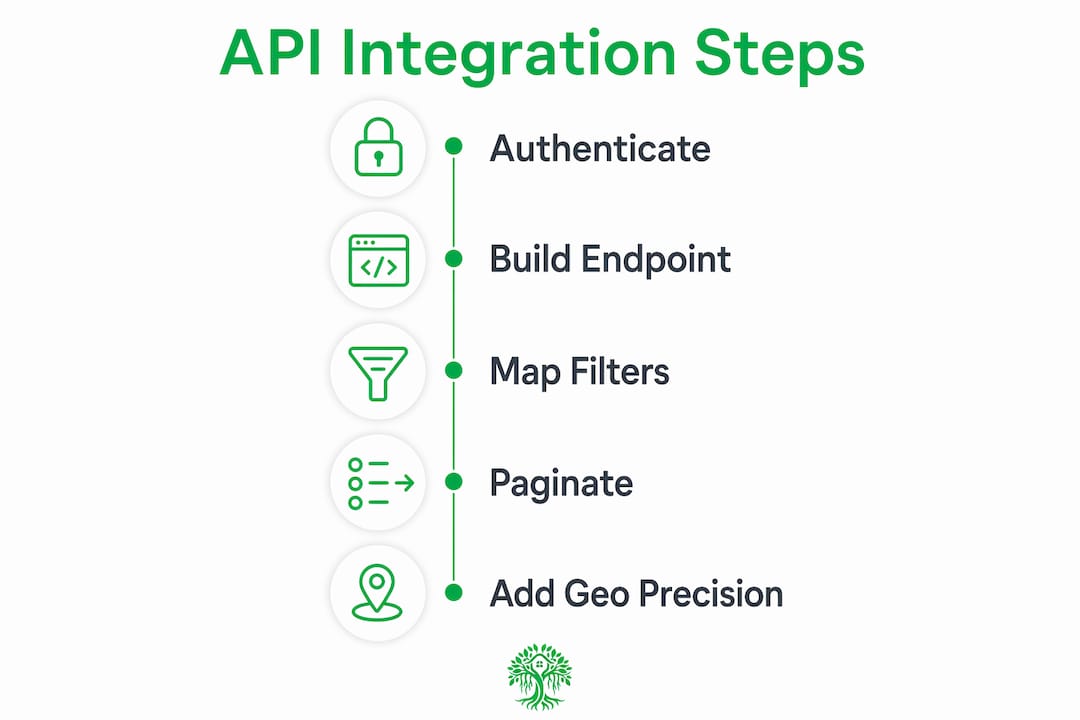
Step 1: Authenticate and obtain a token. Send a POST request to the OAuth2 token endpoint with your client credentials. Store the returned bearer token and refresh it before expiry. Most RESO-compliant sources issue tokens with a 3,600-second TTL.
Step 2: Build your search endpoint URL. A standard API call uses a base URL plus a resource path such as "/Property, followed by OData query parameters. For RESO sources, this looks like: GET /odata/Property?$filter=City eq ‘Austin’ and ListPrice le 750000 and BedsTotal ge 3&$top=25&$skip=0`.
Step 3: Map UI filters to query parameters. Every filter control in your search UI corresponds to one or more API parameters. The table below shows the most common mappings.
| UI Filter | RESO OData Parameter | Notes |
|---|---|---|
| Price range | ListPrice ge X and ListPrice le Y |
Use integer values, no currency symbols |
| Bedrooms | BedsTotal ge N |
Minimum value filter is most common |
| Bathrooms | BathroomsTotalInteger ge N |
Confirm field name per MLS board |
| Property type | PropertyType eq 'Residential' |
Enum values vary by board |
| Location | Bounding box coordinates | Preferred over city/ZIP strings |
Step 4: Implement pagination correctly. Cursor-based pagination with opaque tokens is the right choice for large real estate datasets. Offset pagination times out on deep pages and produces inconsistent results when listings are added or removed mid-session. Cursor pagination gives you stable, sequential retrieval regardless of dataset churn.
Step 5: Add geo precision. Geographic bounding boxes produce more accurate location constraints than city name or ZIP code strings. Pass latitude and longitude bounds as filter parameters to tighten results and improve ranking relevance.
Pro Tip: Throttle your outbound requests to stay below the rate limit of your API source. Build exponential backoff into your retry logic from day one. A 429 response at 2 AM on a Saturday should not require a manual fix.
What are best practices for data handling, compliance, and field mapping?
The hardest part of any home search API integration is not fetching data. It is managing what happens to that data after it arrives.
Field variance is the first problem. MLS boards use the RESO Data Dictionary as a shared standard, but local custom fields, non-standard enumerations, and board-specific naming conventions mean the same concept appears under different field names across boards. A field called GarageSpaces in one board may be ParkingTotal in another. Your integration breaks silently if you hardcode field names.
The solution is a configurable field mapping layer stored as database configuration rather than application code. Storing field mappings as database configuration with transformation functions lets you accommodate new or changed MLS fields without a code deploy. When a board updates its data dictionary, you update a config record, not a codebase.
Compliance is not optional. Media and licensing permissions must be treated as first-class data, not an afterthought. Permission metadata must travel with listing records through every index, cache, and render pipeline. Displaying a photo you are not licensed to show is a compliance violation with legal consequences.
The table below compares two approaches to compliance enforcement.
| Approach | When enforced | Risk level |
|---|---|---|
| Render-time permission check | At display, every request | Low: always current |
| Index-time permission filter | At ingestion, cached | Medium: stale if permissions change |
| No enforcement layer | Never | High: compliance and legal exposure |
Real-time updates require webhooks or EntityEvent resources. Polling for listing changes every few minutes wastes API quota and still misses rapid status changes like a listing going under contract. RESO-compliant sources expose EntityEvent resources that let you subscribe to change notifications. Pair this with a lightweight ingestion worker that processes events and updates your local index within seconds of a change at the source.
- Validate every inbound record against your expected schema before writing to your database
- Log field-level validation failures by board to identify data quality patterns over time
- Carry entitlement metadata as a field on every indexed listing record
- Enforce media permissions at render time, not just at ingestion
How can developers optimize home search API performance and scalability?
A home search feature that takes four seconds to return results loses users. Performance optimization in real estate API solutions is an architecture decision, not a tuning exercise.
Caching is the highest-leverage optimization available. Caching frequently accessed property details can reduce database load by 50% to 80%, with cache hit rates reaching 70% to 90% under normal traffic. That reduction directly translates to faster response times and lower infrastructure cost. The key is using differentiated TTL strategies: static fields like year built, lot size, and school district can cache for hours or days. Dynamic fields like list price, days on market, and listing status need TTLs measured in minutes.
Index only what the search results page needs. Indexing only essential data fields for listing cards and deferring full detail hydration until a user opens a specific listing reduces both latency and API cost. Your search results index should contain address, price, beds, baths, primary photo URL, and listing status. Everything else loads on demand.
Scale horizontally with container orchestration. Microservice architecture with horizontal pod autoscaling handles the unpredictable load spikes that real estate search generates during peak hours and market events. Kubernetes lets you scale your search service independently of your ingestion pipeline and your user-facing API gateway.
Additional architecture patterns worth implementing:
- Read replicas on your listing database to distribute query load without affecting write performance
- A dedicated search index (Elasticsearch or OpenSearch) for full-text and geo queries, separate from your primary database
- Rate limiting at the API gateway layer to protect backend services from traffic spikes
- Circuit breakers on outbound calls to MLS sources so a slow upstream does not cascade into a full outage
Pro Tip: Build a synthetic monitoring job that runs a representative search query every five minutes and alerts on response time degradation. You will catch performance regressions before your users do.
What are common mistakes to avoid during real estate API integration?
Most integration failures are predictable. The teams that avoid them have seen them before.
“The API call is the easy part. The hard part is everything that happens to the data before it reaches the user.”
- Deep offset pagination. Requesting page 500 of a result set with offset pagination causes query timeouts and returns inconsistent data. Switch to cursor-based pagination before you hit production scale.
- Hardcoded field names. A field name change at one MLS board silently breaks your integration for that board’s listings. Use the configurable mapping layer described in the compliance section.
- Missing retry logic. Real estate data APIs return transient errors. Without exponential backoff and retry logic, your ingestion pipeline stalls on the first 503 response.
- Ignoring data freshness metrics. Track the lag between a listing change at the source and its appearance in your index. If that lag exceeds your SLA, your users see stale data without knowing it.
- Treating compliance as a launch checklist item. Entitlement rules change. MLS boards update their data dictionaries. Compliance must be a continuous process with automated validation, not a one-time review.
Key takeaways
Effective real estate API integration for home search requires selecting the right data source tier, enforcing compliance at every layer, and building performance architecture before you need it.
| Point | Details |
|---|---|
| Choose your API tier deliberately | Direct RESO, aggregators like Trestle, and wrappers like Zillapi each carry different control and compliance tradeoffs. |
| Store field mappings as config | Database-driven mapping lets you adapt to MLS field changes without code deploys or downtime. |
| Use cursor pagination at scale | Cursor-based pagination prevents timeouts and data inconsistency on large listing datasets. |
| Cache with differentiated TTLs | Static fields cache for hours; dynamic fields like price and status need short TTLs to stay accurate. |
| Enforce media permissions at render | Carrying entitlement metadata through your pipeline and checking it at display prevents compliance violations. |
Why ecosystem complexity is the real integration challenge
I have worked through enough MLS integrations to say this clearly: the OAuth2 handshake takes an afternoon. The field mapping, entitlement logic, and compliance layer take months, and they never stop needing attention.
The teams I have seen struggle most are the ones who treated licensing as a legal formality rather than a technical requirement. Entitlement metadata has to live in your data model from day one. If you bolt it on later, you will rebuild half your pipeline.
My honest recommendation on the direct versus aggregator question: start with an aggregator like Trestle if you need multi-MLS coverage quickly. Accept the dependency. Then, as your volume and compliance requirements grow, evaluate which boards justify a direct integration. The AI-driven home search use case is also changing this calculus. When AI agents mediate queries rather than users typing filters, MCP server architecture becomes relevant because it isolates AI requests from direct MLS API calls, which is both a security and compliance win.
Caching and deferred hydration are not premature optimization in this domain. Real estate search users abandon slow results pages fast. Build the caching layer before you launch, not after your first traffic spike.
The teams that succeed treat their field mapping configuration and compliance automation as living systems with owners, not documentation artifacts. That mindset is the difference between an integration that works at launch and one that still works two years later.
— Anand
Build smarter home search with Ficustree

Ficustree is an AI-powered real estate platform built on the same API integration architecture this article describes, with real-time MLS data, compliance enforced at every layer, and a search experience designed for first-time buyers. If you are a developer or product manager evaluating what a production-grade property search API solution looks like in practice, the Ficustree platform is worth a close look. The platform handles entitlement, field mapping, and data freshness so your team can focus on the user experience. You can also explore the buyer search experience directly to see how these integration principles translate into a fast, accurate, and personalized home search tool.
FAQ
What is the RESO Web API?
The RESO Web API is the industry-standard protocol for accessing MLS listing data, using OData-style REST endpoints with OAuth2 authorization. It is the foundation for most production-grade home search API integrations in 2026.
Is the Zillow API still available for developers?
Zillow’s public home search API was retired by 2021. Developers now use Bridge Interactive for MLS-affiliated access or third-party wrappers like Zillapi for REST-based access without MLS affiliation.
Why is cursor pagination better than offset pagination for real estate search?
Cursor-based pagination avoids query timeouts and data inconsistencies that occur when paginating deep into large listing datasets. It provides stable, sequential retrieval even as listings are added or removed mid-session.
How often should cached listing data be refreshed?
Static fields like year built or lot size can cache for hours or days. Dynamic fields like list price and listing status require short TTLs, typically measured in minutes, to prevent users from seeing stale data.
What happens if you ignore media licensing compliance in a real estate API integration?
Displaying listing photos or data without proper entitlement verification can result in compliance violations and legal liability. Permission metadata must be carried through every layer of your pipeline and enforced at render time.
Recommended
- AI Home Search for Buyers: What Changes Now
- Home – AI-Powered Real Estate Search
- Home – AI-Powered Real Estate Search
- Blog Post

Leave a Reply