
Seller credits for closing costs are negotiated amounts the seller agrees to pay toward your closing fees, directly reducing the cash you need to bring to the table on closing day. They are not a price discount, and they are not cash in your pocket. The seller pays specific, lender-approved fees on your behalf, and every dollar must be documented on your closing disclosure. Federal guidelines from Fannie Mae, Freddie Mac, HUD, and the VA set firm caps on how much a seller can contribute, and those caps vary by loan type and down payment size.
Typical costs covered by seller credits include:
- Loan origination fees
- Appraisal and credit report fees
- Title insurance and escrow fees
- Prepaid property taxes and homeowners insurance
- Discount points and interest rate buydowns
- Recording fees
Credits cannot cover your down payment, cash reserves, or any amount beyond your actual closing costs. If the negotiated credit exceeds what you owe at closing, the excess disappears. Lenders won’t allow cash back beyond your real costs.
How seller credits work during a real estate transaction

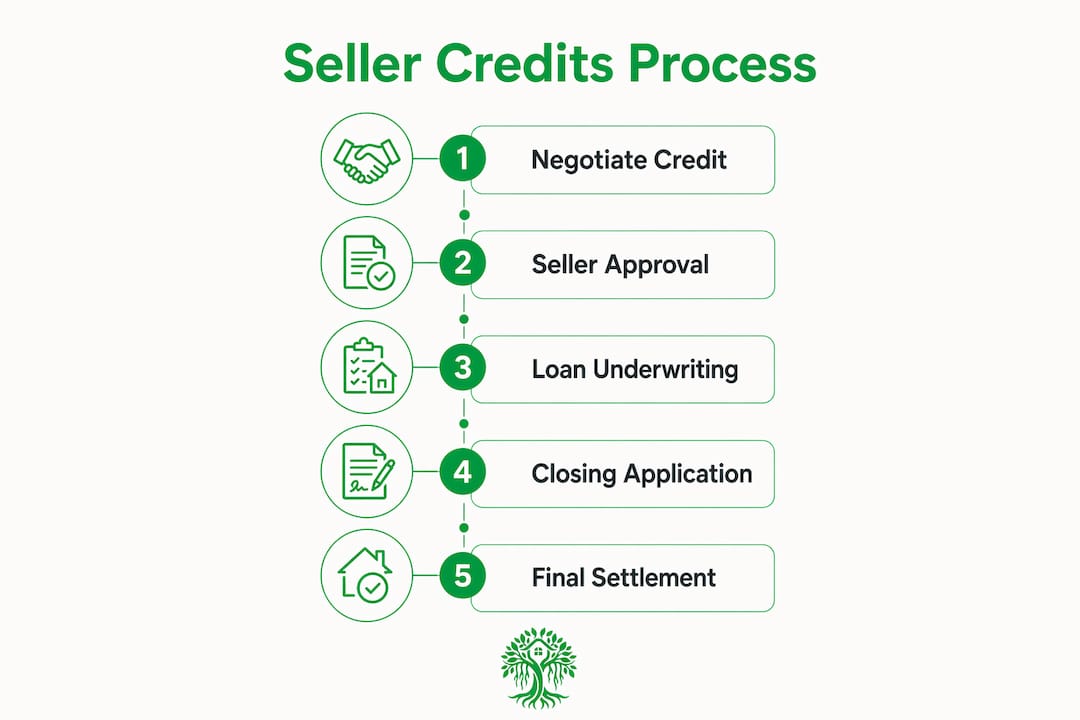
Seller credits enter the deal during offer negotiations. You write the credit amount into the purchase contract, and the seller agrees to it as a condition of the sale. From that point, the credit sits in the deal until closing day, when it gets applied against your itemized closing fees on the settlement statement.
Your lender plays a central role here. Before you request a specific dollar amount, your loan officer should give you a Loan Estimate showing projected closing costs. That number becomes your ceiling. Requesting a credit larger than your actual costs creates a problem at underwriting, not just at closing.
- Include the credit amount and purpose explicitly in the purchase contract
- Share the credit terms with your lender immediately after the contract is signed
- Confirm the credit appears correctly on the Closing Disclosure before signing
The credit also affects loan underwriting. If the agreed sale price is $400,000 and the seller offers $10,000 in credits, the lender still underwrites the loan at $400,000. The appraisal must support that price. If it doesn’t, the credit cap recalculates on the lower appraised value, which can shrink what the seller is allowed to contribute.
Pro Tip: Ask your lender for a revised Loan Estimate after the purchase contract is signed. That document will show exactly how the seller credit applies and whether any amount is at risk of being wasted.
What seller credits can and cannot pay for
The list of allowable costs is broader than most buyers expect, but the prohibited uses are absolute across every loan program.
Seller credits can cover:
- Loan origination charges and processing fees
- Appraisal, inspection, and credit report fees
- Title insurance (both lender’s and owner’s policies)
- Escrow and settlement fees
- Prepaid homeowners insurance premiums
- Property tax escrow deposits
- Discount points and rate buydowns, including temporary buydowns
- Upfront Mortgage Insurance Premium (UFMIP) on FHA loans
Seller credits cannot cover:
- Your down payment or minimum required investment
- Cash reserves required by the lender
- Any amount exceeding your actual closing costs
- Personal property, moving expenses, or cash payments to you
The prohibition on down payment contributions is firm across FHA, VA, conventional, and USDA programs. A seller who tries to funnel money toward your down payment through any channel creates a compliance problem that can kill the loan. The FHA draws this line clearly: closing costs can come from the seller within the applicable cap, but the down payment must come from you or an approved gift donor with no financial interest in the sale.
Loan-type caps on seller credits in 2026
Every loan program sets a maximum. Exceeding the cap doesn’t just waste money. It triggers a dollar-for-dollar reduction in the purchase price the lender uses to calculate your loan, which shrinks your maximum loan amount and forces you to bring more cash to closing.
Conventional loans (Fannie Mae / Freddie Mac): Caps are tiered by down payment:
- Less than 10% down: seller can contribute up to 3% of the purchase price
- 10%–24.99% down: seller can contribute up to 6%
- 25% or more down: seller can contribute up to 9%
- Investment properties have a lower cap, regardless of down payment
FHA loans: HUD caps seller concessions at 6% of the lesser of the sales price or appraised value. Every dollar above that threshold is reclassified as an “inducement to purchase” and reduces the price used for the loan calculation. HUD increased FHA loan limits for 2026 to reflect rising property values, which can raise the total dollar amount a seller can contribute, but the 6% percentage cap stays fixed.
VA loans: The VA treats closing costs and concessions as two separate categories. Sellers can pay all of your standard closing costs with no cap applied to those payments. The 4% cap applies only to concessions, which the VA defines as extras like the VA funding fee, prepaid taxes and insurance beyond what’s customary, and payoff of your debts. You can receive full closing cost coverage and still have the entire 4% concession allowance available on top.
USDA loans: The Rural Development program allows seller contributions up to 6% of the purchase price, similar to FHA rules.
Fannie Mae’s 2026 guideline updates removed the fixed dollar cap on lender incentives but require separate documentation of seller credits versus lender incentives. If your lender is affiliated with an interested party to the transaction, their incentives are treated as sales concessions and subject to stricter limits.
Seller credits vs. seller concessions: what’s the difference?
These terms get used interchangeably, but they are not the same thing, and the distinction can cost you negotiating power if you miss it.
Seller credits refer specifically to payments the seller makes toward your documented closing costs. They are financing concessions, applied line by line against fees on your settlement statement.
Seller concessions is a broader term covering anything of value the seller adds to the transaction at no cost to you, including items that go beyond standard closing costs. The VA Lender’s Handbook makes this distinction explicit in Chapter 8 of VA Pamphlet 26-7.
Key differences to know:
- On VA loans, closing costs paid by the seller are not concessions under the handbook’s definition and don’t count against the 4% cap
- On conventional and FHA loans, both terms generally fall under the same cap calculation
- Lender overlays can impose stricter combined limits than the VA or GSE guidelines actually require
- Fannie Mae distinguishes seller credits from lender incentives; lender-affiliated incentives are treated as sales concessions with tighter restrictions
If you’re using a VA loan, ask your lender directly whether they apply the 4% cap to all seller contributions or only to concessions as the VA Lender’s Handbook defines them. Many retail lenders apply a blanket 4% rule that goes beyond what VA guidelines actually require. That’s a lender overlay, and it limits what you can realistically negotiate. For a deeper look at negotiating seller concessions, the distinction between these two categories is where most buyers leave money on the table.
How to negotiate seller credits effectively
Seller credits are a negotiation tool, not a given. Misunderstanding the caps or asking for the wrong amount can trigger loan reissues or reduce your maximum loan. Here’s how to approach it correctly.
- Get your Loan Estimate first. Your loan officer can project closing costs before you make an offer. That number tells you exactly how much to request. Asking for $12,000 when your actual costs are $9,000 wastes the overage.
- Request credits tied to real expenses. Arbitrary round numbers raise flags at underwriting. Tie your request to the itemized fees on your Loan Estimate.
- Use the inspection as a second opportunity. If the home inspection reveals repair needs, you can negotiate a post-inspection seller credit instead of a price reduction. This keeps your loan amount intact while reducing your out-of-pocket costs.
- Stay under the cap. Know your loan program’s limit before the contract is written. Exceeding it doesn’t give you more money. It reduces your loan amount dollar for dollar.
- Check for lender overlays. Your lender may impose limits stricter than the program guidelines. Confirm this before you negotiate, not after the contract is signed.
Pro Tip: In a buyer’s market, sellers are more willing to offer credits to close the deal. In a competitive market, a credit request can weaken your offer. Time your ask based on market conditions, not just your cash position.
For buyers in California, the seller concession process has some state-specific nuances worth reviewing before you make your offer.
How seller credits affect the sale price and appraisal
Seller credits don’t reduce the official sale price. The contract price stays the same, and the lender underwrites the loan against that number. What changes is how much cash you bring to closing.
The appraisal, though, can create a real problem. FHA and conventional guidelines calculate the credit cap based on the lesser of the sale price or the appraised value. If you agree to buy at $310,000 and the appraisal comes back at $295,000, the FHA’s 6% cap now applies to $295,000, not $310,000. A seller who committed to $18,000 in credits is now $300 over the limit, and that overage gets reclassified as an inducement to purchase, which reduces the price the lender uses to calculate your loan. The adjusted value drops, your maximum loan shrinks, and you owe more at closing than you planned. This scenario catches buyers off guard more than almost any other closing cost issue.
Tax implications of seller credits
For most buyers, seller credits carry no direct tax consequence. The credits reduce your out-of-pocket costs at closing but don’t change your cost basis in the property. Your cost basis for capital gains purposes is still the full purchase price, not the price minus the credits.
For sellers, the IRS generally does not treat a properly disclosed seller credit as a taxable gift when it falls within standard real estate practice and stays within program limits. If a seller contributes an amount that exceeds the allowable cap and that excess is classified as a gift, the seller may need to file a gift tax return. This situation is uncommon in standard transactions, but it’s worth flagging if you’re negotiating unusually large credits outside normal program parameters.
Discount points paid by the seller on your behalf may be deductible by you as mortgage interest in the year of purchase, depending on your tax situation. Consult a tax professional for guidance specific to your transaction.
How seller credits affect the seller’s net proceeds
Every dollar the seller credits to you comes directly out of their proceeds. A seller who accepts $400,000 and agrees to $10,000 in credits walks away with $390,000 before their own closing costs, agent commissions, and any outstanding mortgage balance. For a full picture of what sellers net after fees, the seller’s closing cost breakdown shows how credits stack against other seller-side expenses.
Sellers sometimes prefer to offer credits rather than reduce the list price because the math works differently for both parties. A $10,000 price reduction lowers the buyer’s loan amount and monthly payment slightly. A $10,000 credit keeps the loan amount the same but puts cash back in the buyer’s pocket at closing. For a buyer short on cash to close, the credit is often worth more than the equivalent price cut. Sellers who understand this dynamic can use credits strategically to attract buyers without dropping their asking price.
Key Takeaways
Seller credits reduce your closing day cash by having the seller pay specific, lender-approved fees, but every loan program caps the total amount and prohibits using credits toward your down payment.
| Point | Details |
|---|---|
| Credits cover closing costs only | Allowable uses include origination fees, title insurance, prepaid taxes, and discount points. Down payments are never covered. |
| Conventional caps vary by down payment | Fannie Mae and Freddie Mac set caps at 3%, 6%, or 9% depending on how much you put down, and investment properties are capped at 2% regardless of down payment. |
| FHA cap is 6% | HUD limits seller contributions to 6% of the lesser of the sale price or appraised value. |
| VA treats credits and concessions separately | Standard closing costs have no cap under VA rules; the 4% cap applies only to concessions as the VA Lender’s Handbook defines them. |
| Exceeding the cap shrinks your loan | Any overage reduces the purchase price used for loan calculation dollar for dollar, increasing your cash needed at closing. |
FAQ
Do seller credits count as closing costs?
Seller credits are payments toward your closing costs, not closing costs themselves. They offset fees you would otherwise pay out of pocket, reducing your cash needed at closing.
What does $5,000 in seller concessions mean?
It means the seller has agreed to pay an agreed amount toward your closing fees at settlement. That amount applies against itemized costs on your Closing Disclosure and cannot be taken as cash.
Is it better to get a seller credit or a lower price?
A lower price reduces your loan amount and long-term interest. A seller credit reduces your upfront cash at closing. If you’re short on funds to close, the credit often delivers more immediate value than an equivalent price reduction.
What does 3% seller credit mean?
A 3% seller credit means the seller will contribute 3% of the purchase price toward your closing costs. For example, on a $400,000 home, this percentage cap applies to calculate the maximum seller contribution allowed by lenders.
Navigating seller credits is one of the more technical parts of buying a home, and getting the numbers wrong can cost you at the closing table. Ficustree gives first-time buyers in California and Texas the decision tools and direct representation to negotiate credits confidently, without overpaying for guidance. Buyers pay a closing fee plus commission and may keep a rebate where permitted.

Start your search at ficustree.ai →
Recommended
- How to Ask for Seller Concessions in California (2026)
- California Closing Costs Breakdown for First-Time Buyers – ficustree.ai
- How to Review California Buyer Disclosures(What’s at Stake)

Leave a Reply