
E-closing in real estate is defined as the process of completing a home purchase or mortgage closing electronically, replacing paper documents with digital signatures, electronic notarization, and secure online document delivery. As of 2026, 90% of mortgage lenders offer some form of digital closing option, making this the new standard rather than the exception. The three core formats are hybrid e-closing, In-Person Electronic Notarization (IPEN), and Remote Online Notarization (RON). Platforms like Snapdocs have driven adoption across lenders, title companies, and settlement agents. Whether you are a first-time buyer or a seasoned real estate professional, understanding how e-closing works puts you ahead of the process before you ever sit down to sign.
What is e-closing in real estate and how does it work?
E-closing in real estate, also called online closing or virtual real estate closing, is the digital execution of all documents required to transfer property ownership and fund a mortgage loan. The process relies on three technology pillars: eClose (the digital signing platform), eNote (the electronic promissory note), and eVault (the secure digital storage system). Together, these components replace the traditional stack of paper documents that once required a physical room, a notary, and two to three hours of your afternoon.
The e-closing process follows a clear sequence regardless of which format your lender uses:
- Document preparation. Your lender and title agent prepare all closing documents digitally and upload them to an eClose platform such as Snapdocs or Stavvy.
- Pre-closing review. You receive a secure link to review documents before closing day, often 24 to 48 hours in advance. This alone eliminates the “surprise stack of paper” problem at the table.
- Electronic signing. On closing day, you sign documents using an electronic signature tool. The platform flags any missing signatures or initials before you can submit, which is the error-proofing advantage that paper closings simply cannot replicate.
- Notarization. Depending on your closing type, a notary is either present in person (IPEN), or joins via video call under RON. RON allows borrowers and notaries to meet remotely via live video, with documents digitally signed and legally notarized in real time.
- Funding and recording. Once all signatures are confirmed, the eNote is transmitted to the lender’s eVault, the loan funds, and the deed is recorded electronically with the county.
Pro Tip: Review every document during the pre-closing window, not just on signing day. Ask your lender or title agent to walk you through the loan estimate versus the closing disclosure line by line before you log in to sign.
Benefits of e-closing and why adoption is accelerating in 2026

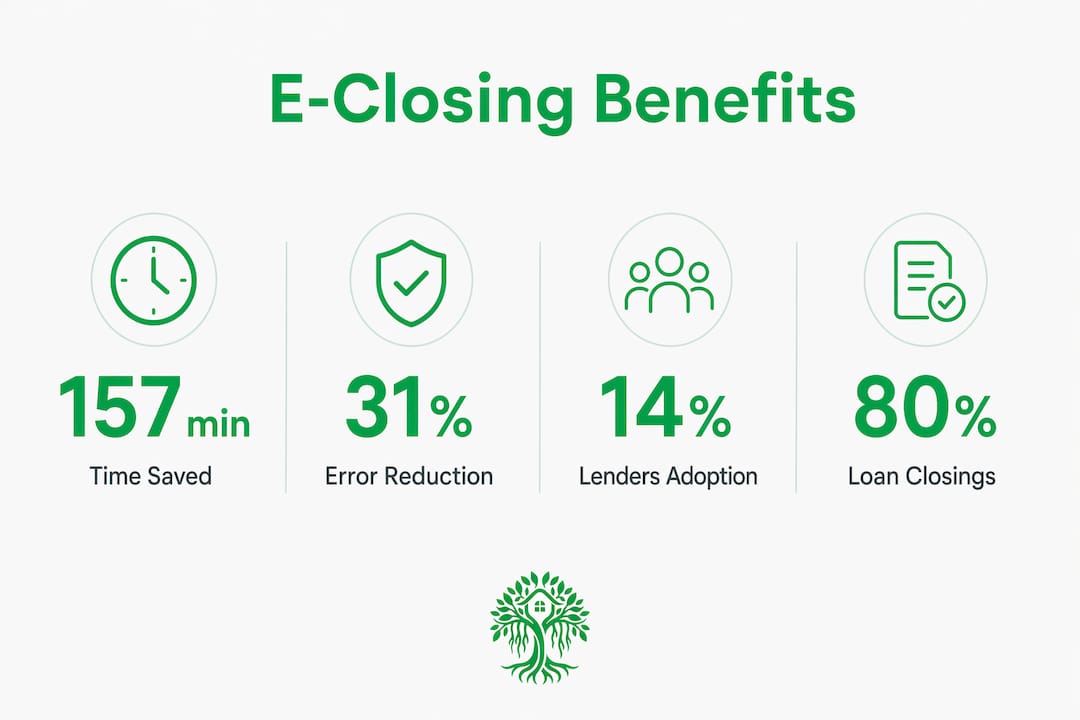
The operational case for e-closing is no longer theoretical. Transitioning to RON-based e-closings saves up to 70 minutes of internal work per loan, reduces total transaction time by 157 minutes, and cuts document errors by 31%. For a lender closing hundreds of loans per month, those numbers translate directly into cost savings and faster funding cycles.
The borrower experience tells the same story. According to Snapdocs research, 83% of lenders report improved borrower satisfaction after adopting e-closing technology, 82% note greater staff efficiency, and 79% observe fewer document errors. That trifecta of outcomes explains why lender investment in digital closing platforms has continued to grow even as mortgage volume has fluctuated.
“Usability and security have overtaken cost as the primary decision factors for lenders selecting eClosing platforms.” — Snapdocs 2025 Industry Study
That shift in priorities matters for buyers too. When your lender chooses an eClose platform based on borrower usability rather than just price, the signing experience is cleaner, the interface is intuitive, and the support is more responsive. The gap between a well-implemented digital closing and a poorly designed one is significant.
Despite these gains, the adoption gap is real. Only 14% of lenders with eClosing technology actually close more than 80% of their loans digitally. The remaining 86% offer the capability but rely on it inconsistently. The barriers include staff training gaps, inconsistent state laws, and secondary market requirements that still demand wet signatures on certain loan types. This means your access to a fully digital closing depends heavily on which lender you choose and where you are buying.
Hybrid vs. full digital e-closing: which one applies to you?
The distinction between hybrid and fully digital e-closing is the most misunderstood part of the entire process, and it has real consequences for how you plan your closing day.
Hybrid e-closing is currently the most common format. Hybrid e-closing combines electronic signing for the majority of documents with wet signatures on a small set of critical instruments, most commonly the Deed of Trust or Mortgage and the Promissory Note. The reason is legal and fraud-related. Certain documents carry such significant financial and legal weight that many states and loan investors still require a physical signature and in-person notarization. You still attend a closing in person or with a notary present, but the bulk of the paperwork is handled digitally before you arrive.
Full digital e-closing via RON eliminates the in-person requirement entirely. You sign every document electronically, and a commissioned RON notary verifies your identity and witnesses your signatures via live video. The session is recorded, and the documents are tamper-evident from the moment they are sealed. This format offers maximum flexibility, particularly for buyers relocating from another state or purchasing investment property remotely.
The practical differences come down to three factors:
- Scheduling. RON closings can happen evenings or weekends since the notary is remote. Hybrid closings still require coordinating with a local title office.
- Questions. In a hybrid closing, your agent or attorney is physically present to answer questions. In a full RON session, you need to schedule legal or financial consultations in advance since no one is in the room with you.
- Eligibility. E-closing eligibility depends on your lender’s technology, your state’s RON laws, and the requirements of the secondary market investor purchasing your loan. All three must align before a fully remote closing is possible.
Pro Tip: Before assuming you qualify for a RON closing, ask your lender three direct questions: Does your platform support RON? Does my state authorize it? And does the loan investor allow it? Missing any one of these means you will need a hybrid or in-person closing instead.
Understanding the role of a real estate attorney in your closing is especially relevant here. In attorney-required states like Massachusetts, Georgia, and South Carolina, an attorney must supervise the closing regardless of whether it is digital or in person.
How eVault and eNote transform mortgage funding
The e-closing process does not end when you click “sign.” What happens in the minutes after your last signature determines how quickly your loan funds and your deed records. This is where eNote and eVault become critical.
An eNote is a legally binding electronic promissory note, the document in which you promise to repay your mortgage. Unlike a paper note, an eNote is registered on the MERS eRegistry, a national database maintained by Mortgage Electronic Registration Systems, Inc. that tracks ownership and transfer of electronic notes. This registration makes the eNote instantly transferable between lenders and investors without physical delivery.
An eVault is a secure digital repository that stores the eNote and other critical closing documents. It maintains a tamper-evident audit trail and controls who can access, transfer, or modify the document. When your lender sells your loan on the secondary market, the eNote transfers from one eVault to another in minutes rather than days.
| Component | Function | Key Benefit |
|---|---|---|
| eClose | Digital signing platform for all closing documents | Eliminates paper, catches errors before submission |
| eNote | Electronic promissory note registered on MERS eRegistry | Enables instant loan transfer and funding |
| eVault | Secure digital storage and custody system | Tamper-proof audit trail, faster secondary market sale |
The integration of eClose, eNote, and eVault enables real-time mortgage funding, which means your loan can fund the same day you sign rather than waiting 24 to 48 hours for paper documents to be couriered and reviewed. For buyers in competitive markets, same-day funding can be the difference between getting the keys and waiting another business day. The digital mortgage stack also reduces fraud exposure because every document interaction is logged, timestamped, and cryptographically sealed.
Key takeaways
E-closing is the most significant operational shift in residential real estate since the introduction of online mortgage applications, and the lenders who implement it fully are delivering measurably better outcomes for borrowers.
| Point | Details |
|---|---|
| Three e-closing formats exist | Hybrid, IPEN, and RON serve different eligibility situations and buyer needs. |
| Adoption gap is wide | 90% of lenders offer e-closing, but only 14% use it for more than 80% of loans. |
| RON saves significant time | Remote Online Notarization reduces transaction time by 157 minutes and errors by 31%. |
| Eligibility has three gates | Lender technology, state law, and loan investor policy must all permit digital closing. |
| eNote and eVault enable same-day funding | The full digital mortgage stack allows real-time loan transfer and faster key delivery. |
Why the adoption gap tells you more than the technology does
I have spent years watching technology get adopted in real estate, and the pattern is always the same. The tool arrives, the early adopters love it, and then the majority stalls. E-closing is no different. The 14% high-adoption figure is not a technology failure. It is a change management failure.
The lenders closing more than 80% of loans digitally are not using better software. They are running better training programs, setting clearer borrower expectations, and choosing platforms based on usability scores rather than contract price. The buyers who have the smoothest e-closing experiences are the ones who reviewed their documents 48 hours before signing day, not the ones who opened the link for the first time at the virtual table.
My honest observation after watching this space closely: hybrid e-closing is not a stepping stone to full RON. For many transactions, it is the right permanent answer. The Deed of Trust carries legal weight that some states will not digitize for years, and that is not a problem to solve. It is a boundary to respect. What matters is that the 200-plus pages of supporting documents are handled digitally, error-proofed, and delivered to you in advance.
The next five years will not be about whether e-closing exists. Every lender will offer it. The real competition will be over which platforms make the experience genuinely easy for buyers who are not tech-savvy, and which lenders invest in the training to back it up. If you are buying a home today, ask your lender not just whether they offer e-closing, but what percentage of their loans actually close digitally. That number tells you everything about their commitment to the process. You can also explore AI-powered home search tools that are already integrating closing-stage guidance into the buyer experience.
— Anand
Ready to close smarter with Ficustree?
Ficustree is an AI-powered real estate platform built specifically for buyers who want guidance from search to closing on a single platform.

When your lender offers e-closing, you want to arrive prepared, not surprised. Ficustree guides you through every stage of the home buying process, including what to expect at closing, how to review your documents, and how to ask the right questions before you sign. The platform pairs AI-driven home matching with personalized closing-stage support so nothing falls through the cracks. Learn more about how Ficustree works and start your search today.
FAQ
What is e-closing in real estate?
E-closing is the process of completing a real estate or mortgage closing using electronic signatures, digital documents, and online or video notarization instead of paper-based, in-person methods. The three main formats are hybrid e-closing, IPEN, and Remote Online Notarization (RON).
What is the difference between hybrid and RON e-closing?
Hybrid e-closing uses electronic signatures for most documents but still requires wet signatures on critical instruments like the Deed of Trust, while RON allows the entire closing to happen remotely via video call with a commissioned electronic notary.
How do I know if I qualify for an e-closing?
E-closing eligibility depends on three factors: your lender’s technology capabilities, your state’s authorization of RON, and the requirements of the secondary market investor purchasing your loan. Ask your lender directly before assuming remote closing is available.
What are the main benefits of e-closing for homebuyers?
E-closing reduces total transaction time by up to 157 minutes, cuts document errors by 31%, and allows you to review all closing documents before signing day. It also enables same-day loan funding when the full eClose, eNote, and eVault stack is in place.
Is e-closing secure?
Yes. RON sessions are recorded and documents are cryptographically sealed, creating a tamper-evident audit trail. eNotes are registered on the MERS eRegistry, and eVaults maintain strict access controls that exceed the security of physical document storage.
Recommended
- How to Review California Buyer Disclosures(What’s at Stake)
- First-Time Homebuyer Mistakes California Buyers Must Avoid – ficustree.ai
- First Time Homebuyer Guide: Simple Steps for Your First Home
- How to Ask for Seller Concessions in California (2026)

Leave a Reply