Windstorm insurance isn’t mandatory under Texas state law, but if you own property in a first-tier coastal county or Harris County, your mortgage lender will almost certainly require it, and standard homeowners policies there typically exclude wind and hail. The Texas Windstorm Insurance Association (TWIA) exists as the insurer of last resort for these areas. Your first move: check your lender’s requirement and search for a WPI-8 certificate on the property.
TL;DR:
- Private insurers frequently exclude wind and hail coverage in first-tier coastal counties, making TWIA or a separate wind endorsement essential for homeowners.
- The typical windstorm policy covers damages to the structure, detached structures, personal belongings, and temporary living expenses, but excludes flood, wear and tear, and landscaping.
- Obtaining a valid WPI-8 Certificate of Compliance is crucial, as its absence can block TWIA coverage and harm resale value, with inspections triggered by new construction or significant modifications.
- Windstorm premiums vary based on construction type, proximity to the coast, coverage limits, and deductible choice, with percentage deductibles often resulting in higher out-of-pocket costs.
- Buyers should verify WPI-8 existence before closing, ask for seller claims history, and build insurance premiums into their affordability assessments to avoid surprises on closing day.
Table of Contents
- What Does Windstorm Insurance Cover in Texas?
- Where Is Windstorm Coverage Required in Texas?
- What Is TWIA and Why Does It Exist?
- How Do You Check a WPI-8 Certificate?
- How Much Does Windstorm Insurance Cost in Texas?
- How Do You Get Windstorm Coverage in Texas?
- How Do You File a Windstorm Claim in Texas?
- Mitigation Credits and a Buyer’s Due-Diligence Checklist
- What Should You Do Before, During, and After a Windstorm?
- What Do Texas Windstorm Policies Typically Exclude?
- How Does Windstorm Insurance Work With Your Homeowners Policy?
- What Options Exist Beyond Appraisal for Claim Disputes?
- How Do You Choose a Windstorm Insurance Agent in Texas?
- An Editorial Take on Windstorm Costs and Offer Strategy
- How Ficustree Helps You Factor Windstorm Costs Into Your Offer
- Where to Verify Windstorm Rules and Coverage
- Sources
- FAQ
What Does Windstorm Insurance Cover in Texas?
Windstorm insurance pays to repair or rebuild a home damaged by wind or hail, including damage tied to hurricanes, tropical storms, and tornadoes. It does not cover flooding, even when a hurricane causes the flood. That’s a separate policy entirely, through the National Flood Insurance Program or a private flood carrier.
A typical windstorm policy breaks coverage into four parts:
- Dwelling coverage: repairs or rebuilds the structure itself.
- Other structures: detached garages, fences, and sheds.
- Personal property: furniture, electronics, and belongings damaged by wind-driven rain or hail.
- Loss of use: hotel bills and living expenses if the storm makes your home temporarily unlivable.
Buyers often assume their homeowners policy already includes this. In coastal Texas, it frequently doesn’t. Wind and hail get carved out entirely, leaving TWIA or a separate wind endorsement as the only way to fill the gap.
Where Is Windstorm Coverage Required in Texas?
Texas doesn’t mandate windstorm insurance statewide, but geography and your lender decide the question for you in practice. The requirement clusters around the coast.
- First-tier coastal counties: These sit directly on the Gulf, including Galveston, Nueces, Aransas, and Cameron. Private insurers routinely exclude wind and hail here, pushing homeowners toward TWIA.
- Harris County exception: Parts of Harris County near the coast fall under TWIA’s designated catastrophe area, even though the county as a whole isn’t classified as first-tier.
- Lender-driven requirement: Even where state law is silent, mortgage lenders in these zones typically will not close a loan without proof of windstorm coverage, separate from your flood or homeowners policy.
- Inland surprises: Some inland private carriers exclude wind and hail from otherwise standard homeowners insurance, particularly after several rounds of severe hail losses. Always check your declarations page for a wind/hail exclusion, wherever you’re buying.
If you’re shopping for a home near the coast, the safest assumption is that Texas storm insurance rates and requirements will factor into your closing timeline, not just your monthly payment.
What Is TWIA and Why Does It Exist?
TWIA is a residual-market insurer created under Texas Insurance Code Chapter 2210 to provide windstorm and hail coverage when private insurers won’t. It doesn’t compete with private carriers. It exists because they’ve largely withdrawn from wind and hail exposure along the coast, leaving a gap that would otherwise strand thousands of homeowners without coverage.
Eligibility isn’t automatic. A property must sit inside the designated catastrophe area, and applicants generally need a declination from at least one private insurer before TWIA will write a policy. Many structures also need a Certificate of Compliance, the WPI-8, before TWIA will insure them at all.
TWIA’s funding works in layers, not a single pool of cash:
- Policyholder premiums and TWIA’s own reserves cover routine losses.
- Catastrophe reserve funds and state-authorized financing kick in for larger events.
- Member insurer assessments and reinsurance backstop the system in a severe hurricane season.
This layered funding structure matters to you as a policyholder because it’s part of why TWIA covers wind and hail only, nothing else. Keep that boundary in mind. It’s the single most common misunderstanding among first-time coastal buyers.
How Do You Check a WPI-8 Certificate?
The Windstorm Inspections Program has existed since 1988, and it runs on a small alphabet soup of forms that each mean something different.
- WPI-1: The application for inspection, filed before construction or major renovation begins.
- WPI-2: The inspector’s report confirming the work meets windstorm building code.
- WPI-8: The Certificate of Compliance itself, the document TWIA and most coastal insurers require before writing a policy.
- WPI-8-E: A temporary certificate issued when final inspection is pending but the structure is otherwise substantially complete.
You can look up an existing WPI-8 record through the Texas Department of Insurance’s online database using the property address. If the record is missing or wrong, contact TDI’s Windstorm Inspections Program directly. Don’t wait until closing week to sort it out.
Timing matters more than most buyers expect. New construction, additions, roof replacements, and window retrofits in the catastrophe area all trigger a fresh inspection requirement. Skip it, and you may find the home uninsurable through TWIA regardless of its actual condition.
Pro Tip: A missing WPI-8 doesn’t just block TWIA coverage today. It can scare off a private carrier’s underwriter and lower your resale value later, since the next buyer’s insurer will ask the same question.
How Much Does Windstorm Insurance Cost in Texas?
Windstorm premiums swing widely based on where the home sits, how it’s built, and what deductible you choose. There’s no flat number that applies to every coastal property.
Deductibles come in two flavors, and the difference changes your out-of-pocket cost dramatically:
- Flat deductible: A set dollar amount, say $1,000, regardless of the loss size.
- Percentage deductible: A percentage of the dwelling coverage limit, often 1% to 5%. On a $300,000 dwelling limit, a 2% deductible means you cover the first $6,000 of any claim yourself.
Premium drivers include:
- Construction type and age (masonry generally costs less to insure than frame construction).
- Proximity to the coastline.
- Coverage limits and the deductible percentage you select.
- Mitigation credits for code-compliant construction and protected openings.
The Texas Department of Insurance notes that windstorm coverage costs vary substantially by location and structure, which is exactly why two neighbors on the same street can pay very different premiums depending on when their roof was last replaced.
How Do You Get Windstorm Coverage in Texas?
Getting covered follows a sequence, and skipping a step usually means starting over.
- Contact a licensed agent first. TWIA applications must be submitted through a Texas-licensed agent, not directly by the homeowner.
- Try the private market. Your agent will typically shop private wind/hail coverage before considering TWIA.
- Get a declination if private coverage falls through. A declination isn’t just a “no.” An offer that isn’t substantially equivalent to the coverage you’re seeking can also count, a nuance worth confirming with your agent before you assume you’re stuck.
- Submit the TWIA application with your WPI-8 if the structure requires one.
- Do this early. You cannot obtain a new TWIA policy while a named storm sits in the Gulf of Mexico. Waiting until a hurricane watch is issued means you’re too late.
How Do You File a Windstorm Claim in Texas?
File as soon as it’s safe to inspect the property, either through your agent, the TWIA website, or by phone. Photograph everything before you touch anything, and keep receipts for any emergency repairs, tarps, or temporary lodging.
- Report the claim promptly. Delayed filing complicates the adjuster’s ability to tie damage to the specific storm.
- Expect an inspection, often paired with aerial imagery review, followed by a repair estimate.
- If you disagree with the payout, most policies offer an appraisal window, a defined period during which you can invoke a formal appraisal process rather than accepting the initial number.
Pro Tip: Keep a folder, physical or digital, with your policy declarations page, the WPI-8, and dated storm photos before hurricane season even starts. You’ll move through the claim twice as fast when you’re not hunting for paperwork after the fact.
Mitigation Credits and a Buyer’s Due-Diligence Checklist
Premium credits reward homes built to current wind codes and homes with protected openings, meaning storm shutters or impact-rated windows and doors. Retrofits qualify too, but only once an inspector certifies the work and it’s logged into the WPI system.
- Ask your insurer or agent which specific upgrades qualify for a credit before you spend money on them.
- If you’re retrofitting, schedule the inspection before you close up the walls, not after.
- As a buyer, verify the WPI-8 exists and matches the current structure, not an earlier version of the home.
- Request the seller’s insurance claims history and current windstorm declarations page during due diligence.
- Build an inspection and insurance contingency into your offer, giving you room to walk away if the WPI-8 is missing or the estimated premium busts your budget.
Pro Tip: Run the windstorm premium estimate before you finalize your offer price, not after. A tool like Ficustree’s affordability calculator folds insurance costs into your true monthly payment, so a coastal listing that looks affordable on paper doesn’t turn into a budget problem at closing.
What Should You Do Before, During, and After a Windstorm?
Preparation before the storm determines how smoothly your claim goes afterward. Start with your paperwork: confirm your windstorm policy number, deductible type, and WPI-8 status are all current, and store copies somewhere other than the house itself, ideally in cloud storage or with a family member inland.
Before the storm arrives, walk the property and photograph every exterior surface, including the roof if you can safely access it, along with fences, detached structures, and any recent improvements like new windows or shutters. Bring in or secure loose outdoor items that could become debris. Note your home’s current condition in writing, with a timestamp, since this becomes your baseline for comparison.
During the storm, your only job is staying safe. Don’t attempt repairs, don’t go outside to “check on things,” and don’t try to document damage while wind and hail are still active. Insurers expect claimants to avoid unnecessary risk, and a mid-storm injury complicates everything.
After the storm, once local authorities confirm it’s safe, photograph the damage from multiple angles before making any repairs. Make only the temporary repairs necessary to prevent further damage, tarping a roof or boarding a broken window, and keep every receipt. Contact your agent or TWIA to open a claim immediately rather than waiting to see if damage “gets worse.” Write a room-by-room inventory of damaged contents while details are fresh. Avoid signing anything from a door-to-door contractor promising a quick fix; verify licensing and insurance before hiring anyone for storm repairs, especially in the chaotic days right after a major hurricane.
What Do Texas Windstorm Policies Typically Exclude?
Texas windstorm coverage is narrower than most new buyers expect, and the exclusions matter as much as the coverage itself.
Flood damage sits at the top of the list. Even when a hurricane’s storm surge causes the water damage, a windstorm policy won’t pay for it; that requires flood insurance through the National Flood Insurance Program or a private flood carrier. This trips up buyers constantly, since “the hurricane caused it” doesn’t automatically mean “windstorm insurance covers it.”
Other common exclusions and limitations include:
- Wear and tear or pre-existing damage. An adjuster who finds evidence of an older, unrepaired roof problem may attribute some damage to prior neglect rather than the storm.
- Landscaping and pools, which are often limited or excluded entirely depending on the policy’s specific terms.
- Business personal property, if you run a home-based business, which typically needs a separate commercial policy rider.
- Mechanical breakdown, such as an air conditioning compressor failure unrelated to direct wind or hail impact.
- Ordinance or law upgrades, meaning the cost to rebuild to current building code standards beyond your prior structure, unless you’ve purchased a specific endorsement for it.
TWIA policies add one more limitation worth flagging: they cover wind and hail only. No fire, no theft, no liability. That’s why most coastal homeowners carry a TWIA policy alongside a standard homeowners policy that handles everything else, rather than treating either one as a complete solution on its own.
How Does Windstorm Insurance Work With Your Homeowners Policy?
Windstorm insurance in Texas usually doesn’t replace your homeowners policy. It fills the specific hole that policy leaves open in high-risk coastal areas. Think of it less as a competing product and more as a puzzle piece that has to click into the rest of your coverage exactly right.
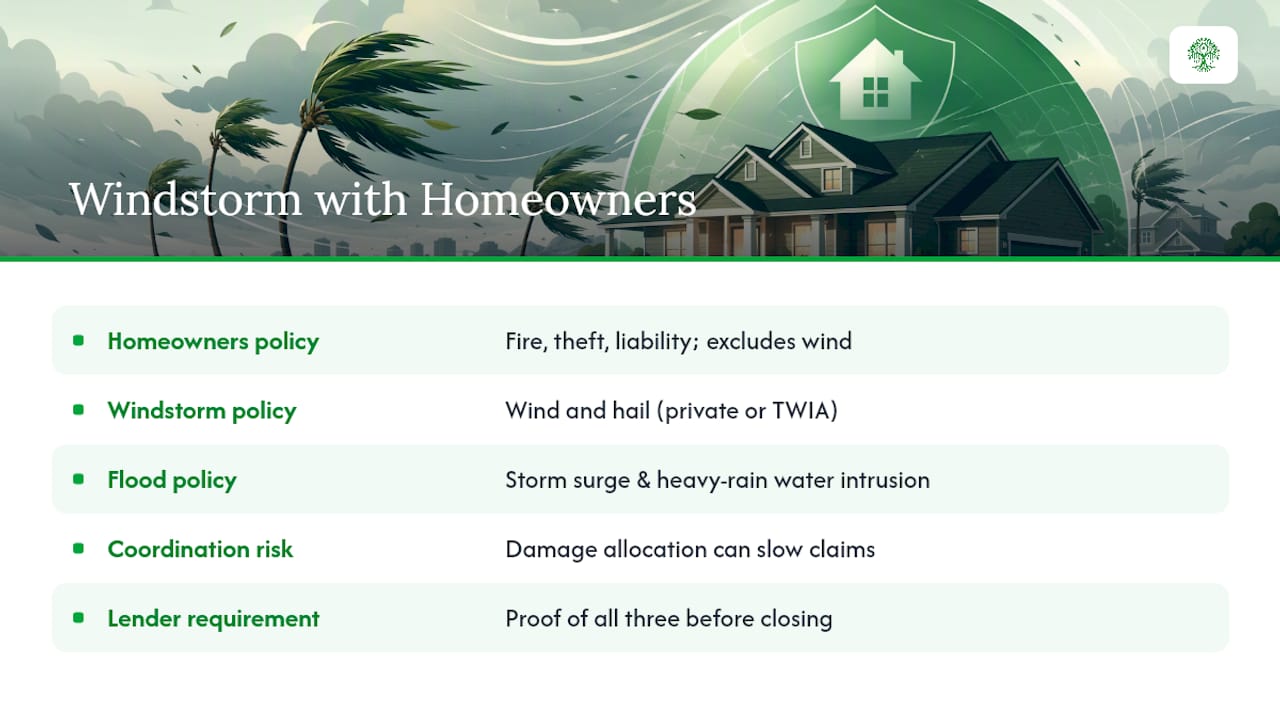
In practice, this means a coastal homeowner often carries three separate policies working together: a homeowners policy covering fire, theft, liability, and everything not wind-related; a windstorm policy (private or through TWIA) covering wind and hail specifically; and a flood policy covering water intrusion from storm surge or heavy rain. Miss one, and you’ve got a gap nobody catches until a claim gets denied.
The coordination gets tricky after a hurricane, since wind and flood damage often hit the same property simultaneously. Insurers and adjusters have to determine which peril caused which damage, a process that can slow claims when the two policies come from different carriers. Keeping detailed, dated photos of damage as it appears, before any cleanup begins, gives both adjusters the evidence they need to allocate the claim correctly instead of arguing over it.
Your mortgage lender typically requires proof of all three coverages before closing in a designated catastrophe area, and letting any one lapse can put you in default on your loan terms, not just uninsured. If you’re bundling homeowners and windstorm coverage with different carriers, keep both declarations pages together and review them every renewal to confirm the wind/hail exclusion language on your homeowners policy still matches what your windstorm policy is actually covering.
What Options Exist Beyond Appraisal for Claim Disputes?
Appraisal is the most commonly used dispute tool, but it isn’t the only one, and it isn’t always the right first move.
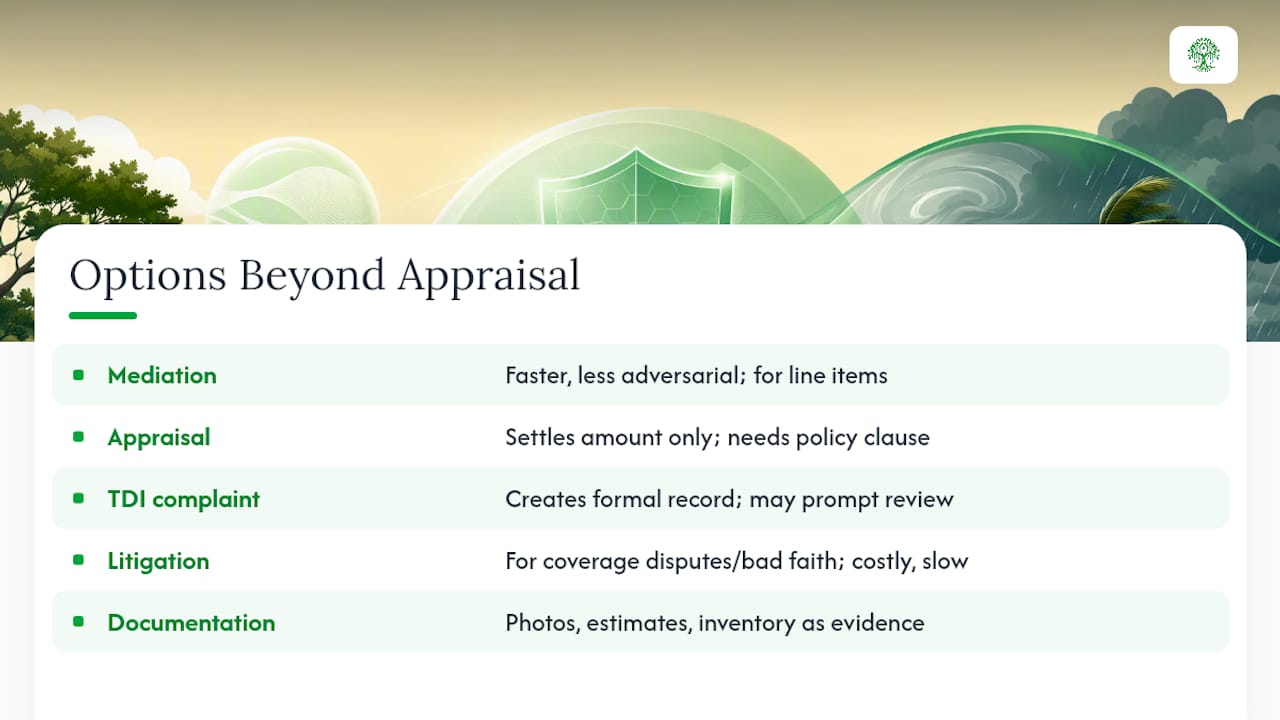
Mediation offers a faster, less adversarial alternative. A neutral third party helps you and the insurer negotiate toward a settlement without the formality of appraisal or the cost of litigation. The Texas Department of Insurance offers mediation for certain property claims, and it tends to work best when the dispute is about a specific line item or valuation gap rather than a wholesale coverage denial.
Appraisal, when your policy includes the provision, lets each side hire an appraiser, and the two appraisers pick a neutral umpire if they disagree on value. It settles the dollar amount of the loss but doesn’t resolve questions about whether something is covered at all.
Filing a complaint with TDI is worth doing even alongside another dispute path. It creates a formal record and sometimes prompts the insurer to revisit a claim faster than internal appeals alone.
Litigation becomes the option when coverage itself, not just the amount, is in dispute, or when an insurer is acting in bad faith. Texas law gives policyholders specific rights against unfair claims settlement practices, and an attorney experienced in property insurance disputes can advise whether your specific denial or delay crosses that line. Litigation takes longer and costs more than the other paths, so it’s usually a last resort rather than a first step.
Whichever path you choose, the documentation you gathered immediately after the storm, photos, contractor estimates, and your written damage inventory, becomes the evidence that decides how fast and how favorably any of these processes resolve.
How Do You Choose a Windstorm Insurance Agent in Texas?
Not every agent handles coastal windstorm business regularly, and that experience gap shows up exactly when you need it least, during a claim dispute or a WPI-8 problem nobody anticipated.
Look for an agent who is explicitly licensed to submit TWIA applications, since that’s a requirement, not a courtesy. Ask directly how many TWIA policies they’ve written in the past year. An agent who handles this weekly will know the declination nuances and moratorium timing cold, while one who rarely touches windstorm coverage may miss a detail that costs you weeks at closing.
Ask how the agent handles claims support, not just sales. A good agent stays involved after the policy is written, helping you gather documentation and pushing back when an adjuster’s initial estimate looks low. Check how quickly they respond to questions before you buy, since that responsiveness rarely improves once you’re a paying customer.
Independent agents who represent multiple carriers can shop the private market before defaulting to TWIA, often finding better rates or broader coverage than the residual market provides. A captive agent tied to one insurer can’t do that comparison for you.
Finally, ask for references from other coastal clients, and check the agent’s standing with the Texas Department of Insurance for any disciplinary history. A few extra questions upfront save real frustration later, particularly the first time you file a claim after a major storm.
An Editorial Take on Windstorm Costs and Offer Strategy
Coastal desirability and windstorm costs pull in opposite directions, and too many first-time buyers price the home before pricing the insurance. Build a real premium estimate, not a guess, before you write an offer. Use inspection contingencies to force WPI-8 verification and request the seller’s claims history outright. True affordability means PITI plus that windstorm premium, not PITI alone.
— Anand
How Ficustree Helps You Factor Windstorm Costs Into Your Offer
Some home buying platforms provide affordability modeling that factors in windstorm premiums, HOA dues, and maintenance, not just principal and interest, to help buyers understand costs earlier in the process.

If you’re weighing a coastal property against an inland one, book an hourly showing agent through Ficustree to walk both and pull the insurance documentation on-site. Start by comparing your target areas on the neighborhood comparison tool before you commit to a coastal search.
Where to Verify Windstorm Rules and Coverage
For official guidance, check the Texas Department of Insurance’s windstorm page, TWIA’s coverage and eligibility page, and Ficustree for buyer-focused affordability tools.
FAQ
What Is the Average Cost of Windstorm Insurance in Texas?
Costs vary widely by location, construction type, and deductible choice, with coastal properties near the Gulf typically paying more than inland homes with wind/hail coverage. There’s no single statewide average that applies reliably to every property.
Is There an Alternative to Texas Windstorm Insurance?
Private insurers sometimes offer wind/hail coverage outside TWIA, but if you’re declined or offered coverage that isn’t substantially equivalent, TWIA becomes the practical fallback in designated catastrophe areas.
Which Counties in Texas Require Windstorm Insurance?
First-tier coastal counties, including Galveston, Nueces, Aransas, and Cameron, along with parts of Harris County, fall within TWIA’s designated catastrophe area where lenders typically require separate windstorm coverage.
Is Windstorm Insurance Worth It in Texas?
For coastal properties, it’s effectively non-optional since lenders require it and standard homeowners policies exclude wind and hail there. Even inland, it’s worth checking your policy for a wind/hail exclusion before assuming you’re covered.
How Do I File a Windstorm Claim in Texas?
Contact your agent or TWIA directly by phone or through their website as soon as it’s safe, and document damage with photos before making repairs beyond temporary protection like tarping.
Recommended
- Home Inspection Secrets Every Buyer Should Know
- How to Make a Competitive Home Offer in 2026
- First-Time Homebuyer Mistakes California Buyers Must Avoid
- What Is E-Closing in Real Estate: 2026 Guide

Leave a Reply