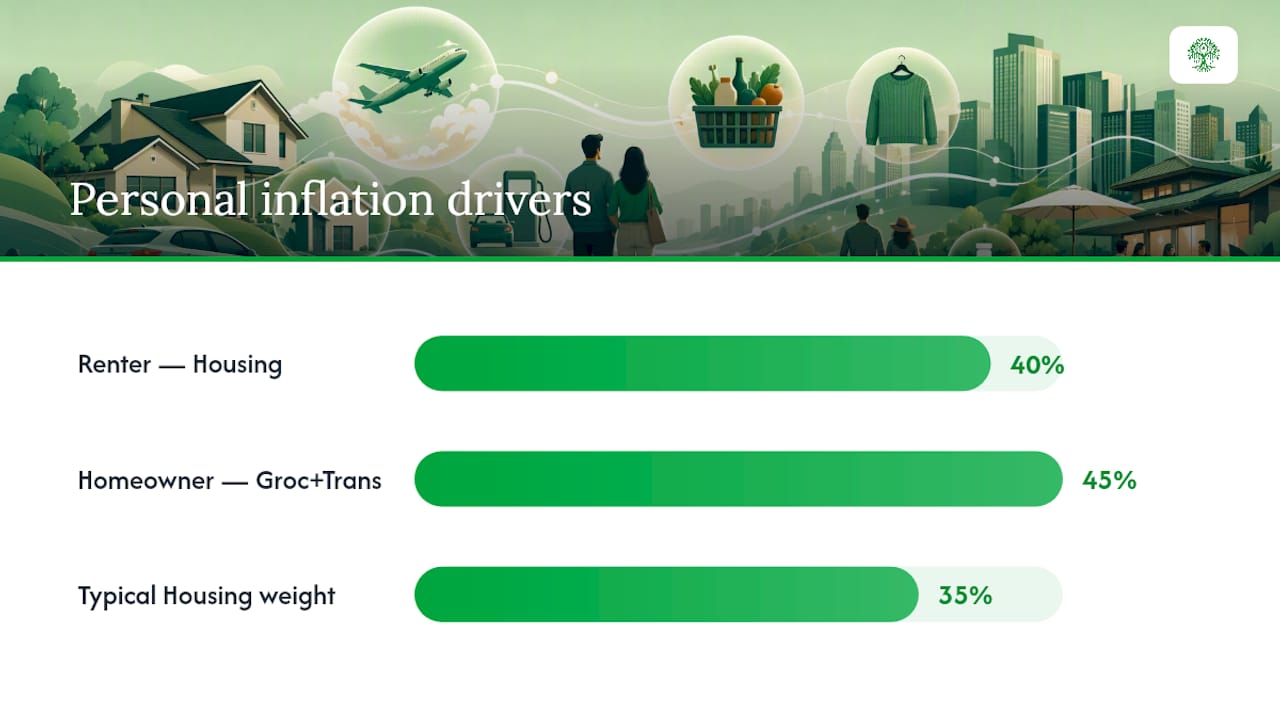
Author: Anand

  • First Time Buyers: Best Online Mortgage Lenders and Ficustree Help

    First Time Buyers: Best Online Mortgage Lenders and Ficustree Help

    Online mortgage lenders are the right call for most straightforward W-2 borrowers who want speed, lower fees, and a digital process from application to closing. If your income is nonstandard or your case is complex, pair a couple of online quotes with a local, human-underwritten option before deciding. For first-time buyers who want more than a rate quote, Ficustree pairs decision intelligence with real buyer representation. Either way, your first move is the same: collect three or four preapprovals and compare Loan Estimates side by side.


    TL;DR:

    • Online lenders are ideal for straightforward W-2 borrowers seeking fast approval, low fees, and digital convenience, but less suitable for complex income or credit situations.
    • Comparing the Loan Estimate, including APR and total cash to close, is essential since interest rates alone can be misleading and fees vary significantly.
    • Verified licensing through NMLS and understanding lender offerings across loan programs like FHA, VA, and jumbo are crucial before applying or accepting a quote.
    • Speed benefits from online lenders include faster closing times, often around 22 days, achieved through automation like soft pulls, e-closings, and automated income verification.
    • First-time buyers should combine lender shopping with buyer representation platforms like Ficustree to clarify affordability, improve offer strategy, and access local agent support.

    Table of Contents

    At a Glance: Who Benefits Most From Online Mortgage Lenders

    The best online mortgage lenders reward borrowers who value speed and transparency over hand-holding. They’re less suited to buyers whose income, credit, or property situation needs a human underwriter’s judgment call. Here’s how to place yourself before you start applying.

    Three borrower profiles that map to the right lender type:

    • Speed and low-fee seekers: W-2 employees with steady income, solid credit, and a straightforward purchase. Digital mortgage lenders are built for this borrower, and this is where they win on both price and turnaround time.
    • Low down payment buyers: First-time buyers stretching for a 3% or 3.5% down payment benefit from online lenders that specialize in conventional and FHA programs, though state assistance programs still require a knowledgeable guide. Ficustree’s California first-time buyer programs resource is a useful companion piece here.
    • Complex-case borrowers: Self-employed applicants, buyers with irregular income, or anyone with credit dings should treat online quotes as one data point, not the only one. A manual-underwrite lender may see nuance an algorithm won’t.

    Three trade-offs worth weighing before you commit:

    • The lowest advertised rate doesn’t always match your actual profile. Confirm it against your credit tier and loan amount, not the homepage teaser rate.
    • Online lenders trade in-person guidance for chat and phone support. That’s fine for confident borrowers, less fine if you want someone walking a contract with you.
    • Not every online lender offers every loan program. Confirm they carry FHA, VA, or jumbo options before ruling out competitors on price alone.

    Your immediate action items: request preapprovals from three or four lenders within a two-week window, verify each one’s NMLS license, and ask every lender for a formal Loan Estimate rather than a verbal rate quote.

    How Do You Choose an Online Mortgage Lender?

    Picking the best online home loan lenders comes down to reading the fine print correctly, not chasing the flashiest homepage rate. The Loan Estimate, a standardized three-page federal disclosure, is where the real comparison happens.

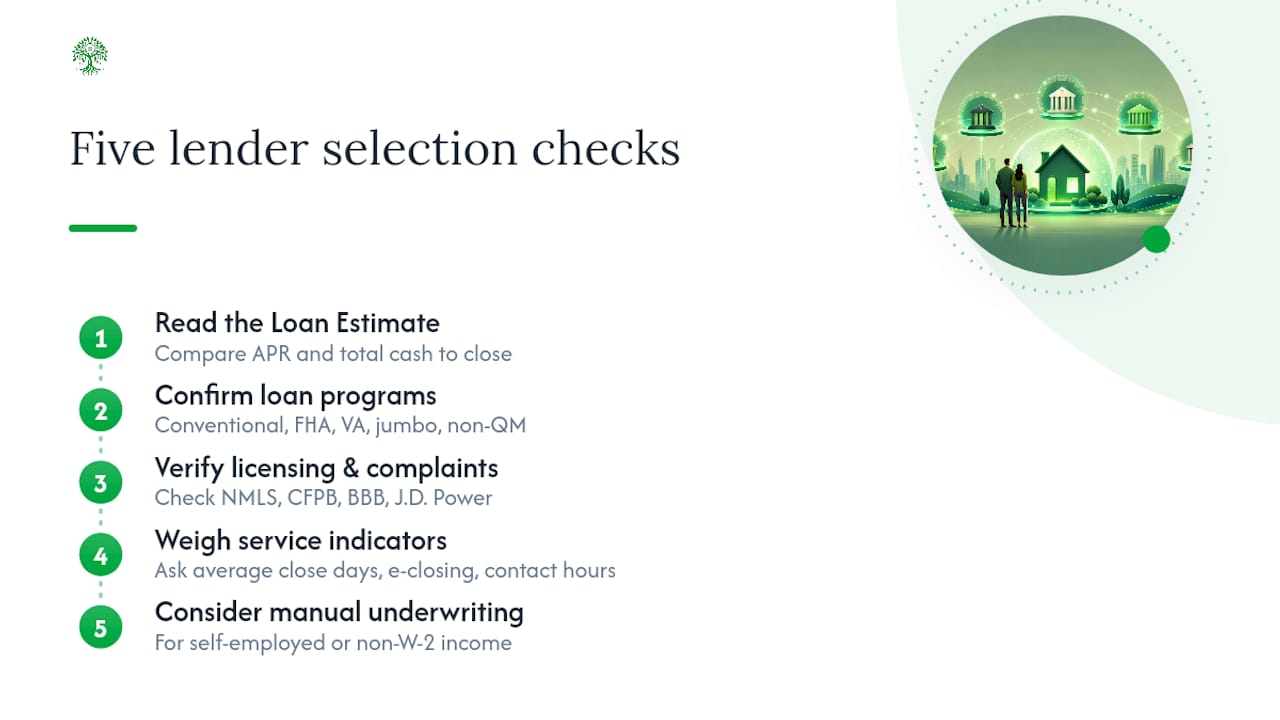
    1. Read the Loan Estimate, not the marketing rate. Every lender must give you this document within three business days of application. Compare the APR (which folds in most lender fees) and the total estimated cash to close, not just the interest rate on page one. A rate comparison from Tomo Mortgage makes the same point: two lenders quoting an identical rate can differ by thousands of dollars once fees are factored in.

    2. Confirm the loan programs each lender actually offers. Conventional, FHA, VA, jumbo, and non-QM products aren’t universal across every digital lender. If you’re a veteran or active-duty service member, verify VA loan eligibility and current limits directly through the Department of Veterans Affairs rather than trusting a lender’s marketing page.

    3. Verify licensing and consumer track record. Every legitimate lender is registered with the Nationwide Multistate Licensing System, and you can look up any company’s license status and approved states through NMLS Consumer Access. Cross-check complaint history with the Consumer Financial Protection Bureau, scan Better Business Bureau reviews, and where available, check J.D. Power’s annual mortgage origination and servicing surveys. Being digital doesn’t mean being unregulated. Online lenders and traditional banks answer to the same NMLS and CFPB oversight.

    4. Weigh service indicators beyond rate. Ask directly: How many days does your average close take? Do you offer e-closing? Can I edit my preapproval letter myself if my offer changes? What channels can I reach a loan officer through, and what are the hours? These questions separate lenders who talk fast from lenders who actually close fast.
    Five checks for choosing a mortgage lender

    5. Know when to add a local or manual-underwrite lender to your list. If you’re self-employed, recently changed jobs, or have income that doesn’t fit a W-2 template, a portfolio lender with manual underwriting can approve scenarios that automated systems flag or decline outright.

    Pro Tip: Ask every lender the same three questions in the same order: your rate, your total fees, and your average closing time in days. Lenders who dodge the fee question are usually the ones padding it.

    Before you request quotes, it helps to know your numbers cold. Run your debt-to-income ratio and check your credit score against typical lender thresholds so you’re not guessing what tier of rate you’ll actually qualify for.

    Why Can Online Lenders Close Faster and Cheaper?

    Online and nonbank lenders more than doubled their share of mortgage originations between 2013 and 2023, climbing from 24% to 55% of the market, according to the CFPB’s mortgage market activity report. That shift didn’t happen by accident. Digital lenders stripped out branch overhead and rebuilt the process around automation, and the savings show up in both speed and price for the right borrower.

    By the Numbers: Online lenders often close roughly 20% faster than traditional banks, with Rocket Mortgage averaging around 22 days to close in one comparative analysis. That’s meaningfully tighter than the 30 to 45 day window many branch lenders still quote.

    The mechanics behind that speed:

    • Soft-pull rate checks let you see personalized pricing before a hard credit inquiry, so you can shop without dinging your score early.
    • E-closings replace stacks of paper signatures with a scheduled digital session, cutting days off the back end of the timeline.
    • Automated income and asset verification pulls bank and payroll data directly instead of waiting on you to scan and upload PDFs.
    • Origination fees at digital lenders often run at or below the industry’s typical 0.5% to 1% range, and some waive them entirely for repeat customers.

    None of that automation eliminates every manual step. Title work, appraisal scheduling, and municipal recording still run on human and institutional timelines no algorithm controls. And if your income doesn’t fit a clean W-2 pattern, or your file needs a documentation exception, automated underwriting tends to be less flexible than a human loan officer reviewing supplemental paperwork. There’s also a quieter risk: many online lenders sell servicing rights shortly after closing, meaning the company you applied with may not be the one you’re mailing payments to a year later.

    Your Week-By-Week Plan to Shop Online Mortgage Lenders

    Comparing mortgage lenders online doesn’t require weeks of research if you work through it in order. Here’s the sequence that gets you comparable, trustworthy offers fastest.

    1. Apply to three or four lenders within a 14-day window. Credit scoring models treat multiple mortgage inquiries within this window as a single shopping event, so your score takes one hit instead of several, according to guidance on rate-shopping windows.

    2. Request a formal Loan Estimate from each one, not a verbal quote. Line up the APR and total cash to close across all four side by side. A quarter-point rate difference can be erased entirely by a $3,000 gap in fees.

    3. Verify NMLS licensing and confirm state availability. Not every online lender operates in every state, and license status can change. A two-minute NMLS lookup confirms you’re dealing with a legitimate, active company.

    4. Apply the total-cost-plus-service-fit rule. The lowest rate on paper isn’t the winner if that lender is slow to respond, inflexible on closing dates, or missing a loan program you need. Weigh price against how the lender actually treats you during the application.

    5. Add a local, manual-underwrite lender if your income is nonstandard. Self-employed borrowers, gig workers, and anyone with recent income changes should get at least one quote from a lender known for flexible, human-reviewed underwriting before ruling out that route.

    If you’re stretching for a low down payment, run the numbers through a down payment calculator first, and check whether 3% down conventional programs or FHA financing fit your situation better than a standard 20% down assumption. Buyers exploring no-money-down options or first-generation buyer programs should confirm which lenders on their shortlist actually support those programs, because not all of them do.

    Why Ficustree Fits First-Time Buyers Who Want Speed Plus Guidance

    Comparing rate quotes solves one piece of the puzzle. It doesn’t tell you which house fits your budget, how to structure an offer, or who’s representing your interests once you’re in escrow. That’s the gap Ficustree is built to close for first-time buyers in California and Texas.

    Ficustree isn’t a lender. It’s a buyer representation platform that layers decision intelligence on top of your home search. You get personalized home matching, on-demand showing agents you can book by the hour, and a real buyer’s agent working your transaction, all while using the premium platform for free.

    Where Ficustree changes the timeline for first-time buyers:

    • It clarifies true affordability up front, including PITI, HOA dues, insurance, and maintenance, so you’re not shopping lenders for a price point you can’t actually sustain.
    • It compresses the confusion most first-time buyers hit around offers, disclosures, and contingencies into a guided, step-by-step process.
    • It gives you a dedicated advocate during negotiation and inspection, something a call center loan officer isn’t positioned to do.
    What You Need Online Lender Alone Ficustree
    Rate and fee comparison Yes, direct Guides you to compare lender quotes
    Buyer representation No Yes, included
    Affordability and offer strategy No Yes
    Local showing access on demand No Yes, hourly booking
    Commission rebate Not applicable Roughly 2% where legal

    Think of it this way: your mortgage lender prices the loan, but Ficustree helps you decide which house, which offer, and which terms make sense before the loan even matters. The two aren’t competitors. Gather your lender quotes first, then let a platform like Ficustree’s buyer portal help you turn those numbers into an actual purchase decision. If you want to see how the two workflows connect in practice, this piece on home buying workflow automation walks through it.

    An Editor’s Take on Speed, Cost, and Certainty

    Most advice on this topic treats rate shopping like the whole game. It isn’t. The real skill is knowing when speed matters more than the lowest possible rate, and when it’s the reverse.
    An Editor's Take on Speed, Cost, and Certainty — overview diagram

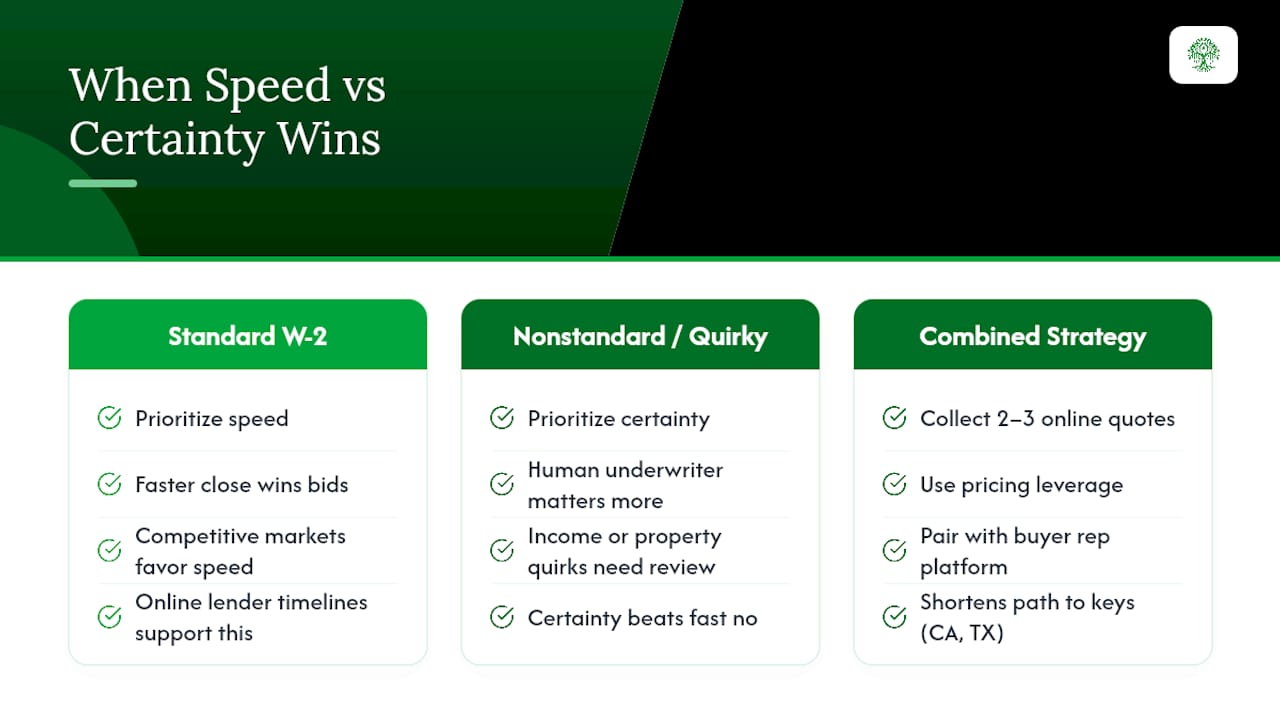
    If you’re a confident, standard W-2 borrower in a competitive market, speed often wins. A faster close can be the difference between winning a bid and losing it, and the data on online lender timelines backs that up clearly. If your income is nonstandard, or you’re buying a property with quirks, certainty beats speed every time. A human underwriter who understands your file is worth more than a fast no.

    The smartest approach combines both. Collect two or three online lender quotes for pricing leverage, then pair that with a buyer representation platform for the parts a rate quote never covers, like offer strategy and negotiation. For first-time buyers in California and Texas specifically, that combination, not a single lender choice, is what actually shortens the path from looking to keys.

    — Anand

    Get Started With Ficustree

    You’ve compared lenders. Now compare what happens after you’re preapproved, because that’s where most first-time buyers actually lose time. Ficustree replaces the scattered mix of agent calls, spreadsheet math, and guesswork with one guided workflow: personalized home matching, on-demand showing agents booked by the hour, and a dedicated buyer’s agent working your offer and negotiation.

    Ficustree

    The process starts simply. You share your budget and preferences, Ficustree surfaces homes that actually fit your numbers, and you book showings on your schedule instead of waiting on a traditional agent’s calendar. The premium platform, including affordability calculators and neighborhood insights, costs nothing to use. If you’re ready to see how it fits your search, start with Ficustree and get matched with homes and a buyer’s agent this week.

    Primary Sources for Verifying Lender Data

    Every claim in this guide traces back to a source you can check yourself. The CFPB’s mortgage market activity report documents the market share shifts and servicing trends referenced above. For veterans confirming loan eligibility, the VA’s official housing assistance pages list current limits and criteria directly from the source. Before applying with any lender, run its name through NMLS Consumer Access to confirm active licensing and approved states. For broader comparative context on lender types, Bankrate’s breakdown of lenders versus banks and CNBC Select’s analysis of online mortgage pros and cons are both worth a direct read.

    This article is general information, not a substitute for advice from a qualified financial advisor. Consult a qualified financial professional about your own circumstances before acting on anything here.

    Sources

    FAQ

    What is the #1 mortgage lender in America?

    There’s no single lender that ranks as the objective “best” for every borrower. Rocket Mortgage and other large online lenders originate high volumes and close quickly for standard W-2 profiles, but the right lender depends on your loan program, credit tier, and how complex your income is.

    Is an online lender or a traditional bank better for a mortgage?

    Online lenders typically win on speed and fees for straightforward borrowers, since nonbank lenders now originate 55% of mortgages, up from 24% in 2013. Traditional banks and manual underwriters still have an edge for complex income situations or borrowers who want in-person guidance.

    How much does a loan officer earn on a $500,000 loan?

    Loan officer compensation isn’t standardized across the industry and varies by lender and commission structure, so there’s no single verified figure to cite here. What you can verify is the lender’s own origination fee, disclosed on your Loan Estimate, which commonly runs 0.5% to 1% of the loan amount.

    Which mortgage lenders are easiest to get approved with?

    Lenders offering FHA loans, non-QM programs, or manual underwriting tend to approve a wider range of credit and income profiles than lenders relying solely on automated underwriting. If your credit or income is nonstandard, ask specifically whether a lender offers manual underwriting before applying.

    Should first-time buyers use an online lender or a platform like Ficustree?

    They solve different problems. An online lender prices and originates your loan, while Ficustree provides buyer representation, affordability guidance, and negotiation support around that loan. Most first-time buyers benefit from doing both: shopping lender quotes for rate and fees, and using a platform like Ficustree to navigate the purchase itself.

  • First Time Buyers: Test 3 Rates With the Best Mortgage Calculators

    First Time Buyers: Test 3 Rates With the Best Mortgage Calculators

    The best mortgage calculators do more than spit out a single monthly payment. They let you enter full PITI (principal, interest, taxes, insurance) plus PMI and HOA dues, and they let you test low, base, and high interest-rate scenarios side by side. Pick a tool with those features, plug in real numbers for your area, and run three rate scenarios before you trust any output. Ficustree’s calculators are built around exactly that approach.


    TL;DR:

    • Use a mortgage calculator that includes full PITI, PMI, and HOA inputs, and test multiple interest rate scenarios to reflect possible rate changes before committing.
    • Always enter county-specific property taxes and real homeowners insurance quotes to avoid underestimating your true monthly obligations.
    • Remember that a 1% increase in interest rate on a $200,000, 30-year loan raises monthly payments by approximately $119, which can significantly impact affordability.
    • Export and compare amortization schedules across different rates to understand the total interest paid and payoff timeline for better decision-making.
    • Avoid relying on default values for taxes, insurance, PMI, or HOA fees, and treat calculator outputs as ranges rather than fixed figures to account for variability.

    Table of Contents

    What Do the Best Mortgage Calculators Actually Do?

    A calculator that only asks for loan amount, term, and rate is giving you half the picture. The other half, taxes, insurance, PMI, and HOA dues, is where most first-time buyers get blindsided. PITI stands for principal, interest, taxes, and insurance, and lenders typically prefer a front-end housing ratio near a third of your gross monthly income. If a calculator skips three of those four letters, it’s not really estimating your payment. It’s estimating a fraction of it.

    The strongest tools separate each cost so you can see exactly where your money goes:

    • Loan amount and term, adjustable independently from the purchase price so you can model different down payments.
    • Interest rate, with room to test more than one number at a time.
    • Property taxes, entered as your actual county rate, not a national average.
    • Homeowners insurance, based on a real quote rather than a placeholder.
    • PMI, triggered automatically when your down payment falls under 20%.
    • HOA or condo dues, added as a flat monthly line item.

    Beyond the core inputs, a handful of extra features separate a decent calculator from a genuinely useful one. Amortization export lets you download or print the full payment schedule so you can see how much of each payment goes to interest in year one versus year twenty. Side-by-side scenario comparison shows two or three rate and down-payment combinations at once instead of forcing you to write numbers down and recalculate manually. Adjustable-rate modeling matters if you’re considering an ARM, since a fixed-rate calculator won’t show how payments could change after the intro period ends. Each of these features exists for one reason: to close the gap between what a calculator predicts and what your lender eventually quotes.

    How to Choose the Right Mortgage Calculator for Your Situation

    Not every buyer needs the same tool. Someone comparing lenders three weeks before closing has different needs than someone who just started browsing listings. A quick checklist cuts through the noise:

    1. Full PITI support. If the calculator can’t add taxes and insurance as separate line items, skip it.
    2. PMI and HOA fields. These need to be optional inputs you control, not baked-in assumptions you can’t see.
    3. Rate scenario slots. Look for a tool that lets you compare at least two or three interest rates without starting over each time.
    4. Exportable amortization. You’ll want this if you plan to share numbers with an agent or lender.
    5. Clear, editable defaults. A calculator that hides its assumptions (or won’t let you change them) is a liability, not a convenience.

    First-time buyers usually get the most value from a calculator that emphasizes affordability and PITI clarity over advanced amortization tools. Buyers actively rate shopping benefit more from scenario comparison and amortization export, since the goal is comparing offers, not just estimating a payment. Someone considering a refinance needs a calculator built around comparing an existing loan balance and rate against a new one, which is a different math problem than a purchase calculator solves.

    Pro Tip: Once your estimated numbers land within a range you’re comfortable with, stop calculating and start the pre-qualification process. A prequalification calculator or a lender’s own intake gives you lender-specific pricing that no public calculator can replicate, since it pulls your actual credit profile.

    How to Use a Mortgage Calculator Correctly

    Garbage in, garbage out applies to mortgage math just as much as anywhere else. Here’s the sequence that produces numbers you can actually act on:

    • Set your loan amount as purchase price minus a realistic down payment, not the maximum you’re hoping to save.
    • Run three interest-rate scenarios: a low rate, a middle-of-the-road rate, and a high rate that accounts for the possibility rates move before you close.
    • Add your county’s actual property tax rate instead of the calculator’s national default.
    • Get a real homeowners insurance quote and enter that figure instead of guessing.
    • Add PMI if your down payment is under 20%.
    • Add HOA or condo fees if the property has them.
    • Compare the amortization output across your three rate scenarios and note the total interest paid over the life of the loan, not just the monthly payment.

    The rate-scenario step matters more than most buyers realize. A 1% increase in interest rate on a $200,000, 30-year loan raises the monthly principal-and-interest payment by roughly $119, according to the Consumer Financial Protection Bureau. That’s not a rounding error. It’s the difference between a payment that fits your budget and one that doesn’t, and it’s exactly why testing a single rate gives you a false sense of certainty.

    Once you’ve run your scenarios, export the amortization schedule and bring it to your agent or lender. Seeing the numbers side by side, rather than as three separate screenshots, makes it much easier to spot which scenario actually makes sense for your timeline.

    Common Mortgage Calculator Mistakes and Pro Tips

    The single biggest mistake is trusting default values for taxes and insurance. National averages can be off by hundreds of dollars a month depending on where you’re buying, and Fannie Mae’s own guidance recommends entering county-specific tax figures and real insurance quotes instead of relying on built-in estimates.

    The second mistake is ignoring PMI and HOA entirely. Skipping PMI on a low down payment or leaving out HOA dues on a condo can significantly understate your real monthly obligation, since PMI and HOA fees vary widely by loan-to-value and association but rarely show up in a calculator’s default view.

    The third mistake is single-rate thinking, running one number and treating it as gospel instead of a starting point.

    • Pull your local tax assessor’s records instead of guessing.
    • Get two or three homeowners insurance quotes before you finalize a number.
    • Always test at least three interest rates.
    • Validate your results with a formal pre-qualification before you shop seriously.

    Pro Tip: A buyer estimating payments on a $350,000 home who forgets PMI and a $250 monthly HOA fee could be underestimating their real payment by $400 or more. That gap is often the difference between a house that fits comfortably and one that strains the budget every month.

    How Calculators Handle Credit Scores and Loan Qualification

    Most public mortgage calculators don’t ask for your credit score at all, and that’s a meaningful blind spot. The interest rate you plug in is a guess based on published averages, not the rate you’ll actually qualify for. Lenders price loans using your credit score, debt-to-income ratio, loan-to-value ratio, and loan type together, and a calculator has no way to see any of that.

    This is why the gap between a calculator’s estimate and your actual closing numbers often comes down to credit-driven pricing. Practitioners who work in mortgage lending note that calculator estimates typically land within a single-digit percentage range of final terms, with the variance driven mostly by credit score tiers and lender-specific fees that no calculator can model in advance.

    A handful of newer calculators, including affordability-focused tools, let you enter a credit score range as a rough proxy, adjusting the assumed interest rate up or down based on typical pricing tiers. That’s a helpful improvement, but it’s still an estimate. The only way to know your real rate is to let a lender pull your actual credit file during pre-qualification. Treat any calculator’s rate assumption as a placeholder, not a promise, especially if your credit score sits outside the “excellent” range.

    Making Sense of What Your Calculator Is Telling You

    A monthly payment number by itself doesn’t tell you much. What matters is how that number moves when you change one input at a time. If shifting from a 6% to a 7% rate pushes your payment past your comfort zone, that tells you something concrete about how much rate risk you can absorb before you lock anything in.

    Pay attention to the ratio between principal-and-interest and everything else. If taxes, insurance, PMI, and HOA make up close to half your total payment, that’s a signal you’re buying in a higher-cost tax jurisdiction or a property with heavier ongoing fees, both worth factoring into your search criteria, not just your monthly budget.

    Look at total interest paid over the loan term, not just the monthly figure. Two loans with similar monthly payments can have wildly different total interest costs depending on the rate and term, and that number only shows up in the amortization schedule, not the headline payment.

    Finally, treat every output as a range, not a single fixed answer. Between the rate uncertainty, the tax and insurance estimates, and the credit-score variable calculators can’t fully account for, a swing of a few hundred dollars in either direction is normal. Use the low and high ends of your scenarios to set a budget ceiling, and don’t anchor too tightly to the middle number just because it feels the most comfortable.

    Where Online Calculators Fall Short of Professional Advice

    A calculator is a planning tool, not a lender. It can’t see your credit report, your debt-to-income ratio, or the specific loan programs you qualify for, and it has no way to account for closing costs, rate locks, or underwriting conditions that vary by lender.

    Calculators also don’t model recurring costs beyond PITI. Maintenance reserves, ongoing repair costs, and the general expense of owning a home are largely absent from calculator outputs, even though they’re a real part of your monthly budget once you own the place. Treat your calculator’s number as the floor of what homeownership costs, not the ceiling.

    This is where formal pre-qualification earns its place in the process. A lender pulling your actual credit and income documentation will give you a rate and loan amount specific to your financial profile, something no public calculator can replicate. Financial advisors and loan officers can also weigh in on questions calculators simply aren’t built to answer: whether an adjustable-rate loan makes sense given how long you plan to stay in the home, or whether paying points to buy down your rate is worth the upfront cost.

    Use calculators to narrow your range and build confidence before you talk to anyone. Use professional advice to finalize the number you actually commit to.

    Affordability Calculators, Amortization Schedules, and Refinance Tools Are Not the Same

    Lumping every mortgage calculator into one category is part of why so many buyers get confused. They solve different problems.

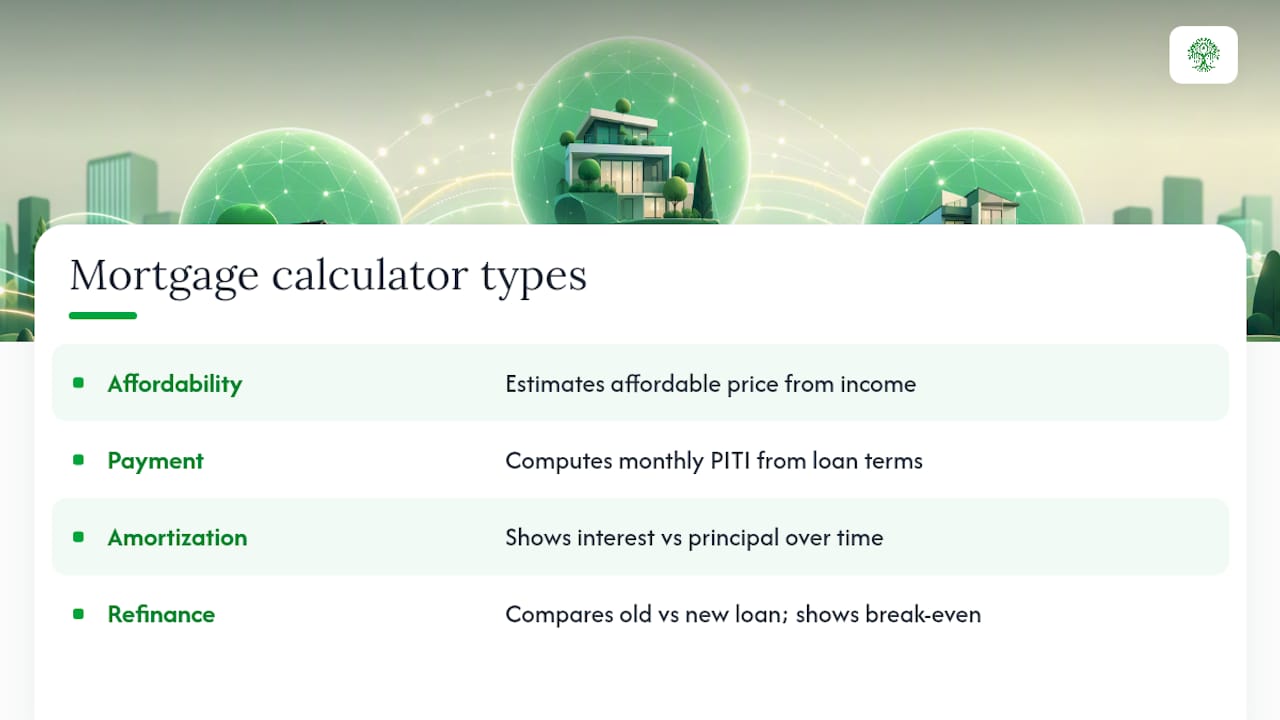
    An affordability calculator works backward from your income and debts to estimate how much house you can reasonably afford, factoring in front-end and back-end debt-to-income limits. It’s the right starting point before you’ve picked a specific property.

    A payment calculator works forward from a specific loan amount, rate, and term to show your estimated monthly PITI. This is the tool you use once you’ve found a property or a price range you’re targeting.

    An amortization calculator breaks that payment down over time, showing exactly how much of each payment goes toward interest versus principal in year one compared to year fifteen. Amortization schedules typically include the option to model extra payments, which is useful once you’re deciding whether an accelerated payoff strategy makes sense.

    A refinance calculator compares your current loan’s remaining balance and rate against a new loan’s terms, factoring in closing costs to calculate a break-even point. It answers a completely different question than a purchase calculator: not “can I afford this,” but “does refinancing save me money before I plan to sell or move.”

    Using the wrong type for your situation is a common source of confusion, not because any of them are inaccurate, but because they answer different questions.

    Affordability Calculators, Amortization Schedules, and Refinance Tools Are Not the Same — overview diagram

    How Extra Payments and Biweekly Schedules Change Your Payoff Timeline

    Most amortization-capable calculators let you model extra principal payments, either as a one-time lump sum, a recurring monthly add-on, or a switch to a biweekly payment schedule. The mechanics are worth understanding because the payoff impact is larger than most buyers expect.

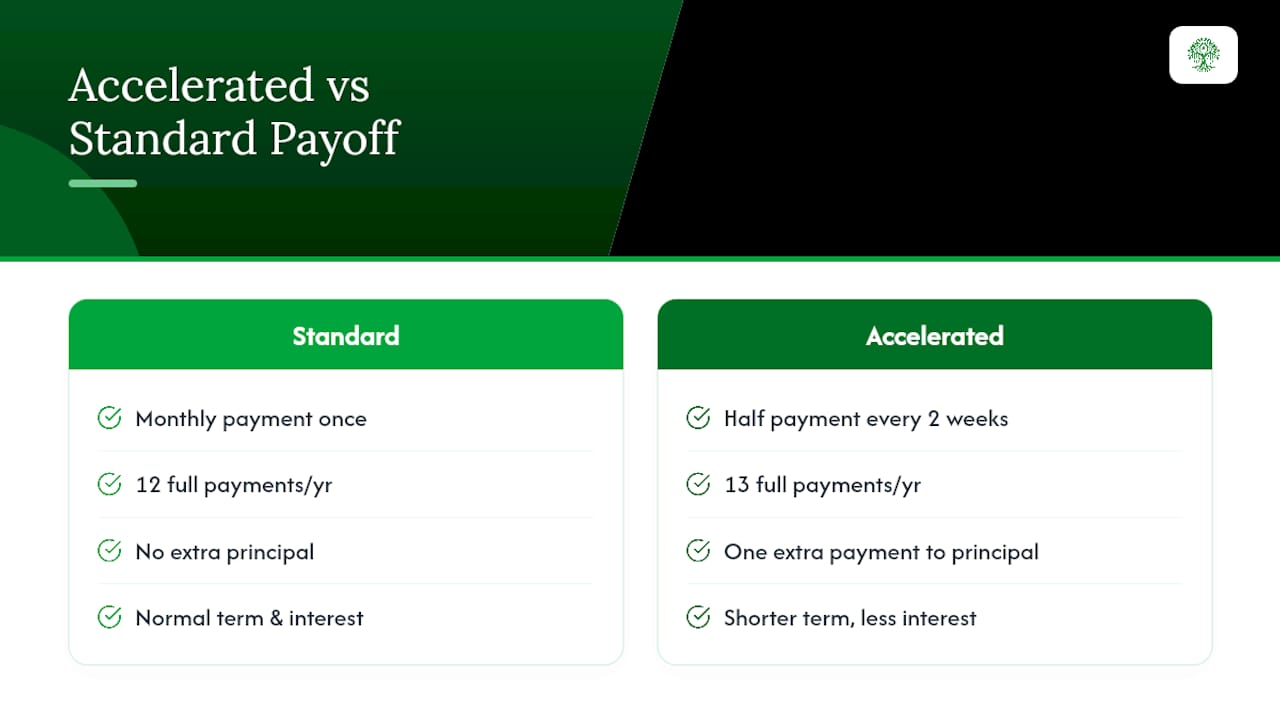
    A biweekly schedule splits your monthly payment in half and collects it every two weeks instead of once a month. Since there are 52 weeks in a year, that works out to 26 half-payments, the equivalent of 13 full monthly payments instead of 12. That one extra payment a year goes straight to principal, which shortens your loan term and reduces total interest paid.

    Adding even a modest extra amount to your monthly principal payment compounds the same way. Because interest is calculated on your remaining balance, every extra dollar toward principal early in the loan reduces the interest charged in every subsequent month. A partner resource on amortization walks through this concept in more detail if you want to see the mechanics laid out step by step.

    The best calculators let you toggle this feature on and compare two amortization schedules side by side, standard versus accelerated, so you can see the exact difference in payoff date and total interest before committing to a strategy. If your calculator doesn’t offer this, Ficustree’s amortization tool shows both schedules together so the tradeoff is visible at a glance.

    How Extra Payments and Biweekly Schedules Change Your Payoff Timeline — overview diagram

    Why Ficustree Builds Mortgage Calculators Differently

    Most calculators treat PITI as an afterthought, one line buried under a headline payment number. Ficustree’s decision-intelligence approach starts from the opposite direction: PMI, HOA, and localized tax and insurance data are built into the core inputs, not optional extras you have to hunt for.

    {{brand_signal:proprietary_calculator_engine}}
    {{brand_signal:localized_tax_insurance_data}}

    That structure exists because first-time buyers need affordability guidance grounded in their actual market, not a national average.

    {{author_bio:anand}}
    {{case_study:ficustree_buyer_outcomes}}

    — Anand

    Try Ficustree’s Mortgage Calculator Before You Shop

    Running the numbers yourself is a solid start, but pairing that with a platform built specifically for first-time buyers changes what happens next. Ficustree’s mortgage calculator includes full PITI, PMI, and HOA inputs by default, plus scenario comparison so you can test three rates without re-entering your numbers each time.

    Ficustree

    The premium platform is free to use, including the calculators, neighborhood insights, and step-by-step guides that walk you from a rough budget to a specific price range. If you decide you want direct representation once you’re ready to make offers, Ficustree charges a flat $1,000 at closing plus 1% commission, with a rebate of roughly 2% passed back to you where legally permitted. You also get access to on-demand showing agents, so you’re not waiting days for a tour. Once your affordability numbers feel solid, the natural next step is checking your true affordability range and seeing what that translates to in your target neighborhoods. Start with the Ficustree buyer platform to see how the calculators connect directly to representation when you’re ready to make an offer.

    Sources

    FAQ

    Which Mortgage Calculator Is the Most Accurate?

    No calculator is perfectly accurate because none can see your actual credit profile or lender-specific pricing. The most reliable ones are those with full PITI support, editable PMI and HOA fields, and rate-scenario testing, since accuracy depends far more on the inputs you provide than the tool itself.

    What Is the 3-7-3 Rule for a Mortgage?

    The “3-7-3 rule” isn’t a standardized industry term with a single agreed definition, so treat any specific formula tied to that name with caution. If you’ve seen it referenced elsewhere, verify the source before applying it to your own budgeting.

    What Salary Do You Need for a $400,000 Mortgage?

    It depends heavily on your interest rate, down payment, property taxes, insurance, and other debts, since lenders generally prefer a front-end housing ratio near a third of gross monthly income. Run your specific numbers through a full PITI calculator rather than relying on a flat salary rule, since local tax and insurance costs vary widely.

    How Much Is a $300,000 Mortgage at 7% for 30 Years?

    A 1% rate increase adds roughly $119 to the monthly payment on a $200,000 loan, which is exactly why testing multiple rate scenarios matters before you commit to a number.

  • Preapproval vs Prequalification: 3 CFPB Backed Steps First Time Buyers Use

    Preapproval vs Prequalification: 3 CFPB Backed Steps First Time Buyers Use

    Prequalification is a quick, self-reported estimate of what you might borrow. Preapproval is a documented, lender-verified number backed by a hard credit check, which is why sellers take it far more seriously. First-time buyers should get prequalified early to set a budget, then move to preapproval once they’re ready to tour homes and make offers. Neither one guarantees the loan actually closes.


    TL;DR:

    • Preapproval requires verified income, assets, and a hard credit check, making it significantly more valuable to sellers than prequalification.
    • Most preapproval decisions take around 10 business days after submitting comprehensive documentation like pay stubs and tax returns.
    • Preapproval letters are typically valid for 30 to 90 days, so timing them close to your offer is essential for best effectiveness.
    • Prequalification is fast and relies on self-reported data, useful mainly for setting a buying budget and identifying initial financial issues.
    • Neither prequalification nor preapproval guarantees loan finalization, as full underwriting and property appraisal follow after a formal offer.

    Table of Contents

    What Is Mortgage Prequalification?

    Prequalification is the financial equivalent of a rough sketch. You tell a lender your income, debts, and estimated credit range, and they hand back a ballpark number of what you could borrow. Some lenders run a soft credit pull to sharpen that estimate; many just take your word for it. Nobody verifies your pay stubs or bank balance at this stage.

    That makes prequalification fast, usually a five-minute online form, and genuinely useful in a few specific moments:

    • Figuring out a realistic price range before you start browsing listings
    • Catching an obvious problem, like a debt-to-income ratio that’s too high, before it wastes your time
    • Deciding whether to spend the next few months paying down cards or fixing credit report errors

    The catch is that prequalification carries almost no weight once you’re competing for a house. A debt-to-income calculator can give you a similar early read, and both tools share the same limitation: they estimate, they don’t verify. Rocket Mortgage notes that prequalification is best treated as a preliminary budgeting step, not proof you can bring to a listing agent.

    What Is Mortgage Preapproval?

    Preapproval is where the lender actually checks your paperwork, and you can explore their current mortgage rates at Get Your Mortgage Pre-Approval or Mortgage Refinance Today. You submit documents, they run a hard credit inquiry, and if the numbers hold up, you get a preapproval letter stating a specific loan amount. The Consumer Financial Protection Bureau describes preapproval as a more rigorous process than prequalification, one that typically requires verified income and asset documentation.

    Lenders commonly ask for:

    • W-2s or 1099s from the past two years
    • Recent pay stubs, usually the last 30 days
    • Two to three months of bank statements
    • Federal tax returns
    • Documentation of any additional assets or gift funds

    Because a human (or an underwriting system) has actually reviewed your finances, a preapproval letter tells a seller’s agent something a prequalification never can: this buyer has been checked out, and financing is unlikely to fall apart over a surprise. NerdWallet’s comparison of the two terms confirms that preapproval carries more weight specifically because the lender has verified the numbers rather than taken them on faith.

    Pro Tip: Ask your lender directly whether their “preapproval” includes employment and asset verification. Some lenders use the term loosely, so the label matters less than what they actually checked.

    Preapproval vs Prequalification, Side by Side

    Once you understand what each term actually means, the decision of which one to get, and when, gets a lot simpler.

    1. Verification level. Prequalification runs on self-reported numbers. Preapproval runs on documented proof, meaning pay stubs, tax returns, and bank statements the lender has physically reviewed.
    2. Credit inquiry type. Prequalification sometimes involves a soft pull that doesn’t touch your score. Preapproval almost always triggers a hard inquiry, which can lower your score by a few points temporarily.
    3. Speed. Prequalification takes minutes, sometimes through an app or a five-question web form. Preapproval takes longer since a human is checking your file, though many lenders return a decision within about 10 business days of receiving your documents, according to Bank of America.
    4. Usefulness to sellers and agents. A prequalification letter rarely moves a listing agent. A preapproval letter often becomes a prerequisite just to get a showing scheduled in a competitive market.
    5. Validity period. Preapproval letters generally stay valid for 30 to 90 days before needing an update. Prequalification doesn’t really expire since it was never a hard commitment to begin with.

    The practical sequence for most first-time buyers: prequalify months before you start touring, so you know your range and can fix any credit issues without a clock running. Then get preapproved once you’re actually walking through open houses or about to write an offer, so the letter is fresh when it matters.

    Documents, Credit Checks, and Timeline: What to Prepare for Preapproval

    Gathering paperwork before you apply saves days you don’t get back. Have these ready:

    • Government-issued photo ID and Social Security number
    • W-2 or 1099 forms from the last two years
    • Pay stubs covering the most recent 30 days
    • Two to three months of bank statements
    • Signed federal tax returns
    • Documentation for any gift funds or additional assets

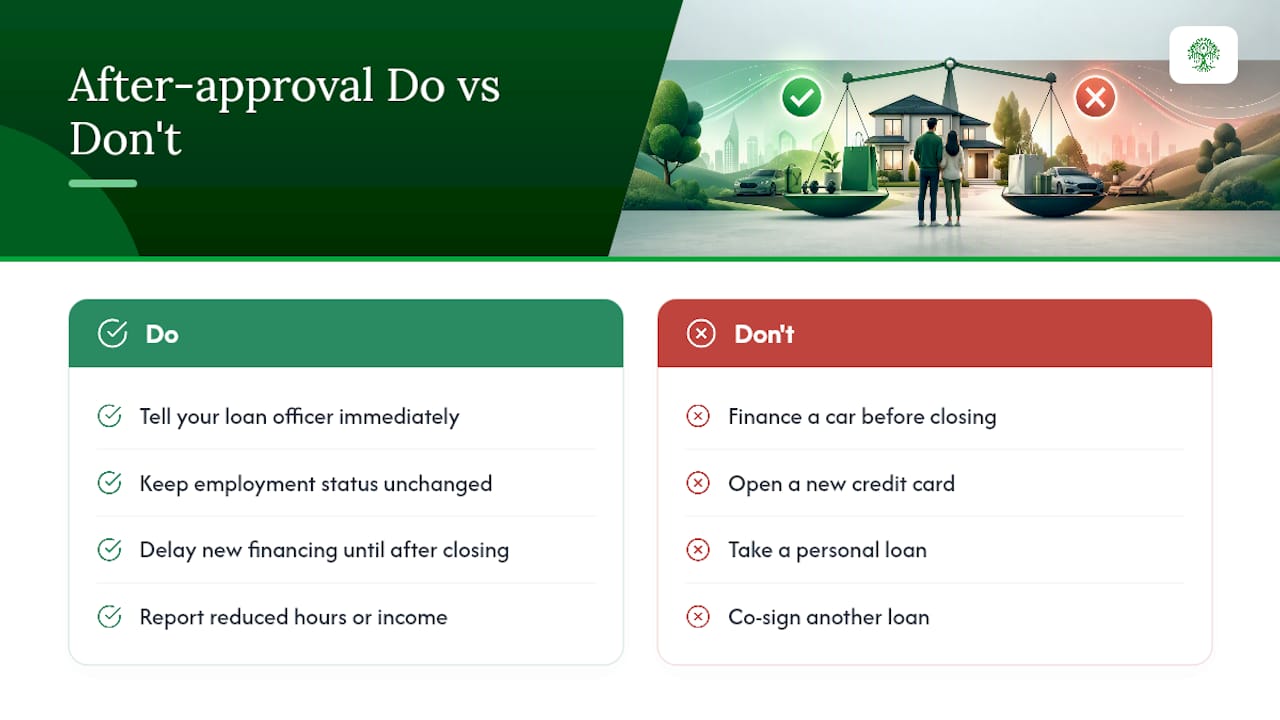
    On the credit side, a soft pull for prequalification typically leaves your score untouched, while the hard pull required for preapproval can shave off a few points, usually temporarily. Once you’re preapproved, avoid opening new credit cards, financing a car, or switching jobs. Any of those can force a lender to re-verify your file right when you need the letter to hold steady, and preapproval letters typically expire in 30 to 90 days.

    How First-Time Buyers Should Use This Timeline

    Think of prequalification and preapproval as two different tools for two different moments, not two steps of the same errand. Prequalify the moment you start seriously thinking about buying, while you’re still deciding what city or price range makes sense. Save preapproval for when you’re actively touring homes or expect to write an offer within a matter of weeks, since timing it close to your offer window keeps it from going stale.

    At Ficustree, this is exactly where our buyer-readiness workflow earns its keep. We help first-time buyers in California and Texas assemble the document checklist above before a lender even asks, flag credit or debt-to-income roadblocks early enough to fix them, and time the preapproval so it’s fresh the day you need to bid. That structure is what compresses months of scattered research into a plan you can actually execute.

    • Prequalify early to set your search range
    • Fix any flagged credit issues while there’s no deadline pressure
    • Get preapproved right before you start touring or bidding, not months ahead

    Pro Tip: Getting preapproved early, even before you’ve found a house, helps you spot financial red flags while you still have time to fix them, not while you’re racing a closing deadline.

    The Three Things Ready-to-Offer Buyers Actually Do

    If I had to boil this down to three moves for a first-time buyer, they’d be: gather your documents before you need them, fix small credit or debt-to-income issues while there’s no clock running, and time your preapproval so it’s still fresh when you’re ready to tour serious listings. The mistake I see most often isn’t skipping preapproval, it’s getting one too early and then opening a new credit card or changing jobs before closing, which can undo the whole thing. One more thing worth remembering: lenders don’t use “prequalification” and “preapproval” consistently, so ask what your specific lender actually verifies rather than trusting the label alone.

    — Anand

    How Ficustree Turns Preapproval Into a Real Offer

    Getting preapproved is only half the battle. Ficustree is built for the other half, turning that letter into a winning offer without the usual scramble. Our platform gives you the document checklist, decision-intelligence guidance, and on-demand showing agents that most first-time buyers cobble together from six different sources and two months of stress.

    Ficustree

    Instead of paying a traditional agent’s full commission, Ficustree buyers pay $1,000 at closing plus 1% commission, and get a rebate of roughly 2% where legally permitted. You get direct buyer representation, not just a listings feed, and the premium platform itself is free to use while you search. If you’re a first-time buyer in California or Texas trying to go from “what’s a hard credit pull?” to a signed offer without wasting a quarter of the year figuring it out, start your buyer readiness process at Ficustree today.

    Sources

    FAQ

    What’s the main difference between preapproval and prequalification?

    Prequalification is a quick, self-reported estimate; preapproval involves a hard credit check and verified documentation like pay stubs and tax returns, which is why it carries more weight with sellers.

    How long does preapproval take?

    Many lenders return a preapproval decision within about 10 business days of receiving your documents, though timing varies by lender and how quickly you submit paperwork.

    What documents do you need for preapproval?

    Typically W-2s or 1099s, recent pay stubs, two to three months of bank statements, signed tax returns, and a government-issued ID with your Social Security number.

    Does prequalification hurt your credit score?

    Usually not. Prequalification often relies on a soft credit pull, which doesn’t affect your score, while preapproval’s hard inquiry can lower it by a few points temporarily.

    How long is a mortgage preapproval good for?

    Most preapproval letters stay valid for 30 to 90 days before you need an updated version.

    Does preapproval guarantee I’ll get the loan?

    No. Final approval still requires full underwriting, an appraisal, and a title search after your offer is accepted, so preapproval is provisional, not a done deal.

  • 3.5% Down or 20% Equity: FHA vs Conventional for First Time Buyers

    3.5% Down or 20% Equity: FHA vs Conventional for First Time Buyers

    If your credit score sits below 620 or you need gift funds and a smaller down payment, FHA usually makes sense. If your credit is strong and you want to avoid paying mortgage insurance forever, conventional usually wins. The core difference comes down to mortgage insurance rules and how long you plan to keep the loan, and many buyers use FHA first, then refinance to conventional once their equity and credit improve. Ficustree can help you model both paths before you make an offer.


    TL;DR:

    • FHA loans are more suitable for buyers with credit scores below 620 or when using gift funds and a smaller down payment.
    • Conventional loans offer better long-term savings through PMI cancellation and better pricing for credit scores above 700.
    • FHA’s mortgage insurance lasts for the life of the loan, whereas conventional PMI cancels automatically once 20% equity is reached.
    • For loans exceeding conforming limits, conventional options provide higher ceilings and typically stricter credit requirements.
    • Running side-by-side affordability comparisons with tools like Ficustree helps buyers understand the long-term costs of each option before making an offer.

    Table of Contents

    FHA vs Conventional: The Differences That Matter Most

    Comparing FHA loans vs conventional loans side by side, the gap shows up in five places: down payment, credit score, mortgage insurance, loan limits, and how sellers respond to your offer. Get these right and the rest of the decision follows.

    • Down payment: FHA allows 3.5% down with a 580 credit score, or 10% down with a score as low as 500. Conventional loans typically require 3% to 5% down, but the best pricing kicks in with 20% down or more.
    • Credit score expectations: FHA’s published floor is 500. Conventional lenders generally want 620+, and many apply their own stricter overlays regardless of what the program technically allows.
    • Mortgage insurance: FHA charges an upfront premium plus annual mortgage insurance premium (MIP) that can last the life of the loan. Conventional loans use private mortgage insurance (PMI), which cancels once you hit 20% equity.
    • Eligible properties: FHA covers primary residences only and requires the home to meet HUD’s minimum property standards. Conventional loans work for primary homes, second homes, and investment properties, with more flexible appraisal standards.

    Loan limits for 2026: the baseline conforming loan limit is $832,750 for most of the country while FHA’s baseline limit runs lower, around $498,257. High-cost counties push both ceilings higher, with some conventional limits exceeding $1,209,750. If you’re buying above these thresholds, you’re likely looking at a jumbo loan, which carries its own credit and reserve requirements.

    What Makes FHA Loans a Practical First-Time Buyer Option?

    FHA loans exist to widen the door for buyers who don’t have perfect credit or a large cash cushion. The program’s published minimum is a 500 credit score with 10% down, or 580 with just 3.5% down. In practice, that 500 tier is nearly theoretical. Most lenders overlay their own stricter minimums, and fewer than 5% of FHA loans close with scores below 580 in most markets.

    The tradeoff for that flexibility is mortgage insurance you can’t easily shake. FHA requires an upfront mortgage insurance premium (UFMIP) of about 1.75% of the loan amount, financed into your balance, plus an annual MIP that ranges roughly 0.45% to 1.05%.

    FHA also enforces HUD property standards during appraisal, checking for safety and habitability issues, and it applies only to homes you’ll occupy as your primary residence.

    Where FHA earns its keep for first-time buyers:

    • Down payment funds can come entirely from a gifted source, which matters if you don’t have family wealth to draw on.
    • Higher debt-to-income ratios are often allowed compared to conventional underwriting.
    • Recent credit events (a past late payment, a thin credit file) are more forgivable here than with most conventional lenders.

    Pro Tip: Ask your loan officer for the exact MIP percentage and duration tied to your specific down payment before you commit. A one-point difference in down payment can change whether you’re paying MIP for 11 years or for the life of the loan.

    When Do Conventional Loans Save You More Money?

    Conventional loans reward good credit with better pricing almost immediately. Most lenders want to see a 620+ score, but the real savings show up between 700 and 720, where loan-level price adjustments (LLPAs) start easing off and your interest rate drops. Below that range, LLPAs can add real cost to your rate even if you technically qualify.

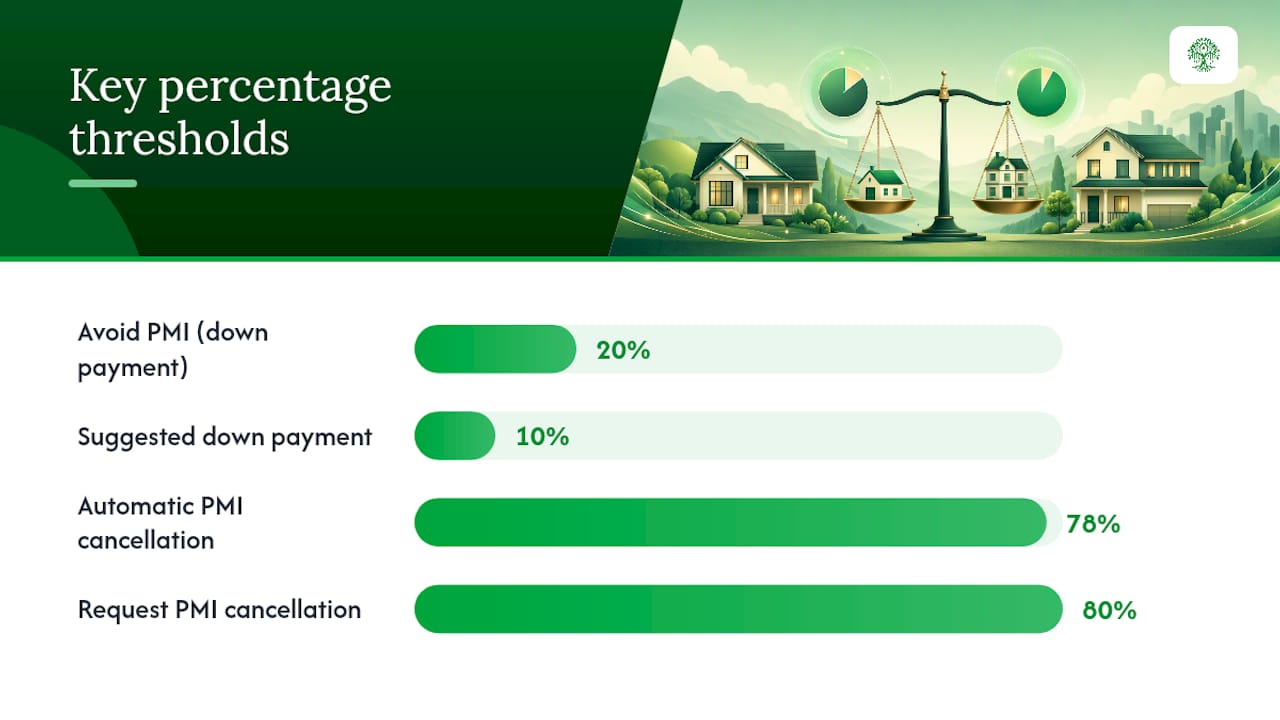
    The insurance math is where conventional loans separate themselves from FHA. Put down less than 20%, and you’ll pay PMI, but PMI cancels automatically once you reach 78% loan-to-value, and you can request cancellation earlier at 80% if your payment history is clean. That’s a fundamentally different deal than FHA’s MIP, which often can’t be removed without refinancing entirely.

    When Do Conventional Loans Save You More Money? — overview diagram

    For 2026, the conforming loan limit for most counties sits at $832,750, with high-cost areas allowing considerably more. Borrow above that ceiling and you’re in jumbo territory, which typically demands a higher credit score and larger reserves.

    Conventional loans tend to make the most sense when:

    • You can put down 10% or more and your credit score is 680 or higher.
    • You plan to stay in the home long enough that PMI’s eventual cancellation actually pays off.
    • You want the option to buy a second home or investment property later using the same loan type.

    How Much Does FHA vs Conventional Actually Cost Over Time?

    Run the numbers past year one, and the FHA vs USDA loan or FHA vs conventional debate stops being about the lower upfront cost and starts being about what you pay for years afterward.

    Say you buy a $400,000 home with 3.5% down on FHA. A conventional loan at the same price with 5% down means paying PMI, but that PMI disappears once you cross the 20% equity line, typically within 5 to 10 years depending on your payment schedule and home appreciation.

    Over a 10-year horizon, that difference compounds. FHA borrowers often keep paying MIP long after conventional borrowers have shed PMI entirely.

    That’s why the refinance-to-conventional strategy is common: buy with FHA now, then refinance into a conventional loan once two things happen:

    • Your home equity crosses roughly 20%, either through payments or appreciation.
    • Your credit score has climbed enough to qualify for competitive conventional pricing.

    At that point, the long-term MIP cost outweighs any short-term convenience.

    What Should You Ask Lenders Before You Choose?

    Before you lock into either loan, run through this checklist with your lender or buyer’s agent:

    1. Pull your current credit score and know your debt-to-income ratio before you apply.
    2. Confirm exactly how much cash you have for a down payment, and whether any of it will come from a gift, including documentation requirements.
    3. Ask what reserves (extra months of mortgage payments in savings) the lender wants on hand.
    4. Request the lender’s LLPA table so you can see how your specific credit score affects conventional pricing.
    5. Ask for a written PMI or MIP estimate, including how long it lasts and what would cancel it.
    6. Get the UFMIP roll-in cost spelled out, plus a realistic closing timeline for each loan type.

    If you’re competing for a home, an FHA offer can look weaker to a seller worried about appraisal repairs. Strengthen it with a larger earnest money deposit, a flexible closing date, or a pre-approval letter that shows your lender has already cleared major hurdles.

    Pro Tip: Have your lender run a side-by-side payment comparison, FHA versus conventional, using Ficustree’s mortgage calculator before you write an offer. Seeing the real monthly numbers next to each other makes the decision far less abstract.

    Why We Built Ficustree Around This Exact Decision

    Most buyers don’t need another article explaining FHA rules. They need someone to run their actual numbers and tell them which door to walk through. That’s the gap Ficustree was built to close.

    Why We Built Ficustree Around This Exact Decision — overview diagram

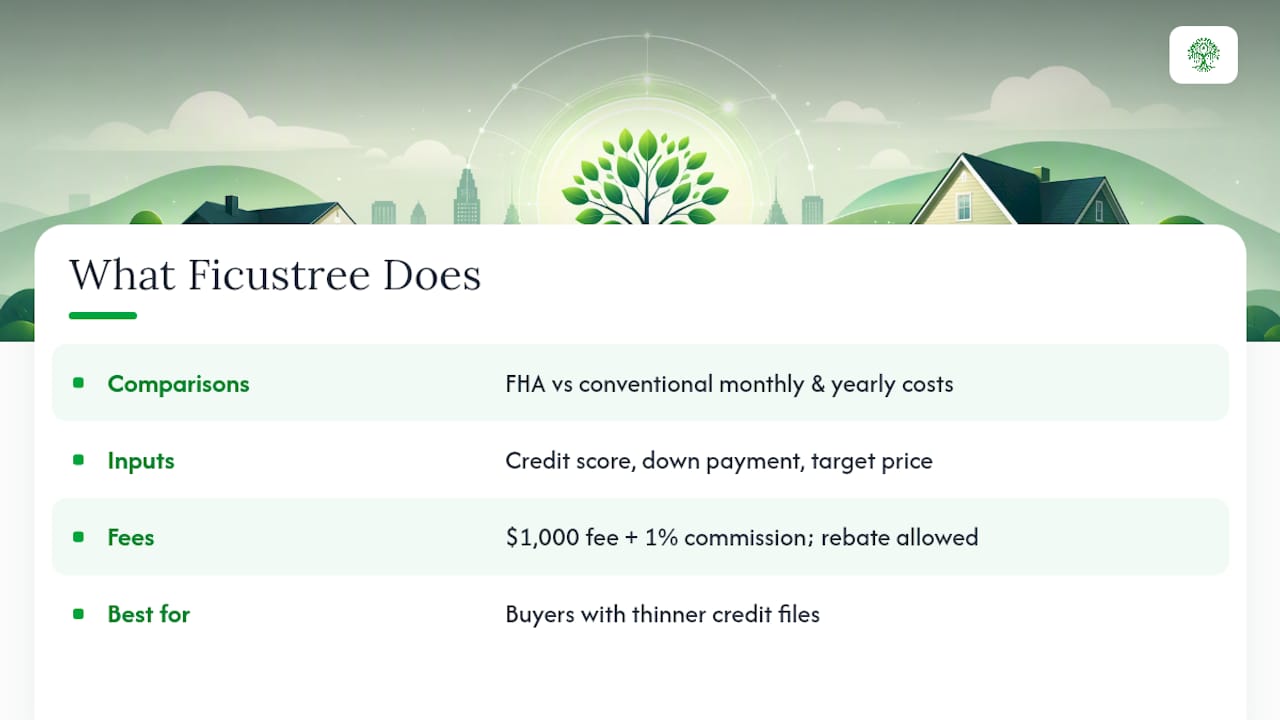
    We designed Ficustree’s affordability tools to do what a good loan officer does in a first conversation: take your credit score, your down payment, your target price, and show you what FHA and conventional actually cost you, month by month and year by year. Buyers get direct representation built around a fixed $1,000 fee plus 1% commission, with a rebate where state law permits it, instead of guessing at what a traditional agent’s cut might mean for their offer.

    Buyers with thinner credit files, the same profile FHA was designed for, often get the most value from running affordability scenarios early, before overlays and lender quirks turn a simple decision complicated.

    — Anand

    Get a Clear Loan Comparison Before You Make an Offer

    Choosing between FHA and conventional loans gets a lot easier once you can see your actual numbers side by side instead of guessing. Ficustree gives first-time buyers in California and Texas a way to run that comparison and get matched with the right next step.

    Ficustree

    With Ficustree, you get:

    • A fixed $1,000 fee at closing plus 1% commission, with a rebate provided where legally permitted.
    • Free access to affordability calculators that model FHA and conventional side by side before you talk to a lender.
    • On-demand showing agents so you can tour homes without waiting on a traditional agent’s schedule.

    If you’re ready to see which loan type actually fits your numbers, start with Ficustree and get a clear read on your options before you write an offer.

    Sources

    This article is general information, not a substitute for advice from a qualified financial advisor. Consult a qualified financial professional about your own circumstances before acting on anything here.

    FAQ

    What’s the Downside of an FHA Loan?

    The biggest downside is mortgage insurance that can outlast the loan itself, plus stricter property condition standards during appraisal that can slow down or complicate a purchase.

    Why Don’t Sellers Like FHA Offers?

    Sellers often favor conventional offers because FHA appraisals enforce HUD minimum property standards that can require repairs before closing, adding time and uncertainty that conventional appraisals typically avoid.

    Is FHA Harder to Qualify for Than Conventional?

    FHA is generally easier to qualify for on paper, with credit score minimums as low as 500 to 580, but many lenders apply overlays that push their real-world requirements closer to conventional standards.

    Should I Choose FHA or Conventional as a First-Time Buyer?

    If your credit score is under 620 or you’re using gift funds for a small down payment, FHA usually fits better; if you have strong credit and a larger down payment, conventional loans typically cost less long-term, and Ficustree’s calculators can help you compare both before you decide.

  • Sewer Lateral Inspection: What Buyers Need to Know

    Sewer Lateral Inspection: What Buyers Need to Know

    A sewer lateral inspection is a CCTV camera scope that runs the pipe connecting your home to the municipal sewer main, checking for cracks, root intrusion, and blockages before they become your problem. If you’re buying a home, get one during due diligence, before your inspection contingency expires. Homeowners who already own the place should schedule one every three to five years or the moment drains start running slow.


    TL;DR:

    • Most sewer scope reports can clearly identify critical defects such as cracks, offsets, root intrusion, and bellies, but do not guarantee future pipe failure.
    • Confirming that the camera reaches the municipal tap is essential, as incomplete runs can lead to inaccurate assessments and buyer regret.
    • Repairs vary widely in cost, with hydro-jetting costing a few hundred dollars and full pipe replacements often exceeding several thousand dollars.
    • Property owners are responsible for maintaining and repairing the private sewer lateral, and local programs may offer inspection rebates or require deadlines for fixing defects.
    • Using detailed video evidence and timely contractor bids can significantly strengthen negotiating power during property transactions.

    Table of Contents

    What Is a Sewer Lateral Inspection, Exactly?

    The private sewer lateral, often shortened to PSL, is the pipe running from your home’s foundation cleanout out to the point where it connects to the municipal sewer main under the street. That connection point is called the tap. Everything on your side of the tap is your pipe, your cost, and your problem. Everything past the tap belongs to the city or county sewer district.

    That ownership split matters because most buyers assume the municipality is responsible for the whole line. It isn’t. InterNACHI’s sewer scope standards describe a proper inspection as a small camera on a flexible cable, fed through a cleanout, that records the pipe’s interior from your foundation all the way to that municipal tap.

    A scope can reliably show you:

    • Cracks, offsets, and separated joints
    • Root intrusion and grease buildup
    • Sags (bellies) where the pipe has settled
    • Whether the line was ever properly connected at the tap

    What it cannot do is promise the pipe won’t fail next year. A camera documents current condition, not future performance. Treat it as a snapshot, not a warranty.

    How Is a Sewer Lateral Inspection Performed?

    A technician typically accesses the line through an exterior cleanout, a roof vent, or occasionally a toilet flange if no cleanout exists. From there, the camera head goes in, and a locator wand on the surface tracks its position so the technician can mark depth and distance as it travels. On a well-prepped job, the camera pushes all the way to the municipal tap, giving you a complete picture end to end.

    Here’s the sequence worth knowing before the technician shows up:

    1. Confirm cleanout location and clear any furniture, plants, or debris blocking access.
    2. Camera enters and is fed slowly toward the street, with the operator narrating findings in real time.
    3. The locator marks defect locations on the surface so distances can be logged accurately.
    4. The camera either reaches the tap or stops at an obstruction, which the report must note explicitly.
    5. You receive the video file and written summary with timestamps.

    Most runs take 30 to 60 minutes, though older homes with tight cleanouts or heavy root mats can run longer. The most common reason for an incomplete run is a blockage the camera simply can’t push past.

    Pro Tip: Before you book, ask the inspector one question: “Will you tell me if the camera reaches the city tap, and will that be noted in writing?” A run that stops halfway and gets reported as “no major issues found” is the single biggest source of buyer regret after closing.

    Sewer camera close to municipal tap connection point

    What Defects Show Up on a Sewer Scope, and What Do They Mean?

    Every scope report tends to surface the same handful of issues, and each one carries a different level of urgency.

    • Root intrusion: roots work through joints and cracks, slowly narrowing the pipe until backups start. Usually manageable with cutting and monitoring unless the roots have split the pipe.
    • Bellies or sags: sections that have settled and now hold standing water and waste. These trap solids and often need spot repair or full replacement of that section.
    • Offsets and separated joints: the pipe has shifted at a connection point, letting soil and groundwater seep in. This drives inflow and infiltration into the sewer system, which is exactly what EPA guidance on sanitary sewer overflows flags as a system-wide problem, not just a homeowner one.
    • Cracks and fractures: minor cracks may just need lining; wide fractures or a fully collapsed section demand immediate specialist bids, not a wait-and-see approach.
    • Scale, grease buildup, or old patch repairs: often cheap to clear with hydro-jetting, but repeated buildup can signal a pipe that’s losing slope or diameter.

    Collapsed sections and major offsets justify getting bids now. Root intrusion and minor scale buildup are usually fine to monitor with a follow-up scope in a year or two.

    What Does a Sewer Inspection Cost, and How Long Does Repair Take?

    A pre-purchase sewer scope typically runs a few hundred dollars, with price shifting based on access difficulty, pipe length, and whether the camera hits an obstruction that requires a second visit. Repair costs vary far more widely, depending on whether the fix is a cleaning job or a full dig-and-replace.

    Repair type Typical cost range Notes
    Hydro-jetting / cleaning A few hundred dollars Clears roots, grease, scale; doesn’t fix structural damage
    Spot repair or trenchless lining A few thousand dollars Works well for isolated cracks or offsets; avoids full excavation
    Full replacement Several thousand dollars or more Needed for collapsed sections or pipe failure along most of the run

    Some municipal programs give property owners a fixed window to fix a failed lateral once it’s flagged. Pinellas County’s PSL program, for example, gives owners 365 days to complete repairs after a lateral is documented as defective. Local programs vary, so check your own county’s rules before assuming a timeline.

    Who’s Responsible for Sewer Lateral Repairs, and Where Do You Check Local Rules?

    The property owner covers maintenance and repair of the private sewer lateral, full stop, from the foundation to the municipal tap. That responsibility transfers with the sale, which is exactly why a scope during due diligence protects buyers from inheriting someone else’s deferred maintenance.

    Some counties go further and require a lateral video inspection as a permit trigger, meaning you can’t pull a remodel permit or complete a property transfer without one on file. Common program mechanics include:

    • Mandatory inspection upload to a county portal before permit approval
    • Required use of certified or registered contractors, not just any plumber
    • Rebate programs that offset inspection or replacement costs to reduce system-wide inflow and infiltration
    • Defined repair deadlines once a lateral is flagged as defective

    Your actionable next step: search “[your county] private sewer lateral program” or call your county utilities or public works department directly. If a rebate or certified-contractor list exists, that’s where you’ll find it, and skipping this step can mean paying full price for work the county would have partly subsidized.

    How Do Buyers Turn Scope Results Into Negotiating Power?

    A sewer scope is only as useful as what you do with it. Buyers generally have four paths once a defect shows up on the video, and picking the right one depends on severity, repairability, and how much time is left before closing.

    1. Ask the seller to complete the repair before closing. Works best for straightforward spot repairs with a clear scope of work and enough time in escrow.
    2. Negotiate a credit at closing instead of a repair. Better when the fix is complex, involves permitting, or you’d rather choose your own contractor after you own the place.
    3. Request a cleaning and re-scope. Useful when the first run stopped short of the tap or showed grease and roots that might resolve with jetting rather than structural work.
    4. Get two independent specialist bids before you finalize anything. This is the path that protects you from both underestimating and overpaying for the fix.

    The documentation that makes any of these paths viable is the same: the raw video file, a written report with timestamps and distance-to-tap markers, and at least one contractor estimate tied directly to what the footage shows.

    Pro Tip: Run through this quick checklist before you decide which path to take: how severe is the defect, is it repairable with lining or does it need excavation, will repair disturb driveway or landscaping, and how many days are left in your inspection contingency? That last one matters more than buyers expect. A cleaning and re-scope can eat a week you don’t have.

    Before you finalize a credit request, it’s worth reviewing how to calculate the right seller credit so the number you ask for actually covers the repair, not just a token gesture.

    Ficustree Perspective: Fitting a Sewer Scope Into Buyer Decision Intelligence

    Ficustree treats a sewer scope the way it treats every inspection finding: as data that feeds directly into your affordability math and your contingency timeline, not as a standalone technical checkbox. If a scope surfaces a repair estimate, that number should adjust your true cost of ownership calculation immediately, alongside PITI, HOA dues, and maintenance reserves.

    Before a scope becomes negotiation-ready, Ficustree walks buyers through a short verification checklist: confirm the camera reached the municipal tap, request the full raw video (not a highlight clip), collect two independent contractor bids tied to the footage, and confirm the contractor holds any local certification your county requires.

    Pairing a lateral scope with a full home inspection checklist closes the gap most standard inspections leave open, since general home inspectors typically don’t scope the sewer line at all.

    The Sewer Scope Is a Leverage Tool, Not a Formality

    Most advice on sewer inspections treats them like a box to check alongside radon and termite reports. That undersells what a scope actually does. The footage and written report are the single most concrete piece of evidence you’ll have in a negotiation, more persuasive than a general inspector’s summary paragraph, because a seller can watch the roots choking their own pipe on video.

    The Sewer Scope Is a Leverage Tool, Not a Formality — overview diagram

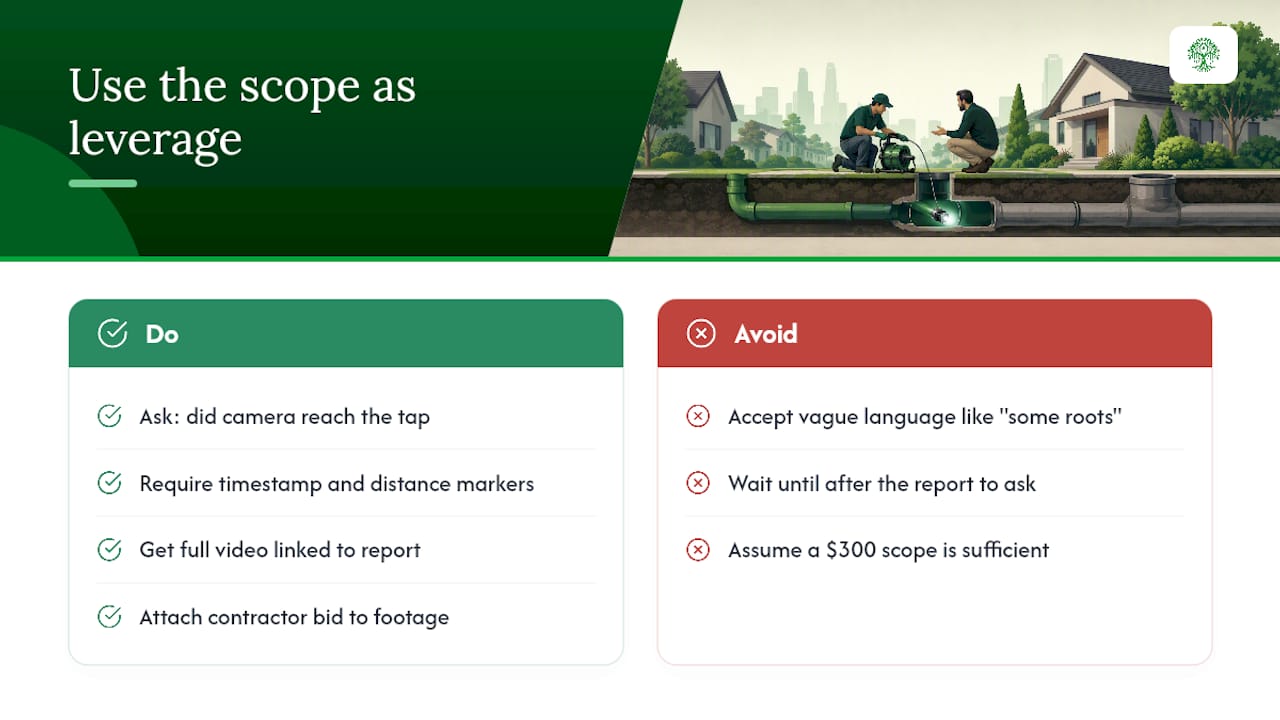
    The conventional advice, get a scope, falls short because it stops short of telling buyers what makes that scope usable. A report that says “some root intrusion noted” without a timestamp, a distance marker, or confirmation that the camera reached the tap is close to worthless in a negotiation. Sellers and their agents will push back on vague language. They have a much harder time pushing back on a video showing a collapsed section at 47 feet with a contractor bid attached to that exact footage.

    If there’s one thing to prioritize first, it’s asking the “did the camera reach the tap” question before you even book the inspector, not after you get a report that leaves you guessing. That single question determines whether the $300 you spent bought you real information or a false sense of security.

    — Anand

    Get Help Interpreting Your Sewer Scope Before You Close

    Ficustree represents first-time buyers directly, for a flat $1,000 fee plus 1% commission at closing, with a rebate back to you where state law allows it. That structure means when a sewer scope comes back with defects, you have a buyer’s agent actually incentivized to negotiate the credit or repair hard, not talk you out of asking for one to keep the deal moving.

    Ficustree

    Ficustree’s decision-intelligence platform folds inspection findings like a sewer scope directly into your affordability numbers and contingency timeline, so you’re not juggling a spreadsheet, a PDF report, and a countdown clock separately. If you’re mid-escrow with a defective lateral on your hands and need help figuring out whether to ask for a credit or a repair, visit Ficustree and get a buyer-side read on your specific findings before your contingency window closes.

    Sources

    FAQ

    How Is a Sewer Lateral Inspection Done?

    A technician feeds a CCTV camera through a cleanout, toilet flange, or vent, pushing it toward the municipal tap while a surface locator marks defect positions, a process that typically takes 30 to 60 minutes.

    How Often Should a Sewer Lateral Be Inspected or Replaced?

    Homeowners should scope the line every three to five years, or immediately if drains run slow or back up; replacement timing depends entirely on what the scope finds, since a well-maintained pipe can last decades while a damaged one may need action within the year.

    What Is a Sewer Lateral?

    A sewer lateral, or private sewer lateral (PSL), is the pipe running from your home’s foundation cleanout to the point where it connects to the municipal sewer main, known as the tap.

    Who Is Responsible for Sewer Lateral Repairs?

    The property owner is responsible for maintaining and repairing the private sewer lateral from the foundation to the municipal tap; some counties also require inspections for permits or property transfers, with defined repair deadlines once a defect is found.

  • California FAIR Plan: What Homeowners Need to Know

    California FAIR Plan: What Homeowners Need to Know

    The California FAIR Plan is the state’s insurer of last resort for basic fire coverage. It exists for one reason: to make sure homeowners who cannot find a standard policy on the open market still have some way to insure their property against fire. If you have been turned down by admitted carriers, or you’re buying a home in a high-wildfire zone where nobody will write a policy, the FAIR Plan is very likely your next move.

    But it comes with a catch that surprises a lot of people. The FAIR Plan only covers fire and a handful of related perils. It does not include liability protection, and it offers little to no coverage for water damage or theft. That means most homeowners who go this route also need a companion policy, called a Difference-in-Conditions wrap, to fill the gaps.

    Here’s what to do right now, in order:

    • Confirm you actually have documented declines from admitted carriers, since you’ll need proof of a “diligent search” before applying.
    • Call a licensed FAIR Plan broker rather than trying to apply directly, since the process runs through broker submissions.
    • Start gathering mitigation documentation (defensible space, roof condition, recent upgrades) since it affects your premium and your path back to the private market.

    TL;DR:

    • The FAIR Plan only covers fire, lightning, smoke, and limited vandalism or theft endorsements, requiring a DIC wrap to cover liability and water damage gaps.
    • Premiums in high-risk wildfire zones typically range from $5,000 to $12,000 annually, depending on property value, fire-hazard severity, and mitigation efforts.
    • Applicants must provide three documented declines from admitted carriers, with a licensed broker managing the diligent search and application process.
    • Most mortgage lenders require proof of both FAIR Plan and DIC coverage, and gaps in insurance can delay or jeopardize escrow closing.
    • Buying in fire-prone areas benefits from early insurance screening, with platforms like Ficustree helping buyers assess affordability and coverage options before making an offer.

    Table of Contents

    What Is the California FAIR Plan and Why Does It Exist?

    The California FAIR Plan Association is not a government program, even though it’s often mistaken for one. It’s a private, non-profit pool created under California Insurance Code section 10090, funded entirely by California’s admitted property insurers rather than taxpayer dollars. Every licensed insurer doing business in the state contributes to the pool, and those same companies share in its losses.

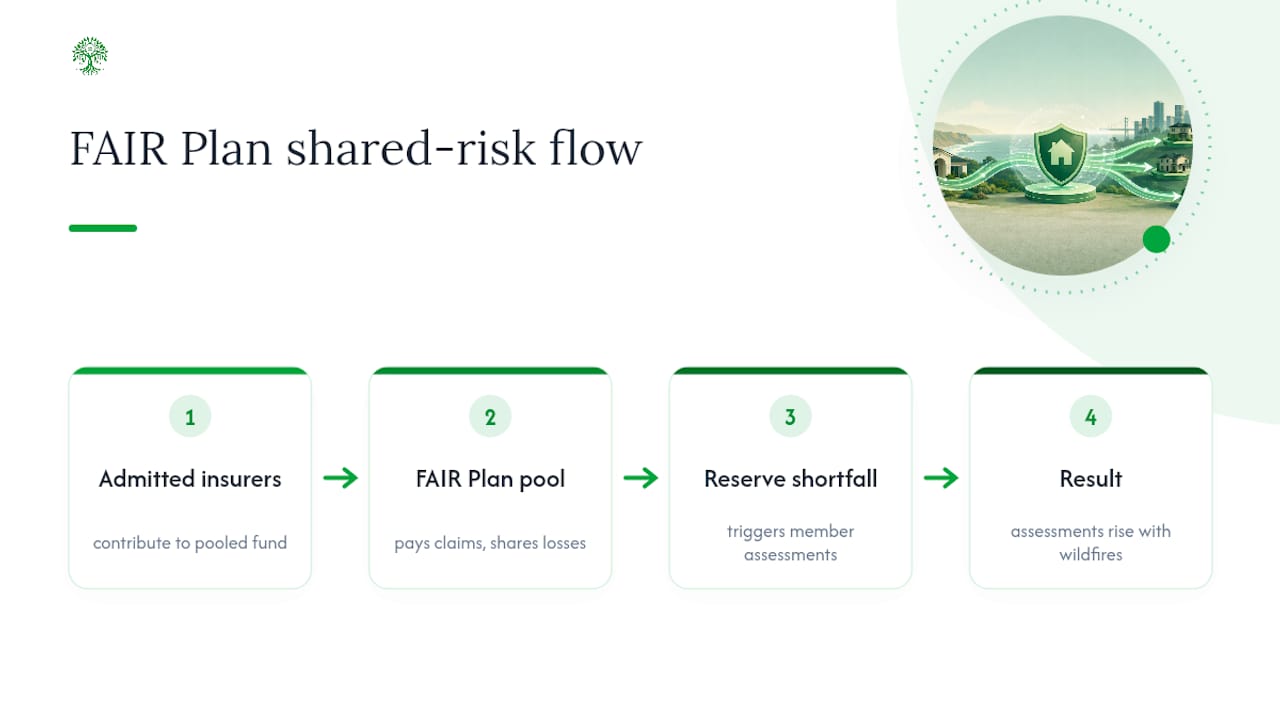
    The FAIR Plan Association operates as a shared-risk mechanism: member insurers split profits and losses proportionally, and when wildfire claims outpace reserves, the association can assess member companies to cover the shortfall. Those assessments have grown more frequent as major wildfire seasons have hit the reserve fund hard.

    Diagram of California FAIR Plan insurer contributions and risk sharing

    The California Department of Insurance regulates the FAIR Plan and sets the rules for who can access it, but the demand driving its growth is a market story, not a bureaucratic one. Private insurers have pulled back from wildfire-exposed ZIP codes across the state, and homeowners who used to have several carrier choices now sometimes have exactly one option left: the FAIR Plan. That shift, more than any policy change, explains why FAIR Plan enrollment has climbed steadily in recent years.

    Who Qualifies for the California FAIR Plan?

    Eligibility isn’t automatic, and it isn’t based on need alone. The FAIR Plan requires proof that you tried the normal market first and it failed you. Here’s the checklist a broker will walk through with you:

    1. Documented declines. You need at least three documented rejections from admitted carriers, known as a “diligent search,” and a licensed FAIR Plan broker has to perform and submit that search on your behalf. You cannot self-certify this step.
    2. Property type. Owner-occupied and tenant-occupied residential properties up to four units generally qualify, along with certain commercial property classes under the FAIR Plan’s commercial program.
    3. Property condition. Homes with more than 50% vacancy or unrepaired structural damage are typically excluded until the issues are resolved. Insurers want to know the risk they’re taking on is a stable one.
    4. Inspection readiness. Expect a property inspection as part of underwriting, particularly for older homes or properties in extreme fire-hazard zones.

    Processing usually takes two to four weeks, depending on how quickly inspections get scheduled and how complete your paperwork is on the first submission. Missing documentation is the single biggest reason applications stall past that window, so having your declines letters, property photos, and any mitigation records ready before you apply saves real time.

    What Does a FAIR Plan Policy Actually Cover?

    This is where expectations and reality diverge most for new applicants. The FAIR Plan is a named-peril policy, meaning it covers a specific, limited list of causes of loss rather than everything not explicitly excluded (the way a standard HO-3 policy works).

    Covered perils typically include:

    • Fire and lightning
    • Internal explosion
    • Smoke damage
    • Limited optional endorsements for vandalism and limited theft, added at extra cost

    What it generally does not cover: liability if someone gets hurt on your property, most water damage, mold, theft beyond a narrow endorsement, and loss of use in many cases. Residential dwelling coverage typically caps out around $3 million, which covers the vast majority of California homes, while a newer Commercial High Value program extends higher limits for qualifying commercial properties through July 2028.

    Think of two neighbors after a wildfire sweeps through. One loses the house to flames. That’s a clean, covered claim under the FAIR Plan. The other neighbor’s roof holds, but a burst pipe floods the kitchen during freezing temperatures that same winter. Under a FAIR Plan-only policy, that water damage claim likely gets denied, which is exactly the scenario a DIC wrap is built to catch.

    Kitchen floor with water leak from pipe

    How Much Does the California FAIR Plan Cost?

    Premiums vary widely based on where the property sits and how much fire risk surrounds it. Statewide average annual premiums land in the low thousands, often around $3,000 to $3,200, while homes in high-wildfire ZIP codes commonly see $5,000 to $12,000 a year, and properties in the most extreme fire-hazard zones can run higher still.

    Several factors drive where you land in that range:

    • Replacement cost value. A higher rebuild estimate means a higher premium, independent of market value.
    • Brush score and fire-hazard severity zone. State fire-hazard mapping plays directly into your rate.
    • Roof and construction materials. Class-A fire-rated roofing and non-combustible siding tend to lower risk scores.
    • Defensible-space documentation. Proof that you’ve cleared vegetation and hardened your property can meaningfully affect underwriting.

    FAIR Plan premiums frequently run higher than what an equivalent admitted-market HO-3 policy would have cost, which is one reason the combined FAIR Plan plus DIC cost often exceeds a standard policy price by a noticeable margin. Recent wildfire-driven assessments on member insurers have also put upward pressure on the broader market, and homeowners should expect rate filings to continue reflecting that pressure over the next year.

    Do You Need a DIC Wrap With Your FAIR Plan?

    Almost certainly, yes. A Difference-in-Conditions policy is a companion insurance product that fills in exactly what the FAIR Plan leaves out: liability coverage, water damage, theft beyond the FAIR Plan’s limited endorsement, and loss-of-use coverage if you’re displaced after a covered loss.

    Most FAIR Plan policyholders pair their fire policy with a DIC wrap to approximate a standard HO-3 policy, and for good reason: mortgage lenders almost always require liability coverage as a loan condition, something the FAIR Plan alone doesn’t provide.

    Pro Tip: Get your DIC quote at the same time you apply for the FAIR Plan, not after. Brokers who handle both can often bundle the underwriting timeline, which shaves days off your total wait.

    Your other option is a surplus lines policy, a single non-admitted policy that bundles fire and broader coverage into one product. It can simplify your paperwork, but surplus lines carriers operate outside California’s standard guaranty-fund protections, so you’re trading regulatory backstop for convenience. For most homeowners, FAIR Plan plus DIC remains the more transparent path, even if it means managing two policies instead of one.

    How Do You Apply for the California FAIR Plan?

    The application runs through a broker, not a direct portal, and the process follows a fairly predictable sequence:

    1. Hire a licensed FAIR Plan broker. They’ll run your diligent search, document the required declines, and submit your full application package.
    2. Gather your property facts. Have an accurate replacement-cost estimate ready, along with photos and any records of repairs or fire mitigation work you’ve completed.
    3. Schedule the inspection. Inspectors typically check roof condition, defensible space, proximity to vegetation, and overall structural upkeep.
    4. Wait out the underwriting window. Most applications process in two to four weeks, though incomplete documentation or a backlog of inspection requests can push that timeline longer.

    Buyers in escrow should start this process the moment an offer gets accepted, not after. Insurance delays are one of the more common reasons closings slip past their original date, something covered in more detail in Ficustree’s guide on wildfire risk and home buying in California.

    Will Your Lender Accept a FAIR Plan Policy?

    Usually not on its own. Most mortgage lenders require liability coverage as a condition of the loan, and the FAIR Plan doesn’t provide it. That’s the practical reason most policyholders end up with a FAIR Plan plus DIC combination rather than the FAIR Plan alone.

    To keep your loan on track:

    • Send your servicer or underwriter proof of both policies together, not just the FAIR Plan declarations page.
    • Confirm your combined coverage meets your lender’s minimum liability threshold before closing, not during final underwriting.
    • Never let either policy lapse. A gap, even briefly, can trigger force-placed insurance, which lenders buy on your behalf at a cost that’s almost always higher than anything you’d choose yourself.

    Mortgage details and insurance requirements often get missed during a fast-moving escrow. Options Home Loans covers how lenders evaluate these requirements in more depth if you want the underwriting side explained plainly.

    How Do You Get Off the California FAIR Plan?

    Regulators view the FAIR Plan as a temporary safety net, not a permanent home for your policy, and there’s a real path back to the private market if you’re willing to invest in mitigation.

    The moves that actually change your underwriting profile: clearing defensible space around your structure, hardening vents and roofing against embers, and using certified contractors whose work insurers recognize during reassessment. Cosmetic landscaping doesn’t move the needle nearly as much as documented structural hardening does.

    Home exterior with wildfire defensible space mitigation

    Keep a file. Photos before and after mitigation work, contractor invoices, and any defensible-space certification you receive all matter when a broker re-shops your policy.

    Pro Tip: Re-shop your coverage annually, or immediately after completing a major mitigation project, whichever comes first. Waiting for your FAIR Plan renewal date to reconsider your options usually means leaving savings on the table for months longer than necessary.

    What the FAIR Plan Means for California Home Buyers

    Insurance status can quietly wreck a home purchase if it surfaces too late. If a property you’re bidding on can only get FAIR Plan coverage, your monthly PITI calculation needs to reflect the FAIR Plan premium plus a DIC wrap, not the admitted-market rate you might be assuming from a quick online estimate. That gap can run into hundreds of dollars a month, and it changes what you can actually afford.

    The buyers who avoid last-minute scrambles are the ones who check insurance availability before writing an offer, not after it’s accepted. That single step should be part of your offer strategy the same way inspection contingencies are, because an insurance surprise during escrow can blow past your closing date.

    This is exactly the kind of gap decision intelligence is built to catch. Ficustree’s buyer representation model pairs neighborhood-level wildfire data with real affordability modeling, so insurance-sensitive properties get flagged before you’re emotionally attached to them, not after.

    — Anand

    Get Insurance Clarity Before You Offer, With Ficustree

    Ficustree gives California buyers something a listings site never will: a fixed-fee representation model that puts insurance risk into your affordability picture before you write an offer, not after you’re already in escrow scrambling for a FAIR Plan broker.

    Ficustree

    Buying in a wildfire-exposed neighborhood means your true monthly cost depends on more than the mortgage. It depends on whether your target property qualifies for admitted-market coverage or whether you’re heading straight into a FAIR Plan plus DIC combination, and what that actually adds to your PITI. You keep the premium platform free the entire time.

    If you’re actively shopping in a fire-hazard zone, or you already have an offer in and need to move fast on insurance, start with Ficustree’s buyer platform and get a clear read on affordability before your contingency clock runs out.

    Key Takeaways

    The California FAIR Plan works as insurer of last resort only when paired with a DIC wrap, and buyers who check insurance eligibility before making an offer avoid the costliest closing delays.

    Point Details
    FAIR Plan is fire-only coverage It covers named perils like fire, lightning, and smoke, not liability, most water damage, or theft.
    Pair it with a DIC wrap Most policyholders add a Difference-in-Conditions policy to get liability and water/theft coverage.
    Expect $5,000 to $12,000 in high-risk ZIPs Premiums vary by fire-hazard zone, roof materials, and defensible-space documentation.
    Diligent search is mandatory You need three documented carrier declines, filed by a licensed FAIR Plan broker, before applying.
    Check insurance before you offer Ficustree’s buyer platform flags insurance-sensitive properties early so affordability math stays accurate through closing.

    This article is general information, not a substitute for advice from a qualified financial advisor. Consult a qualified financial professional about your own circumstances before acting on anything here.

    Sources

    FAQ

    How Much Will California FAIR Plan Premiums Increase in 2026?

    Exact statewide figures for future rate changes aren’t publicly finalized, but recent wildfire-driven assessments on member insurers point toward continued upward pressure on premiums, particularly in high-hazard ZIP codes already paying $5,000 to $12,000 annually.

    Who Runs and Funds the California FAIR Plan?

    The California FAIR Plan Association administers the program, and it’s funded entirely by California’s admitted property insurers rather than taxpayer dollars, with member companies sharing profits and losses proportionally.

    Is the California FAIR Plan Still Available to New Applicants?

    Yes, the FAIR Plan remains open to eligible homeowners and certain commercial property owners who can document a diligent search showing at least three declines from admitted carriers.

    What Is the Average Cost of a California FAIR Plan Policy?

    Statewide averages fall around $3,000 to $3,200 a year, while properties in high-wildfire zones commonly pay $5,000 to $12,000, with the highest-risk areas running even higher.

    Does Ficustree Help With Insurance-Sensitive Home Purchases?

    Yes. Ficustree’s buyer representation platform factors neighborhood-level wildfire and insurance data into affordability modeling, helping buyers spot FAIR Plan exposure before making an offer rather than discovering it during escrow.

  • Debt to Income Mortgage Rules Every First-Time Buyer Needs

    Debt to Income Mortgage Rules Every First-Time Buyer Needs

    Debt-to-income ratio, or DTI, is the percentage of your gross monthly income that goes toward debt payments, and it is one of the biggest factors deciding whether a lender approves your mortgage. Lenders care most about your “back-end” DTI, which counts every recurring debt plus your future housing payment. The general target is under 36%, though automated underwriting can approve borrowers up to 50% in the right circumstances, according to Fannie Mae’s guidance.

    Your first move should be math, not guessing. Before you talk to a lender, add up your monthly debts and run your own numbers.

    • Gather your last two pay stubs and a list of every recurring debt payment.
    • Divide total monthly debt by gross monthly income, then multiply by 100.
    • Run your numbers through Ficustree’s debt-to-income ratio calculator to see where you stand before you apply.

    Quick benchmark: Manually underwritten loans typically have a maximum total DTI around 36%, with possible exceptions up to 45% if the borrower meets certain credit and reserve requirements, while Fannie Mae’s automated Desktop Underwriter can approve loans with DTI ratios as high as 50%, according to Fannie Mae’s B3-6-02 guidance.

    Key Takeaways

    Lowering your minimum monthly debt payments before applying does more to improve your mortgage eligibility than almost any other single action a first-time buyer can take.

    Point Details
    Back-end DTI drives approval Lenders weigh total debt plus housing costs, not just your future mortgage payment alone.
    Know your program’s ceiling Manual underwriting typically caps at 36% (up to 45% with strong credit); Desktop Underwriter can allow 50%.
    Minimum payments matter most Paying down revolving balances lowers your DTI faster than paying off installment loans with fixed terms.
    Don’t change your finances late New debt or income shifts between pre-approval and closing can trigger re-underwriting and delay your loan.
    Use Ficustree’s calculators first Run your numbers through Ficustree’s DTI, mortgage, and affordability tools before talking to a lender.

    Table of Contents

    What Debt-to-Income Ratio Measures for a Mortgage

    DTI is a simple fraction with a big impact: total monthly recurring debt payments divided by gross monthly income, multiplied by 100. Chase’s explainer breaks this into two versions that lenders track separately, and mixing them up is one of the most common points of confusion for first-time buyers.

    • Front-end DTI covers only housing costs: principal, interest, taxes, insurance (PITI), and any HOA dues.
    • Back-end DTI covers everything: your future PITI payment plus credit cards, auto loans, student loans, child support, and any other recurring obligation that shows up on your credit report.

    Lenders lean on back-end DTI as the real test of whether you can handle a mortgage payment on top of your existing life. Bankrate notes that when a lender says “your DTI,” they almost always mean the back-end number. That distinction trips people up during prequalification conversations. Telling a loan officer you have a “low DTI” without specifying which one can send the wrong signal and slow down your file.

    How to Calculate Your DTI (With a Real Example)

    Diagram explaining DTI calculation example

    Start by listing every debt that shows up on your credit report or gets paid monthly: minimum credit card payments, auto loans, student loans, child support or alimony, and the future mortgage payment including taxes, insurance, and HOA fees. Skip your grocery bill, utilities, and subscriptions. Those don’t count toward DTI even though they hit your bank account every month.

    Here’s the method, step by step:

    1. Add up all monthly debt payments, excluding housing, to get your non-housing debt total.
    2. Estimate your future PITI payment, including property taxes, homeowner’s insurance, and any HOA dues.
    3. Find your gross monthly income (before taxes) from pay stubs or tax returns if you’re self-employed.
    4. Divide non-housing debt plus future PITI by gross monthly income, then multiply by 100 for back-end DTI.
    5. Divide just the future PITI by gross monthly income for front-end DTI.

    Say you earn $7,000 a month before taxes. You have a $400 car payment, a $250 student loan payment, and $150 in minimum credit card payments, totaling $800. Your estimated future mortgage payment, including taxes and insurance, is $2,100. Your back-end DTI is ($800 + $2,100) / $7,000 = 41.4%. Your front-end DTI is $2,100 / $7,000 = 30%.

    That back-end number sits above the traditional 36% target but could still work depending on the loan program and your credit profile. Plug your own figures into Ficustree’s DTI calculator to see exactly where you land before you fill out an application.

    How Lenders Actually Use DTI to Approve Loans

    Lenders don’t apply one universal DTI cutoff. They work within program limits, and those limits shift depending on how your loan gets underwritten. Fannie Mae’s B3-6-02 guidance sets a 36% ceiling for manually underwritten loans, though that can stretch to 45% if you bring strong compensating factors. Loans run through Desktop Underwriter, Fannie Mae’s automated system, can be approved with DTI as high as 50%.

    A borrower with a 41% back-end DTI might get flagged for manual review at one lender and sail through automated underwriting at another. The math doesn’t change. The underwriting path does.

    Compensating factors are what push a marginal DTI into approval territory. Lenders weigh:

    • A higher credit score, often 700 or above.
    • Larger cash reserves after closing, sometimes two to six months of payments.
    • A bigger down payment that lowers the loan-to-value ratio.
    • Residual income well above minimum guidelines.

    Every lender also layers its own overlays on top of Fannie Mae’s baseline rules, meaning one bank might reject a 47% DTI while another approves it with documentation. Fannie Mae’s guidance itself acknowledges that automated underwriting allows more flexibility, but individual lenders still apply their own risk tolerance on top. Talking to two or three lenders before committing to one is not extra work. It’s how you find out which DTI ceiling actually applies to you.

    How to Lower Your DTI Before You Apply

    Not all debt payoff strategies move the needle equally. Focus your effort where it counts.

    1. Pay down revolving balances with the highest minimum payments first. DTI calculations use minimum payments, not current balances, so reducing a card’s minimum by paying down the balance can shift your ratio meaningfully even without paying the debt off entirely.
    2. Avoid new credit and delay big purchases. A new auto loan or furniture financing plan adds a fresh monthly obligation right when you need your ratio as low as possible.
    3. Document debts close to payoff. Installment loans with fewer than ten payments remaining may be excluded from your DTI calculation entirely, according to Homebuyer.com. Ask your loan officer to confirm this in writing.
    4. Consider a qualified co-borrower. Adding a co-borrower combines both incomes and both debt loads, which helps only if their financial profile is stronger than the added debt they bring.
    5. Build a larger down payment instead. This doesn’t lower your DTI directly, but it can qualify you as a stronger applicant with fewer strings attached to income ratios.

    Auto loans deserve a specific look here, since loan-to-value ratios on auto financing directly shape your monthly payment size and, by extension, your DTI.

    Pro Tip: Call your credit card issuer and ask for a lower interest rate before applying for a mortgage. A lower rate can shrink your minimum payment enough to nudge your DTI down a full percentage point, and it costs you nothing to ask.

    Turning DTI Into a Real Affordability Plan

    A DTI percentage tells you what a lender will approve. It doesn’t tell you what you’ll actually be comfortable paying once maintenance, utilities, and surprise repairs enter the picture. Front-end DTI only means something once you’ve built out the full PITI number, including realistic property tax and insurance estimates for the actual neighborhood you’re considering.

    Ficustree built three tools specifically to close that gap. Start with the DTI calculator to see your qualifying ratio. Then run your numbers through the mortgage calculator with taxes and insurance to convert a monthly payment ceiling into an actual loan amount. Finally, use the home affordability calculator to translate that loan amount into a realistic price range based on your full financial picture, not just your credit report.

    Step Tool
    Check your qualifying ratio Debt-to-Income Ratio Calculator
    Convert payment into loan amount Mortgage Calculator with Taxes and Insurance
    Set your real price range Home Affordability Calculator

    Once those three numbers line up, you’re ready to talk to a lender and start touring homes with a figure you can actually defend.

    What Happens if Your Income or Debt Changes After Approval

    Your DTI isn’t locked in the moment you get pre-approved. Lenders re-check your financial picture again before closing, and sometimes a second time right before funding. If you finance a car, open a new credit card, or take on a personal loan between pre-approval and closing, your back-end DTI can climb past what your loan program allows.

    Fannie Mae’s underwriting guidance requires lenders to re-underwrite a loan when new debt pushes DTI beyond program tolerances, and a loan that no longer fits those tolerances can become ineligible for delivery. That’s mortgage-industry language for: your closing gets delayed or your loan falls through entirely.

    A job loss or reduced income between approval and closing creates the same problem from the other direction. Even a temporary reduction in hours or a switch from salary to commission-based pay can shrink your qualifying income enough to push your DTI over the line.

    The safest move between approval and closing is to change nothing. Don’t finance furniture for the new place. Don’t quit your job for a better one, even if the new offer looks great on paper, since lenders often want a documented history at a new position. Don’t co-sign a loan for a family member. If your circumstances do shift, tell your loan officer immediately rather than letting it surface during final underwriting. A heads-up gives them room to work around it. A surprise at the closing table usually doesn’t.

    What Happens if Your Income or Debt Changes After Approval — overview diagram

    Common Myths About DTI That Trip Up Buyers

    It isn’t. Automated underwriting through Desktop Underwriter can approve DTIs up to 50% with the right compensating factors, per Fannie Mae’s own guidance. Treating any single percentage as an absolute cutoff means you might rule yourself out of a loan you’d actually qualify for.

    Another common misconception: that all debt counts equally. It doesn’t. A car loan with eight payments left might be excluded from your calculation entirely. Some lenders will exclude a co-signed loan if you can document twelve months of someone else making the payments, though this varies by lender and requires solid paperwork.

    Buyers also assume a good DTI guarantees a good interest rate. It doesn’t work that way. DTI affects approval odds far more directly than it affects your rate, which is driven mainly by credit score, loan type, and market conditions.

    Finally, plenty of buyers think DTI is the only number that matters. It’s one of several. Credit score, which you can review here, down payment size, and cash reserves all factor into the final decision.

    The Advice Nobody Gives First-Time Buyers About DTI

    That framing does first-time buyers a disservice. The real story is that DTI is a negotiation between your financial profile and the underwriting path your lender chooses, and Fannie Mae’s own rules make that flexibility explicit rather than hiding it in fine print.

    Where conventional advice falls short is treating DTI reduction as an afterthought instead of the first move. Buyers spend months browsing listings before they’ve even calculated their real ratio, then get blindsided during pre-approval. Flip that order. Calculate your DTI first, using real numbers, before you fall in love with a price range you can’t support.

    What I’d prioritize differently: stop fixating on the percentage and start fixating on your minimum payments. Paying down a credit card balance by a few hundred dollars can lower a minimum payment enough to shift your qualifying ratio meaningfully, often faster than waiting for a raise or bonus. That’s the lever most buyers ignore because it feels too small to matter. It isn’t.

    — Anand

    How Ficustree Turns Your DTI Number Into a Home You Can Actually Buy

    Knowing your DTI is step one. Knowing what that number means for the specific homes on the market in your area is a different problem entirely, and it’s the one Ficustree was built to solve. Instead of bouncing between a lender’s pre-approval letter, a separate mortgage calculator, and a spreadsheet of your own, Ficustree’s decision intelligence platform connects your DTI directly to real listings and a realistic price range, so you’re not guessing which homes actually fit your numbers.

    Ficustree

    You get an on-demand showing agent, step-by-step guidance through offers and closing, and the full premium platform free while you search. Start by running your numbers through the affordability tools and see what price range actually fits your DTI today.

    Sources

    FAQ

    What Is a Good DTI for a Mortgage?

    A back-end DTI under 36% is a widely cited target, though Fannie Mae’s automated underwriting can approve borrowers with DTIs up to 50% given strong compensating factors.

    What’s the Difference Between Front-End and Back-End DTI?

    Front-end DTI counts only your future housing payment (PITI plus HOA), while back-end DTI adds every other recurring debt on top of housing, according to Chase.

    What Is the Max DTI for an FHA Loan?

    FHA loans often allow higher back-end DTI than conventional loans, sometimes up to 45%, when compensating factors like strong credit or reserves are documented.

    Does DTI Affect My Mortgage Interest Rate?

    DTI mainly affects your approval odds and loan amount, not your rate directly. Your interest rate is driven more by credit score, loan type, and current market rates.

    Can My DTI Change After I’m Pre-Approved?

    Yes. New debt or reduced income between pre-approval and closing can push your DTI past your loan program’s limit, forcing lenders to re-underwrite the loan or delay closing.

  • Texas Homestead Exemption 2026: How to File and Save

    Texas Homestead Exemption 2026: How to File and Save

    The Texas residence homestead exemption cuts the school-taxable value of your qualifying primary home by $140,000 in 2026, and you claim it by filing Form 50-114 with your county appraisal district. That single form, once approved, sticks with your home year after year without refiling. Miss it, and you’re leaving real money on the table.

    Here’s what changed and what to do about it:

    • General school exemption: $140,000 off your home’s taxable value for school district taxes, up from $100,000 before the 2025 legislative session.
    • Seniors and disabled homeowners: an additional $60,000, for a combined $200,000 school exemption plus a tax ceiling that locks your school tax bill from rising further.
    • The deadline: April 30, 2026, though Texas law allows late filing for up to two years back if you missed it.
    • The action: file Form 50-114 with your county appraisal district, not the state Comptroller’s office. Filing is free.

    These increases came from voter-approved constitutional amendments passed in November 2025, and they apply to every qualifying primary residence in the state, whether you’ve owned your home for decades or closed on it last month.

    Key Takeaways

    The Texas homestead exemption cuts $140,000 from your home’s school-taxable value in 2026, and filing Form 50-114 with your county appraisal district by April 30 is the only action required to claim it.

    Point Details
    2026 exemption amount The mandatory school-district homestead exemption is $140,000, up from $100,000.
    Seniors and disabled An additional $60,000 school exemption brings the combined total to $200,000, plus a tax ceiling.
    Filing deadline April 30 is standard, with late filing allowed up to two years back under Tax Code §11.431.
    Where to file Submit Form 50-114 to your county appraisal district, not the Texas Comptroller’s office.
    Ficustree’s role Buyer representation that builds homestead filing into your closing checklist so it doesn’t get missed.

    Table of Contents

    Who Qualifies for a Homestead Exemption in Texas?

    You qualify for the Texas homestead exemption if you own the home, live in it as your principal residence, and occupied it as of January 1 of the tax year. That’s the entire test at its core, but the details around ownership structure and timing trip up a surprising number of applicants.

    Ownership doesn’t have to be a clean, sole-name deed. Partial owners, revocable trusts, and life estate holders all typically qualify, provided the applicant has an ownership interest in the property and it functions as their primary home. If you inherited a share of a family property, known in Texas as heir property, you can usually claim the exemption on your percentage interest even without a formal probate resolution, though appraisal districts increasingly ask for an affidavit of heirship.

    One rule catches people off guard every year: you can only claim one homestead exemption at a time. If you own a home in Dallas and a lake house in the Hill Country, only the one you actually live in as your primary residence qualifies. Claiming both is a violation with real financial consequences, covered later in this guide.

    For buyers closing on a home after January 1, the exemption doesn’t apply automatically for that tax year. If the previous owner already claimed the exemption on that property, some counties allow a prorated qualification once you take occupancy, but rules vary by county appraisal district, so check with yours directly.

    Here’s the sequence for confirming your eligibility before you file:

    1. Confirm you hold an ownership interest in the property, whether sole, joint, or through a qualifying trust.
    2. Verify you occupied the home as your principal residence on January 1 of the tax year (or qualify under your county’s post-purchase rule).
    3. Check that you have not claimed a homestead exemption on any other property for the same tax year.
    4. Update your Texas driver’s license or state ID so the address matches the property exactly.
    5. Gather ownership documentation if you’re a partial owner, heir, or trust beneficiary.

    The address-match requirement deserves its own callout because it derails more applications than any other single issue. Appraisal districts generally require the address on your driver’s license or state ID to match the homestead property address exactly, with limited exceptions for people enrolled in the Texas Address Confidentiality Program or residents of certain licensed care facilities.

    Pro Tip: Update your Texas driver’s license address before you submit Form 50-114, not after. Chief appraisers enforce the address-match rule closely, and a mismatched ID is the single fastest way to get your application bounced back for resubmission.

    How Much Does the Homestead Exemption Save You in Texas?

    The math is straightforward once you know the formula: your annual savings equal the exemption amount multiplied by your school tax rate, divided by 100. With the $140,000 school exemption now in effect, it translates into real, calculable relief no matter what your home is worth.

    Diagram of homestead exemption savings calculation

    At a common school tax rate of $1.05 per $100 of value, $140,000 in exempted value works out to roughly $1,470 in annual school-tax savings alone, separate from any county, city, or special-district exemptions that stack on top.

    Because the exemption is a flat dollar amount rather than a percentage, it delivers a bigger proportional benefit to lower-valued homes. A $180,000 home effectively drops to $40,000 in school-taxable value, an enormous cut, while a $600,000 home drops to $460,000, a smaller percentage reduction. Local percentage-based exemptions sometimes flip that dynamic, letting higher-value homes capture larger dollar savings overall once city and county exemptions are layered in.

    Notice the savings amount stays roughly flat regardless of home value, since the exemption itself is a fixed dollar figure, not a percentage of your home’s price. The variable that actually moves your savings is your local school tax rate, which differs district by district across Texas.

    Your total savings climb higher once local optional exemptions enter the picture. Counties, cities, and special districts can each adopt their own homestead exemptions on top of the mandatory school exemption, and many do.

    What Other Exemptions and Tax Protections Exist?

    Beyond the base $140,000 school exemption, several additional categories of relief apply to specific homeowners, and stacking the right ones can meaningfully lower your total bill.

    • Over-65 and disabled homeowners receive an additional $60,000 school exemption, bringing their combined school exemption to $200,000. They also receive a school tax ceiling, which freezes the school-tax portion of their bill at the amount owed in the year they first qualify, even if their home’s value rises later.
    • Disabled veterans qualify for exemptions on a sliding scale tied to their VA disability rating, ranging from partial reductions up to a full 100% exemption from property taxes for veterans rated at 100% disabled or individually unemployable.
    • Surviving spouses of qualifying seniors, disabled homeowners, or disabled veterans can often retain the exemption and tax ceiling after the qualifying spouse’s death, provided they continue living in the home and were 55 or older at the time of death for the over-65 category.
    • Local optional exemptions let counties, cities, and special districts adopt their own homestead exemptions, commonly up to 20% of appraised value with a $5,000 minimum, and counties that collect farm-to-market or flood-control taxes must offer at least a $3,000 exemption for those specific levies.

    These programs aren’t mutually exclusive. A 68-year-old disabled veteran with a qualifying VA rating could potentially stack the base exemption, the senior exemption, the disabled veteran exemption, and any local optional exemption their county offers, all on the same homestead.

    How Do You Apply for the Texas Homestead Exemption?

    Filing the Texas homestead exemption comes down to one form, one recipient, and a handful of documents that need to line up exactly. Here’s the process from start to finish.

    Step 1: Get Form 50-114. Download it from your county appraisal district’s website or the Texas Comptroller’s forms page. Both versions are identical statewide, since it’s a standardized state form, but your county CAD site usually has local filing instructions attached.

    Step 2: Confirm where to send it. This trips up more people than any other step. You file Form 50-114 with your county appraisal district, never the Comptroller’s office in Austin. The Comptroller sets statewide rules and publishes the form; your local CAD processes the actual application. Search “[your county] appraisal district homestead exemption” to find the right office.

    Step 3: Complete the form accurately. You’ll need to provide the tax year you’re applying for, a legal description of the property, your percentage of ownership interest, and check the boxes for any additional exemptions you qualify for, such as over-65, disabled, or disabled veteran status. Leave a box unchecked and you simply won’t receive that exemption, even if you qualify.

    Step 4: Assemble your supporting documents. You’ll need a copy of your Texas driver’s license or state-issued ID with an address that matches the homestead property exactly. If you’re claiming a partial ownership interest, an over-65 or disability status, or a disabled veteran exemption, some counties request additional documentation like a disability determination letter or VA rating decision. Check your specific county’s requirements before submitting.

    Step 5: Choose your submission method. Most Texas counties now accept Form 50-114 through three channels:

    1. Online portal. A growing number of counties offer electronic filing directly through their appraisal district website, generally the fastest option.
    2. Mail. Print the completed form, attach copies of your documents, and send it to your county appraisal district’s mailing address, listed on their site.
    3. In person. Drop off your application at the appraisal district’s office if you want confirmation of receipt on the spot.

    Step 6: Know what happens next. After submission, your county appraisal district reviews the application, verifies your documentation, and either approves the exemption or requests additional information. Processing times vary by county and by how close you file to the deadline, with faster turnaround for applications submitted well before the April 30 rush.

    Step 7: Track the deadline and your fallback window. The standard filing deadline is April 30. If that date falls on a weekend or state holiday, your deadline typically shifts to the next business day, though you should confirm this with your specific county rather than assume. If you miss April 30 entirely, Texas Tax Code Section 11.431 allows you to file late and claim the exemption retroactively for up to two years back, which can mean a meaningful refund if you’ve been overpaying without realizing it.

    Pro Tip: File as soon as you close on your home rather than waiting for a reminder. Applications submitted early in the year are more likely to be processed before appraisal notices go out in the spring, which means your exemption shows up correctly the first time instead of requiring a corrected notice later.

    What Happens After Your Homestead Exemption Is Approved?

    Once your county appraisal district approves Form 50-114, the exemption appears on your next appraisal notice and carries forward automatically. You don’t need to refile every year, and the savings show up on your annual property tax bill once the district applies the reduced taxable value.

    A few things happen behind the scenes that are worth understanding:

    • Automatic renewal is standard, but it isn’t unconditional. Texas appraisal districts periodically run verification audits, roughly every five years, to confirm the property still qualifies. If you get a verification letter, respond promptly with the requested documentation. Ignoring it can result in your exemption being removed.
    • Your exemption and your appraisal protest are two separate processes. The exemption reduces your taxable value once it’s granted; a protest challenges whether your home’s overall appraised value is accurate in the first place. You can and should do both. Reducing an inflated appraisal saves you money on top of whatever your homestead exemption already saves.
    • Savings typically show up the same tax year you’re approved, assuming you filed before the appraisal roll was certified. Late filers see their savings applied retroactively once approved, sometimes as a refund or credit rather than a lower bill in real time.

    Keep an eye on your annual appraisal notice each spring. It’s the fastest way to confirm your exemption is still active and correctly calculated.

    What Mistakes Cause Homestead Exemption Delays or Denials?

    Most rejected or delayed applications trace back to one of four preventable errors, and every one of them is fixable before you ever hit submit.

    Address mismatch on your ID is the most common denial reason by a wide margin. If your driver’s license still shows your old apartment or a previous home, update it with the Texas Department of Public Safety before filing Form 50-114. This takes a few minutes online and saves weeks of back-and-forth with your appraisal district.

    Paid filing services are worth naming directly because they prey on new homeowners. Filing your homestead exemption costs nothing and takes maybe fifteen minutes. Any company charging a fee to “file” it for you is charging for something you can do yourself for free, often by simply mailing a one-page form.

    Co-owner filing errors show up often among unmarried couples or family members who jointly purchased a home. Unmarried co-owners generally need to file separately, each listing their percentage of ownership interest on their own application, rather than submitting one combined form.

    Documentation gaps for special exemptions, like a missing VA disability letter for a veteran exemption or an incomplete heirship affidavit, are the final common snag.

    • If your application is denied, ask your appraisal district for the specific reason in writing.
    • Correct the issue, whether it’s an ID address or missing document, and resubmit promptly.
    • If you believe the denial was made in error, you can appeal to your county’s appraisal review board.

    Pro Tip: Keep a copy of everything you submit, including the date and method. If a dispute arises later, having your own paper trail speeds up resolution considerably.

    When Does Your Homestead Exemption Officially Kick In?

    Your eligibility date is fixed by law: you must own and occupy the home as your principal residence on January 1 of the tax year you’re claiming. Everything else in the timeline flows from that anchor point.

    1. January 1 is your qualification snapshot date. If you bought the home in November and moved in immediately, you likely won’t qualify for that tax year unless your county has a specific post-purchase provision, but you will qualify starting the following January 1.
    2. April 30 is the standard deadline to file Form 50-114 for that tax year’s exemption.
    3. Up to two years back is your safety net if you miss the deadline entirely. Filing late under Tax Code Section 11.431 lets you claim the exemption retroactively, and your county will typically issue a corrected tax bill or refund for the affected years once approved.

    Processing timelines vary county by county, but refunds or adjusted bills from retroactive claims commonly appear within a billing cycle or two after approval, not instantly. If you’re expecting a refund from a late filing, follow up with your appraisal district if you haven’t seen an adjustment within a couple of months.

    How Ficustree Helps First-Time Texas Buyers Handle Homestead Filing

    Filing Form 50-114 is free and simple once you know the steps, but it’s also the kind of task that quietly slips through the cracks during the chaos of closing week. That’s exactly the gap Ficustree exists to close for first-time buyers in Texas.

    Ficustree represents buyers directly through the entire purchase, and that includes making sure homestead filing doesn’t get lost in the shuffle. Here’s what that looks like in practice:

    • A closing checklist that flags Form 50-114 as an action item, with your specific county appraisal district’s submission method already identified.
    • An ID and address-match reminder built into your post-closing timeline, so you update your driver’s license before you file rather than after a rejection.
    • Buyer representation for a fixed fee of $1,000 at closing plus 1% commission, with a rebate of roughly 2% where legally permitted, all built around getting first-time buyers from an accepted offer to a fully settled home without missed paperwork.
    • On-demand showing agents and a premium platform available at no cost, so the guidance doesn’t stop once you’re under contract.

    None of this changes the fact that the homestead exemption itself is free to file. What Ficustree adds is timeline management: a system that makes sure the task actually happens instead of becoming a forgotten line item three months after you’ve moved in.

    Point Details
    Filing cost Form 50-114 is free to file directly with your county appraisal district.
    Common risk Post-closing checklists often omit homestead filing, delaying savings by a full tax year.
    Ficustree’s role Buyer representation that folds homestead filing into a standard closing timeline for Texas buyers.

    Where to Verify Homestead Exemption Rules and File Your Application

    What Texas Homeowners Get Wrong About This Exemption

    Most guides treat the homestead exemption as a one-time errand: file the form, forget about it. That undersells how much this benefit actually shapes a Texas homeowner’s long-term tax exposure, especially with the 2026 increases pushing the school exemption to $140,000.

    The bigger blind spot is timing. Buyers fixate on closing costs and interest rates, then let homestead filing slide for months because nobody frames it as urgent. It is urgent. A delayed filing can cost a full year of savings, roughly $1,470 at a typical school tax rate, money that simply evaporates if the form sits in a drawer past the appraisal roll certification.

    I’d also push back on the instinct to hire a paid filing service. This is a fifteen-minute form with a free process behind it. If you’re paying someone to file it for you, you’re paying for convenience you don’t need. Spend that energy instead on getting your driver’s license address updated before you file. That’s the detail that actually derails applications.

    — Anand

    Get Buyer Representation That Tracks Every Deadline for You

    Ficustree is the alternative to hiring a traditional agent and hoping they remember your paperwork after closing. Where a typical transaction leaves homestead filing entirely on you, Ficustree’s buyer representation builds it into your closing timeline from day one, alongside document checklists and on-demand showing agents whenever you need to see a property.

    Ficustree

    That means the guidance that catches a missed Form 50-114 deadline costs you nothing extra beyond the representation you’d need anyway. If you’re getting ready to buy, start your search on the Ficustree buyer platform and see how a closing checklist built around Texas filing deadlines keeps you from losing a year of homestead savings before you’ve even unpacked.

    Sources

    FAQ

    Who qualifies for a homestead exemption in Texas?

    You qualify if you own the home, occupy it as your principal residence, and lived there as of January 1 of the tax year. Partial owners, trust beneficiaries, and heir-property owners typically qualify on their ownership share.

    How much does the homestead exemption reduce your taxes in Texas?

    The $140,000 school exemption saves many homeowners roughly $1,400 to $1,700 annually on school taxes alone, depending on their local school tax rate, with additional savings possible from county, city, and special-district exemptions.

    How much is the homestead exemption in Texas for 2026?

    The mandatory school-district exemption is $140,000 in 2026, and homeowners who are 65 or older or disabled receive an additional $60,000 for a combined $200,000 exemption.

    Should I claim the homestead exemption?

    Yes, if your home is your principal residence and you meet the ownership and occupancy requirements. It’s free to file, reduces your taxable value permanently, and Ficustree can help fold the filing step into your closing checklist so it never gets missed.

  • Tech Campus Proximity and Home Value, Explained

    Tech Campus Proximity and Home Value, Explained

    Living near a tech campus or data center most often raises nearby home values, but the size of that boost depends heavily on distance, market tightness, and what kind of facility it is. A 2021 difference-in-differences study of Bay Area tech campuses found homes in the immediate vicinity gained an additional 7.1% in value two years after a firm arrived. Newer research on data centers points the same direction in several markets.

    That said, the verdict comes with real caveats:

    • Distance matters more than the headline number. Effects concentrate near the site and fade within a few miles.
    • Local demand shapes the outcome. The same campus can lift prices sharply in a tight market and barely move them in a market with abundant housing supply.
    • Not all tech facilities behave alike. A corporate campus with retail and foot traffic differs from a data center’s industrial footprint, noise, and truck routes.

    If you’re evaluating a specific property, your next move is simple: pull recent comps from before and after any nearby announcement, and treat proximity as one input among several, not the whole story.

    Key Takeaways

    Proximity to a tech campus typically raises nearby home values, but distance, market tightness, and facility type determine whether that premium is real or speculative.

    Point Details
    Headline evidence Bay Area tech campuses added 7.1% to nearby home values within two years, per difference-in-differences research.
    Distance decay is real Price effects concentrate within a mile or two and fade with distance from the site.
    Facility type matters Corporate campuses and data centers affect prices differently, and design buffers can neutralize disamenities.
    Watch for speculation Prices often rise before a facility opens, creating appraisal risk if job growth hasn’t caught up yet.
    Get buyer-side analysis Ficustree’s AI-powered platform scores neighborhood fit and flags speculative pricing before you offer.

    Table of Contents

    Tech Campus Proximity Home Value Explained: What the Studies Actually Found

    The strongest, most cited number in this space comes from Bay Area research using a difference-in-differences design, a method that compares price changes near a new campus against similar neighborhoods without one, isolating the campus effect from broader market trends.

    The headline figure: Homes near a new tech campus in the San Francisco Bay Area saw an additional 7.1% price increase within two years of the firm’s arrival, on top of normal market appreciation.

    That study also found something buyers tend to overlook: prices start moving before the campus opens. Investors and homebuyers who expect an employment boom bid up prices in anticipation, which means the “tech premium” can already be baked into asking prices well before a single employee shows up.

    Data centers tell a related but distinct story. A 2025 Schar School release reports that in the markets studied, home prices were higher the closer a house sat to a data center, contradicting the assumption that industrial-feeling infrastructure automatically depresses nearby values.

    Three patterns emerge when you line the research up:

    1. Positive effects near corporate campuses, driven largely by job growth and amenity spillover, with the clearest gains in the first two years after arrival.
    2. Positive-to-neutral effects near data centers, varying by market and by how well the facility is screened from view.
    3. Mixed or muted effects in weaker markets, where housing supply is abundant enough that a single employer doesn’t move the needle much.

    None of this means every data center or campus lifts every nearby home. It means the average effect, across the studies available, leans positive, with plenty of room for local exceptions.

    Why Proximity Changes Home Prices in the First Place

    Distance decay is the pattern researchers keep finding: price effects are strongest closest to the site and shrink as you move away, following the same logic as commute-time savings. A home five minutes from a major employer captures more of that value than one 25 minutes away, because proximity itself functions like a scarce good once demand rises.

    A few mechanisms drive the actual price movement:

    • Higher wages raise willingness to pay. Tech employers tend to pay more than the local median, and those workers compete for housing near their commute.
    • New amenities follow the jobs. Coffee shops, gyms, and retail often cluster around large employers, and buyers pay for that convenience.
    • Speculation front-loads the gain. Investors buy ahead of the announcement effect, which is why prices sometimes rise before a single job is created locally.
    • Disamenities can offset the gain. Noise, truck traffic, and an industrial silhouette (especially with data centers) can drag on price unless the site is well screened.

    Pro Tip: Ask whether the facility has landscaping, sound buffers, or setback requirements. A well-screened data center behaves more like a quiet corporate park in pricing terms than an industrial neighbor.

    There’s an equity dimension worth naming here too. Homeowners with more education and existing equity tend to capture the most upside near a new tech employer, while renters and lower-skilled residents face a higher risk of being priced out as the neighborhood recalibrates around new demand.

    What Local Factors Change the Effect’s Size or Direction

    Distance and demand aren’t the only variables. Several local conditions determine whether a tech campus turns into a price tailwind or barely registers.

    1. Distance threshold. Effects are strongest within roughly a mile or two of a campus entrance, though some corporate relocations showed measurable impact out to 5 to 10 miles, depending on labor market ties.
    2. Supply constraints. Tight housing markets amplify tech-proximity effects because buyers have fewer alternatives; markets with ample new construction absorb the demand shock with less price movement.
    3. School quality. Strong schools already command a price premium on their own, and that premium can either compound with or dilute a nearby tech effect depending on which factor a buyer weighs more heavily.
    4. Facility type and design. A data center with visible cooling towers and truck access reads differently than one behind landscaped buffers, even at the same distance.
    5. Timing relative to opening. Prices often move during the announcement and construction phase on pure speculation, then settle into a more durable pattern two to five years after the facility opens and local employment effects materialize.

    How to Evaluate a Property Near a Tech Campus or Data Center

    Start with the basics before you fall for the story a listing agent tells you about “the next big employer down the street.”

    Property-level checklist:

    • Distance from the property to the campus or data center entrance, not just the parcel line.
    • Recent comps from the past 12 to 24 months, split into pre-announcement and post-announcement sales if possible.
    • Permits or public notices for expansion, additional buildings, or increased truck traffic.
    • Physical buffers: landscaping, sound walls, setback distance.
    • School ratings and any recent boundary changes.

    Questions worth asking directly:

    1. Has the employer announced any expansion plans, and where are they mapped?
    2. What truck routes or delivery schedules exist for a data center, and do they run near residential streets?
    3. Are there noise mitigation requirements on file with the municipal planning department?
    4. How much of the recent price gain reflects speculation versus realized job growth in the immediate area?

    Appraisal risk deserves special attention. Because speculative pricing can outrun the comps an appraiser has access to, you can end up paying a premium that the appraisal doesn’t yet support. If you’re bidding in a market like this, think carefully before you waive an appraisal contingency, and consider working with a buyer’s agent who understands how to model that gap before you make an offer.

    How Ficustree Helps You Weigh a Tech-Proximity Property

    Evaluating a home near a fast-growing employer means juggling comps, permits, distance data, and speculation risk, usually under a tight offer deadline. Ficustree’s AI-powered home search was built for exactly that kind of pressure.

    Here’s what that looks like in practice:

    • Neighborhood fit scoring that factors in proximity to major employers alongside schools, commute time, and amenity access.
    • Distance and risk signaling that flags when a listing sits inside a zone likely to carry speculative pricing.
    • Offer strategy support that helps you decide how much of a premium is justified by comps versus hype.
    • On-demand showing agents so you can see a property fast, before speculation-driven price movement outpaces the comps.

    Pro Tip: Ask your agent for the property’s price history relative to the employer’s announcement date. A sharp jump right after the announcement, with no matching change in local job data yet, is your clearest speculation signal.

    Why the “Just Buy Near Tech” Advice Misses the Point

    The evidence supports a narrower claim than most real estate advice suggests: proximity to a tech campus tends to help, but only within a fairly tight radius, and only when local supply and school quality don’t already dominate the price. Conventional wisdom treats “near a tech campus” as a blanket positive, which flattens a pattern that’s actually distance-sensitive and highly market-dependent.

    What gets underweighted is timing. Buyers chase the story of a coming employer and pay speculative prices before any job growth shows up in the data, then get stuck if the appraisal doesn’t match. The 7.1% Bay Area figure is real, but it measured realized effects two years after arrival, not the speculative runup that often precedes it.

    If you take one thing from the research, prioritize distance and comps timing over the employer’s name recognition. A modest, well-screened facility a half mile away with strong recent comps beats a famous campus three miles out with a spike in asking prices and no matching sales data yet.

    Get Buyer-Side Help Evaluating Tech-Proximity Properties

    Weighing a tech campus or data center against comps, appraisal risk, and school ratings is a lot to model on your own, especially against a competing buyer who’s moving fast on the same listing. Ficustree gives you an AI-powered buyer representation platform built for exactly this kind of decision, not another listings feed to scroll through.

    Ficustree

    The premium platform, including affordability calculators and decision guides, is free to use. Start your search on Ficustree’s buyer platform and get a clear read on whether that listing near the new campus is priced on comps or on hype.

    Sources

    FAQ

    Does Living Near a Tech Campus Increase Home Value?

    Most research says yes within a short radius. Bay Area campuses added roughly 7.1% to nearby home values within two years, though effects fade with distance and depend on local demand.

    Do Data Centers Bring Down Property Value?

    Not necessarily. A 2025 Schar School study found home prices higher closer to data centers in the markets studied, especially when the facility is well screened with landscaping and setbacks.

    What Is the 3-3-3 Rule in Real Estate?

    Does Living Near a Good School Increase Property Value?

    Yes, school quality is consistently capitalized into home prices, and in some neighborhoods it carries as much or more weight than proximity to a major employer.

    How Much Does Location Affect Home Value?

    Location typically drives a large share of price variation, combining school quality, commute distance, and proximity to employers like tech campuses into a single capitalized premium. Tools like Ficustree’s neighborhood fit scoring help isolate how much of that premium applies to a specific address.

  • Why the Cost-of-Living Index Quietly Reshapes What You Buy

    Why the Cost-of-Living Index Quietly Reshapes What You Buy

    Rising cost-of-living index scores shrink your real purchasing power, which pushes you toward cheaper substitutes, delayed big-ticket purchases, and tighter budgets, whether you notice the shift or not. By the second quarter of 2026, 62% of U.S. consumers increased grocery spending. That is not belt-tightening out of habit. It is a direct, measurable response to a number most people only glance at in a news headline.

    Here’s what that number actually forces you to decide:

    • Whether to trade down to store brands or hold the line on quality
    • Whether now is the moment to buy a car, a home, or wait another year
    • Whether your paycheck still covers the same standard of living it did last year
    • Whether the city you’re house hunting in is quietly pricing you out

    For anyone shopping for a home, this math gets personal fast. A tool like Ficustree’s affordability calculator turns an abstract index score into a concrete monthly payment, which is where the real decision-making happens.

    Key Takeaways

    Your real purchasing power drops when the cost-of-living index rises faster than your income, and the fix is calculating your own weighted inflation rate rather than trusting the national CPI headline.

    Point Details
    COLI measures place, not time A cost-of-living index compares your area’s costs to a 100-point national baseline, unlike CPI, which tracks price change over time.
    Housing drives most of the swing Housing carries the heaviest weight in most COLI composites, so location choice affects affordability more than any other factor.
    Spending shifts to essentials first Consumers cut dining and entertainment before groceries, a pattern confirmed by the 2026 EY-Parthenon survey.
    Personal inflation beats headline CPI Weighting your own 4 to 6 spending categories gives a far more accurate picture than a national average.
    Ficustree turns index data into real numbers Ficustree’s affordability calculator converts regional cost differences into an actual monthly PITI figure for first-time buyers.

    Table of Contents

    Why Cost-of-Living Index Movements Change Your Buying Decisions

    A cost-of-living index, or COLI, measures how much it costs to maintain a given standard of living in one place compared to another, using 100 as the national baseline. Score 115 and you’re looking at a metro that runs 15% above average; score 92 and you’re in a market that stretches your paycheck further. This is different from the Consumer Price Index, or CPI, which tracks how prices for a fixed basket of goods change over time in one location rather than comparing places against each other.

    The distinction matters more than most people realize. CPI tells you whether milk cost more this March than last March. COLI tells you whether living in Austin costs more than living in Sacramento right now. Bankrate’s breakdown of the concept is a good plain-English starting point if you want the full mechanics.

    Four categories drive most COLI scores, and they carry very different weights:

    1. Housing — rent or mortgage costs, which typically dominate the index and swing scores the most
    2. Groceries — the cost of a standard food basket, adjusted regionally
    3. Transportation — gas prices, insurance, and public transit costs
    4. Healthcare — regional variation in medical and insurance pricing

    Housing’s outsized weight is the detail most people miss. Two cities can have nearly identical grocery and transportation costs and still land 20 or 30 points apart on the overall index, purely because one has dramatically higher rent. That is why a “high cost-of-living city” almost always means a high housing-cost city first and everything else second.

    How Cost-of-Living Numbers Get Built, and Where They Mislead You

    The Bureau of Labor Statistics collects monthly price quotes across hundreds of CPI subcategories, from bread to dental visits, and those figures ripple into everything from Social Security cost-of-living adjustments to interest rate decisions. Regional cost-of-living comparisons, by contrast, typically follow the C2ER Cost of Living Index methodology, which surveys local prices across dozens of metro areas and weights housing heaviest in the composite score.

    That housing weight is also the index’s biggest vulnerability. A small sampling error in local rent data or an unrepresentative apartment sample can swing a whole metro’s score by several points, since housing carries so much influence in the final number.

    Statistic Callout: A metro area scoring even a few points higher on housing alone can shift its entire composite index enough to change whether a household qualifies as “affordable” or “expensive” by national standards, according to the C2ER manual.

    Common pitfalls worth watching for:

    • Free online calculators that don’t disclose their data sources or sample size
    • Comparisons built on outdated baskets that don’t reflect current rent or grocery prices
    • Indexes that blend metro-wide averages, hiding neighborhood-level swings within the same city
    • Confusing CPI trend data (how fast prices are rising) with COLI level data (how expensive a place is right now)

    CPI and COLI can diverge sharply. National CPI might show mild 3% annual inflation while a specific metro’s COLI jumps because local rents spiked independently of the national trend. Know which number you’re actually looking at before you make a decision based on it.

    How Rising Living Costs Actually Change What You Buy

    The data on this is remarkably consistent: when the cost-of-living index climbs, households don’t cut spending evenly. They reallocate it, often within weeks. The EY-Parthenon consumer sentiment survey found 62% of consumers increased grocery spending in the second quarter of 2026 while 27% pulled back on restaurants and entertainment, a textbook trade-down pattern.

    Here’s how that shows up in real shopping carts and calendars:

    • Trading down to private label. Shoppers swap name brands for store brands on staples first, since the quality gap on basics like pasta or paper towels is smallest.
    • Cutting discretionary categories before touching essentials. Streaming subscriptions and dining out get trimmed long before grocery or utility budgets do.
    • Delaying big-ticket purchases. Cars, appliances, and home renovations get pushed back a quarter or a year when the index climbs faster than income.
    • Shifting brand loyalty. Consumers who’ve never comparison-shopped start doing it, and retailers that offer loyalty pricing or bulk discounts pick up share.
    • Timing purchases around sales cycles more deliberately. Instead of buying when they need something, cost-conscious shoppers wait for the predictable markdown window.

    The first, a family of four, delays replacing their aging minivan for another year and instead handles the extra maintenance costs, because a car payment on top of higher grocery and rent bills doesn’t pencil out. The second, a single professional, doesn’t touch major purchases at all but switches from a name-brand grocery run to a discount grocer and cancels two subscription services. Same index movement, two completely different household responses, based on what’s flexible in each budget.

    This is also where big purchases like homes diverge sharply from smaller ones. A car purchase decision might get delayed a few months. A home purchase decision often gets delayed a few years, or redirected entirely toward a different, more affordable metro area, because the dollar amounts at stake are so much larger relative to income.

    Hand holding house keys in suburb

    Pro Tip: Before you assume you need to cut a category entirely, check whether the price increase is temporary (like a seasonal grocery spike) or structural (like a rent increase that resets your whole budget baseline). Structural increases deserve a permanent budget line change; temporary ones don’t.

    Turning Index Numbers Into Budget, Salary, and Timing Decisions

    Reading a cost-of-living index is only useful if it changes what you do next. Here’s a practical sequence for putting the number to work.

    1. Look up your metro’s current COLI score against the national baseline of 100, using a source that discloses its methodology rather than a black-box calculator.
    2. Compare that score to your last salary negotiation or lease renewal. If your area’s index rose 6% and your income rose 2%, you’ve lost real ground even though your paycheck grew.
    3. Anchor a raise request to local data, not gut feeling. A simple script: “Cost of living in this metro has risen roughly [X]% based on regional CPI data since my last review, and I’d like to discuss adjusting my compensation to reflect that.” Numbers make the conversation concrete instead of emotional.
    4. Decide whether a big purchase should move earlier or later. If financing rates are tied to inflation trends and expected to climb further, locking in sooner can save money. If your local index is driven by a temporary spike, waiting it out often makes more sense.
    5. Adjust your savings targets, not just your spending. A higher regional cost of living usually means a higher down payment target and a bigger emergency fund, since your baseline monthly costs have moved up too.

    Statistic Callout: Between 2020 and 2023, the Congressional Budget Office found prices for typical consumption bundles rose an average of 4.5% annually for middle-income households, cutting purchasing power by roughly $3,000 a year. That’s not a rounding error. That’s a car payment or a meaningful chunk of a down payment fund, gone before you even noticed.

    The mistake most people make here is applying a national inflation number to a very local decision. Your personal experience of rising costs depends heavily on what you actually spend money on, which is exactly what the next section fixes.

    Calculating Your Own Personal Inflation Rate

    National CPI numbers are averages across millions of households buying wildly different things. A renter in a hot rental market and a homeowner with a fixed-rate mortgage experience completely different inflation, even in the same city. A quick personal inflation calculation fixes that mismatch, and it only takes five steps.

    1. List your 4 to 6 biggest spending categories. Typically: housing, groceries, transportation, healthcare, and one discretionary category like dining or entertainment.
    2. Assign each category a share of your total spending. If housing eats 35% of your budget, that’s its weight.
    3. Find the price change for each category using regional CPI subcategory data where available.
    4. Multiply each category’s weight by its price change, then add the results together for your personal inflation rate.
    5. Compare that number to your income growth over the same period to see if you’re actually gaining or losing ground.

    Two quick examples show how differently this plays out:

    Household Type Biggest Weighted Category Personal Inflation Driver
    Renter, high rent exposure Housing at 40% of budget Rent increases dominate the total, even if groceries stay flat
    Homeowner, fixed mortgage Groceries and transportation at 45% combined Food and gas price swings matter more since housing costs are locked in

    Diagram of inflation drivers by household type

    A homeowner with a fixed mortgage barely feels housing inflation at all, but gets hit harder by a spike in grocery or gas prices since those categories carry more relative weight in their budget. Once you know your number, you know whether to pad your emergency fund, delay a purchase, or renegotiate a bill.

    What Housing-Heavy Cost-of-Living Data Means for First-Time Buyers

    Housing’s outsized weight in every COLI calculation is exactly why your choice of metro area, and even neighborhood, does more to determine home affordability than almost anything else in your control. A buyer comparing two similarly priced homes in different cities isn’t just comparing sticker prices. They’re comparing entire cost structures, since property taxes, insurance rates, and typical HOA fees vary right alongside the index score itself.

    That’s the gap Ficustree’s tools are built to close. The Home Affordability Calculator takes regional cost inputs and converts them into a real monthly PITI number, so you’re not guessing how a higher-COLI metro translates into your actual mortgage payment. Pair that with a true cost of homeownership breakdown and you get a picture that goes well beyond the listing price.

    • Run your target metro’s numbers before you fall for a listing photo
    • Compare neighborhoods, not just cities, since scores can vary block by block
    • Treat a high COLI score as a signal to revisit your down payment target, not a reason to panic

    Pro Tip: If you’re deciding between two metros with a 10 to 15 point COLI gap, run both through an affordability calculator before you commit to a search area. The gap usually shows up almost entirely in housing costs, not groceries or gas.

    Ficustree built its Ultimate Home Affordability Calculator specifically for first-time buyers trying to make sense of numbers like these, since the standard advice to “figure out what you can afford” rarely accounts for regional cost differences that swing affordability by tens of thousands of dollars.

    The Psychology Behind Cutting Back When Costs Rise

    Rising living costs don’t just shrink your budget. They change how your brain processes every purchase decision, often before you’ve consciously registered that prices have moved.

    Loss aversion kicks in first. Once people notice their grocery bill or rent has climbed, they become more sensitive to any additional spending, even in categories unrelated to the original increase. That’s why a rent hike often triggers cuts in dining out, not just housing-related belt-tightening. The brain treats the household budget as one connected system, and a shock anywhere in it makes every purchase feel riskier.

    Anchoring plays a role too. Consumers who remember what a grocery cart or a car payment used to cost keep comparing new prices to that old anchor, which makes every purchase feel like a loss even when their income has technically kept pace. This is part of why emotional decision-making trips up first-time buyers specifically, since a home purchase carries more emotional weight and more anchoring bias than almost any other transaction a household makes.

    There’s also a scarcity mindset effect: once people start cutting back in one area, they tend to overcorrect and cut more broadly than the actual cost increase justifies, out of a general sense of caution. Recognizing that tendency is often the difference between a rational budget adjustment and an overcorrection that delays a purchase you could actually afford.

    How Inflation and the Cost-of-Living Index Work Together Against Your Wallet

    Inflation and the cost-of-living index measure related but distinct things, and confusing them leads to bad decisions. Inflation tracks how fast prices are rising over time nationally. The cost-of-living index tracks how expensive a specific place is right now, relative to everywhere else. You can live somewhere with low inflation but a high absolute cost of living, or somewhere with rapid inflation but a still-low baseline cost.

    The two interact in a way that compounds pressure on your purchasing power. National inflation raises the price of everything you buy, while your local COLI score determines the baseline you’re inflating from. A 4.5% annual inflation rate, the CBO’s estimate for middle-income households between 2020 and 2023, hits a household in a high-COLI metro much harder in dollar terms than the same percentage hitting a household in a low-COLI metro, because the starting costs were already higher.

    This is why BLS inflation data ripples into decisions far beyond the grocery aisle. Interest rates, Social Security cost-of-living adjustments, and even contract escalator clauses in leases and union agreements are tied to inflation figures. When those adjustments lag behind actual local cost increases, which happens often in high-COLI metros, purchasing power erodes even for households receiving regular raises.

    For big-ticket purchases specifically, long-term inflation expectations matter more than short-term CPI swings. A buyer deciding whether to purchase a home now or wait should weigh where inflation and interest rates are headed over the next few years, not just this month’s headline number.

    Real Households, Real Adjustments: What This Looks Like in Practice

    The pattern shows up consistently across income levels, just with different pressure points. A mid-career professional watching their metro’s COLI climb might not change their grocery habits much, but delays a kitchen renovation by a year and redirects that money into a higher emergency fund instead.

    A young family renting in a high-cost metro faces a sharper version of the same math. With housing eating close to 40% of their budget, even a modest rent increase forces cuts elsewhere, usually starting with dining out and subscription services, exactly the pattern the EY-Parthenon survey documented at the national level.

    First-time home buyers show a distinct version of this adaptation. Rather than cutting spending, many redirect their entire search radius, choosing a lower-COLI suburb or a different metro entirely once they run the numbers and realize their target city’s housing costs have outpaced their savings timeline. Others adjust the type of home they’re searching for, moving from a single-family search to a condo or townhouse to bring the monthly payment back in line with a realistic budget. Tools like neighborhood comparison calculators make that kind of pivot data-driven instead of a guess based on a few open houses.

    A useful outside reference for how sharply this varies by geography comes from comparisons like Fremont vs. San Jose cost of living, where two neighboring cities show meaningfully different affordability profiles despite being minutes apart, and broader regional forecasts like expected city-level price growth that help buyers anticipate where costs are headed before they commit to a search area.

    What the Data Actually Tells You to Do Differently

    Most advice on cost of living stops at “budget more carefully,” which is close to useless. The research points somewhere more specific: your personal inflation rate, not the national CPI, should drive your decisions, because the gap between the two can run several points wide depending on your housing situation alone.

    The conventional wisdom also gets the timing question backward. People tend to delay big purchases the moment costs feel tight, when the smarter move is often the opposite: lock in a home purchase or a fixed-rate decision before a high-COLI trend fully compounds, rather than waiting for prices to feel comfortable again. They rarely do, not on their own schedule.

    If you take one thing from this, let it be this: run your own numbers before you make a decision based on a headline. A national inflation figure tells you almost nothing about your specific rent, your specific grocery basket, or your specific home search. The tools to calculate the real, personal version of that number already exist. Use them before you cut a budget line or sign a purchase agreement based on a guess.

    Get a Real Affordability Number Before You Search, Not After

    Cost-of-living data only matters if it changes what you actually do next, and for first-time buyers that means knowing your true monthly number before you fall for a listing. Ficustree replaces guesswork with a direct calculation: input your target metro, and the platform’s affordability tools translate that area’s cost profile into real PITI, HOA, insurance, and maintenance figures, the same components that make cost-of-living data actually usable.

    Ficustree

    There’s no long-term contract and no premium fee to use the platform itself. If you’re weighing whether your target city fits your real budget, run your numbers through the buyer platform and see the monthly picture before you write an offer.

    Sources

    FAQ

    Is it good or bad when CPI goes up?

    A rising CPI generally erodes purchasing power, meaning your money buys less than it did before, which is why the CBO found middle-income households lost roughly $3,000 in annual purchasing power between 2020 and 2023. It isn’t automatically “bad” if your income rises faster, but for most households, rising CPI means tighter budgets.

    What happens when the Consumer Price Index falls?

    A falling CPI, or disinflation, means prices are rising more slowly or dropping, which can ease pressure on household budgets, though a sharp or sustained decline sometimes signals broader economic weakness rather than good news for consumers.

    What is a good cost-of-living index score?

    A score below 100 means an area costs less than the national average, while anything above 100 means it costs more; whether that’s “good” depends entirely on local wages, since a low-COLI area with even lower pay can leave you worse off than a high-COLI area with strong income.

    Is it better to have a low or high CPI?

    A low, stable CPI is generally better for consumers because it means prices are predictable and purchasing power holds steady, while a high or rapidly rising CPI erodes what your income can buy, especially for essentials like housing and groceries.