
For most California homeowners, the smartest path to coverage right now is shopping admitted-standard carriers and the surplus and excess (E&S) lines at the same time, not waiting to get rejected by one before trying the other. Treat the FAIR Plan as a last resort, paired with a supplemental policy. Stanford research shows statewide premiums climbing roughly 84% since 2020, and the California Department of Insurance urges homeowners to compare quotes independently rather than settle for the first offer.
TL;DR:
- Shopping both admitted-standard and surplus lines simultaneously offers the best chance of coverage and competitive rates, especially in wildfire-prone counties.
- Standard carriers have reduced capacity due to wildfire losses and rising reinsurance costs, leading to higher deductibles and limited availability in high-risk areas.
- Comparing policies should focus on replacement cost coverage, policy forms, endorsements, and confirming carriers are actively accepting new business in your ZIP code.
- The FAIR Plan alone covers only fire-related damages and must be paired with additional policies to provide comprehensive protection against theft, water damage, and liability.
- Improving home resilience through wildfire mitigation and documenting upgrades can significantly lower premiums and improve chances of obtaining standard coverage.
Table of Contents
- What Are the Best Homeowners Insurance Options in California Right Now?
- How Do You Compare Policies and Pick the Right Coverage?
- What Can You Do to Lower Your Premium or Qualify for Standard Coverage?
- What Does the FAIR Plan Actually Cover?
- Anand’s Perspective: What First-Time Buyers Should Actually Prioritize
- How Ficustree Helps You Factor Insurance Into Your Home Search
- Primary Sources and Further Reading
- Sources
- FAQ
What Are the Best Homeowners Insurance Options in California Right Now?
California’s homeowners insurance market splits into four distinct lanes, and knowing which one applies to your property changes how you shop. Most searches for the best homeowners insurance in California assume there’s one ranked list of top providers. There isn’t. Availability now depends heavily on your ZIP code, home value, and construction, which means the “best” carrier for your neighbor might not even quote your address.
- Admitted standard carriers. Regulated under Proposition 103, these companies offer the most consumer protections and the most predictable pricing, but many have pulled back new business in wildfire-exposed counties.
- Surplus and excess (E&S) lines. Less regulated, often pricier, but frequently the only option for homes standard insurers won’t touch. The Triple-I reports E&S market share rose notably by 2025, up sharply from prior years.
- High-net-worth specialty carriers. Built for larger homes with higher rebuild costs; NerdWallet notes insurers like Chubb specialize here, though availability varies by ZIP code and isn’t guaranteed statewide.
- The FAIR Plan plus a Difference-in-Conditions (DIC) wrap. California’s insurer-of-last-resort program, now covering close to 5% of single-family homes statewide as of March 2026.
Wildfire losses, rising reinsurance costs, and rate-review limits under Proposition 103 have combined to squeeze standard-market capacity. The state’s Sustainable Insurance Strategy reforms aim to loosen some of those constraints, but the effects are still working through the system. Deductibles have risen too, from an average of $1,813 to $2,553 according to the Stanford research. Ask every agent or broker to run quotes across at least two lanes before you accept a decline as final.
How Do You Compare Policies and Pick the Right Coverage?
Shopping for homeowners insurance in California takes more discipline than shopping for auto coverage, mostly because the stakes are higher and the market is less forgiving of a wrong guess. Follow these steps in order:
- Calculate replacement cost, not market value. Insuring your home for what it would cost to rebuild, materials and labor included, is the only sound basis for your dwelling limit. Insuring against your home’s sale price or the land under it leads to over-insurance and inflated premiums.
- Compare policy forms. An HO-3 (all-risk) policy covers more perils by default than an HO-2 (named-peril) policy. Check wildfire-specific provisions closely, since some carriers apply a percentage deductible on fire claims instead of a flat dollar amount.
- Review endorsements. Water backup coverage, ordinance-or-law coverage for code upgrades after a loss, and additional living expense limits often need to be added separately.
- Confirm the carrier is actually writing new business in your ZIP code. Some insurers technically operate in California but have stopped issuing new policies in specific high-risk areas.
- If FAIR Plan is your only offer, ask for DIC quotes immediately. Understand exactly which perils the base policy excludes before you sign anything.
Bring photos of the home, receipts for any upgrades, and recent inspection reports to your broker meeting. Ask directly whether wildfire mitigation work, defensible space, or a home-hardening certificate qualifies you for a discount or better placement.
Pro Tip: Get quotes from at least one admitted carrier and one E&S broker in the same week. Rates and appetite shift fast, and a broker who quoted you a decline in January may have new capacity by summer.
What Can You Do to Lower Your Premium or Qualify for Standard Coverage?
Underwriters weigh specific home features more heavily than most homeowners realize, which means the fixes that matter most are often invisible from the curb.
Harden the structure. Defensible space clearance, a non-combustible roof, and ember-resistant vents are the improvements insurers ask about first in fire-prone areas. Enrolling in a local wildfire mitigation program can unlock discounts and open doors to carriers that otherwise decline the address outright.
Stack the easy discounts. Bundling home and auto with the same insurer, installing a monitored alarm system, and confirming working smoke detectors and deadbolt locks are simple line items that lower the quote without touching the structure.
- Bundle home and auto policies with one carrier.
- Install monitored fire and burglar alarms.
- Verify smoke detectors and deadbolts meet the insurer’s checklist.
- Document any electrical panel or plumbing upgrades with contractor invoices.
Document your upgrades before you call for quotes. A pre-inspection report or an itemized contractor invoice for rewiring or repiping can shift an underwriter’s decision from decline to approve, since aging electrical and plumbing systems are common reasons standard carriers walk away.
Know when to go specialty. If your home’s value, construction type, or location gets a flat no from standard carriers, an experienced E&S broker who places wildfire-zone or high-value homes regularly is worth the extra step. For buyers still comparing neighborhoods, our wildfire risk guide walks through mitigation factors before you’re locked into an address.
Pro Tip: Ask your broker for the insurer’s current wildfire mitigation discount list by name. Some programs, like Wildfire Prepared Home certification, aren’t advertised on every quote page.
What Does the FAIR Plan Actually Cover?
The FAIR Plan exists because some California homes genuinely cannot get standard coverage, but it was never built to be a complete substitute for a regular policy. It’s a safety net, not a full replacement.
- What it covers: fire, smoke, lightning, and in-home explosion damage.
- What it typically excludes: theft, most water damage, liability protection, and many personal property perils that a standard HO-3 policy would include automatically.
Because of those gaps, most homeowners who end up on the FAIR Plan pair it with a Difference-in-Conditions (DIC) policy, or a standalone liability and contents policy, to fill in what’s missing. Skipping that second policy means you’re uninsured against a burglary or a slip-and-fall lawsuit even while your fire coverage is technically active.
This matters more every year. Stanford’s research on the California home insurance crisis found FAIR Plan enrollment increased substantially in recent years, a sign that availability pressure has spread well past the classic wildfire zones and into markets homeowners assumed were safe from it.
Anand’s Perspective: What First-Time Buyers Should Actually Prioritize
Here’s what most first-time buyers get backward: they shop for the cheapest premium before they’ve locked in the coverage their lender actually requires. Dwelling replacement cost and adequate liability limits come first. Water backup riders and other extras can wait until the essentials are funded.
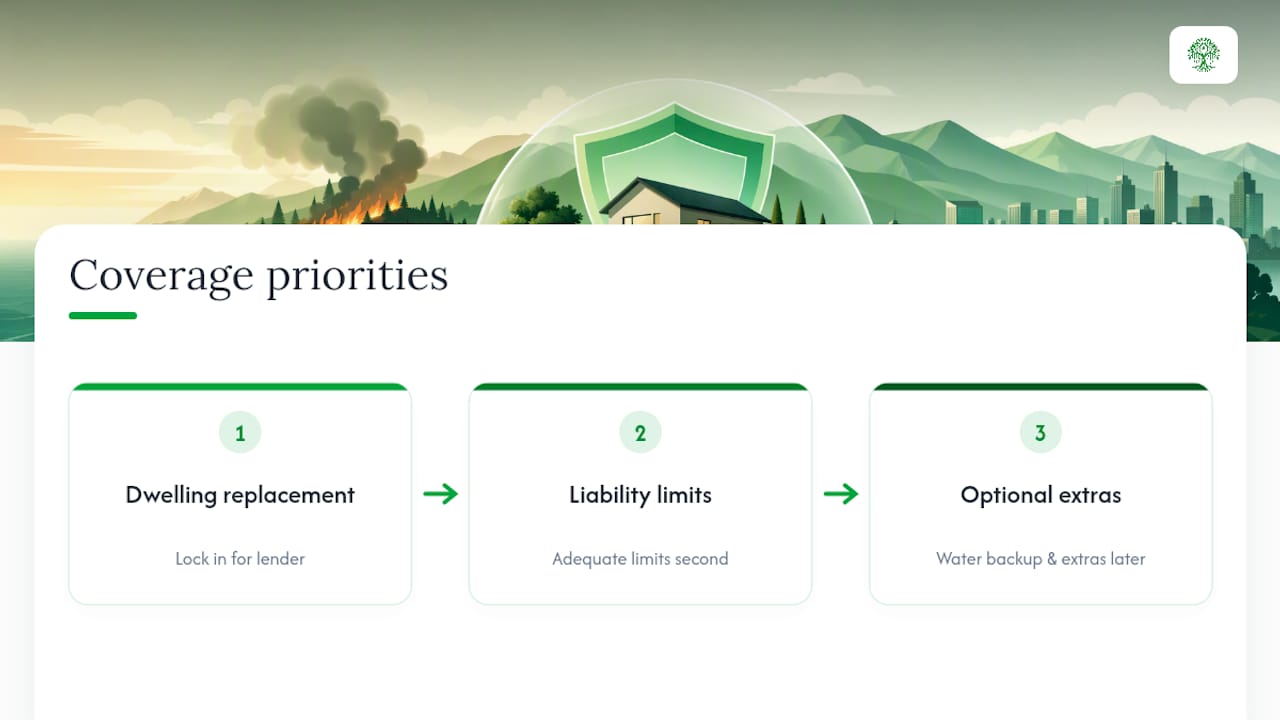
The bigger mistake is treating insurance as an afterthought in the affordability math. A $400 monthly premium quote that jumps to $650 after underwriting can break a budget that was calculated too tightly. Folding a realistic premium and a higher wildfire deductible into your upfront numbers, not your post-closing surprises, is what separates buyers who stay comfortable from buyers who feel stretched thin.
This is exactly where decision intelligence earns its keep. Ficustree’s neighborhood risk scoring and affordability tools surface likely insurance exposure before you fall in love with an address, which cuts weeks off the guesswork most first-time buyers go through on their own.
— Anand
How Ficustree Helps You Factor Insurance Into Your Home Search
Ficustree is the alternative to shopping blind. Instead of falling for a listing and finding out about wildfire exposure or a FAIR Plan situation during underwriting, you see the risk signals up front, while you’re still comparing neighborhoods.

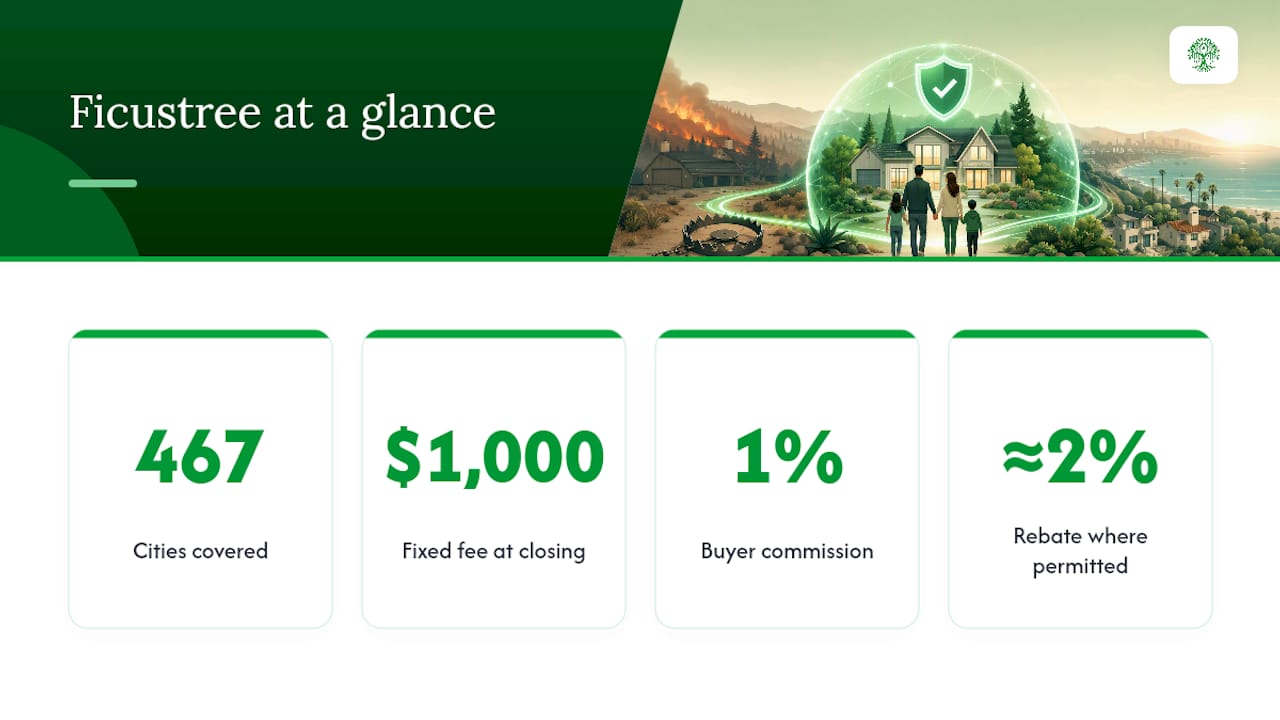
Our platform lets you browse homes across 467 California cities with neighborhood-level context built in, so insurance risk becomes part of your search from day one instead of a closing-week surprise. The same wildfire risk research that shapes this guide feeds directly into how Ficustree scores neighborhoods for first-time buyers. And because Ficustree represents you directly, for a fixed $1,000 fee at closing plus 1% commission, with a rebate of roughly 2% kept where legally permitted, you get a showing agent on demand and a platform built to compress months of confusion into weeks of clarity, at no cost to use the premium tools themselves.
If insurance availability is already shaping where you’re willing to buy, start on the Ficustree buyer page and let the platform surface the trade-offs before you write an offer.
Primary Sources and Further Reading
For deeper detail, see the Stanford Woods Institute research on premium and FAIR Plan trends, the Triple-I market reform report, NerdWallet’s California carrier roundup, and Phys of the broader crisis.
This article is general information, not a substitute for advice from a qualified financial advisor. Consult a qualified financial professional about your own circumstances before acting on anything here.
Sources
- California’s home insurance crisis is spreading beyond wildfire country | Stanford Woods Institute for the Environment
- California’s Insurance Challenges Signal Need for Continued Market Reforms, Triple-I Report Finds – Insurance News | InsuranceNewsNet
- The Best Homeowners Insurance in California in 2026 – NerdWallet
- Phys
FAQ
Is the FAIR Plan considered part of the best homeowners insurance in California?
Only as a last resort. The FAIR Plan covers fire, smoke, and explosion damage but excludes theft and liability, so most homeowners pair it with a supplemental Difference-in-Conditions policy.
What is the cheapest homeowners insurance in California right now?
There’s no single cheapest carrier statewide, since pricing depends on your ZIP code, home value, and construction. Comparing admitted and surplus-line quotes side by side is the most reliable way to find affordable homeowners insurance in California for your specific address.
How do I choose home insurance in California if I keep getting declined?
Ask your broker to quote surplus and excess (E&S) lines immediately after a standard decline, and request FAIR Plan plus DIC quotes if no standard carrier will write your address.
Does Ficustree offer homeowners insurance directly?
No. Ficustree is a buyer representation platform that helps first-time buyers factor insurance risk and affordability into their home search; current service details are available on the Ficustree buyer page.
Should I insure my home for its market value or its replacement cost?
Replacement cost, not market value. Basing your dwelling limit on what it would actually cost to rebuild avoids over-insuring and keeps your premium tied to real risk.
Recommended
- California FAIR Plan: What Homeowners Need to Know
- First-Time Homebuyer Mistakes California Buyers Must Avoid
- First Home Buying California Guide: Steps That Work

Leave a Reply