
An escalation clause helps California buyers stay competitive in tight bidding markets, but it works best when paired with a firm cap, a strict proof requirement, and a lender who has already confirmed your numbers. The main risks are an appraisal gap you have to cover in cash and a cap that tips your hand to the seller. Before writing one into an offer, confirm the listing agent will accept escalation language at all, then talk through the math with your lender.
TL;DR:
- Escalation clauses should be paired with a firm cap, proof requirement, and lender confirmation to avoid overpaying or appraisal gaps in California markets.
- Using small to moderate increments signals confidence without revealing too much to sellers, especially when the cap aligns with your true affordability.
- Confirm the listing agent’s acceptance and check your lender’s limits before drafting or submitting an escalation clause, as ambiguous language can lead to disputes.
- Many brokerages restrict custom escalation language, so it is advisable to have a real estate attorney review your clause to ensure enforceability.
- An escalation clause works best when you have a clear bidding strategy, are mentally prepared for the cash gap if the price exceeds appraisals, and are in a market that still considers them acceptable.
Table of Contents
- How Does an Escalation Clause Work in California?
- The Four Essential Drafting Elements to Include
- Pros, Cons, and Common Risks for California Buyers
- When Is an Escalation Clause a Good Idea for First-Time Buyers?
- California Drafting and Legal Considerations
- Practical Checklist and Sample Clause Pattern
- Recent Legal Cases or Regulatory Updates Influencing Escalation Clause Usage in California
- Ficustree’s Perspective: How We Advise First-Time Buyers in California
- How Ficustree Helps You Draft a Safer Competitive Offer
- Sources
- FAQ
How Does an Escalation Clause Work in California?
An escalation clause is a contract addendum that automatically raises your offer above a competing bid, in set increments, up to a maximum you choose. It only activates when the seller receives a verified competing offer, which is why the drafting checklist matters as much as the concept itself.
Four pieces make the mechanism work:
- Base offer. The starting price you are willing to pay outright, competing offers or not.
- Increment. The dollar amount your offer rises each time a higher bid appears.
- Cap. The absolute ceiling your offer will never cross, no matter how many competing bids show up.
- Verification. Proof the seller must provide showing a real, qualifying competing offer exists.
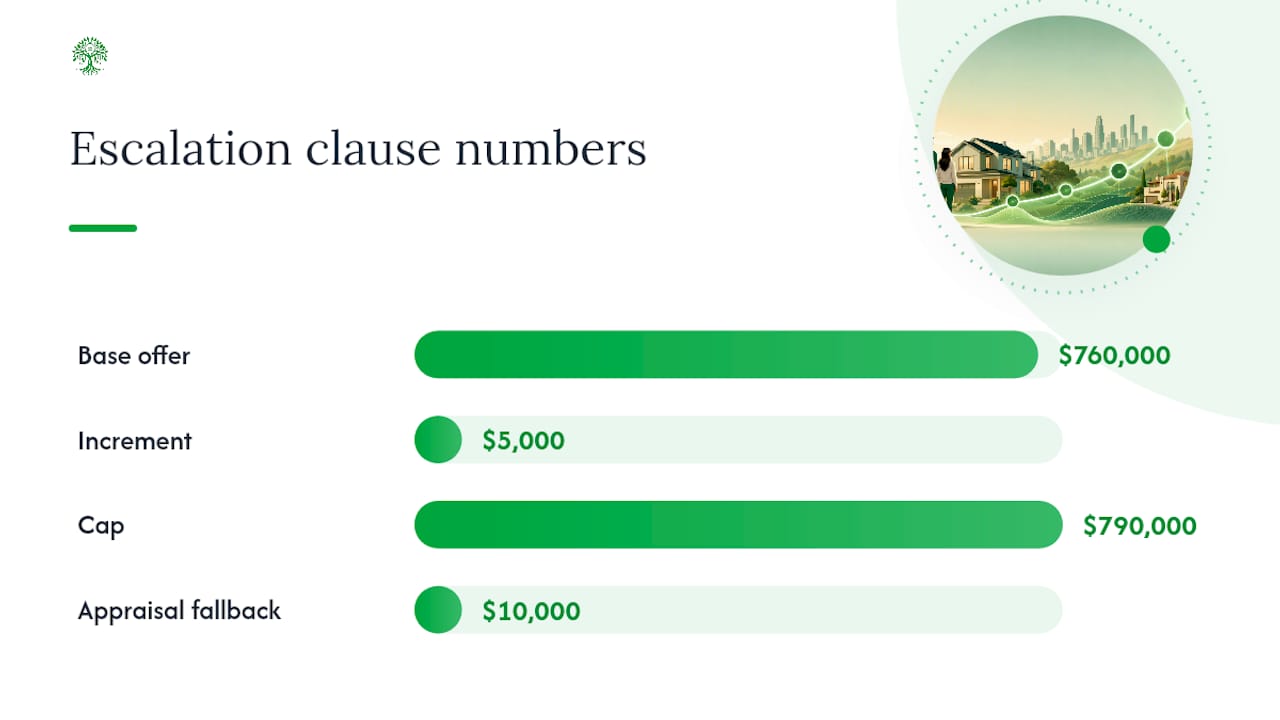
Here’s the math in action. Say a home is listed at $750,000. You offer $760,000 with a $5,000 increment and a $790,000 cap. A competing buyer offers $770,000. Your offer escalates to $775,000 (one increment above $770,000). If a second buyer comes in at $785,000, your offer rises to $790,000, your hard stop, and you either win at that price or lose the house. The seller typically must supply a redacted copy of the competing contract before your escalation triggers, not just a verbal claim that another offer exists.
The Four Essential Drafting Elements to Include
A vague escalation clause is often worse than no clause at all. Get these four elements locked down before you sign anything.
- Increment sizing. Smaller increments ($2,000 to $5,000) signal less desperation on homes under $500,000; larger jumps ($5,000 to $15,000) tend to show up on higher-priced properties, according to market practice guidance.
- Cap calculation. Set your ceiling based on real affordability, not just what you think will win. Factor in your lender’s limits and what you expect the home to appraise for.
- Proof requirement. Spell out exactly what counts as verification, typically a redacted purchase agreement plus proof of funds or a pre-approval letter from the competing buyer.
- Gross vs. net language. State clearly whether escalation is based on the competing offer’s gross price or its net price after concessions, since the two can differ by thousands of dollars.
Pro Tip: Never leave “bona fide competing offer” undefined in your clause. Courts and agents interpret vague terms inconsistently, so spell out what documentation counts as proof before you submit the offer.
Pros, Cons, and Common Risks for California Buyers
Escalation clauses solve a real problem: bidding blind. Instead of guessing what a competing buyer might offer and either overpaying or losing the house by a few thousand dollars, you let the clause respond in real time.
The trade-offs are just as real.
- Pro: You stay competitive without committing to your absolute maximum upfront.
- Con: Your cap tells the seller exactly how high you’ll go, which weakens your negotiating position if the clause gets revealed.
- Con: An escalated price that outpaces the appraisal leaves you covering the gap in cash, since lenders won’t finance above appraised value.
- Risk: Without a strict proof requirement, a seller could claim a competing offer exists that never really did.
- Market behavior: Many listing agents prefer clean, highest-and-best offers and will ignore escalation language entirely.
When Is an Escalation Clause a Good Idea for First-Time Buyers?
Use one when the situation actually calls for it, not by default on every offer.
- Confirm the listing agent accepts escalation clauses first. Some California listing agents, especially in high-demand markets like Silicon Valley, request highest-and-best offers and won’t consider them.
- Use one when you have a firm number in mind. If you know your true ceiling and want to avoid guessing at a single blind bid, an escalation clause keeps you disciplined.
- Skip it when appraisal risk runs high. If comparable sales suggest the home may not appraise near asking price, an escalation clause just increases your exposure to a cash gap.
- Decide your contingencies before you escalate. Waiving inspection or appraisal contingencies changes your risk profile independently of any escalation math.
California Drafting and Legal Considerations
Not every agent will write this clause for you. Many California brokerages restrict agents from drafting custom escalation language beyond standard C.A.R. forms, which pushes buyers toward attorney-drafted addenda for anything non-standard.
That caution exists for good reason. Ambiguous terms are the top cause of escalation clauses falling apart in a dispute, and courts have been inconsistent about enforcing language that doesn’t clearly define the trigger, the proof standard, or the cap.
- Ask your agent directly whether their brokerage allows custom escalation addenda.
- Budget for attorney review. It typically costs a few hundred dollars, which is modest relative to the financial exposure of a poorly worded clause on a home purchase.
- Understand the appraisal interaction before you sign: if your escalated price lands above the appraised value, you are on the hook for the difference in cash unless you’ve negotiated an appraisal-gap provision separately.
- Verify your lender’s stance on escalated purchase prices before you submit, since lenders lend against appraised value, not your winning bid.
Practical Checklist and Sample Clause Pattern
Run through this before you submit any offer with escalation language attached.
- Confirm the listing agent will accept an escalation clause.
- Check with your lender about appraisal and financing limits at your proposed cap.
- Set your cap based on real affordability, not competitive pressure.
- Choose an increment that signals confidence without over-committing.
- Require redacted proof of any competing offer before escalation triggers.
- Get the clause reviewed by a real estate attorney before signing.
A basic pattern looks like this: Base Offer $760,000, Increment $5,000, Cap $790,000, Proof Requirement redacted competing contract plus proof of funds, Gross vs. Net based on gross contract price, Appraisal Fallback buyer covers gap up to $10,000 above appraised value.
Pairing that structure with strong proof-of-funds documentation or an appraisal-gap guarantee tends to reduce seller resistance, since sellers increasingly weigh the whole offer package, not price alone.
Recent Legal Cases or Regulatory Updates Influencing Escalation Clause Usage in California
California courts have not issued a landmark ruling specifically striking down or blessing escalation clauses statewide, but the pattern in disputes that do surface is consistent: ambiguity kills enforceability. When a clause fails to define what counts as a “bona fide” competing offer, or leaves gross versus net proceeds unaddressed, buyers and sellers end up in disagreement over what price actually applies, and that disagreement can stall or unwind a closing.

Brokerage-level policy has shifted faster than case law. More California brokerages now require any escalation language to run through an attorney rather than get bolted onto a standard C.A.R. purchase agreement by an agent, a trend that tracks directly with legal guidance urging precise contract language to avoid disputes.
On the market-practice side, high-demand submarkets have been quietly moving away from escalation clauses altogether. Agents in intensely competitive areas increasingly ask for highest-and-best offers instead, partly because escalation language slows down multiple-offer review and partly because it can invite the exact ambiguity disputes courts have flagged. If you’re buying in one of these submarkets, ask your agent directly whether escalation clauses are even being considered before you spend time drafting one. The regulatory direction of travel favors clearer, simpler offer terms over clever conditional pricing, and buyers who follow that trend tend to face fewer surprises at closing.
Ficustree’s Perspective: How We Advise First-Time Buyers in California
Anand has spent years watching California bidding wars punish buyers who escalate without doing the math first. At Ficustree, we run three checks before recommending escalation language: true affordability including appraisal-gap exposure, a direct lender conversation confirming your ceiling is financeable, and a verification plan that won’t let a seller bluff you into overpaying. Cap-setting happens before drafting, not after.
— Anand
How Ficustree Helps You Draft a Safer Competitive Offer
Ficustree is the direct alternative to piecing together escalation strategy from generic templates and hoping your agent catches the risk. Instead of guessing at your cap or discovering the appraisal gap after you’re already under contract, you get AI-guided offer strategy that checks affordability first, flags lender and appraisal constraints before you sign, and connects you with attorney review when your clause needs it.

You also get hourly showing agents on demand instead of scheduling around one agent’s calendar, and the platform itself is free to use. Buyers who close through Ficustree pay a fee at closing plus commission, with a rebate kept where legally permitted. If you’re heading into a competitive bid and want your escalation math checked before you submit, start with Ficustree and walk into your offer with numbers you can trust.
Sources
- How to Write an Escalation Clause in Real Estate – LegalClarity
- What is an escalation clause? – Living in California
- NMLS Consumer Access
FAQ
Can an Escalation Clause Backfire?
Yes. Revealing your cap can lead a seller or listing agent to counter at or near your maximum, and if your escalated price outpaces the appraisal, you cover the gap in cash unless you’ve negotiated appraisal-gap protection.
Is an Escalation Clause a Good Idea?
It depends on your market and your numbers. It can help in bidding wars where you have a firm ceiling in mind, but it’s a poor fit where appraisal risk is high or the listing agent wants clean highest-and-best offers.
How Do You Beat an Escalation Clause?
A strong, clean offer with solid pre-approval, proof of funds, and flexible terms can outcompete an escalation clause because sellers weigh the whole offer package, not price alone. Confirming your numbers with a platform like Ficustree before you bid helps you compete on strength rather than just price.
What Is a Typical Escalation Clause?
A typical clause sets a base offer, an increment of $2,000 to $15,000 depending on price tier, a hard cap, and a requirement that the seller provide redacted proof of any competing offer before the escalation triggers.
Does Ficustree Charge for Help With an Escalation Clause?
Ficustree’s platform and guidance are free to use. Buyers who close through Ficustree pay a $1,000 fee at closing plus 1% commission, with a rebate kept where legally permitted.
Recommended
- How to Review California Buyer Disclosures (What’s at Stake)
- Escrow Process for First-Time Buyers: California Guide
- How to Make a Competitive Home Offer in 2026
- California Closing Costs Breakdown for First-Time Buyers

Leave a Reply