
The 2024 settlement pulled offers of buyer-agent compensation off the MLS and now requires a signed, written buyer-broker agreement before any home tour. Commissions haven’t collapsed. Buyer-side rates still average roughly 2.4% to 2.8%, with total commissions sitting in the mid-5% range. Your move: negotiate and lock in your agent’s fee in writing before you sign anything, and ask for a seller concession if paying it yourself would strain your closing costs.
TL;DR:
- Buyer-agent commissions remain around 2.4% to 2.8%, and total commissions stay close to 5.5% to 5.7%, despite regulatory changes.
- Buyers must now sign a written agreement before touring homes and negotiate the fee upfront, with the possibility of seller concessions covering costs.
- Compensation discussions shifted from MLS listings to purchase offers and seller concessions, but sellers can still pay fees off-MLS.
- Negotiating the agent’s fee early and obtaining clear, written terms helps protect against dispute caps and reduces transaction uncertainty.
- Platforms like Ficustree offer transparent, fixed-fee models with upfront costs and rebates, simplifying the process for first-time buyers.
Table of Contents
- Where Buyer Agent Commission Levels Sit Today
- What Changed in Policy and Practice Since 2026
- Who Pays the Fee Now, and How It Shows Up at Closing
- How Do You Negotiate Your Agent’s Commission?
- How a Transparent, AI-Enabled Buyer Model Reduces Friction
- The One Thing First-Time Buyers Should Do First
- Ready to Buy With a Clear Fee From Day One?
- Sources
- FAQ
Where Buyer Agent Commission Levels Sit Today
If you expected buyer-agent fees to crater after the rules changed, the numbers say otherwise. Redfin’s transaction data put the average buyer-agent commission at about 2.43% in the second quarter of 2025, nearly identical to pre-settlement levels. That figure reflects what actually closed, not what agents advertised, and it’s the number that matters most for your budgeting.
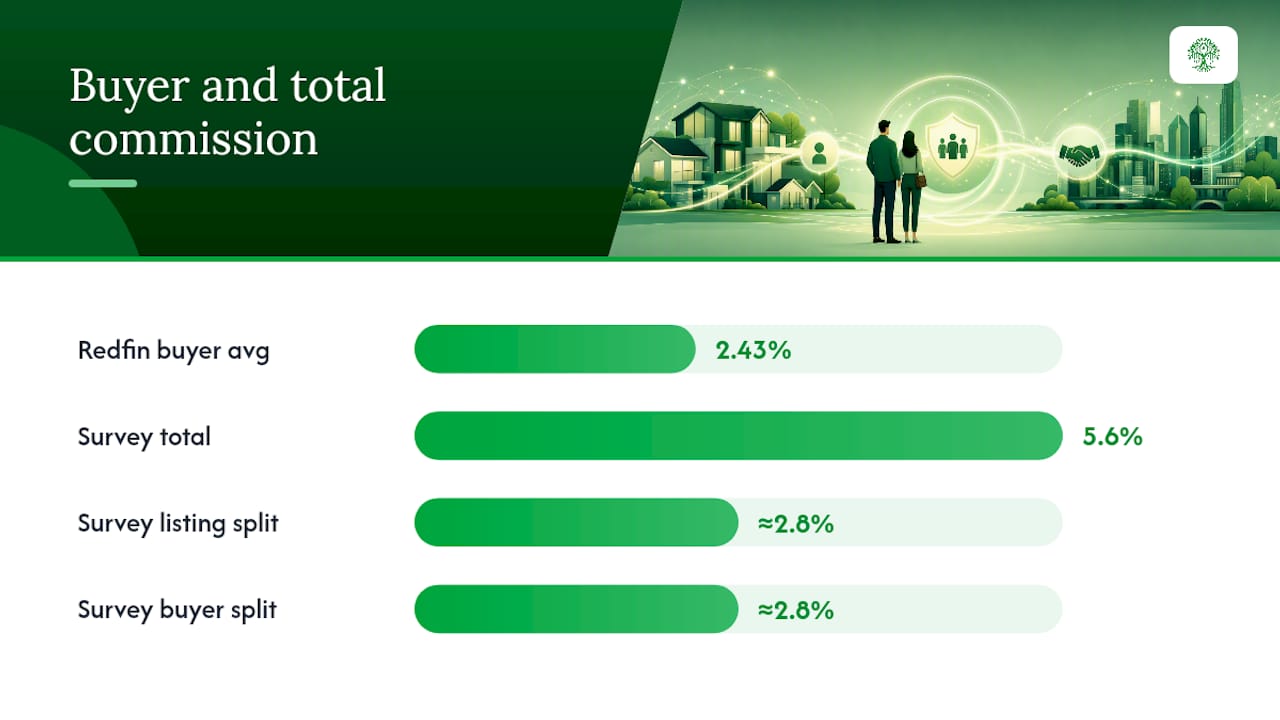
Separately, industry surveys from Clever and FastExpert paint a similar picture from a different angle. Their polling of working agents shows total commission still landing between 5.5% and 5.7%, split close to evenly between listing and buyer sides.
Statistic Callout: Buyer-side commissions have held near 2.4% to 2.8% through 2025 and into 2026, despite predictions that removing MLS compensation offers would push rates sharply lower.
Why the stability? A few forces are at work:
- Home price appreciation, not policy, drives most of the long-term decline in commission percentage, according to Federal Reserve research on commission trends.
- Sellers in competitive markets keep offering to cover buyer-agent fees because it widens their buyer pool.
- Survey-based averages and closed-transaction averages measure slightly different things, so expect small gaps between the two.
Read our breakdown of how real estate commission works for buyers and sellers if you want the full mechanics behind these figures.
What Changed in Policy and Practice Since 2026
The August 17, 2024 settlement rewired two core practices. First, MLS listings can no longer carry offers of buyer-agent compensation. Second, buyers must sign a written buyer-broker agreement before an agent shows them a home. Both changes came straight from NAR’s settlement FAQs and practice-change summary, which also confirms that sellers can still offer compensation off-MLS or as a purchase-offer concession.
NAR’s guidance clarifies a few practical points buyers run into constantly:
- Compensation talk moved off the MLS but not out of the transaction. It now happens through purchase offers, broker-to-broker calls, or seller concessions.
- MLS participants may still opt in to display cooperative compensation in some markets, so rules vary locally.
- Buyer agreements must state a fee that’s objectively ascertainable. Vague language like “TBD” or open-ended percentages won’t hold up.
Then came the 2026 NAR ethics updates, effective January 1. Article 7’s disclosure duty narrowed to apply mainly to the agent’s own client. Standard of Practice 3-4, which required disclosing compensation offers to cooperating brokers, was deleted outright. And arbitration awards are now capped at whatever amount your buyer agreement specifies, or what you actually paid, whichever applies.
Pro Tip: Ask your agent for the exact arbitration cap language in your buyer agreement before signing. Under the 2026 rules, that clause now limits what you can recover in a dispute, not just what your agent can claim.
Who Pays the Fee Now, and How It Shows Up at Closing
Nothing in the settlement bans sellers from paying buyer-agent commissions. It just moved that conversation out of the MLS and into the purchase contract. You can still ask a seller to cover your agent’s fee as a concession, and plenty of sellers agree, especially in markets where buyer demand is soft.
Statistic Callout: Analysts tracking post-settlement deals found that sellers frequently continue offering buyer-side compensation through purchase offers rather than MLS listings, meaning the underlying incentive to pay didn’t disappear, only the advertising mechanism did.
Here’s what changes practically for your transaction:
- Your buyer-broker agreement sets the fee amount or percentage before you tour a single home, so negotiate it early rather than at the closing table.
- The fee appears on your Closing Disclosure, itemized separately from the seller’s own commission obligations.
- If a seller concession covers part or all of the fee, that gets documented in your purchase agreement, not buried in fine print.
- VA loan buyers face extra scrutiny here. NAR’s own guidance flags that VA program rules can restrict how buyer commissions are paid, so confirm structure with your lender before you assume a concession will work the same way it does with conventional financing.
Talk to your lender or a real estate attorney if your situation touches VA financing, a low-down-payment program, or state-specific concession limits. Our guide on how to review California buyer disclosures covers related paperwork you’ll encounter around the same time.
How Do You Negotiate Your Agent’s Commission?
Negotiating your buyer-agent fee isn’t rude. It’s expected, and the new agreements make it easier because the number has to be spelled out in writing anyway. Here’s how to work it:
- Get quotes before you sign anything. Ask two or three agents what percentage or flat fee they charge, and don’t sign the first buyer agreement handed to you.
- Counter the percentage. If an agent proposes 3%, ask why, and propose a lower figure or a flat dollar amount instead. Many agents will negotiate, especially for straightforward transactions.
- Build a seller concession into your offer. Structure your purchase offer to request the seller cover part or all of your agent’s fee, particularly in a slower market where sellers have more incentive to close.
- Ask about rebates where they’re legal. Some brokerages return part of their commission to you at closing; confirm whether your state permits it before you count on it.
- Read the arbitration and cap language line by line. Under the 2026 ethics update, that clause caps what you can recover if a dispute arises, so vague wording works against you, not just your agent.
Your buyer agreement checklist should cover the exact fee or percentage, any cap, a clear list of included services, the dispute resolution process, and how amendments get made if your situation changes mid-search. For state-specific scripts, see our Texas buyer representation guide or the practical primer on seller concessions in California.
Pro Tip: If an agent resists putting a specific number in writing, treat that as a warning sign. The 2026 rules require the fee to be objectively ascertainable, so vague answers usually mean a harder negotiation later, not a favor to you.
Flat-fee buyer representation, hourly showing agents, and platform-based models are all worth comparing here. They can offer more predictable costs than a straight percentage, particularly on higher-priced homes.
How a Transparent, AI-Enabled Buyer Model Reduces Friction
Ficustree represents buyers directly under a fixed structure: $1,000 due at closing plus 1% commission, with a rebate of roughly 2% passed back to you where state law allows it. That’s the whole fee, stated upfront, before you sign anything or tour a single showing.
The friction most buyers run into with commission negotiations comes from not knowing what’s normal or what to ask for. Ficustree’s decision intelligence tools were built to close that gap:
- Explainable offer strategy support, so you understand why a counter makes sense before you make it.
- Disclosure analysis that flags what actually matters in the paperwork you’re signing.
- Neighborhood fit scoring based on your actual criteria, not just listing photos.
- Hourly showing agents on demand, so you’re not locked into a single agent relationship before you’ve found the right home.
Every one of these tools runs on the premium platform at no cost to you until you close.
The One Thing First-Time Buyers Should Do First
If you take one thing from all of this: negotiate your buyer agreement’s fee language before you tour a single home, then get it in writing with specific numbers, not ranges. That single step protects your negotiating position and keeps your remedy options open if a dispute ever comes up under the new arbitration caps.
Buying your first home is stressful enough without wondering whether your agent’s fee is fair or fixed. Locking it down early turns one more unknown into a settled question, and settled questions are what actually reduce the overwhelm everyone talks about in this market.
— Anand
Ready to Buy With a Clear Fee From Day One?
Ficustree is the alternative to a traditional agent for buyers navigating these commission changes in California and Texas: one flat fee of $1,000 at closing plus 1% commission, stated upfront, with a rebate of roughly 2% back to you where legally permitted, instead of a vague percentage you negotiate blind.

You get AI-guided offer strategy, disclosure analysis, and neighborhood scoring free on the platform, plus hourly showing agents when you need a tour without committing to a long-term agreement. If the negotiation steps above felt like a lot to manage alone, that’s exactly the gap Ficustree’s Direct Path was built to close. Start your search on Ficustree and see what a transparent fee looks like before you sign anything.
Sources
- NAR settlement FAQs and practice-change summary
- It’s been a year since new rules changed how real estate agents are paid—where commissions stand now (CNBC)
- Real Estate Commissions Went Up, Not Down, After the NAR Settlement (Offerpad analysis, 2026)
- 3 NAR Rules Changed Jan 1 2026 — Team Compliance Guide (RobinFlow)
FAQ
Is a 3% Buyer Agent Commission Normal?
A 3% fee is on the higher end but not unheard of, since transaction data shows buyer-side commissions averaging closer to 2.4% to 2.8%. Always negotiate the percentage before signing your buyer-broker agreement rather than accepting the first number offered.
Can a Seller Refuse to Pay a Buyer’s Agent?
Yes. Since the 2024 settlement removed compensation offers from the MLS, sellers decide case by case whether to cover your agent’s fee through a concession. If a seller declines, you’re contractually responsible for the fee stated in your buyer agreement, which is exactly why negotiating that number early matters.
Will Real Estate Agents Work for a 2% Commission?
Many will, particularly for straightforward transactions or when you’re a well-qualified, pre-approved buyer. Rates are negotiable under the new written-agreement requirement, so ask directly and get competing quotes before you commit.
Do Real Estate Agents Still Charge 6% Total Commission?
Total commission today typically runs in the mid-5% range, closer to 5.5% to 5.7% combined across both sides, rather than a flat 6%. The exact split between listing and buyer-agent commission is negotiated separately in most transactions now.
What Does Ficustree Charge Buyers?
Ficustree charges a $1,000 fee at closing plus 1% commission, with a rebate of roughly 2% passed back where legally permitted. Details are available on the Ficustree buyer page.
Recommended
- Save on First Home: Flat Fee Buyer Agents with Rebates in California
- How Real Estate Commission Works for Buyers and Sellers
- What Is a Buyer’s Agent? Your 2026 Home Buying Guide
- Exclusive Buyer Agency: NAR Rules and AI Tools First Time Buyers Need

Leave a Reply