
You apply for a CalHFA loan through a CalHFA-approved private lender, not directly through CalHFA. That single fact trips up more first-time buyers than any other part of this process. Here is your immediate action list:
- Find a CalHFA-approved loan officer using the official lender database or Preferred Loan Officers list.
- Prequalify to understand your price range before you start touring homes.
- Complete your homebuyer education certificate early — certificate timing is the most common cause of application delays.
- Gather your documents (ID, income, assets, employment) before your first lender meeting.
- Submit your application through your chosen loan officer, who handles underwriting and funding under CalHFA program rules.
Pro Tip: Before sharing any financial documents, confirm your loan officer’s NMLS registration at NMLS Consumer Access and ask specifically whether they have closed CalHFA loans before — not just whether their branch is approved.
Key Takeaways
CalHFA loans are applied for through CalHFA-approved private lenders, not directly through CalHFA, and completing homebuyer education early is the single most effective way to avoid application delays.
| Point | Details |
|---|---|
| Apply through a lender | CalHFA does not accept direct borrower applications; find an approved loan officer first. |
| Education certificate timing | Certificates typically expire one year after issuance; complete counseling before your home search. |
| NMLS verification is required | Confirm every loan officer’s license at NMLS Consumer Access before sharing financial documents. |
| Income limits vary by county | Check current CalHFA income limits for your county and household size before prequalifying. |
| Ficustree organizes your application | Ficustree’s platform maps your documents to CalHFA requirements and tracks milestones to closing. |
This article is general information, not a substitute for advice from a qualified financial advisor. Consult a qualified financial professional about your own circumstances before acting on anything here.
Table of Contents
- Which CalHFA programs should you consider first?
- Who actually qualifies for a CalHFA loan?
- What homebuyer education does CalHFA require?
- Documents you need before contacting a lender
- How to apply for a CalHFA loan, step by step
- How do you find and vet a CalHFA-approved loan officer?
- What do CalHFA loans actually cost?
- What is the typical CalHFA loan timeline?
- Common mistakes that slow or kill CalHFA applications
- How does down payment assistance actually work within CalHFA?
- Why do CalHFA applications get denied, and what can you do?
- What most first-time buyers get wrong about the CalHFA process
- Ficustree helps you move through the CalHFA process faster
- Sources
- FAQ
Which CalHFA programs should you consider first?
CalHFA offers several distinct loan programs, and picking the right family early saves weeks of back-and-forth. Here is a plain-language snapshot of each:
- CalHFA FHA: An FHA-insured 30-year fixed mortgage with government-backed underwriting. Best for buyers with credit scores in the mid-600s who need more flexible qualifying ratios.
- CalHFA Conventional: A 30-year fixed conventional loan with standard private mortgage insurance. Better for buyers with stronger credit who want to avoid FHA mortgage insurance premiums long-term.
- CalPLUS Conventional / CalPLUS FHA: These CalPLUS programs pair directly with ZIP, CalHFA’s zero-interest closing-cost assistance loan. Ideal if you need help covering closing costs on top of a down payment.
- California Dream For All (DFA): A shared-appreciation loan that provides up to 20% of the purchase price as down payment assistance. When you sell or refinance, you repay the original assistance plus a share of the home’s appreciation. Best for buyers who need maximum upfront help and plan to stay long-term. Check California first-time buyer programs for a side-by-side comparison.
- MyHome Assistance Program: A deferred-payment junior loan for down payment or closing costs, paired with most CalHFA first mortgages.
For exact rate quotes, contact a CalHFA-trained loan officer — rates change daily and depend on your credit profile and the lender’s fee structure.
Who actually qualifies for a CalHFA loan?
CalHFA’s borrower eligibility requirements are specific, and a quick self-check before calling a lender saves everyone time.
Core borrower rules:
- You must occupy the property as your primary residence. Investment properties and vacation homes are not eligible.
- CalHFA defines “first-time homebuyer” as someone who has not owned and occupied a primary residence in the past three years. If you owned a home more than three years ago and have rented since, you may still qualify.
- You must meet the credit and debt-to-income requirements of the underlying loan type (FHA or conventional) plus any CalHFA overlays your lender applies.
Income limits:
Household income limits vary by county and household size. CalHFA publishes current limits on its program pages, and they are updated periodically. Check the CalHFA income limits by county before your first lender call so you know whether your household income falls within range. The limit is based on all occupying borrowers and, for some programs, all household members — confirm the exact calculation method with your loan officer.
Property requirements:
- One-unit single-family residences, condos, and planned unit developments (PUDs) are generally eligible.
- The property must be in California.
- Manufactured homes and multi-unit properties are typically not eligible under standard CalHFA programs.
- Condos must meet the approval requirements of the underlying loan type (FHA or conventional).
Pro Tip: If you have a co-borrower who owned a home recently, or if you owned a property through a business entity, ask a Preferred Loan Officer to review your situation before assuming you are ineligible. Edge cases come up often, and the three-year rule has nuances.
What homebuyer education does CalHFA require?
Most CalHFA loans require at least one occupying borrower to complete a homebuyer education and counseling course and provide a valid certificate at closing. This is not optional, and the format matters.
Accepted providers and formats:
- eHome America: The only online course CalHFA explicitly accepts. The eHome eight-hour online course must be paired with a one-hour one-on-one counseling session to satisfy CalHFA’s requirement. An online-only certificate without the counseling follow-up is commonly rejected.
- NeighborWorks-affiliated agencies: In-person and virtual courses through NeighborWorks HomeOwnership Centers are accepted.
- HUD-approved housing counseling agencies: Local agencies offering in-person or virtual sessions qualify. Find one near you through the HUD-approved counseling guide.
Certificate timing:
Certificates typically expire one year after issuance, though individual lenders may apply stricter timelines per the CalHFA Lender Program Handbook. If your certificate expires before you close, you may need to retake the course. Lenders verify completion directly with the provider or through the certificate documentation you submit.
Pro Tip: Schedule your counseling session in the first week of your home search, not after you find a property. Waiting until you are under contract to book a counseling appointment is the single most avoidable delay in the CalHFA process.
Documents you need before contacting a lender
Arriving at your first lender meeting with a complete packet cuts days off your timeline. Organize everything by category and save files as PDFs with clear names.
Identity:
- Government-issued photo ID (driver’s license or passport)
- Social Security number for all borrowers
Income:
- Two most recent pay stubs
- W-2s for the past two years
- Federal tax returns (signed, all pages) for the past two years
- If self-employed: profit and loss statement, business tax returns
Assets:
- Two to three months of bank statements (all pages, all accounts)
- Investment or retirement account statements if used for down payment
Employment:
- Employer contact information for verification
- If recently changed jobs: offer letter and prior employment history
Rental history:
- Twelve months of canceled rent checks or landlord contact information
Program-specific:
- Income limit worksheet (your loan officer may provide this)
- For California Dream For All: first-generation documentation, which may include parent or guardian records confirming they did not own a home in California. See the first-generation homebuyer guide for a full documentation breakdown.
File-naming tip: Use a consistent pattern such as LastName_W2_2024.pdf or LastName_BankStmt_Jan2026.pdf. Lenders process dozens of files per loan; clear names reduce back-and-forth requests.
Pro Tip: Scan documents with a flatbed scanner or a scanning app like Adobe Scan rather than photographing them with your phone camera. Lenders and underwriters flag low-resolution or angled images, which can trigger re-submission requests and add days to your timeline.
How to apply for a CalHFA loan, step by step
The CalHFA loan process has six clear stages. Your loan officer drives most of the work after Step 2, but knowing what happens at each stage keeps you from being caught off guard.
- Find a CalHFA-approved loan officer. Use the CalHFA lender database to find a branch that participates in your target program, then confirm the specific officer’s CalHFA experience. Preferred Loan Officers are the fastest path.
- Prequalify. Share your income, assets, and credit profile. Your loan officer calculates your maximum purchase price under CalHFA income limits and identifies which programs fit.
- Complete homebuyer education. Book your counseling session now if you have not already. Your certificate must be valid at closing.
- Make an offer and go under contract. Once your offer is accepted, your loan officer opens the formal loan file.
- Submit the full application and enter underwriting. You provide the complete document packet. The lender underwrites the loan against both standard guidelines and CalHFA program rules per the Loan Program Handbook. CalHFA does not underwrite the loan — your lender does, then submits to CalHFA for program enrollment and funding.
- Clear conditions and close. Underwriters issue a conditional approval with a list of outstanding items. Respond within 24–48 hours for each condition. Once you receive a clear-to-close, you sign closing documents and receive your keys.
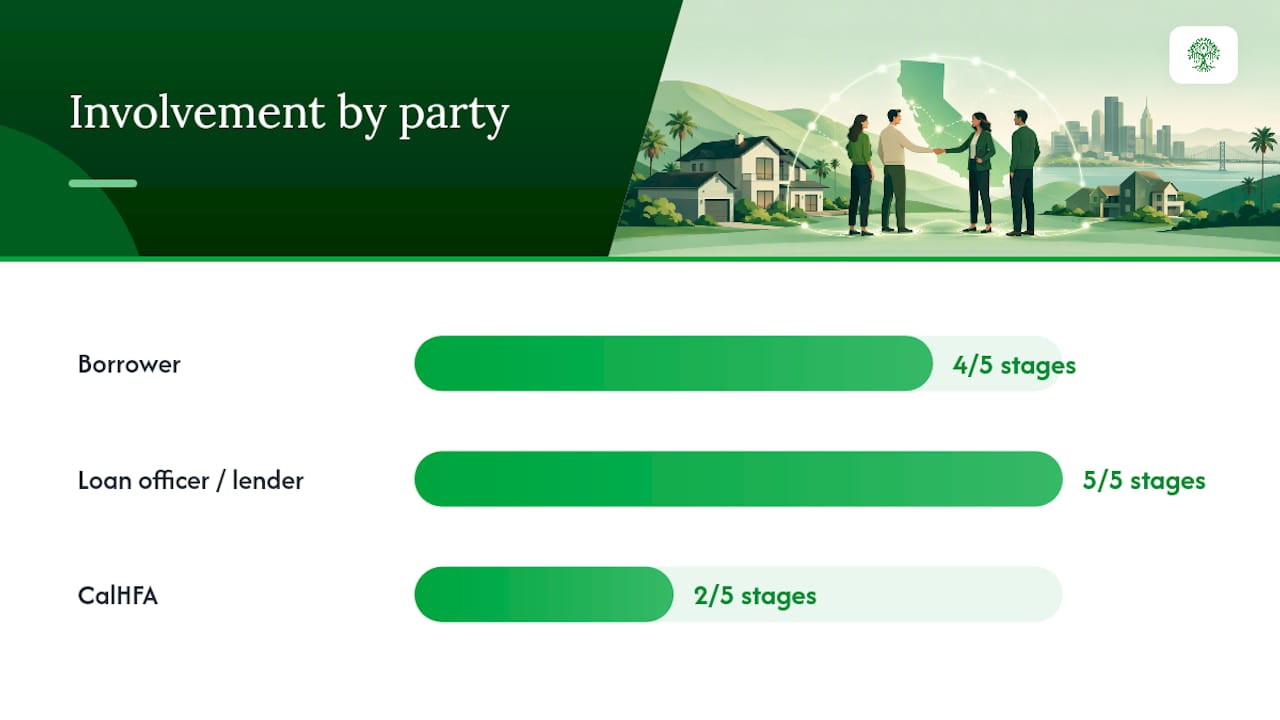
| Stage | Borrower | Loan officer / lender | CalHFA |
|---|---|---|---|
| Prequalification | Provide income and asset info | Reviews eligibility, selects program | Not involved |
| Application | Submit full document packet | Opens loan file, orders appraisal | Not involved |
| Underwriting | Respond to conditions promptly | Underwrites against program rules | Not involved |
| Program enrollment | None | Submits to CalHFA for enrollment | Enrolls loan, confirms program terms |
| Closing | Sign documents, pay closing costs | Coordinates title and escrow | Funds the loan |
Pro Tip: When underwriting issues a condition, read it carefully before responding. Sending the wrong document wastes a review cycle. If the condition is unclear, call your loan officer the same day rather than guessing.
How do you find and vet a CalHFA-approved loan officer?
Not every loan officer at an approved branch has CalHFA experience. The branch being listed does not mean the individual officer has closed a CalHFA loan. That distinction matters.
Where to search:
- The CalHFA Preferred Loan Officers list is your first stop. Preferred Loan Officers have completed CalHFA-specific training and are familiar with program documentation quirks.
- The approved-lenders search lets you filter by county and see which specific CalHFA products each branch offers (CalPLUSConv, CalHFAFHA, etc.).
How to verify NMLS registration:
Every mortgage loan originator must hold a valid license and be registered in the NMLS. Look up any officer at NMLS Consumer Access before sharing financial documents. CalHFA requires Preferred Loan Officers to maintain a valid Mortgage Loan Originator license and report any changes, though CalHFA does not independently verify registry status for every update.
Questions to ask before committing:
- How many CalHFA loans have you closed in the past 12 months?
- Which CalHFA programs do you originate most frequently?
- What is your typical timeline from application to clear-to-close?
- Have you worked with the California Dream For All shared-appreciation program?
Pro Tip: A Preferred Loan Officer who has closed multiple CalHFA loans recently will catch documentation issues before they reach underwriting. That experience alone can shave one to two weeks off your timeline.
What do CalHFA loans actually cost?
Interest rates on CalHFA loans are not fixed by CalHFA — they vary daily based on your credit score, the loan program, and the lender’s fee structure. The CalHFA FHA program page notes this explicitly: rates change daily and depend on borrower-specific factors. Get a written rate quote from your loan officer and compare it against the Loan Estimate you receive within three business days of application.
Common cost drivers:
- Origination fees: Lender charges for processing your loan, typically expressed as a percentage of the loan amount.
- Discount points: Optional upfront payments to buy down your interest rate. Ask your loan officer whether points make sense given your expected time in the home.
- PMI: Conventional CalHFA loans with less than 20% down require private mortgage insurance. FHA loans carry a mortgage insurance premium (MIP) instead, which includes an upfront charge and an annual premium.
- Junior loan costs: MyHome and ZIP are deferred or zero-interest junior loans, but they add to your total debt load and affect your debt-to-income ratio.
How down payment assistance changes your numbers:
Pairing a MyHome or ZIP loan with your first mortgage reduces your cash to close but increases your total loan balance. The California Dream For All program eliminates the need for a large down payment upfront, but when you sell or refinance, you repay the original assistance plus a share of the home’s appreciation. For buyers who plan to stay five or more years, that trade-off often works in their favor. For a deeper look at how no-money-down options affect your monthly payment, run the numbers before you commit.
When you receive your Loan Estimate, compare every line item against CalHFA program rules and ask your loan officer to explain any fee you do not recognize.
What is the typical CalHFA loan timeline?
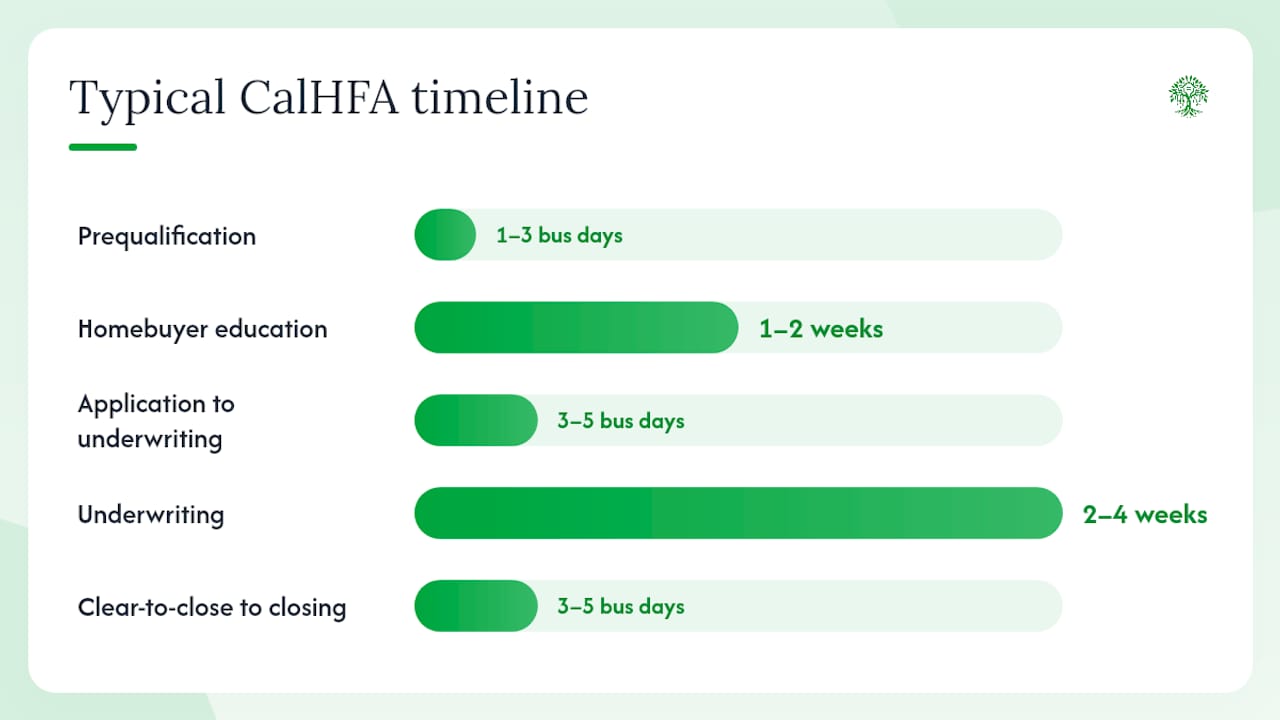
Plan for several weeks to a couple of months from application to closing under normal conditions. Here are the major milestones:
- Prequalification: 1–3 business days once you provide complete information.
- Homebuyer education: 1–2 weeks if you schedule promptly; longer if counseling slots are limited in your area.
- Offer and contract: Variable, depending on your home search.
- Formal application to underwriting submission: 3–5 business days after going under contract.
- Underwriting: 2–4 weeks under standard conditions; longer if conditions require additional documentation or a condo project approval.
- Clear-to-close to closing: 3–5 business days.
Common bottlenecks and how to avoid them:
- Expired or missing education certificate: Complete counseling before you start your home search.
- Document gaps: Use the checklist above and submit complete packets the first time.
- Condo project approval: If you are buying a condo, ask your loan officer to confirm project eligibility under FHA or conventional guidelines before you make an offer. Condo approvals can add two to three weeks if the project is not already on the approved list.
- Appraisal delays: Order the appraisal as soon as you go under contract. Appraisal scheduling in competitive California markets can run 10–14 days.
- Tax transcript delays: Request your IRS tax transcripts (Form 4506-C) early. Underwriters often need them, and IRS processing can take time.
For a broader look at the California buying timeline, the first home buying California guide walks through each stage in detail.
Common mistakes that slow or kill CalHFA applications
Most CalHFA application denials and delays trace back to a short list of avoidable errors.
Do not do these:
- Submit an incomplete document packet and expect the lender to ask for what is missing. Underwriters flag incomplete files and set them aside.
- Assume any online homebuyer education certificate qualifies. Only eHome’s course with the one-hour counseling follow-up is explicitly accepted as an online option. Other online-only certificates are commonly rejected.
- Skip NMLS verification. Sharing financial documents with an unverified loan officer is a fraud risk.
- Ignore asset seasoning rules. Large deposits in your bank accounts within 60 days of application require a paper trail. Unexplained deposits can stall underwriting.
- Change jobs or take on new debt after prequalification. Both can invalidate your approval.
What actually works:
- Complete homebuyer education before you start your home search.
- Work with a Preferred Loan Officer who has recent CalHFA closing experience.
- Prepare a two-year income documentation package before your first lender meeting.
- Respond to every underwriting condition within 24 hours.
Pro Tip: When you receive a conditional approval, ask your loan officer to prioritize the conditions by complexity. Tackle the hardest ones first — usually tax transcripts or employment verification — so simpler items do not sit waiting while you chase paperwork.
How does down payment assistance actually work within CalHFA?
Down payment assistance (DPA) within CalHFA is not a grant. It is a junior loan that sits behind your first mortgage and must be repaid under specific terms.
No monthly payments are required. The balance is due when you sell, refinance, or pay off the first mortgage. MyHome can be paired with most CalHFA first mortgages.
ZIP (Zero Interest Program): Paired exclusively with CalPLUS programs. ZIP covers closing costs, not the down payment, and carries a zero-interest deferred payment structure. You cannot use ZIP with a standard CalHFA FHA or CalHFA Conventional loan — it requires the CalPLUS version.
You make no monthly payments on the DFA portion. At sale or refinance, you repay the original assistance amount plus a percentage of the home’s appreciation proportional to CalHFA’s original contribution. This program has historically been oversubscribed and operates through a lottery when demand exceeds funding. Confirm current availability with a CalHFA-trained loan officer.
Sourcing rules: DPA funds must come from CalHFA-approved programs. You cannot layer an outside DPA grant on top of a CalHFA junior loan without lender and program approval. Ask your loan officer which combinations are permitted under current program guidelines.
Why do CalHFA applications get denied, and what can you do?
Denial is not the end of the road. Most CalHFA application issues are fixable with the right information.
Common denial reasons:
- Income over the limit: Your household income exceeds the county limit for your program. Solution: check limits before applying, and confirm which household members’ income counts. Some programs exclude certain income sources.
- Credit score below program minimum: FHA loans have more flexibility, but a score below the program floor is a hard stop. Solution: work with a credit counselor to identify and address the specific factors pulling your score down, then reapply after 6–12 months of improvement.
- Debt-to-income ratio too high: Your monthly debt obligations relative to your gross income exceed program limits. Solution: pay down revolving debt before applying, or consider a lower purchase price.
- Property does not meet program requirements: The home is a multi-unit, manufactured, or non-warrantable condo. Solution: select an eligible property type.
- Incomplete or inconsistent documentation: Missing pages, unsigned tax returns, or income figures that do not match across documents. Solution: submit complete, consistent packets the first time.
- Homebuyer education certificate expired or not accepted: Solution: retake the course with an accepted provider.
If you believe a denial was made in error: Contact your loan officer first. They can request a reconsideration of value on an appraisal or escalate documentation disputes. For program-level issues, CalHFA’s homebuyer resources page provides contact information for program staff. You may also consult a HUD-approved housing counselor for an independent review of your situation.
What most first-time buyers get wrong about the CalHFA process
The conventional advice on CalHFA applications focuses almost entirely on eligibility checklists. That is useful, but it misses the real friction point: the relationship between the borrower, the lender, and CalHFA is not a triangle. It is a chain. CalHFA sits at the end of it.
Your lender is your primary contact. They underwrite, they collect documents, they submit to CalHFA for program enrollment. CalHFA funds the loan, but it does not manage your application. That means a loan officer who is vague about CalHFA program rules, or who has never closed a CalHFA loan, will cost you weeks — not because they are incompetent, but because CalHFA’s documentation requirements are specific and unforgiving of first-time mistakes.
The second thing buyers underestimate is the homebuyer education requirement. Most people treat it as a box to check. CalHFA treats it as a prerequisite for long-term success, and the timing rules reflect that. A certificate that expires before closing means starting over. Scheduling counseling early is not just good advice — it is the single highest-leverage action in this entire process.
Finally, the California Dream For All program is genuinely powerful for buyers who qualify, but the shared-appreciation structure deserves careful thought. If your home appreciates significantly over 10 years, the repayment at sale will be larger than it looks on paper today. Run the numbers with your loan officer before committing.
Ficustree helps you move through the CalHFA process faster
Pulling together a lender-ready packet for a CalHFA application takes most buyers two to three weeks of scattered effort. Ficustree compresses that into a structured workflow. The platform organizes your documents by category, flags missing items before you submit, and maps your checklist directly to CalHFA application requirements so nothing slips through.

Three ways Ficustree shortens your path to closing: it generates a personalized document checklist matched to your target CalHFA program, it connects you with CalHFA-trained representation so you are not navigating lender conversations alone, and it tracks your application milestones so you always know what comes next.
Ready to get your CalHFA application organized? Start with Ficustree and move from scattered paperwork to a lender-ready packet in days, not weeks.
Sources
- Steps to Buying a Home | CA Housing Finance Agency
- Find a Loan Officer for your Home Loan | CALHFA
- CalHFA Approved Lenders
- Loan Program Handbook for Lenders, Real Estate … – CalHFA
FAQ
Does CalHFA accept direct applications from borrowers?
No. CalHFA does not accept applications directly from borrowers. You apply through a CalHFA-approved private lender or Preferred Loan Officer, who handles underwriting and submits to CalHFA for program enrollment and funding.
Which online homebuyer education course does CalHFA accept?
CalHFA explicitly accepts eHome America’s eight-hour online course, but only when paired with a one-hour one-on-one counseling session. Online-only certificates without the counseling component are commonly rejected.
How long does the CalHFA loan process take?
Most CalHFA loans typically close within about two months from formal application under standard conditions. Underwriting alone typically takes 2–4 weeks, and delays from missing documents, condo approvals, or expired education certificates can extend that timeline.
What is the income limit for CalHFA programs?
Income limits vary by county and household size and are updated periodically by CalHFA. Check the current limits on CalHFA’s program pages or use the CalHFA income limits guide for county-level tables before you prequalify.
Can you use CalHFA with down payment assistance?
Yes. Most CalHFA first mortgages can be paired with MyHome (a deferred junior loan for down payment or closing costs), and CalPLUS programs pair with ZIP for closing-cost assistance.
Recommended
- California First-Time Buyer Programs Explained for 2026 – ficustree.ai
- First Home Buying California Guide: Steps That Work – ficustree.ai
- First Generation Homebuyer Program: 2026 Guide for CA and TX – ficustree.ai

Leave a Reply