
HELOCs are popular with tech homeowners because they combine rates lower than unsecured credit, a draw-as-needed structure that matches phased projects, and a digital-first application experience that fits how tech professionals expect to borrow. Here is the short version:
- Flexible draws: Pull only what you need, when you need it, during a 5–10 year draw period.
- Lower rates: HELOC rates typically run well below credit cards and personal loans.
- Interest-only payments during the draw period keep monthly costs manageable while a project is underway.
- Fast digital applications: Many lenders now approve and close HELOCs online, often in days rather than weeks.
The single biggest caution: When the draw period ends, your payment switches from interest-only to full principal-and-interest. That jump can be significant. Model it before you draw a dollar, as The Mortgage Reports warns.
Key Takeaways
HELOCs work best for tech homeowners running phased projects with stable income, but the repayment-period payment jump is the risk most borrowers underestimate before drawing.
| Point | Details |
|---|---|
| Draw structure fits phased projects | A revolving line matches smart-home and renovation timelines better than a lump-sum loan. |
| Model repayment before drawing | The switch from interest-only to principal-and-interest can significantly raise your monthly payment. |
| Size for overruns | Add 15–20% to your project estimate; renovation overruns of 20–40% are common. |
| Tax deductibility has conditions | Interest is only deductible when funds are used to buy, build, or substantially improve the secured home. |
| Ficustree for the buy alternative | If renovating no longer makes sense, Ficustree’s affordability calculator helps you model buying instead. |
This article is general information, not a substitute for advice from a qualified financial advisor. Consult a qualified financial professional about your own circumstances before acting on anything here.
Table of Contents
- How does a HELOC actually work for homeowners?
- Why tech-savvy homeowners prefer HELOCs
- What can you use a HELOC for, and when does it make sense?
- What are the real risks of a HELOC?
- How does a HELOC compare to other home equity options?
- How do you shop for and apply for a HELOC?
- Why you can trust this guide
- An honest take on the renovate-vs-buy decision
- When buying makes more sense than borrowing
- Sources
- FAQ
How does a HELOC actually work for homeowners?
A home equity line of credit (HELOC) is an open-end revolving credit line secured by your home’s equity. Think of it like a credit card backed by your house: you get a credit limit, draw against it as needed, and repay what you use.
Draw period vs. repayment period:
- Draw period (typically 5–10 years): You borrow up to your limit, pay interest only on the outstanding balance, and can repay and redraw repeatedly.
- Repayment period (typically 10–20 years): The line closes to new draws, and your balance converts to a fully amortizing loan with principal-and-interest payments.
Lenders set your credit limit based on your home’s appraised value minus your outstanding mortgage balance, subject to a maximum loan-to-value ratio (usually 80–85%). Qualifying factors include your credit score (most lenders want 620 or higher, with better rates above 700), debt-to-income ratio, and income documentation.
HELOC rates have been trending toward the high single digits, with Bankrate noting movement toward around 8% depending on market conditions, still well below most credit cards. IRS rules limit interest deductibility to funds used to buy, build, or substantially improve the secured home, so how you use the money matters for tax purposes.
Why tech-savvy homeowners prefer HELOCs
The fit is almost structural. Tech homeowners tend to run projects in phases: a smart-home infrastructure rollout this quarter, a home office buildout next year, a kitchen upgrade after that. A HELOC’s revolving draw structure mirrors that cadence exactly. You do not borrow $80,000 upfront for a project you will complete in stages over 18 months.
The MBA’s white paper on HELOC growth attributes rising HELOC uptake directly to digital-first lenders offering faster approvals and closings, often measured in days rather than the weeks traditional lenders require. For a homeowner who files taxes digitally, manages investments through an app, and expects instant account access, waiting three weeks for a paper-based loan approval feels archaic.
Market context: Bankrate reports $17.8 trillion in aggregate homeowner equity as of Q2 2025, and a TD Bank survey found many borrowers used that equity specifically for property upgrades. High mortgage rates have also pushed owners to renovate rather than move, keeping HELOC demand strong.
That “renovate vs. move” calculus is especially sharp for tech homeowners in high-equity markets like California, where home prices remain elevated and trading up often means surrendering a low locked-in mortgage rate.
What can you use a HELOC for, and when does it make sense?
For midrange renovations in the $15,000–$100,000 range, a HELOC often offers the best practical balance: near-cash-out-refinance rates, low closing costs, and draw-as-needed access. Common use cases for tech homeowners:
- Phased kitchen or bathroom remodels where contractor schedules mean costs arrive in waves.
- Smart-home infrastructure (wiring, panels, networking) — typical smart-home upgrades run $12,000–$20,000, and structured cabling or panel upgrades may qualify as substantial improvements.
- Energy retrofits (solar, battery storage, EV charging) that add measurable resale value.
- Home office buildouts — a dedicated workspace with proper electrical and HVAC can justify the spend.
- ADU or addition financing, where a HELOC pairs well with phased construction draws.
Quick decision checklist — a HELOC fits when:
- Your project budget is $15,000 or more and will be drawn over several months.
- You plan to stay in the home long enough to recoup the cost.
- Your current mortgage rate is well below today’s market (so a cash-out refinance would cost you).
- You have a stable income and can absorb a rate increase.
Pro Tip: Size your line at your project estimate plus a 15–20% contingency. EquityWiser notes typical renovation overruns of 20–40%, and a HELOC’s revolving structure lets you draw that buffer without opening a new loan.
Note on smart-home tech: devices like smart speakers, displays, and security cameras depreciate quickly and add limited resale value. Finance infrastructure, not gadgets.

What are the real risks of a HELOC?
Core risks:
- Payment shock: The draw-to-repayment transition is the most common source of financial stress. A $60,000 balance at 8% costs roughly $400/month interest-only during the draw period. At repayment, that same balance on a 15-year amortization schedule runs closer to $570/month.
- Variable rate exposure: Most HELOCs are indexed to the prime rate. A 2-point rate rise meaningfully increases your monthly cost.
- Foreclosure risk: Your home is the collateral. Missing payments is not like missing a credit card payment.
- Lender line freezes: If your home value drops or your credit profile weakens, lenders can reduce or freeze your available credit mid-project.
Mitigation steps:
- Model your repayment-period payment now, before drawing, using a HELOC payment calculator.
- Run a rate-sensitivity scenario: what does your payment look like if the rate rises 2 points?
- Stagger draws to match actual project milestones, not your maximum approved limit.
- Ask your lender whether a fixed-rate conversion option is available for part or all of the balance.
- Maintain a cash buffer of at least two to three months of projected repayment-period payments.
How does a HELOC compare to other home equity options?
| Product | Best for | Typical rate/cost | Repayment structure | Flexibility | Application speed | Tax deductibility |
|---|---|---|---|---|---|---|
| HELOC | Phased projects, renovations | ~8% variable, low closing costs | Interest-only draw, then P&I | High — revolving draw | Fast with digital lenders | Yes, if used for home improvement |
| Home equity loan | Single large expense, fixed budget | Fixed, slightly higher than HELOC | Fixed P&I from day one | Low — lump sum only | Moderate | Yes, if used for home improvement |
| Cash-out refinance | Replacing a high-rate mortgage | Tied to current mortgage rates | New 15-year mortgage | Low — one-time draw | Slowest, full underwrite | Yes, mortgage interest rules apply |
| Unsecured personal loan | Small projects, no equity | 10–20%+, no closing costs | Fixed P&I | Moderate | Fastest | No |
For tech homeowners with a low locked-in mortgage rate, a cash-out refinance almost never makes sense right now. A home equity loan works when you know the exact amount upfront. A personal loan fits small purchases under $10,000 where speed matters more than rate.
How do you shop for and apply for a HELOC?
- Check your current mortgage rate and balance to confirm a cash-out refinance is off the table.
- Estimate your available equity: home value minus mortgage balance, then apply an 80–85% LTV cap.
- Get prequalified online with two or three lenders to compare APR, not just the rate.
- Compare total costs: origination fees, annual fees, early-closure penalties (common in the first 2–3 years), and minimum draw requirements.
- Confirm draw and repayment term lengths in writing — lenders vary on this.
Questions to ask every lender:
- What index is the rate tied to, and how often does it reset?
- Is a fixed-rate conversion available, and at what cost?
- What triggers a line freeze or reduction?
- What is the minimum draw at closing?
Pro Tip: Many digital lenders now use automated valuation models (AVMs) instead of full appraisals and offer remote online notarization (RON) at closing. Both can cut days off the timeline. Ask whether your lender supports RON — Ficustree’s guide to e-closing in real estate explains how the process works.
Why you can trust this guide
This guide was written by Anand, who leads content at Ficustree, an AI-powered home buying platform serving buyers in California and Texas. Ficustree’s home affordability calculator is built to model real carrying costs, including scenarios like HELOC repayment-period payments stacked on top of a primary mortgage.
Primary sources used:
- MBA HELOC white paper — market context and digital-lending trends
- Bankrate home equity guide — rate data and equity statistics
- The Mortgage Reports — payment-shock risk guidance
- EquityWiser renovation HELOC guide — project sizing and overrun data
- HonestCasa smart-home upgrade guide — tech-specific cost and resale data
- Truss Financial Group — IRS deductibility rules
Disclaimer: This article is general information, not tax or financial advice. Consult a licensed financial or tax advisor to confirm interest-deduction eligibility and structuring decisions for your specific situation.
An honest take on the renovate-vs-buy decision
The HELOC math works cleanly on paper. But the decision is rarely just about rates.
Here is a realistic scenario: you want a $40,000 kitchen update and $12,000 in smart-home infrastructure. At 8%, a $52,000 HELOC draw costs roughly $347/month interest-only during the draw period. When repayment starts on a 15-year schedule, that payment climbs to around $496/month. That is manageable if your income is stable and your primary mortgage payment is not already stretched.
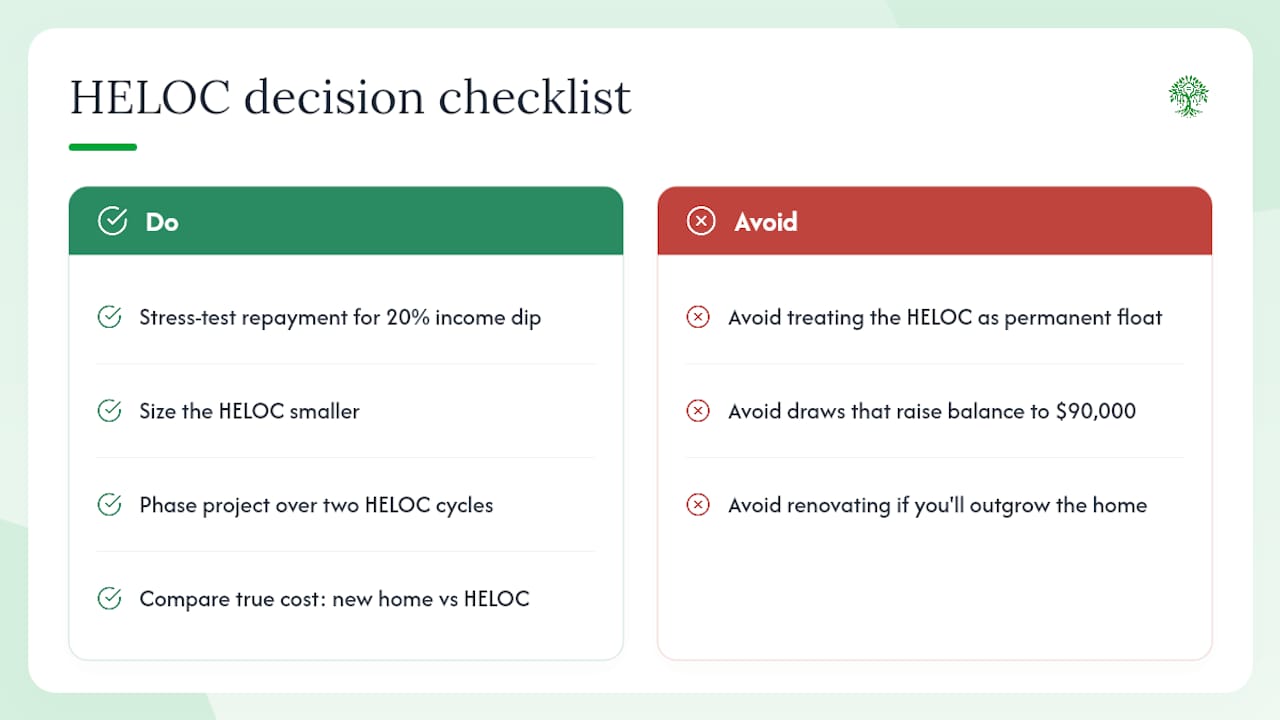
Where I see tech homeowners get into trouble is treating the HELOC as a permanent float. They draw for the kitchen, then for the home office, then for the EV charger, and suddenly the balance is $90,000 and the repayment-period payment is a real problem. The draw period’s low payments make it easy to underestimate what you have actually committed to.
The smarter question is not “can I afford the draw period?” but “can I absorb the repayment period if my income dips 20%?” If the answer is uncertain, size the line smaller or phase the project over two HELOC cycles rather than one large draw.
And if your current home genuinely no longer fits your life, borrowing to renovate a house you will outgrow in three years rarely pencils out. Knowing the true cost of homeownership on a new property versus the cost of a HELOC on your current one is the comparison worth running first.
When buying makes more sense than borrowing
Sometimes the numbers point toward a new home rather than a HELOC. If your current home no longer fits your needs and your equity has grown substantially, buying could be the cleaner financial move.

Ficustree is built for exactly that decision. As an AI-powered buyer representation platform serving California and Texas, Ficustree gives you the tools to model whether buying beats renovating: a full affordability calculator that factors in PITI, HOA, and maintenance, plus AI-powered home discovery that matches you to properties based on your actual priorities. Buyers pay $1,000 at closing plus 1% commission and keep a rebate of roughly 2% where permitted. No traditional agency markup, no guesswork on what you can actually afford. If you are weighing a $50,000 HELOC against trading up, start with Ficustree’s buyer platform to run both scenarios side by side before you commit.
Sources
- Why 2025 is the Year of the HELOC (MBA white paper)
- HELOC for home improvements (The Mortgage Reports)
- Home equity for improvement and renovation (Bankrate)
- Can I use a HELOC for any purpose? (Truss Financial Group)
- HELOC for smart home upgrade (HonestCasa)
FAQ
Why are HELOCs popular with tech homeowners specifically?
Tech homeowners prefer HELOCs because digital-first lenders now offer fast online approvals and account management, and the revolving draw structure matches phased projects like smart-home rollouts and home office buildouts. The MBA white paper ties rising HELOC uptake directly to this digital-first lending shift.
What is the biggest risk of a HELOC?
Payment shock at the draw-to-repayment transition is the primary risk. Monthly payments can jump substantially when the line switches from interest-only to full principal-and-interest, so model that scenario before drawing any funds.
Is HELOC interest tax-deductible?
Only if the funds are used to buy, build, or substantially improve the home securing the loan, and only if you itemize deductions. Using a HELOC for vacations, car purchases, or non-home expenses eliminates the deduction.
How much can you borrow with a HELOC?
Most lenders allow you to borrow up to 80–85% of your home’s appraised value minus your outstanding mortgage balance. Your credit score, income, and debt-to-income ratio also affect the approved limit.
When does a home equity loan beat a HELOC?
A home equity loan is the better choice when you know the exact amount you need upfront and want a fixed monthly payment from day one, such as a single contractor bid for a defined scope of work.
Recommended
- Blog Post
- Home – AI-Powered Real Estate Search
- Home – AI-Powered Real Estate Search
- AI Home Search for Buyers: What Changes Now

Leave a Reply