
Hybrid work changes home buying by shifting the top priority from minimizing commute time to balancing commute optionality with lifestyle and long-term financial resilience. If you only need to be in an office one to three days a week, the math on where you live opens up, but it also gets riskier if you buy assuming that schedule stays fixed.
Three facts anchor that claim:
- Remote work has held steady at roughly 26–28% of paid U.S. workdays since early 2023, which tells you hybrid arrangements are now a structural feature of the labor market, not a pandemic leftover.
- Hiring data tells a different story: about 87% of new professional job postings in Q2 2026 required full-time on-site work, with only around 10% hybrid and 3% fully remote. Your current arrangement and the market you’d re-enter if you switched jobs are two very different pictures.
- Tools like Ficustree exist specifically to help you run these tradeoffs against real listings instead of guessing.
Use the checklist further down before you write an offer. It’s built to catch the assumptions that quietly wreck a hybrid buyer’s budget.
Key Takeaways
Hybrid work reshapes home buying by trading pure commute minimization for a balance of location flexibility, lifestyle quality, and financial resilience against policy change.
| Point | Details |
|---|---|
| Verify before you buy | Get your employer’s hybrid schedule in writing, not a verbal understanding with your manager. |
| Budget the hidden costs | Add fuel, tolls, parking, and vehicle wear to your affordability math, not just PITI and HOA. |
| Prioritize connectivity and flexibility | Test real internet speeds at showings and prioritize homes with genuine office space. |
| Plan for policy drift | With 87% of new postings requiring full-time on-site work, buy a home that resells well to a five-day commuter too. |
| Use a decision-intelligence tool | Ficustree offers affordability recalculations and connectivity checks built for hybrid-buyer tradeoffs. |
Table of Contents
- What Does “Hybrid Work” Actually Mean for Home Buyers?
- How Hybrid Work Shifts What You Look For in a Home
- What’s a Reasonable Commute for a Hybrid Worker?
- The Real Risk of Buying Around a Hybrid Arrangement
- Your Hybrid Home-Buying Checklist
- How Long Does This Take, and What Should You Budget?
- What the 2026 Data Actually Tells Hybrid Buyers
- Let Ficustree Run the Hybrid-Buyer Math for You
- Sources
- FAQ
What Does “Hybrid Work” Actually Mean for Home Buyers?
Hybrid work means splitting your workweek between home and an employer-designated office, but the phrase covers wildly different arrangements. Gartner defines it as an arrangement where employees alternate between home and office, and that alternation can be dictated by your company, your team, or you.
You’ll typically run into one of three variants:
- Employer-specified days: the company sets fixed office days for everyone (often Tuesday through Thursday).
- Team-scheduled days: your manager or department decides the cadence, which can shift when leadership changes.
- Individual choice: you and your manager agree on a personal schedule, sometimes with a minimum monthly office-day quota instead of a weekly one.
Researchers studying hybrid arrangements describe them along three dimensions: modality (where you physically work), location (which office or region), and temporality (how often and when). A 2024 framework published on ScienceDirect makes this case well, and it explains why two people at the same company can have completely different “hybrid” realities. One person’s two office days a month is another person’s three days a week.
Pro Tip: Get your exact variant in writing before you shop for homes. “Hybrid” on a job offer letter is not a commute plan. It’s a starting point for a conversation with your manager.
How Hybrid Work Shifts What You Look For in a Home
Hybrid work tends to move your priority list from “shortest commute possible” to a balance between commute optionality and everyday lifestyle quality. When you only drive to the office two or three days a week, the marginal pain of an extra fifteen minutes each way matters far less than it did for a five-day commuter, and that opens the door to homes you’d never have considered before.
That shift changes what you actually filter for in a home search:
- Reliable fiber or cable internet, not just “internet available”
- A room, alcove, or converted space that can function as a real office, not a laptop-on-the-kitchen-table setup
- Flexible parking or garage space if you need a dedicated car for occasional commute days
- Proximity to a commuter rail line, highway on-ramp, or park-and-ride, even if you won’t use it daily
- Access to coworking space nearby, useful on the days your home internet goes down or your kids are loud
- Outdoor space and neighborhood amenities, since you’ll spend more waking hours at home than a traditional five-day office worker
How you weigh these depends on which kind of hybrid worker you are. A fully remote buyer with occasional in-person meetings can chase lifestyle and price almost without commute constraints. A “3-2” hybrid buyer, now the most common pattern reported for 2026, needs a commute that’s tolerable three times a week, not zero times. An occasional commuter, someone in the office once or twice a month, can effectively treat commute distance as a non-issue and optimize purely for cost and lifestyle.
Pro Tip: During any showing, virtual or in person, run a live speed test on your phone and ask to test the home’s actual Wi-Fi, not just the listing agent’s hotspot. Treating internet like a utility, the same way you’d check the water heater, catches problems before you’re locked into a mortgage.

If you want a deeper dive into search strategy for this exact tradeoff, our guide to finding homes around a hybrid commute walks through filter setups that balance both sides.
What’s a Reasonable Commute for a Hybrid Worker?
A commute of 45 to 60 minutes each way is generally tolerable for hybrid buyers going into the office one to three days a week, even though that same commute would be a dealbreaker for a five-day-a-week worker. The math changes because you’re absorbing that cost less often.
Here’s what the numbers actually look like. A 45-minute each-way commute, three days a week, costs you about 4.5 hours weekly, roughly 18 hours a month. Compare that to a traditional five-day worker at the same distance: 7.5 hours weekly, 30 hours a month. That’s 12 hours a month you get back, worth real money if you value your time at even a modest hourly rate.
Direct costs matter just as much as time. A 30-mile round trip three days a week runs roughly 360 miles a month. At current averages for fuel and maintenance, that’s a real monthly line item, and if your route includes tolls or downtown parking, add another $100 to $300 a month depending on your metro. Vehicle wear accelerates too. More highway miles mean earlier tire replacement and more frequent oil changes, costs that rarely make it into a buyer’s mental math.
There’s a cost that’s even easier to miss: childcare timing. If your commute pushes daycare pickup past a facility’s cutoff, you’re either paying late fees or hiring a backup sitter for your office days, and that expense can erase the savings from buying farther out.
Before comparing two locations, run through this:
- Total monthly commute hours at your actual office-day frequency, not a hypothetical daily rate
- Fuel, tolls, and parking added up monthly, not per trip
- Estimated added vehicle maintenance from the extra mileage
- Whether commute timing conflicts with childcare, school pickup, or a partner’s schedule
The Real Risk of Buying Around a Hybrid Arrangement
The biggest risk in hybrid-based home buying is that your employer’s policy or the broader hiring market shifts after you’ve already committed to a 30-year mortgage built around a two-day commute. Policies change, managers change, and companies get acquired. None of that shows up in your current offer letter.
Here’s the market context that makes this risk concrete: Robert Half’s Q2 2026 hiring analysis found that roughly 87% of new professional job postings required full-time on-site work, with only about 10% hybrid and 3% fully remote. If your current hybrid job disappeared tomorrow, the postings you’d likely be applying to skew heavily toward full-time in-office. That’s the gap between what current employees experience and what today’s hiring market actually offers new hires.
Run through this before you commit to a location built around your current schedule:
- Is your hybrid schedule written into your offer letter or employee handbook, or is it a verbal understanding with your manager?
- Does your manager’s team follow the same cadence as company policy, or does your specific team have unwritten expectations?
- Has your company enforced office-day attendance in the past, or has it looked the other way?
- Would your role be portable to a different company, or is it tied to something location-specific?
- If hybrid ended tomorrow, what’s your realistic maximum tolerable commute, and does your home still work under that scenario?
Ask your manager directly whether the policy is documented anywhere beyond a Slack message, and ask HR if there’s a formal remote-work agreement you can request in writing. If you’re in California and want a sense of how return-to-office obligations are treated legally, this overview of RTO rules is a useful starting point, though your specific employment contract governs your situation. For a broader look at the financial mistakes that trip up first-time buyers generally, our guide to common buyer mistakes covers overlapping ground.
Your Hybrid Home-Buying Checklist
Start by verifying your employer’s actual policy in writing, then map a realistic commute before you fall in love with anything on Zillow. Everything else in your search should follow from those two facts, not precede them.
- Verify your employer’s hybrid policy in writing. Get the cadence, the enforcement history, and whether it’s team level or company wide.
- Re-run your affordability calculation including commute costs. Add fuel, tolls, parking, and estimated maintenance to your monthly budget, not just PITI and HOA.
- Test connectivity at every serious showing. Run a real speed test, not just a listing claim.
- Rehearse your actual office-day logistics. Drive the commute at the real time of day you’d make it, ideally more than once.
- Check resale and resilience. Would this home still make sense to a five-day commuter, in case you need to sell after a policy change?
- Adjust your offer strategy accordingly. A home in a hybrid-commute corridor may face less competition than one right next to the office, giving you room to negotiate.
When you re-run affordability, add these hybrid-specific line items to your monthly PITI and HOA baseline: estimated fuel and tolls for your actual office-day frequency, any coworking membership you might need as backup, and a modest buffer for connectivity upgrades. Subtract the commuting costs you’d have paid under a closer, more expensive home, and compare the net numbers side by side rather than comparing sticker prices alone.
Pro Tip: If you’re preparing an offer, mention in your buyer’s letter or through your agent that you specifically value the home office setup and connectivity, particularly for a listing that highlights fiber availability or a converted flex room. Sellers who’ve marketed to remote or hybrid buyers already know what matters and respond well to it.
How Long Does This Take, and What Should You Budget?
Buying a home as a hybrid worker generally follows the same timeline as any purchase, but expect to add time for connectivity verification and commute rehearsal before you’re comfortable making an offer. Most buyers underestimate how long the “make sure this actually works” phase takes.
A realistic timeline looks like this:
- Search phase (4 to 10 weeks): includes virtual walkthroughs, connectivity checks on shortlisted homes, and at least one in-person commute test drive.
- Offer and negotiation (1 to 2 weeks): faster in a hybrid-commute corridor with less competition than in a tight urban core.
- Inspection and contingencies (2 to 3 weeks): standard timeline, though add a connectivity confirmation if it wasn’t verified pre-offer.
- Escrow to closing (3 to 5 weeks): varies by state and lender.
Beyond the standard closing costs, hybrid buyers often carry a few line items that traditional budgets skip:
| Cost Item | Typical Range | Notes |
|---|---|---|
| Home office furniture and setup | $500–$2,500 | Desk, chair, lighting, monitor arm |
| Connectivity upgrade (fiber install, mesh Wi-Fi) | $100–$600 | One-time, plus possible monthly rate increase |
| Backup coworking membership | $150–$400/month | Optional, useful if home internet is unreliable |
| Added commute costs (fuel, tolls, parking) | $150–$450/month | Scales with office-day frequency and distance |
That buffer absorbs a commute you underestimated or a connectivity upgrade you didn’t plan for.
What the 2026 Data Actually Tells Hybrid Buyers
Roughly 26–28% of all paid U.S. workdays. Read together, those two numbers tell you hybrid work is stable for people who already have it, but far less available if you’re job-hunting from scratch.
That distinction matters because it’s easy to conflate “current workers with remote flexibility” with “the hiring market you’d face tomorrow.” They’re not the same population. The BLS figure describes existing paid workdays across the current workforce. The Robert Half figure describes new job postings, a leading indicator of what employers actually want going forward, not what current employees already have.
| Metric | Figure | What It Measures |
|---|---|---|
| Remote share of paid U.S. workdays | 26–28% | Existing workforce, BLS tracking |
| New postings requiring full-time on-site | ~87% | Robert Half, Q2 2026 |
| New postings that are hybrid | ~10% | Robert Half, Q2 2026 |
| New postings that are fully remote | ~3% | Robert Half, Q2 2026 |
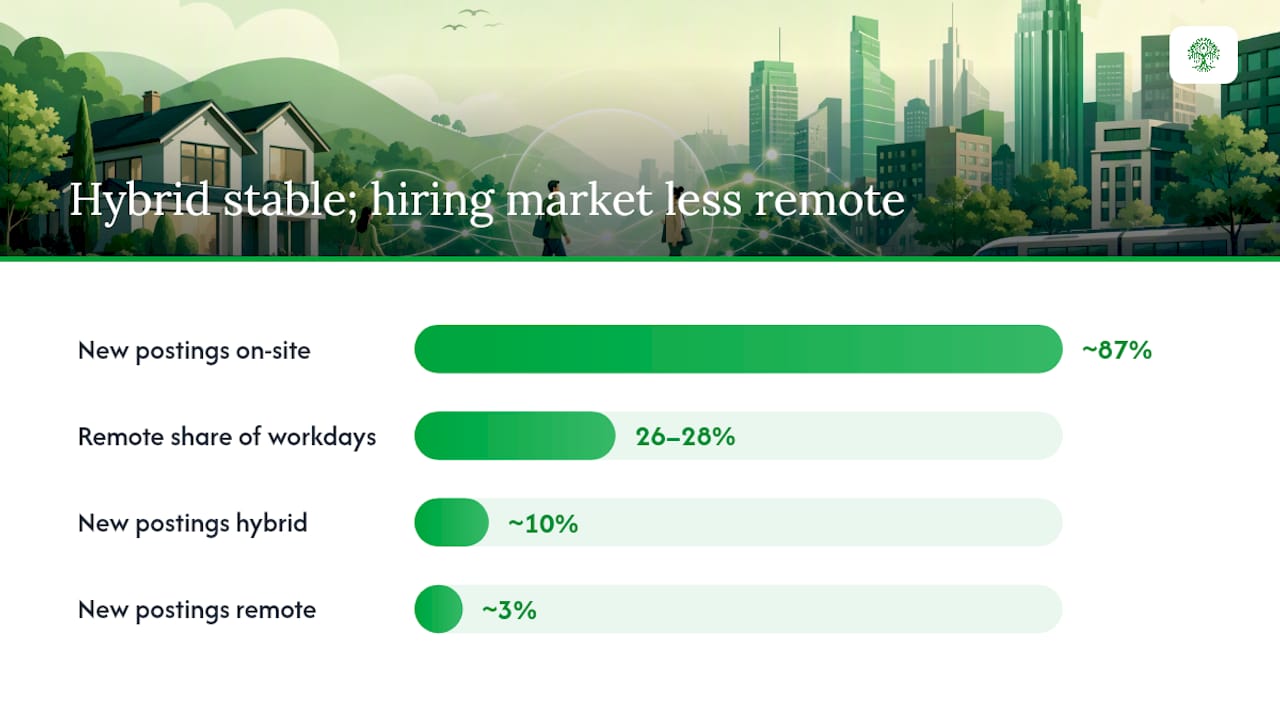
When you’re deciding how much weight to put on your current hybrid arrangement, weight the hiring-market figure more heavily the more likely you are to change jobs in the next three to five years.
An honest note on where the market is heading
Buying a home around hybrid work forces you to reconcile two truths: your current schedule feels stable, and the hiring market that would replace it if things changed looks very different. I don’t think that means hybrid buyers should avoid the tradeoff, real estate coverage increasingly points to durable clustering in what analysts call hybrid-commute corridors, locations far enough out to save real money but close enough for the occasional office day. What I do think buyers underestimate is how much of their financial cushion should come from resale flexibility rather than from betting the whole plan on their employer’s current mood.
The anxious first-time buyers I think about most are the ones treating this decision as permanent instead of adaptable. It doesn’t have to be either. A home that works for a hybrid schedule and still resells well to a five-day commuter is the safer bet, and that’s the frame Ficustree’s decision-intelligence tools are built around: showing you not just what a home costs today, but how resilient that choice is if your work arrangement changes tomorrow.
Let Ficustree Run the Hybrid-Buyer Math for You
Ficustree helps hybrid workers cut through the guesswork of comparing homes by running personalized tradeoff analysis, connectivity checks, and affordability recalculations that account for commute costs, not just sticker price. Instead of manually building spreadsheets for every candidate neighborhood, you get a decision-intelligence layer built specifically for the questions this article just walked through.

As direct buyer representation, Ficustree charges $1,000 at closing plus 1% commission, with a rebate of roughly 2% passed back to you where legally permitted, and the platform itself is free to use. You also get access to hourly showing agents on demand, useful when you want to test connectivity and commute logistics in person without coordinating a full-time agent’s schedule. Pricing structures and rebate eligibility vary by state, so confirm current terms for California or Texas directly with Ficustree before you rely on a specific number.
If you’re ready to see how a hybrid-commute tradeoff actually pencils out for your budget, start your search on Ficustree and run your own numbers against real listings instead of assumptions.
Sources
- Gartner — Hybrid work (glossary)
- ScienceDirect — Conceptual clarity on hybrid work (2024)
- ShowingNow — Remote work impact on housing market (2026)
This article is general information, not a substitute for advice from a qualified financial advisor. Consult a qualified financial professional about your own circumstances before acting on anything here.
FAQ
What is the hybrid work-from-home model?
Hybrid work is an arrangement where you split your workweek between home and an employer office, following a schedule set by the company, your team, or a personal agreement with your manager.
Is remote work dying in 2026?
workdays](https://www.bls.gov/opub/ted/2024/35-percent-of-employed-people-did-some-or-all-of-their-work-at-home-on-days-they-worked-in-2023.htm) still performed remotely, though new hiring skews heavily toward full-time on-site roles.
What are the downsides of hybrid work for home buyers?
The main downside is policy risk: your employer could tighten office-day requirements, or you could need a new job in a market where most new postings require full-time on-site work, making your original commute assumption obsolete.
What does a hybrid work model mean for where I should buy?
It generally means you can look further from the office than a five-day commuter, prioritizing connectivity, home office space, and lifestyle amenities, as long as you verify your actual office-day frequency stays stable enough to justify the distance.
How can I reduce risk when buying a home around a hybrid schedule?
Get your hybrid policy in writing, budget commute costs into your affordability calculation, and choose a home that would still make sense to a five-day commuter if your schedule changes. Tools like Ficustree can run those tradeoff calculations directly against real listings.
Recommended
- Best Hybrid Work Commute Home Finders for 2026 – ficustree.ai
- Blog Post
- AI Home Search for Buyers: What Changes Now
- First Time Homebuyer Guide: Simple Steps for Your First Home

Leave a Reply