
Sellers in a tight market rarely just take the highest number. They take the offer that feels safest. Making a competitive offer in a low-inventory market means building a package that maximizes price and certainty at the same time, because a seller comparing five offers on a Tuesday morning is scanning for reasons to say no as much as reasons to say yes.
Here’s your one-minute checklist before you write anything:
- Price it right, not high. Base your number on real comps and days-on-market data, not gut feeling.
- Put up strong earnest money. Bigger deposits signal you won’t walk.
- Get full underwriting, not just pre-approval, if your lender offers it.
- Have an appraisal-gap plan or escalation clause ready, sized to cash you actually have.
- Shorten or convert your inspection to informational, but don’t skip it entirely.
- Match the seller’s closing timeline, even if it’s inconvenient for you.
- Offer seller-friendly terms like flexible move dates or a short rent-back.
Before any of that: set an absolute maximum bid and keep your emergency reserves walled off from the cash you’re earmarking for earnest money or an appraisal gap. That single boundary is what keeps a competitive offer from turning into a financial mistake.
Key Takeaways
Winning a competitive offer in a low-inventory market means maximizing seller certainty through price, terms, and clean documentation, while protecting your own finances with pre-set limits.
| Point | Details |
|---|---|
| Set a hard maximum bid | Decide your ceiling and reserve floor before you start touring homes, and don’t move them under pressure. |
| Get full underwriting | A conditional loan approval carries more weight with sellers than a basic pre-approval letter. |
| Earmark appraisal-gap cash | Keep gap funds separate from emergency reserves so a low appraisal doesn’t force a scramble. |
| Trade terms, not just price | Flexible closing dates, rent-backs, and larger earnest money often matter more than a few thousand extra dollars. |
| Use Ficustree for coordination | Ficustree bundles documents, plans appraisal-gap coverage, and books on-demand showings to speed up competitive offers. |
Where to Verify Lenders and Market Data
Before you sign with a lender or set your offer price, a few outside resources are worth checking directly rather than relying only on what an agent tells you.
- NMLS Consumer Access lets you verify a lender’s license, complaint history, and contact information in about two minutes.
- The National Association of Realtors publishes ongoing research on inventory levels and pricing trends nationally.
- Bankrate is a solid starting point for comparing lender rates and understanding fee structures side by side.
- For local comps and months-of-supply figures specific to your target neighborhood, ask your buyer’s agent for MLS-based reports, since these numbers shift by micro-market far more than national averages suggest.
Table of Contents
- Preparation You Need Before You Start Touring Homes
- What Sellers Actually Compare in a Competitive Offer
- How Do You Find Out What the Seller Actually Wants?
- Negotiation Rules for Multiple-Offer Situations
- Costly Mistakes Buyers Make Under Competitive Pressure
- What the Data Says About Safer Competitive Tactics
- Your Ready-to-Use Offer Checklist and Sample Language
- How Ficustree Helps You Compete Without Losing Your Safety Net
- Sources
- FAQ
Preparation You Need Before You Start Touring Homes
The buyers who win multiple-offer situations almost always did their hardest work before they ever walked into an open house. By the time a listing hits the market, there’s no time to fix a shaky financial picture.
Start with mortgage pre-approval, and push further if your lender allows it. A full underwrite, sometimes called a loan-in-principle or “underwritten pre-approval,” means a human underwriter has already reviewed your income, assets, and credit rather than just running an automated check. That distinction matters to a listing agent evaluating offers, because it tells them your financing is far less likely to fall apart in escrow.
Pull together your documentation now, not later: recent pay stubs, two months of bank statements, tax returns, and proof of funds for your down payment and closing costs. Attach these to every offer instead of promising to send them “if needed.” A seller’s agent who sees complete financials attached to an offer reads that as a buyer who has done the work.
It’s worth shopping more than one lender for rate and fees before you commit. Comparing multiple mortgage offers is one of the easiest ways to lower long-term cost, since lenders price the same borrower differently and origination fees can vary by thousands of dollars over a 30-year loan.
Before you write a single offer, decide three numbers in advance: your maximum bid, your minimum reserve balance you won’t touch, and which contingencies you’re willing to waive under what circumstances. Writing these down when you’re calm keeps you from making a panicked decision in a bidding war three weeks from now.
Pro Tip: Don’t open a new credit card, finance a car, or switch jobs between pre-approval and closing. Lenders re-verify credit and employment before funding your loan, and a new balance or job change can trigger a denial days before you’re supposed to get keys.
- Get pre-approved, then ask your lender about full underwriting
- Gather pay stubs, bank statements, tax returns, and proof of funds now
- Compare at least two or three lenders on rate and fees
- Set your max bid, reserve floor, and contingency policy in writing
- Freeze new credit activity until after closing
What Sellers Actually Compare in a Competitive Offer
Price is only one column on the spreadsheet a listing agent builds when multiple offers land. The other columns, quietly, often decide the winner.
Sellers and their agents weigh the offered price against earnest money size and how fast it’s due, how solid your financing looks, which contingencies you’re keeping or waiving, your proposed closing date, and how clean and simple the contract itself reads. A messy offer with unusual conditions can lose to a slightly lower one that closes without drama.
Two of the more advanced tools for competing on terms, not just price, are escalation clauses and appraisal-gap coverage. An escalation clause automatically raises your offer above a competing bid up to a ceiling you set, so you’re not guessing what the highest number needs to be. Appraisal-gap coverage promises to make up the difference in cash if the home appraises below your offer price, which matters because lenders won’t loan against a gap between the appraisal and the sale price.
| Strategy | Seller signal | Buyer risk | Typical usage | Evidence to attach |
|---|---|---|---|---|
| Escalation clause | Confidence, willingness to compete openly | Can overshoot your comfort zone if not capped carefully | Multiple-offer situations with an unclear ceiling | Proof of funds covering the cap, pre-approval or underwriting letter |
| Appraisal-gap guarantee | Certainty the deal survives a low appraisal | Requires liquid cash beyond the down payment | Markets where bidding regularly exceeds list price | Bank statement showing gap funds, separate from down payment reserves |
| Large earnest money deposit | Seriousness, low flight risk | Ties up cash until closing; can be forfeited if you default without a valid contingency | Competitive offers where price alone won’t stand out | Proof of funds, wire confirmation timeline |
Sample appraisal-gap language an agent can adapt: “Buyer agrees to cover any difference between the appraised value and the purchase price up to $15,000, with funds to be verified by bank statement prior to acceptance.” A sample escalation clause might read: “Buyer offers $650,000, and agrees to increase the purchase price by $2,000 above any competing bona fide offer, up to a maximum price of $685,000.”
Choose an escalation clause when you genuinely don’t know what the ceiling is and want the contract to do the math for you. Choose a straight over-ask price paired with appraisal-gap coverage when you already have strong comps and want to present one clean, confident number instead of a formula the seller has to interpret. A practical competitive-offer framework also points to shortening contingency timeframes as a lower-risk lever than eliminating contingencies outright.
How Do You Find Out What the Seller Actually Wants?
Every seller has a hidden priority list, and it’s rarely just “highest number.” Some need to close in three weeks because they’ve already bought their next place. Others need 60 days and a rent-back because their new construction isn’t finished. Figuring this out before you write an offer costs nothing and can matter more than an extra $5,000.
Your buyer’s agent should call the listing agent directly, not just read the MLS remarks. That single phone call often surfaces the real story: a job relocation deadline, a divorce timeline, an estate sale with multiple heirs who need unanimous sign-off. Listing remarks and any seller disclosures provided upfront are worth rereading for clues too.
Practical seller-facing tactics that cost buyers little include writing a short, neutral cover letter explaining your readiness to close, matching the seller’s preferred closing date, and offering flexible occupancy terms. None of these move your purchase price, but all of them reduce the seller’s perceived risk.
- Ask your agent to call the listing agent before you write the offer
- Reread listing remarks and disclosures for timeline clues
- Offer a flexible closing date or a short rent-back if the seller needs one
- Keep repair requests minimal or bundle them into a credit instead of a repair list
- Write a brief, factual cover letter, not a sentimental one
Pro Tip: If a seller’s top concern is certainty of closing on their schedule, matching that date usually beats shaving a few thousand dollars off your price. A seller who needs to be out in 30 days will often take a lower offer that guarantees it.
Negotiation Rules for Multiple-Offer Situations
Once your offer is in a pool with three or four others, the negotiation shifts fast, and having pre-set rules keeps you from making decisions you’ll regret.
- Present strength up front. Your agent should submit verified financing documents, proof of funds, and a short cover letter focused on the seller’s needs, not your excitement about the house.
- Use your pre-set maximum bid as a hard stop. If a competing offer pushes past the ceiling you set while calm, that’s your answer. Walk.
- Deploy an escalation clause only with a verified reason to believe in real competition. Before assuming there’s a bidding war, it’s reasonable to ask the listing agent to confirm that multiple offers genuinely exist. Most agents will confirm the number of offers without disclosing terms.
- Know your walk-away triggers before you’re in the room. These include an appraisal gap that exceeds your reserved cash, a new lender condition that raises your rate or reduces your loan amount, or a counteroffer that crosses your financial ceiling.
- Separate emotion from math at every counter. If you find yourself justifying “just $10,000 more” for the fourth time, that’s the moment to reread your written maximum bid.
Low-inventory markets move fast for a reason: record-low inventory paired with strong demand means sellers frequently field several offers within days of listing, so hesitation itself can cost you the house even when your terms are strong.
Costly Mistakes Buyers Make Under Competitive Pressure
Competitive pressure pushes buyers toward decisions that look fine on offer day and turn into financial trouble weeks later.
The most common mistakes: waiving the inspection contingency with no fallback plan, bidding beyond what pre-approval actually supports, draining emergency savings to cover earnest money or a gap, opening new credit lines mid-escrow, and rushing or skipping inspections entirely to look more attractive. Each of these individually is risky. Combined, they compound fast. A buyer who overbids and waives the appraisal contingency at the same time has no protection if the home appraises low. They’re now responsible for covering that entire shortfall in cash or walking away and losing their deposit.
Waiving contingencies without adequate cash or underwriting exposes buyers to exactly this kind of predictable financial harm, and it’s one of the most frequent errors first-time buyers make in fast-moving markets. Reversing these mistakes isn’t complicated, it just requires discipline before you’re emotionally invested in a specific house. Pre-inspections let you know what you’re buying before you waive the contingency. Earmarked appraisal-gap cash, kept separate from your emergency fund, means a low appraisal doesn’t become a crisis. Full underwriting reduces financing surprises. A conservative reserve policy, set before you start touring homes, keeps a bidding war from turning into a liquidity problem.
- Waiving inspection with no pre-offer walkthrough or professional opinion
- Bidding above what your actual approved loan amount supports
- Draining reserves meant for moving costs, repairs, or emergencies
- Opening new credit or financing a car mid-escrow
- Rushing an inspection to speed up the offer timeline
For a deeper look at how emotional pressure specifically drives these decisions, see first-time buyer emotional pitfalls and how to set boundaries before you’re in a bidding war.
What the Data Says About Safer Competitive Tactics
The tactics that actually protect buyers while keeping offers competitive aren’t secret, they’re just underused because they take a bit more upfront effort.
Inspection and appraisal contingency waivers rise noticeably in hot markets, largely because buyers assume waiving is the only way to compete. A pre-offer inspection, where you pay an inspector to walk the property before you write your offer, preserves the information you’d otherwise give up. You still learn about the roof, the foundation, and the electrical panel; you just do it on a compressed timeline before submitting rather than after.
On the financing side, lenders routinely re-verify credit and employment in the days before closing, which is exactly why full underwriting matters more than a basic pre-approval letter. And rate shopping across lenders remains one of the few moves that lowers your total cost without raising your risk at all. Before working with any lender, you can verify their license and complaint history through NMLS Consumer Access, a public database that takes about two minutes to search.
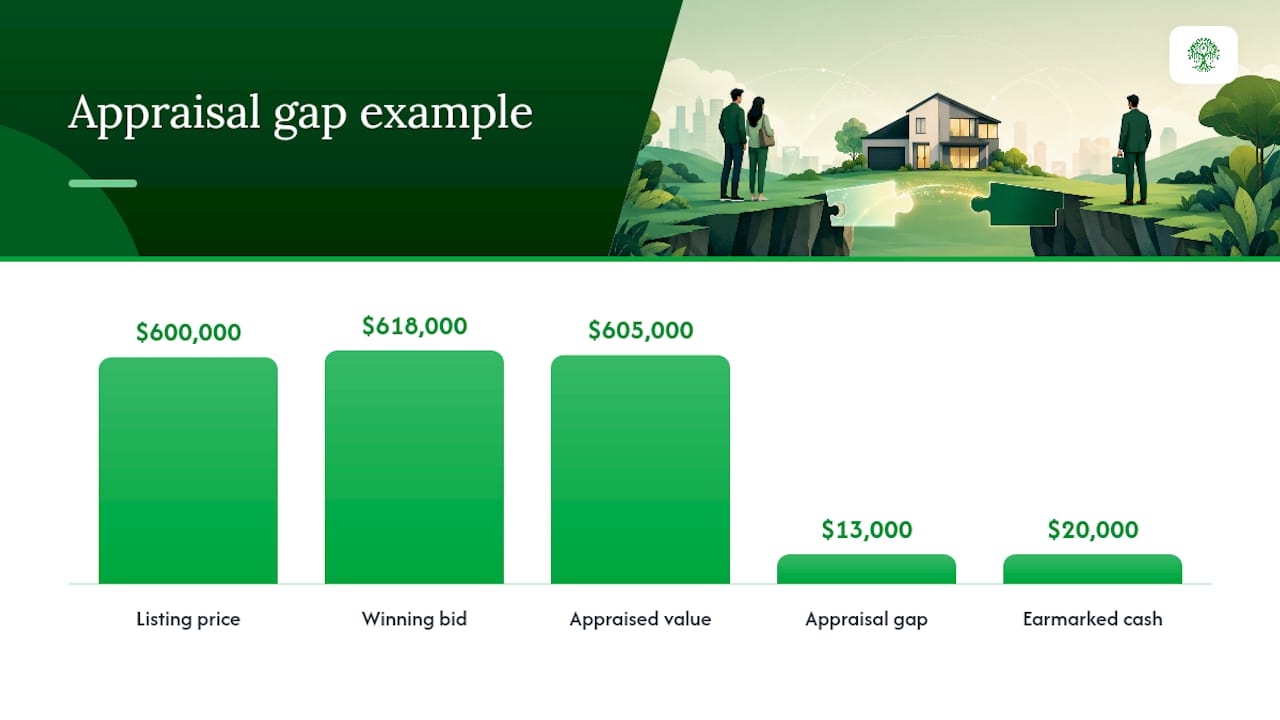
Here’s how this plays out in practice: a buyer targeting a $600,000 listing sets a maximum bid of $625,000 and earmarks $20,000 in cash specifically for an appraisal gap, kept separate from their emergency fund and down payment. Three offers come in. The winning bid lands at $618,000. The home appraises at $605,000, a $13,000 gap. Because that cash was already set aside and never touched, covering the gap doesn’t touch reserves or delay closing. The buyer who instead spent that $20,000 cushion on moving costs or a new couch would have faced a choice between renegotiating, walking away, or scrambling for cash days before closing.
Pro Tip: Get full underwriting or a conditional loan approval before you agree to waive a financing contingency. A pre-approval letter is a starting point, not a guarantee, and the gap between the two can be the difference between a smooth closing and a canceled one.
Your Ready-to-Use Offer Checklist and Sample Language
Copy this before your next offer goes out.
Documents to attach: pre-approval or full underwriting letter, proof of funds for down payment and closing costs, proof of funds for any appraisal-gap coverage (kept as a separate document), and a one-page cover letter addressed to the seller.
Earnest money: wire or certified funds, typically due within 1 to 3 business days of acceptance.
Contingency windows to propose: inspection within 5 to 7 days (or convert to informational), appraisal contingency tied to your gap coverage terms, financing contingency shortened to reflect your underwriting status.
| Item | Suggested range or timing | Notes |
|---|---|---|
| Earnest money deposit | typically a small percentage of purchase price | Higher deposits signal seriousness in competitive markets |
| Deposit due date | 1 to 3 business days after acceptance | Faster timing reads as stronger commitment |
| Inspection contingency window | a few days or informational only | Shorter windows are common in low-inventory markets |
| Appraisal-gap coverage | Sized to available cash, separate from reserves | Never pledge more than verified liquid funds |
| Closing timeline | a few weeks to over a month, matched to seller preference | Confirm with listing agent before finalizing |
Sample informational inspection clause: “Buyer reserves the right to conduct an inspection for informational purposes only. Buyer will not request repairs or credits as a result of this inspection, and this contingency will be waived upon receipt of the inspection report.”
Ask your agent to adapt these ranges to your specific market. A downloadable version of this checklist, alongside a full walkthrough of the appraisal-gap process, is available through Ficustree’s appraisal gap guide.
A Founder’s View on Winning Offers Without Taking Foolish Risks
Representing first-time buyers through multiple-offer situations makes one pattern obvious fast: the buyers who win without regret are the ones who did the boring work early. Full underwriting instead of a basic pre-approval. A pre-offer inspection instead of a blind waiver. Cash set aside specifically for a gap, never touched for anything else.
I’ve seen a borderline offer, one that was actually a bit below the top bid on price, win because the buyer had already completed a pre-offer inspection and could waive the contingency with real confidence instead of blind hope. I’ve also seen a buyer with full underwriting beat a higher cash offer because the seller’s agent trusted the file completely and didn’t want to risk a financing fallthrough with a less-verified buyer. Preparation, not aggression, won both times.
The instinct in a hot market is to strip away every protection to look aggressive. That instinct is usually wrong. The buyers who protect their downside while still competing hard on the terms that actually matter to sellers are the ones who end up with keys and their savings intact.
How Ficustree Helps You Compete Without Losing Your Safety Net
Building a genuinely competitive offer, one with strong pricing, clean contingencies, and fast documentation, takes real coordination between your lender, your inspector, and your agent. Ficustree exists to manage that coordination for you instead of leaving you to juggle it during the most stressful two weeks of the process.

Ficustree pairs you with on-demand showing agents so you can tour a new listing within hours, not days, and bundles your pre-approval documents, proof of funds, and cover letter into a package ready to submit the moment you find the right house. The platform’s pre-offer workflows help you plan appraisal-gap coverage against your actual cash position, and coordinate with your lender toward full underwriting instead of stopping at a basic pre-approval letter. If you’re getting ready to compete in a low-inventory market, start a pre-approval workflow with Ficustree and see what a fully prepared offer package looks like before you find your next listing.
Sources
- NMLS Consumer Access
- 8 mistakes first-time buyers make in a hot market — Quartz
- Bankrate: First-time homebuyer mistakes
FAQ
What Is the 3-3-3 Rule in Real Estate?
It’s a starting sanity check, not a substitute for your lender’s actual underwriting numbers.
Do Sellers Usually Come Down If the Appraisal Is Low?
Not automatically. Sellers often expect the buyer to cover the gap in cash, especially in a low-inventory market with backup offers waiting, which is exactly why earmarking appraisal-gap funds before you offer matters so much.
What Is the Hardest Month to Sell a House?
Late fall and winter, particularly December, tend to see fewer buyers actively touring homes, which can mean less competition for buyers willing to shop during that window. Seasonal patterns vary by local market, so check recent days-on-market data for your specific area.
What Is Considered Low Inventory in Real Estate?
There’s no single universal number, but many agents consider a market with less than three months of supply, meaning it would take under three months to sell all current listings at the current sales pace, to be a seller’s market with low inventory. National data shows inventory has stayed near record lows in many regions, which is part of why competitive offer strategy matters more than ever for buyers today.
Can Ficustree Help Me Build a Competitive Offer Faster?
Yes. Ficustree bundles your pre-approval documents, proof of funds, and offer materials so your agent can submit a complete, competitive package quickly, and coordinates appraisal-gap planning against your actual available cash.
Recommended
- How to Make a Competitive Home Offer in 2026 – ficustree.ai
- How the Real Estate Offer Process Works in California – ficustree.ai
- Common Home Offer Negotiation Mistakes to Avoid – ficustree.ai
- First Time Homebuyer Guide: Simple Steps for Your First Home

Leave a Reply