Category: Market Guides

  • How AI Matches Buyers to Listings: A First-Timer’s Guide

    How AI Matches Buyers to Listings: A First-Timer’s Guide

    AI buyer-listing matching is the process where algorithms analyze your stated preferences, browsing behavior, and purchase patterns to surface properties you are most likely to buy, not just properties that fit your filters. For first-time buyers, this shift matters enormously. Traditional search tools make you do all the work. AI property recommendation systems flip that equation. Real estate agencies using AI report 25–40% higher click-through rates and shorter time-to-enquiry compared to filter-based search. That gap reflects a fundamental difference in how the technology understands what you actually want.


    How does AI learn and infer buyer preferences?

    AI matching starts with what you tell it, then goes much further. When you set up a search, you enter explicit preferences: price range, bedrooms, zip code, school district. That is the easy part. The more powerful layer is what the system infers from your behavior over time.

    Hands scrolling home listings on smartphone in café

    Every listing you click, every photo you linger on, every home you save or skip teaches the algorithm something. AI platforms combine explicit onboarding data with behavioral tracking to produce the most accurate personalized matches. Stated preferences alone are a weak signal. Behavior is a much stronger one.

    Natural language processing adds another dimension. Instead of checking boxes, you can describe what you want in plain English: “a bright kitchen with open space” or “a quiet street with mature trees.” AI’s natural language ability identifies nuanced preferences that rigid filter systems simply cannot capture. Architectural style, natural light, neighborhood ambiance, and even the feeling of a space become part of the match criteria.

    Here is where it gets counterintuitive. Buyers often end up purchasing homes that differ from their stated criteria. AI models learn these discrepancies by studying what buyers actually choose, not just what they say they want. The system builds a profile based on real decisions, not aspirational ones. That is why AI recommendations often feel more accurate than your own search filters.

    The three main data inputs AI uses to build your buyer profile:

    • Explicit preferences: price, size, location, and features you enter directly
    • Behavioral signals: click patterns, time spent on listings, saves, and skips
    • Comparative profiles: what buyers with similar behavior ultimately purchased

    Pro Tip: When you first use an AI-powered search tool, interact with listings even if you are not serious about them. Every click and skip trains the algorithm faster, so your recommendations improve within days, not weeks.


    Traditional filter-based search is a blunt instrument. You set parameters, the database returns matches, and you scroll through hundreds of listings that technically qualify but feel completely wrong. AI in real estate search solves this by ranking results based on predicted fit, not just technical compliance.

    The performance difference is measurable. Automated delivery within 15 minutes of a listing going live reduces lead time-to-enquiry by 40–60%. Speed matters in competitive markets like California, where good homes receive multiple offers within days of listing. Getting there first is not luck. It is a system advantage.

    AI also handles the emotional and lifestyle dimensions of a home purchase that filters ignore entirely. A filter can match “3 bedrooms in Austin under $500,000.” It cannot match “feels like a place where I can raise kids and work from home comfortably.” AI-powered tools shift the buyer experience from listing search to full journey navigation, addressing affordability questions, commute tradeoffs, and neighborhood fit before you ever schedule a showing.

    Feature Filter-based search AI-powered matching
    Preference input Checkboxes and sliders Natural language plus behavior
    Result ranking Technical compliance Predicted buyer fit
    Alert speed Manual refresh Automated, within minutes
    Lifestyle matching Not available Neighborhood and ambiance scoring
    Learning over time None Continuous improvement

    “AI acts as a pre-search discovery tool, helping buyers answer affordability, commute, and tradeoff questions before they ever open a listing.” — Realtor.com research, 2026


    How do AI-driven property matching tools work in practice?

    The practical experience of using an AI matching tool is simpler than the technology behind it. Here is how the process typically unfolds for a first-time buyer.

    1. Onboarding and preference capture. You answer a structured questionnaire covering budget, location priorities, must-have features, and lifestyle needs. Some platforms also ask about commute destinations, school preferences, and deal-breakers. This initial data seeds your buyer profile. The more honest and specific you are here, the faster the system calibrates.
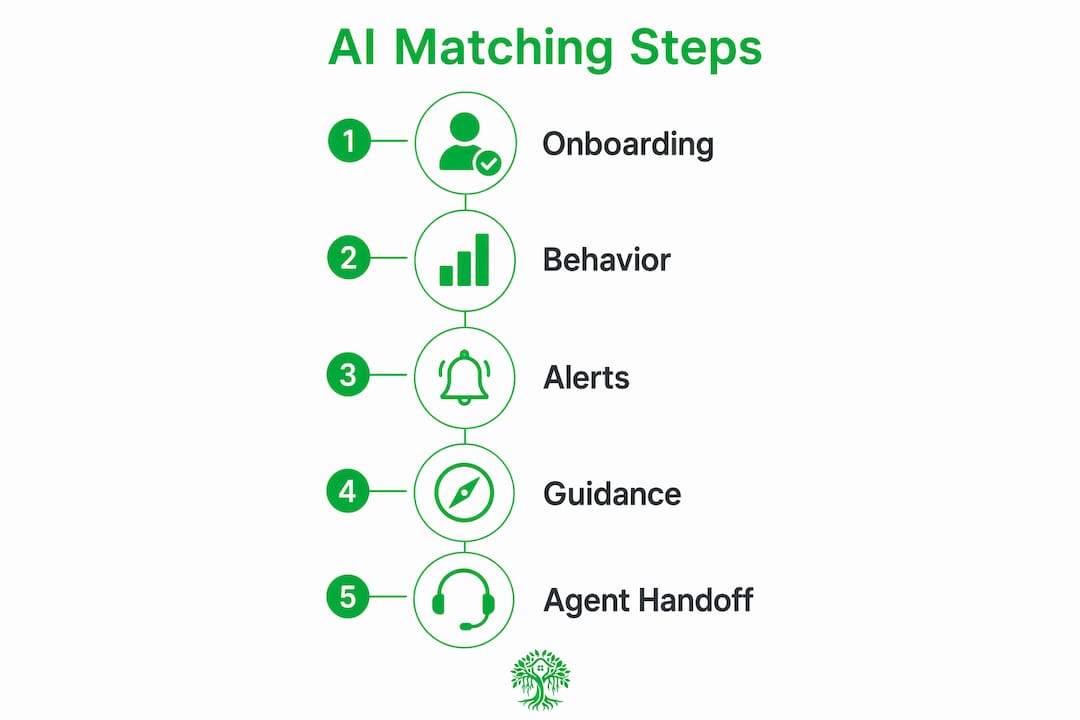
    Infographic illustrating AI buyer matching process steps

    2. Behavioral refinement. As you browse, the AI watches what you engage with and what you skip. A buyer who consistently clicks on homes with large backyards but skips homes with small lots will see that preference weighted heavily, even if they never stated it explicitly. AI matches are most accurate when they reflect actual purchase behavior, not just stated criteria.

    3. Automated alerts. When a new listing matches your profile, the system notifies you automatically. 85% of buyers prefer receiving notifications about new listings automatically and quickly. Speed is the point. In a fast market, a 15-minute head start on a new listing is a real competitive edge.

    4. Pre-search guidance. Good AI tools do not just surface listings. They help you answer the questions that come before listings: What can I actually afford? Which neighborhoods fit my commute? What am I trading off between location and size? Ficustree is built around this exact idea. The platform functions as a decision intelligence layer for the entire purchase, not just a search box.

    5. Agent handoff. When you find listings worth seeing, AI tools connect you with agents for showings and negotiation. The technology handles discovery and analysis. The human handles trust, local knowledge, and the final push to close.

    Pro Tip: Do not treat your first round of AI recommendations as final. Spend a week clicking through results, saving homes you like, and dismissing ones you do not. Your second week of recommendations will be noticeably sharper.


    AI matching is genuinely useful. It is not magic. First-time buyers who understand its limits use it better.

    The biggest misconception is that AI replaces the need for a good agent. It does not. 82% of American homebuyers use AI tools to navigate their purchase, but 66% still trust human agents most. AI is excellent at discovery and filtering. Agents are essential for negotiation, disclosure review, and reading a local market that no algorithm fully captures.

    A few honest limitations to keep in mind:

    • Optimization bias. Some AI systems are tuned to maximize time-to-enquiry, meaning they surface listings you are likely to click quickly, not necessarily listings that are the best long-term fit. Ask how the system ranks results.
    • Data quality dependency. AI recommendations are only as good as the listing data feeding them. Incomplete or outdated listings produce weaker matches.
    • Cold start problem. A brand-new profile with no behavioral data produces generic recommendations. The system needs time to learn your actual preferences.
    • No substitute for in-person judgment. A listing can look perfect on paper and feel wrong the moment you walk in. AI cannot replicate the experience of standing in a space.

    The right frame is to treat AI as a very capable research assistant. It narrows the field, surfaces options you might have missed, and alerts you fast. You and your agent make the final call. That combination, AI plus human judgment, consistently outperforms either one alone. Ficustree’s AI home search approach is built on exactly this principle.


    Key takeaways

    AI matches buyers to listings most accurately when it combines stated preferences with behavioral data and rapid automated alerts to surface properties buyers will actually purchase.

    Point Details
    Behavior beats stated preferences AI learns more from what you click and skip than from the filters you set.
    Speed is a real advantage Automated alerts within 15 minutes of a listing going live cut time-to-enquiry by 40–60%.
    Natural language expands matching Describing preferences in plain English captures style and ambiance that checkboxes miss.
    AI complements agents, not replaces them 66% of buyers still trust agents most; AI handles discovery while agents handle negotiation.
    Engagement improves accuracy The more you interact with recommendations, the faster your profile calibrates.

    I have spent years watching first-time buyers burn weeks on search tools that were never designed for them. Filter-based search assumes you already know exactly what you want. Most first-time buyers do not. They have a rough idea, a budget ceiling, and a lot of anxiety. Dropping them into a database of 10,000 listings and telling them to filter their way to a home is not a process. It is a stress test.

    What AI matching gets right is that it meets buyers where they actually are. You do not need to know you want a craftsman bungalow with a south-facing yard. You just need to click on a few homes that feel right, and the system figures out the pattern. That is a fundamentally more honest way to search.

    The part I find most underappreciated is the pre-search layer. The anxiety first-time buyers feel is rarely about finding listings. It is about not knowing what they can afford, which neighborhoods are realistic, and what they are giving up by choosing one option over another. AI tools that address those questions before surfacing listings are doing something genuinely useful. They are compressing the confusion phase, which is exactly what Ficustree is built to do.

    My honest advice: use AI tools aggressively in the first two weeks of your search. Interact with everything. Let the system learn. Then bring your shortlist to an agent who knows the local market. That sequence, AI first, human expertise second, produces better outcomes than either approach alone. You can read more about how this plays out in practice in Ficustree’s guide to emotionally intelligent home buying.

    — Anand


    How Ficustree puts AI matching to work for first-time buyers

    Ficustree is an AI-powered home buying platform built specifically for first-time buyers in California and Texas. The platform goes beyond listing search. It functions as a decision layer, helping you understand what you can afford, which neighborhoods fit your life, and which listings are worth your time before you ever schedule a showing.

    https://ficustree.ai

    Ficustree combines behavioral matching, natural language preference capture, and automated alerts with on-demand showing agents and direct buyer representation. Buyers pay $1,000 at closing plus 1% commission and keep a rebate of roughly 2% where legally permitted. The premium platform is free to use. If you are ready to search smarter, start your home search with Ficustree and let the house find you.


    FAQ

    How does AI match buyers to listings?

    AI analyzes both your stated preferences and your browsing behavior, then ranks listings by predicted fit rather than technical filter compliance. The more you interact with the system, the more accurate your matches become.

    Can AI replace a real estate agent?

    AI cannot replace an agent for negotiation, disclosure review, or local market knowledge. Research shows 66% of buyers still trust agents most, even when using AI tools throughout their search.

    How fast does AI send listing alerts?

    The best AI property recommendation systems deliver alerts within 15 minutes of a listing going live. That speed reduces time-to-enquiry by 40–60% compared to manual search methods.

    What data does AI use to build a buyer profile?

    AI uses your onboarding questionnaire answers, your click and save behavior, and patterns from buyers with similar profiles. Behavioral data typically produces more accurate matches than stated preferences alone.

    Is AI matching useful for first-time buyers specifically?

    AI matching is especially useful for first-time buyers because it does not require you to know exactly what you want upfront. The system learns your preferences from your behavior and surfaces options you might not have found through manual filtering.


  • Home Closing Checklist for First-Timers: 2026 Guide

    Home Closing Checklist for First-Timers: 2026 Guide

    A home closing checklist for first-timers is a step-by-step list of every document, payment, and verification task you must complete to legally transfer ownership of a property into your name. Federal law sets the foundation: lenders must deliver the Closing Disclosure at least 3 full business days before closing, giving you time to review final loan terms and costs. In California and Texas, local escrow practices and title customs add another layer of detail that catches many first-time buyers off guard. This guide covers every stage of the closing process checklist for buyers, from document prep to the signing table, so you walk in ready.

    1. What documents and funds must you prepare before closing?

    The Closing Disclosure is the most critical document you will receive before closing day. The Loan Estimate is a shopping tool; the Closing Disclosure reflects your finalized loan terms and fees. Read every line of both side by side and flag any number that changed without explanation.

    Your preparation checklist before closing day:

    • Closing Disclosure: Receive it at least 3 business days early and compare it line by line to your Loan Estimate.
    • Photo ID: A government-issued ID is mandatory at the signing table. Bring two forms if possible.
    • Proof of homeowner’s insurance: Your lender will not fund the loan without it. Confirm your policy is active and the lender is listed as the mortgagee.
    • Cashier’s check or wire transfer: Personal checks are not accepted at most closings. Arrange your funds 1–3 days before closing.
    • Wire fraud prevention: Before sending any funds, call your title or escrow officer directly using a phone number you looked up independently. Scammers spoof emails to intercept closing funds. Verbal confirmation is not optional.

    Pro Tip: Double-check the exact dollar amount on your cashier’s check the morning of closing. Even a one-cent discrepancy can delay the transaction.

    Wire fraud is the fastest-growing threat in real estate closings. Never trust wiring instructions sent by email alone, even if the sender looks legitimate. One phone call to a verified number protects tens of thousands of dollars.

    Hands writing cashier's check on kitchen counter

    2. How should you schedule and perform the final walk-through?

    The final walk-through is your last chance to confirm the property is in the condition you agreed to buy. Schedule it within 24–48 hours before closing so any problems surface while you still have negotiating power.

    Work through this checklist room by room:

    1. Confirm agreed repairs are complete. Bring your inspection report and repair addendum. Check every item the seller promised to fix.
    2. Test all appliances. Run the dishwasher, oven, refrigerator, and washer and dryer if they convey with the sale.
    3. Check HVAC, plumbing, and electrical. Turn on the heat and air conditioning. Run every faucet. Flip every light switch.
    4. Open and close all windows and doors. Look for sticking frames, broken locks, or cracked glass that was not there before.
    5. Inspect the exterior. Check the roof, gutters, driveway, fencing, and any landscaping items specified in the contract.
    6. Look for new damage. Moving furniture out sometimes damages walls, floors, or doorframes. Document anything new with photos.
    7. Verify the property is empty. Sellers must remove all personal belongings unless the contract says otherwise.

    The walk-through and the closing are legally separate events. Do not rush through it just because closing is hours away. A properly timed walk-through gives you the right to negotiate credits, request an escrow holdback, or delay closing if repairs are incomplete.

    3. What should you bring to the closing appointment itself?

    Closing day is a signing marathon. Knowing what to bring prevents delays that can push your funding to the next business day. In California, closings typically happen through an escrow company. In Texas, a title company usually manages the process. The required items are largely the same.

    Your closing day bag:

    • Government-issued photo ID. Bring your driver’s license and passport if you have both.
    • Final Closing Disclosure. You already reviewed it, but bring the copy you signed off on.
    • Proof of payment. Bring your cashier’s check or a bank confirmation of your wire transfer.
    • Proof of homeowner’s insurance. A declarations page showing the policy is active and the lender is named.
    • Any outstanding signed documents. Your agent or escrow officer will tell you in advance if anything is missing.
    • Contact information. Keep your escrow officer’s, title agent’s, and real estate agent’s phone numbers accessible.
    • Confirm logistics. Verify the closing location, time, and who will be present at least 24 hours in advance.

    Pro Tip: Bring a phone charger. Closings can run two to three hours, and you may need to make calls or pull up documents on your phone.

    Closing documents for first-timers can feel like a stack of fine print. Ask the escrow or title officer to explain any document before you sign it. That is their job, and a good one will not rush you.

    4. How can you verify the final closing figures and handle last-minute issues?

    The Closing Disclosure’s Page 2 details every loan fee and cost. Compare it to your original Loan Estimate before you sit down to sign. Lenders are subject to a zero-tolerance policy on certain fee categories, meaning those fees cannot increase at all from the Loan Estimate to the Closing Disclosure.

    Watch for these specific issues:

    • Origination charges: These are zero-tolerance fees. Any increase is a lender error that must be corrected before closing.
    • Third-party fees you did not shop for: Also zero-tolerance. If a fee appears that was not on your Loan Estimate, flag it immediately.
    • Prepaid items and escrow deposits: These can change based on timing. A small shift is normal; a large one needs an explanation.
    • Seller credits: Confirm any negotiated credits appear correctly on the Closing Disclosure.

    “Proactive review of final documents is the single most effective way to catch unexpected fees and avoid last-minute surprises.” — Consumer Financial Protection Bureau

    If your final walk-through revealed incomplete repairs, you have three options before signing: request a price reduction, ask for a cash credit at closing, or negotiate an escrow holdback where funds are set aside until the seller completes the work. Delaying closing is also a valid choice if the issues are serious. Communicate any concerns to your agent and lender immediately. Waiting until you are at the signing table removes your leverage.

    The Closing Disclosure is a legally binding document. Treat it that way. Read it the same day it arrives, not the morning of closing.

    Key Takeaways

    A complete home closing checklist for first-time buyers requires reviewing the Closing Disclosure early, verifying funds verbally, completing the walk-through within 48 hours of closing, and arriving at the signing table with every required document in hand.

    Point Details
    Review Closing Disclosure early Federal law gives you 3 business days; use every hour to compare fees against your Loan Estimate.
    Verify wire instructions by phone Call your escrow officer directly before sending funds to prevent wire fraud.
    Walk through within 48 hours Schedule the final walk-through 24–48 hours before closing to catch incomplete repairs in time.
    Bring the right documents Photo ID, proof of insurance, and payment confirmation are mandatory at the signing table.
    Flag fee discrepancies immediately Zero-tolerance fees cannot increase; raise any concern before you sign, not after.

    What I have learned watching first-timers close

    Most closing mistakes I have seen are not about missing documents. They are about timing. Buyers receive the Closing Disclosure and set it aside, planning to read it the night before closing. That is too late. By then, your lender’s office may be closed, your agent is unavailable, and you have no time to push back on a fee that should not be there.

    The walk-through gets rushed more often than any other step. Buyers feel the pressure of the closing appointment and treat the walk-through as a formality. It is not. I have seen buyers discover missing appliances, water damage from a move-out, and unfinished repairs that the seller swore were done. Every one of those situations was fixable before closing and would have been a legal headache after.

    The other pattern I see constantly is buyers who skip the verbal wire verification because it feels unnecessary. Wire fraud in real estate closings is not a rare edge case. It happens in California and Texas markets regularly. One phone call to a number you looked up yourself takes three minutes and protects your entire down payment.

    The buyers who close without stress are the ones who treat the checklist as a real deadline system, not a suggestion list. Start your Closing Disclosure review the day it arrives. Schedule your walk-through the moment your closing date is confirmed. Confirm your wire instructions 48 hours before you send a dollar. That sequence works every time.

    — Anand

    Ficustree helps you close with confidence

    Closing on your first home in California or Texas involves dozens of moving parts across a compressed timeline. Ficustree is built specifically for buyers like you: an AI-powered platform that tracks your home purchase steps from offer acceptance through keys in hand.

    https://ficustree.ai

    Ficustree gives you document reminders, closing timeline tracking, and local insight for both California and Texas markets. Buyers pay $1,000 at closing plus 1% commission and keep a rebate of roughly 2% where legally permitted. The platform is free to use. If you are buying in California, the California buyer resources on Ficustree give you city-specific guidance alongside your closing checklist. You do not have to piece this together alone.

    FAQ

    When do I receive the Closing Disclosure?

    Federal law requires your lender to deliver the Closing Disclosure at least 3 full business days before closing. Review it immediately upon receipt and compare every fee to your Loan Estimate.

    Can I use a personal check at closing?

    Personal checks are not accepted at most closings. Use a cashier’s check or wire transfer, and verify wiring instructions by phone before sending any funds.

    What happens if the final walk-through reveals problems?

    You can request a price reduction, a closing credit, or an escrow holdback before signing. The walk-through and closing are legally separate, which means you retain negotiating power until you sign.

    What documents do I need at the closing appointment?

    Bring a government-issued photo ID, your final Closing Disclosure, proof of homeowner’s insurance, and confirmation of your payment. Missing any one of these can delay funding.

    How do I protect myself from wire fraud at closing?

    Call your title or escrow officer directly using a phone number you independently verified before sending any funds. Never rely solely on email instructions, even from a familiar address.

  • Home Buying Emotional Stress Management: A First-Timer’s Guide

    Home Buying Emotional Stress Management: A First-Timer’s Guide

    Home buying emotional stress management is the practice of using targeted financial, psychological, and behavioral strategies to reduce anxiety throughout the purchase process. Surveys show home buying ranks as more stressful than dating, starting a new job, or beginning college, with 65% of buyers losing sleep and 42% reporting family conflicts during the process. That stress is predictable, and it is manageable. This guide gives you specific techniques, grounded in expert research, to stay clear-headed from pre-approval through closing day.

    What triggers emotional stress in first-time homebuyers?

    Stressed man reviewing homebuying paperwork in living room

    Anxiety during home buying is a rational response to a complex, high-stakes process. It is not a sign of weakness or inexperience. Understanding the specific triggers helps you address each one directly instead of feeling overwhelmed by a vague sense of dread.

    The most common stress triggers for first-time buyers include:

    • Financial uncertainty. A home purchase is likely the largest financial commitment of your life. Down payments typically range from 3% to 20% of the purchase price, and hidden costs like property taxes, HOA fees, and maintenance add up fast. Not knowing your true ceiling creates constant low-grade anxiety.
    • Unfamiliar terminology. Terms like earnest money, title insurance, contingencies, and escrow are not part of everyday vocabulary. Unanswered questions about jargon are a primary source of anxiety for first-time buyers. Confusion breeds hesitation, and hesitation costs you offers.
    • Decision fatigue. Viewing dozens of listings without a clear filter system drains your mental energy fast. Excessive listing views overwhelm buyers and make every choice feel harder than it needs to be.
    • Emotional attachment to outcomes. Home carries deep psychological meaning. When a bid falls through, it does not just feel like a lost transaction. It feels personal.
    • Timeline uncertainty. Escrow periods, inspection delays, and lender processing times are hard to predict. Not knowing when the process ends keeps your nervous system in a state of low-level alert.
    • Relationship pressure. Money worries drive the majority of relational conflicts during home buying. Couples and families often disagree on priorities, price, or neighborhoods, adding interpersonal stress on top of an already demanding process.

    Recognizing these triggers is the first step. Each one has a direct countermeasure, covered in the sections below.

    How can financial planning reduce home buying stress?

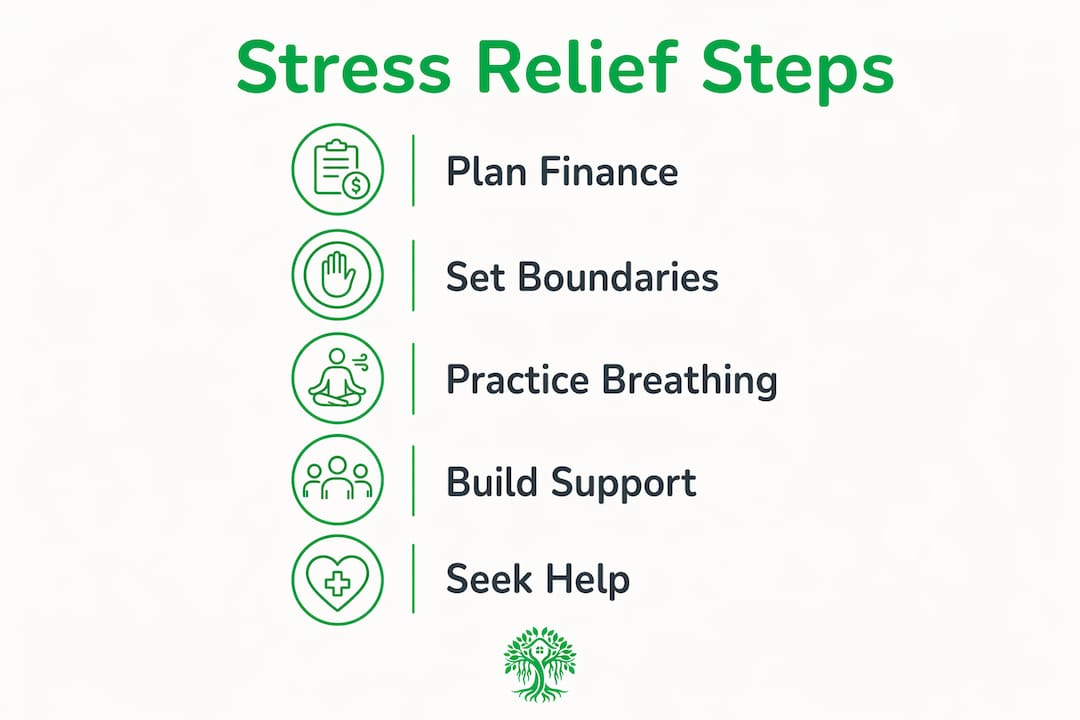
    Financial clarity is the single most effective stress-reduction tool available to a first-time buyer. When you know your exact budget, your anxiety has less room to grow.

    1. Get full mortgage pre-approval, not just pre-qualification. Pre-qualification is a rough estimate based on self-reported numbers. Full pre-approval verifies your income, assets, credit, and debt with actual documentation. It locks in your budget, speeds up underwriting, and makes your offers significantly stronger. Pre-approval removes the single biggest unknown before you ever walk into an open house.

    2. Build a budget that includes reserves. Your budget is not just the purchase price. Calculate your full PITI (principal, interest, taxes, and insurance), add HOA fees if applicable, and factor in a maintenance reserve. Build a 3–6 month reserve fund on top of your down payment. Knowing you have a financial cushion changes how you feel about every decision.

    3. Set a maximum offer price before you start searching. Decide your ceiling in advance and commit to it in writing. Emotional attachment to a specific property will push you past your limit if you have not already drawn the line. A pre-set maximum protects you from yourself in the heat of a bidding situation.

    4. Define your non-negotiables before viewing listings. Decide in advance which features are required and which are preferences. Filtering listings by clear priorities reduces decision fatigue and buyer’s remorse compared to viewing every available property.

    Pro Tip: Ask your lender to walk you through the full loan estimate line by line before you sign anything. Every number should make sense to you in plain English. If it does not, ask again.

    What emotional self-care techniques ease acute anxiety during homebuying?

    Financial preparation handles the logical side of stress. Your nervous system also needs direct support. These techniques work in real time, during open houses, after a lost bid, or on a sleepless night before closing.

    • 4-4-4 breathing. Inhale for four counts, hold for four counts, exhale for four counts. Grounding techniques like 4-4-4 breathing lower sympathetic nervous system arousal within minutes. Use it before entering a competitive open house or after receiving bad news from your agent.
    • 5-4-3-2-1 sensory grounding. Name five things you can see, four you can hear, three you can touch, two you can smell, and one you can taste. This technique pulls your attention out of anxious future-thinking and anchors it in the present moment.
    • Daily movement anchor. Twenty minutes of physical activity resets your emotional baseline. It does not need to be a gym session. A brisk walk around the block after a stressful call with your lender is enough to shift your state.
    • Regular meals and scheduled breaks. Skipping meals while rushing between showings compounds stress. Daily anchors like regular meals and 10 minutes of pleasure maintain emotional stability across a process that can last months.
    • Sleep hygiene as a non-negotiable. Maintaining sleep hygiene reduces decision fatigue and supports clearer thinking throughout the buying process. A consistent bedtime, a dark room, and no screens for 30 minutes before sleep are the minimum. Poor sleep turns manageable stress into a crisis.

    Pro Tip: Schedule one “no real estate” evening per week. No listings, no lender emails, no neighborhood research. Your brain needs recovery time to make good decisions the rest of the week.

    Emotional wellness during home buying is not a luxury. It is a performance requirement. Buyers who are rested and regulated make better offers, negotiate more clearly, and recover faster from setbacks.

    Infographic of five steps to manage homebuying stress

    How to build a supportive network and get professional help

    No first-time buyer should navigate this process alone. The right people around you reduce both the practical and emotional load.

    • Work with a buyer’s agent who communicates proactively. Real estate professionals confirm that first-time buyer anxiety is a natural reaction. The goal is not to eliminate anxiety but to prevent it from paralyzing your decisions. An agent who explains each step before it happens gives you a map instead of a maze. Check out the home buying timeline to understand what to expect at each stage.
    • Ask for plain-language explanations every time. Asking for plain-language translations of real estate jargon directly reduces stress levels. You are paying for professional guidance. Use it fully.
    • Talk openly with your partner or family. Use time-limited discussions anchored on shared values rather than open-ended arguments about price or location. Agree to a 20-minute conversation with a clear agenda, then stop. This structure prevents money conversations from spiraling.
    • Know when to bring in a counselor or financial advisor. If anxiety is affecting your sleep, your relationships, or your ability to make decisions for more than two weeks, a licensed counselor or financial planner is a worthwhile investment. Emotional validation from a professional is not a sign that the process is too hard. It is a sign you are taking it seriously.

    The first-time buyer emotional pitfalls guide covers specific mistakes that compound stress, including the ones most buyers do not see coming.

    What are common pitfalls and how to avoid them?

    Most home buying anxiety spikes are predictable. These are the mistakes that cause the worst of it, and how to sidestep each one.

    1. Confusing pre-qualification with pre-approval. Pre-qualification gives you a ballpark. Pre-approval gives you a verified number. Buyers who start searching with only a pre-qualification often discover their real budget is different mid-process, which is a significant emotional shock.

    2. Letting emotion override your price ceiling. Falling in love with a property that is $30,000 over your maximum is one of the most common home buying emotional challenges. Set your ceiling before you start viewing, and treat it as fixed.

    3. Avoiding questions out of embarrassment. First-time buyers often hesitate to ask about loan terms, inspection findings, or contract language because they do not want to appear inexperienced. Every unanswered question becomes a source of anxiety. Ask everything.

    4. Refusing to take breaks. Taking breaks and accepting imperfection lowers stress during home buying. Flexibility and stepping away briefly reset your perspective. Buyers who treat every weekend as a mandatory search session burn out within weeks.

    5. Ignoring sleep and self-care during the final stretch. The period between accepted offer and closing is the most administratively intense. It is also when buyers most often abandon their routines. Skipping sleep and exercise during escrow leads to poor decisions on inspection negotiations and loan terms.

    Pitfall Smarter approach
    Pre-qualification only Get full pre-approval before searching
    No price ceiling set Commit to a maximum offer price in writing
    Skipping questions Ask for plain-language explanations at every step
    No scheduled breaks Block one “no real estate” evening per week
    Ignoring self-care in escrow Protect sleep and movement routines through closing

    Key takeaways

    Effective home buying emotional stress management combines financial preparation, grounding techniques, and a trusted support network to keep anxiety from derailing your decisions.

    Point Details
    Pre-approval first Full mortgage pre-approval removes the biggest financial unknown before you search.
    Set a price ceiling early Commit to your maximum offer price in writing before viewing any property.
    Use grounding techniques 4-4-4 breathing and sensory naming lower acute anxiety within minutes.
    Protect sleep and routine Sleep hygiene and daily movement reduce decision fatigue across the full process.
    Ask every question Plain-language explanations of jargon directly reduce stress for first-time buyers.

    What I have learned about stress and the home buying process

    Anxiety during home buying is not a malfunction. It is your brain correctly identifying that this decision is large, complex, and consequential. The problem is not the anxiety itself. The problem is when buyers treat it as a signal to freeze rather than a signal to prepare.

    The buyers I have seen navigate this process most confidently share one trait: they do their homework early and they ask questions without apology. They get pre-approved before they fall in love with a neighborhood. They set their price ceiling before they walk into an open house. They build a support team that includes their agent, their lender, and at least one trusted person who has no financial stake in the outcome.

    What surprises most first-time buyers is how much the emotional load lightens once the financial picture is clear. Uncertainty is the fuel for anxiety. Clarity is the antidote. When you know your exact budget, your non-negotiables, and what happens at each stage of the process, the fear of the unknown shrinks to a manageable size.

    One more thing: do not skip the self-care basics because you feel like you do not have time. The buyers who push through exhausted and skipping meals make worse decisions. They overbid, they miss red flags in inspections, and they agree to terms they later regret. Protecting your sleep and your routine is not indulgent. It is part of buying well.

    — Anand

    How Ficustree helps you buy with less stress

    https://ficustree.ai

    Ficustree is built specifically for first-time buyers in California and Texas who are tired of sorting through noise. The AI-powered platform filters listings to match your actual priorities, so you spend less time scrolling and more time evaluating real options. That alone cuts decision fatigue significantly. Ficustree also represents you directly: you pay $1,000 at closing plus 1% commission and keep a rebate of roughly 2% where permitted. Clear timelines, transparent costs, and on-demand showing agents give you the structure that makes anxiety manageable. Start with your buyer profile on Ficustree and see how much clarity two months of focused searching can create. Or visit ficustree.ai to learn how the platform works.

    FAQ

    Is anxiety during home buying normal?

    Yes. Anxiety is a rational response to a high-stakes, complex process, not a sign of weakness. The goal is to prevent it from paralyzing your decisions, not to eliminate it entirely.

    What is the fastest way to reduce acute stress during a showing or bidding situation?

    4-4-4 breathing (inhale four counts, hold four counts, exhale four counts) lowers sympathetic nervous system arousal within minutes and requires no tools or preparation.

    What is the difference between pre-qualification and pre-approval?

    Pre-qualification is a rough estimate based on self-reported information. Pre-approval verifies your income, assets, credit, and debt with documentation, giving you a confirmed budget and stronger offers.

    How do I avoid decision fatigue when searching for a home?

    Define your non-negotiables before you start viewing listings, then filter strictly by those criteria. Viewing fewer, better-matched properties reduces mental exhaustion and buyer’s remorse.

    When should a first-time buyer seek professional mental health support?

    If anxiety is disrupting your sleep, relationships, or decision-making for more than two weeks, a licensed counselor is a worthwhile resource. Stress relief for home buyers sometimes requires professional support, and asking for it is a practical choice, not a last resort.

  • Bridge Loan Home Buying Explained for First-Time Buyers

    Bridge Loan Home Buying Explained for First-Time Buyers

    A bridge loan is a short-term loan that lets you use the equity in your current home to fund the purchase of a new home before your existing property sells. For first-time buyers in California and Texas who already own a home and are moving up, bridge loan home buying explained simply means: you borrow against what you already own so you can buy without waiting. These loans typically run 6–12 months, carry higher costs than conventional mortgages, and require a clear repayment plan. Understanding how they work can be the difference between winning a home in a competitive market and losing it to a cash buyer.

    How do bridge loans work?

    A bridge loan gives you access to your current home’s equity before the sale closes. Loan amounts are structured at 65%–80% of your home’s current value, minus your remaining mortgage balance. That net figure becomes your available bridge capital for a down payment on the new property.

    Most bridge loans are interest-only during the loan term. You pay only the interest each month, and the full principal comes due in a lump sum when your old home sells or when you refinance. Terms run 6–12 months, with some lenders offering extensions if the sale takes longer than expected.

    Hands reviewing bridge loan interest documents

    The collateral structure varies by lender. Some lenders secure the bridge loan against your current home only. Others cross-collateralize, meaning both your current home and the new property back the loan. Cross-collateralization gives lenders more security but gives you less flexibility if either deal runs into trouble.

    Pro Tip: Calculate your available bridge capital before you talk to a lender. Take your home’s estimated sale price, multiply by 0.75, then subtract your mortgage payoff. That number is roughly what a bridge lender will offer you.

    Feature Typical bridge loan terms
    Loan amount 65%–80% of home value minus mortgage balance
    Loan term 6–12 months
    Payment structure Interest-only monthly; principal due at sale
    Repayment trigger Home sale proceeds or refinance
    Collateral Current home, or current and new home combined

    Infographic outlining bridge loan process steps

    What does a bridge loan cost, and what are the risks?

    Bridge loans are expensive. Interest rates range from 8%–14% as of 2026, well above conventional mortgage rates. On top of that, origination fees and closing costs add another 3%–6% of the loan amount. On a $200,000 bridge loan, that fee layer alone can reach $12,000.

    The underwriting process is different from a standard mortgage. Bridge lenders focus on collateral value and exit strategy rather than your debt-to-income ratio. A strong exit plan, meaning a realistic sale price and timeline for your current home, carries more weight than your paycheck. That said, your home still needs to appraise cleanly and be priced in line with market expectations.

    The risks worth knowing before you commit:

    • Overlapping payments. During the period between purchase and sale, you may carry a mortgage on the new home, interest payments on the bridge loan, and possibly a remaining mortgage on the old home. That triple payment load requires real financial reserves.
    • Sale timeline risk. If your current home sits on the market longer than expected, the bridge loan term can expire before you repay it. Extensions are possible but cost more.
    • Market absorption risk. Lenders deny bridge loans when the home being sold shows poor sale prospects, regardless of your income or credit score. A slow neighborhood or overpriced listing can kill the application.
    • HELOC is not a substitute. Many buyers assume a home equity line of credit can serve the same purpose. HELOCs are frequently frozen or denied once your home is listed for sale, making them unreliable as a last-minute financing tool.

    Pro Tip: Get a comparative market analysis on your current home before applying for a bridge loan. Lenders will order their own appraisal, but knowing your home’s realistic sale price in advance helps you size the loan correctly and avoid a shortfall.

    Bridge lenders also require a minimum equity floor of at least 20%, with 30% being the comfortable threshold for approval. If your equity is thin, the math may not work regardless of how strong your income looks.

    When does a bridge loan actually make sense?

    The right situation for a bridge loan is specific. It is not a product for every buyer or every market condition. The core use case is a timing mismatch: you need to close on a new home within 30–45 days, but your current home’s sale will take longer.

    In California and Texas markets, that timing gap is common. Sellers in high-demand areas often reject offers with sale contingencies. Contingent offers are rejected over 70% of the time in competitive metro markets. A bridge loan lets you remove that contingency and compete with cash-equivalent offers, which sellers strongly prefer.

    A bridge loan makes sense when all of the following are true:

    1. You have at least 20%–30% equity in your current home.
    2. Your current home is priced correctly and will sell within the bridge loan term.
    3. You have financial reserves to cover overlapping payments for at least 2–3 months.
    4. The cost of the bridge loan is less than the cost of moving twice or renting between sales.
    5. You have a clear exit strategy that a lender will find credible.

    “The decision to use a bridge loan depends more on situation economics and timing than on the product itself. The cost must be lower than the alternatives, including moving twice, losing the home, or waiting in a rising market.” — AmeriSave, 2026

    If your current home is in a slow market, priced above comparable sales, or has been sitting without offers, a bridge loan is a poor fit. The lender will likely decline the application, and even if approved, the risk of carrying two properties for an extended period is real.

    What is the bridge loan process, step by step?

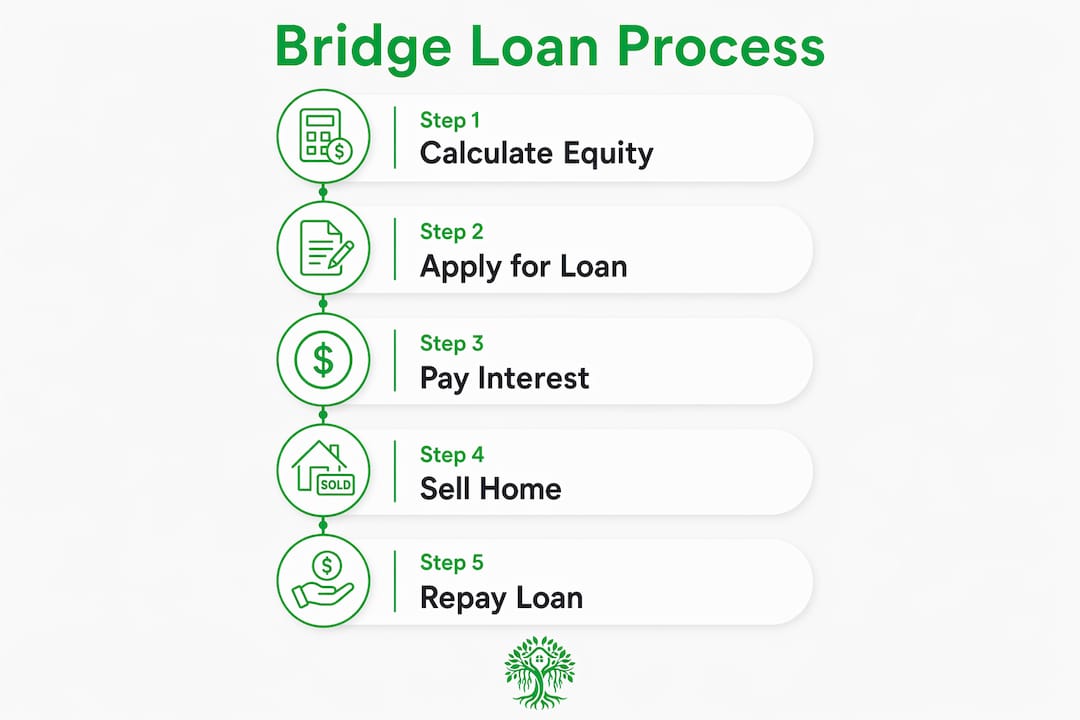
    The bridge loan process follows a clear sequence. Knowing each step helps you move quickly when the right home appears.

    1. Assess your equity and exit plan. Calculate your home’s likely sale price, subtract your mortgage payoff, and confirm you have enough equity to meet the lender’s 65%–80% threshold. Identify a realistic sale timeline based on current market conditions in your area.

    2. Apply with a bridge lender. Submit your application with documentation of your current home’s value, your mortgage balance, and your purchase contract for the new home. Underwriting focuses on collateral and exit strategy, so have your pricing rationale ready.

    3. Close on the new home. Once approved, bridge funds are used for your down payment and closing costs on the new property. You now own both homes simultaneously.

    4. Manage overlapping payments. Pay interest on the bridge loan monthly while also carrying your new mortgage. Keep a cash reserve specifically for this period. Most buyers experience 1–3 months of overlap.

    5. Sell your current home. When your old home closes, the sale proceeds pay off both the bridge loan balance and your remaining mortgage in a balloon payment. Any amount left over goes to you.

    6. Handle extensions if needed. If your home has not sold before the bridge loan term ends, contact your lender early. Extensions are available but add cost. Having a clear exit strategy from day one reduces the chance you will need one.

    Key Takeaways

    A bridge loan is a viable financing tool when your equity is strong, your home will sell quickly, and the cost is lower than your alternatives.

    Point Details
    Loan sizing Borrow 65%–80% of your home’s value minus your mortgage balance.
    Cost reality Rates of 8%–14% plus 3%–6% in fees make bridge loans expensive; calculate total cost before committing.
    Underwriting focus Lenders prioritize your exit strategy and collateral value over income or credit score.
    Competitive advantage Removing a sale contingency lets you make offers that compete with cash in California and Texas markets.
    Exit plan is non-negotiable A slow market or overpriced listing will result in loan denial regardless of your financial profile.

    My honest read on bridge loans for first-time movers

    I have watched buyers in California use bridge loans brilliantly and badly. The brilliant ones had one thing in common: they were honest about their home’s sale timeline before they signed anything. The bad outcomes almost always traced back to wishful pricing. A seller who insists their home is worth $50,000 more than the comps will not get a bridge loan approved, and if they do, they will carry two properties longer than they planned.

    The other mistake I see is treating bridge financing as a way to avoid hard decisions. If you are not ready to price your current home aggressively and sell it fast, a bridge loan adds cost without solving the real problem. The product works when the math works. First-time buyers in California often underestimate how quickly lender patience runs out when a home sits on the market.

    My advice: before you apply, get a realistic broker price opinion on your current home from someone who will tell you the truth, not what you want to hear. Then model the worst case. If your home takes four months to sell instead of six weeks, can you cover the payments? If the answer is no, the bridge loan is not the right tool right now.

    Bridge loans are not a universal solution. They are a situation-specific product that rewards buyers who plan carefully and punishes those who assume everything will go smoothly.

    — Anand

    How Ficustree helps buyers compete in California and Texas

    Knowing your financing options is only part of the equation. You also need to find the right home fast, make a strong offer, and avoid the common negotiation mistakes that cost buyers deals in competitive markets.

    https://ficustree.ai

    Ficustree is an AI-powered home buying platform built specifically for first-time buyers in California and Texas. The platform helps you identify properties that match your criteria, understand your offer position, and move with confidence when timing matters. Buyers pay $1,000 at closing plus 1% commission, keep a rebate of roughly 2% where permitted, and get access to on-demand showing agents. If you are weighing bridge financing and want to know which homes are worth the cost of competing for, start your search at Ficustree and let the platform do the heavy lifting.

    FAQ

    What is a bridge loan in home buying?

    A bridge loan is a short-term loan secured by your current home’s equity, used to fund the purchase of a new home before your existing property sells. Terms typically run 6–12 months, with interest-only payments during the loan period.

    How much can you borrow with a bridge loan?

    Most bridge lenders offer 65%–80% of your current home’s value minus your remaining mortgage balance. That net figure is the maximum available for your new home’s down payment and closing costs.

    Are bridge loans worth it in California and Texas markets?

    In competitive markets where contingent offers are rejected over 70% of the time, a bridge loan can be the only way to make a credible non-contingent offer. The cost is justified when the alternative is losing the home or moving twice.

    What happens if my home does not sell before the bridge loan expires?

    You can request an extension from your lender, though extensions add cost. Lenders may also require updated appraisals. The best way to avoid this is to price your home correctly from day one and have a realistic sale timeline before you apply.

    Can I use a HELOC instead of a bridge loan?

    A HELOC is not a reliable substitute. Lenders frequently freeze or deny HELOC applications once your home is listed for sale, which is exactly when you need the funds. A dedicated bridge loan is structured specifically for this transition and does not carry that restriction.

  • AI Home Search Tools Walkthrough for First-Time Buyers

    AI Home Search Tools Walkthrough for First-Time Buyers

    AI home search tools are advanced digital assistants that use conversational search, natural language processing, and data analytics to match homebuyers with properties that fit their specific needs. For first-time buyers in California and Texas, these tools cut through the noise of thousands of listings and compress months of research into focused, manageable sessions. Nearly half of prospective homebuyers planned to use AI tools during their home search in late 2025. That number signals a clear shift: AI home search is no longer a novelty. It is becoming the standard starting point for buyers who want clarity before they ever call an agent.

    What is an AI home search tools walkthrough?

    An AI home search tools walkthrough is a step-by-step process of using AI-powered real estate platforms to find, evaluate, and compare homes. The industry term for the underlying technology is conversational AI search, which lets you describe what you want in plain language instead of filling out rigid filter forms. You might type “three-bedroom under $550k near good schools in Austin with a short commute” and receive a curated list of matching homes. Conversational AI platforms like Realtor.com’s RealAssist, powered by Google Gemini, already handle requests exactly like that. The result is a search experience that feels more like talking to a knowledgeable friend than clicking through dropdown menus.

    These tools go beyond basic filtering. They analyze listing photos, flag potential issues, estimate renovation costs, and score neighborhoods on commute times, school ratings, and walkability. AI adoption among brokerage leaders has reached approximately 90% in 2026. That professional adoption means the underlying data feeding buyer-facing tools is more accurate and more current than it was even two years ago.

    Hands holding and annotating real estate photos and documents

    Getting the most from any AI real estate tool requires a few things in place before you type your first query.

    Technology basics:

    • A reliable internet connection and a smartphone or laptop
    • An account on at least one AI-powered real estate platform
    • Familiarity with basic search terms: bedrooms, bathrooms, square footage, zip code or neighborhood name

    Information you need ready:

    • Your pre-approval amount or a realistic budget range (principal, interest, taxes, insurance, and HOA combined)
    • Your must-have features versus nice-to-haves
    • Your target neighborhoods or commute corridors in California or Texas
    • Your timeline: are you buying in 60 days or 6 months?

    Privacy considerations: AI platforms collect your search behavior to personalize results. Read each platform’s data policy before creating an account. Avoid entering sensitive financial details like Social Security numbers into any search tool that is not a licensed lender or verified financial institution.

    Pro Tip: Write your home criteria in one clear paragraph before you open any platform. Buyers who enter vague queries get vague results. Specificity is the single biggest factor in getting useful AI recommendations on the first try.

    Infographic illustrating five key steps in AI home search process

    How do you use AI home search tools step by step?

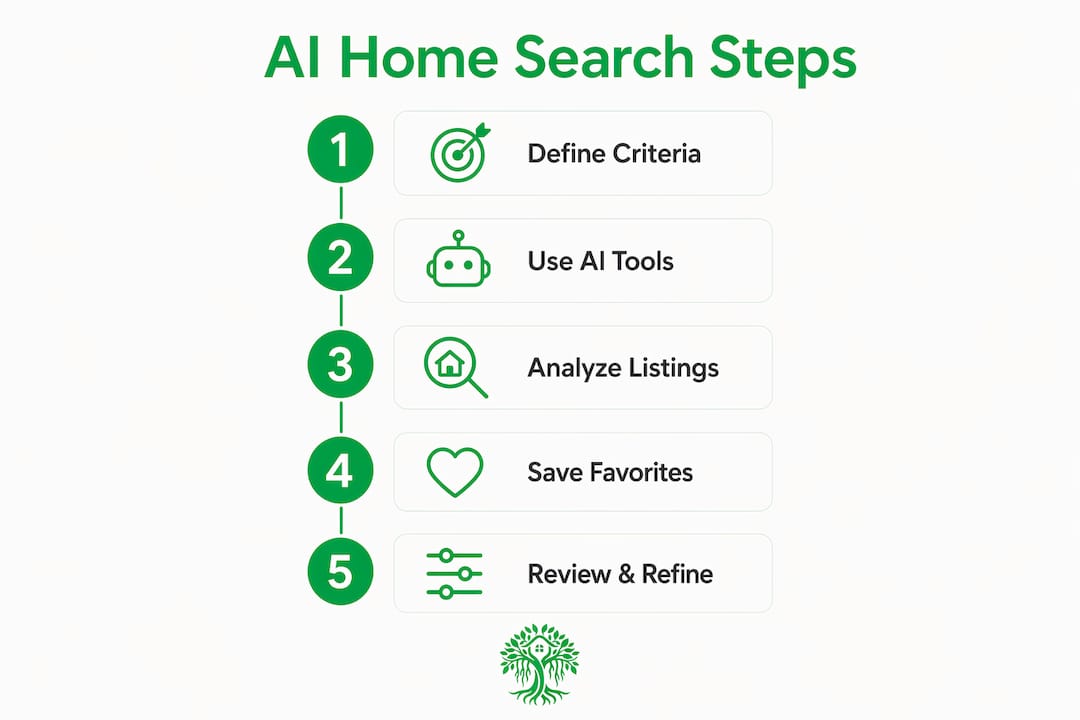
    This walkthrough covers the full sequence from first query to informed offer decision.

    1. Set your criteria in natural language. Open your chosen platform and describe your ideal home as if you were texting a friend. Include price range, bedroom count, location, and one or two non-negotiable features. Conversational AI tools remember your preferences across sessions and refine results as you give feedback. That means your second search session will be sharper than your first.

    2. Explore neighborhoods with AI scoring. Most platforms offer neighborhood insight tools that pull commute data, school ratings, crime statistics, and walkability scores. In California, pay attention to wildfire risk overlays. In Texas, check flood zone data, which is especially relevant in Houston and parts of the Austin metro. Use these scores as a starting filter, not a final verdict.

    3. Take virtual tours and analyze photos. 3D virtual tours with AI spatial tagging let you measure rooms, check ceiling heights, and assess layout before scheduling a showing. You can also upload listing photos to tools like Google Gemini to simulate renovation options and check whether a home has structural potential worth pursuing.

    4. Decode listing language with AI. Listing descriptions are written to sell, not to inform. AI tools can analyze listing text and photos to flag phrases like “cozy” (small), “as-is” (needs work), or “investor special” (significant repairs likely). AI photo and text analysis identifies features, potential issues, and renovation possibilities that a quick scroll would miss.

    5. Run affordability and mortgage estimates. Many platforms integrate AI-powered mortgage calculators that adjust in real time as you change down payment amounts or loan terms. Cross-reference these estimates with your lender’s pre-approval letter. The calculator gives you a range; your lender gives you the real number.

    6. Set multi-platform alerts. Different platforms pull MLS data at different speeds. Setting alerts across multiple platforms increases your chances of catching new listings and price reductions early. In competitive California markets like the Bay Area or San Diego, a 24-hour head start on a new listing can be the difference between scheduling a showing and missing out entirely.

    Pro Tip: After your first week of searching, review which listings you saved and look for patterns. If you keep saving homes with open floor plans or large backyards, update your AI criteria to weight those features more heavily. The tool improves when you teach it.

    Here is a quick reference for matching your goal to the right AI feature:

    Your goal AI feature to use
    Find homes matching your lifestyle Conversational natural language search
    Evaluate neighborhoods before visiting AI neighborhood scoring and commute tools
    Visualize a home’s potential Virtual tours and photo upload with renovation simulation
    Check if a listing price is fair AI valuation estimate (cross-check multiple sources)
    Stay ahead of new inventory Multi-platform listing alerts

    What mistakes should you avoid with AI home search tools?

    AI tools are powerful, but first-time buyers make predictable errors that cost time and money.

    • Over-relying on AI valuations without cross-checking. AI valuation tools can carry meaningful error margins depending on the market. A single estimate from one platform is a starting point, not a final price opinion. Always compare estimates from at least two sources and confirm with your agent before making an offer.
    • Treating neighborhood scores as ground truth. AI scores aggregate public data and user-reported inputs. They can miss hyperlocal details: a noisy flight path, a planned commercial development two blocks away, or a neighborhood that is actively gentrifying. No score replaces a Saturday afternoon walk through the area.
    • Skipping alert setup. Buyers who browse manually and check listings once a day miss early inventory. Configure alerts on at least two platforms with your full criteria set, including price range, bedroom count, and zip codes.
    • Accepting AI document summaries without professional review. AI can summarize a disclosure report or HOA document in seconds. That summary is useful for triage. It is not a substitute for a licensed agent or real estate attorney reviewing binding contracts.
    • Ignoring the limits of AI in fast-moving markets. In California and Texas metros, homes can go under contract within 48 hours of listing. AI tools help you prepare and prioritize, but speed still depends on having a responsive agent and a ready offer.

    “AI is a research assistant, not a replacement for licensed agents who provide negotiation expertise, local market knowledge, and legal guidance critical to home buying.” — Real estate industry consensus, 2026

    How do you combine AI insights with real agent expertise?

    AI tools and licensed agents solve different problems. Knowing which to use for what saves you time and protects you legally.

    • Use AI for research; use agents for decisions. AI surfaces data, scores, and comparisons. Licensed agents provide negotiation strategy, read local market dynamics, and guide you through contracts. These are not interchangeable functions.
    • Bring AI data to agent conversations. Print or screenshot your AI neighborhood comparisons and valuation estimates before meeting with your agent. It makes the conversation more productive and helps your agent understand your priorities quickly.
    • Cross-reference AI price estimates with comparable sales. Your agent can pull recent comparable sales (comps) from the MLS. Compare those comps to the AI estimate. When they align, you have confidence. When they diverge, ask why.
    • Use AI summaries to prepare questions, not to skip reading. If an AI tool summarizes a seller’s disclosure report, use that summary to identify which sections need closer attention. Then read those sections in full with your agent.
    • Visit every serious contender in person. Virtual tours and AI photo analysis are excellent filters. They are not substitutes for standing in a kitchen, checking water pressure, or noticing that the neighbor’s yard backs directly to a highway sound wall.

    Pro Tip: Before your first showing, run the address through an AI tool to generate a list of questions about the property. Bring that list to the showing. Buyers who arrive with specific questions get far more useful information from listing agents than buyers who walk through without a plan.

    My honest read on AI home search in California and Texas

    I have watched buyers in both California and Texas use AI tools with wildly different results. The buyers who get the most out of these tools share one habit: they treat AI as a preparation engine, not a decision engine. They use it to narrow a field of 400 listings to 12 serious candidates before they ever call an agent. That is genuinely valuable. It saves weeks.

    What AI consistently misses in both markets is the texture of a neighborhood at 7 p.m. on a Tuesday. In the Bay Area, two zip codes with identical walkability scores can feel completely different because of street-level density and parking. In Dallas, a neighborhood AI scores as “family-friendly” might have school zoning lines that cut right through it, sending kids on one block to a top-rated school and kids on the next block to an underperforming one. These details live in local knowledge, not in datasets.

    My advice: use AI to get to the right 10 homes faster, then invest your real energy in those 10. The AI personalized search tools available in 2026 are genuinely good at matching stated preferences. They are less good at matching unstated ones, the things you only discover when you are standing in the space. That gap is where a great agent earns their value. The hybrid approach, AI for research and humans for judgment, is not a compromise. It is the most effective way to buy a home right now.

    — Anand

    How Ficustree puts this walkthrough into practice

    Ficustree is built specifically for first-time buyers in California and Texas who want AI-powered search without giving up real representation. The platform uses conversational search and neighborhood fit scoring to match you with homes that meet your actual criteria, not just your keyword inputs. You keep a rebate of roughly 2% where legally permitted, pay $1,000 at closing plus 1% commission, and get hourly showing agents on demand.

    https://ficustree.ai

    Ficustree’s AI home search platform integrates the tools covered in this walkthrough, including listing analysis, neighborhood insights, and document summarization, into one place designed for buyers who are serious about making a clear, confident decision. The promise is simple: compress six months of first-time-buyer confusion into two months of clarity. Start your search at Ficustree and see which homes match you today.

    Key takeaways

    AI home search tools work best when buyers use them for research and preparation, then rely on licensed agents for negotiation, legal review, and final decisions.

    Point Details
    Start with clear criteria Write your must-haves before opening any platform to get useful results from the first query.
    Use conversational search Natural language queries return better matches than rigid filter forms on AI-powered platforms.
    Cross-check AI valuations Compare estimates from at least two sources before using a price as the basis for an offer.
    Set multi-platform alerts Different platforms update MLS data at different speeds; alerts on multiple platforms catch listings earlier.
    Combine AI with agent expertise AI handles research and filtering; licensed agents handle negotiation, contracts, and local nuance.

    FAQ

    What are AI home search tools?

    AI home search tools are software platforms that use natural language processing and data analytics to match buyers with properties based on conversational queries and behavioral preferences. They go beyond basic filters to include neighborhood scoring, virtual tours, and listing analysis.

    How accurate are AI property valuations?

    AI valuations vary by platform and market. Cross-checking estimates from multiple sources and comparing them to recent comparable sales pulled by a licensed agent gives you the most reliable price picture before making an offer.

    Can AI replace a real estate agent for first-time buyers?

    AI cannot replace a licensed agent. Agents provide negotiation expertise, local market knowledge, and legal guidance that AI tools are not equipped to deliver, especially for contracts and offer strategy.

    How do I get better results from AI home search tools?

    Enter specific criteria in natural language, including price range, location, bedroom count, and key features. Update your preferences after each session based on which listings you saved, since conversational AI tools refine results dynamically based on your feedback.

    Are AI home search tools useful in competitive California and Texas markets?

    Yes, particularly for early-stage research and alert setup. In fast-moving markets, AI tools help you identify and prioritize homes quickly, but closing a competitive offer still requires a responsive agent and a prepared financing strategy.

  • Home Inspection Checklist for Buyers: 2026 Guide

    Home Inspection Checklist for Buyers: 2026 Guide

    A home inspection checklist for buyers is a structured tool that guides you through evaluating every major system and component of a property before you commit to closing. Think of it as your financial defense plan. A qualified inspector, credentialed through organizations like ASHI (American Society of Home Inspectors) or InterNACHI (International Association of Certified Home Inspectors), will assess the property and deliver a detailed report. That report becomes your negotiating foundation. For first-time buyers in California and Texas, where home prices leave little room for costly surprises, this process is not optional. It is the step that separates confident buyers from regretful ones.

    1. What does a home inspection checklist for buyers actually cover?

    A standard buyer’s home inspection guide covers eight core categories. Each one can hide defects that cost thousands to fix after closing. Knowing what falls under each category helps you follow along during the inspection and ask the right questions.

    • Foundation and grading. Inspectors look for cracks, settling, and water intrusion at the base of the structure. Poor grading that slopes toward the house is a leading cause of basement and crawl space moisture.
    • Exterior walls, windows, and doors. Damaged siding, failed caulking, and rotted wood trim are common entry points for water. Inspectors check that windows open, close, and seal properly.
    • Roof condition and drainage. Missing shingles, damaged flashing, and clogged gutters all accelerate roof deterioration. In Texas, hail damage is frequently missed by untrained eyes.
    • Electrical panel and outlets. Inspectors verify the panel is properly labeled, breakers function, and outlets are grounded. Older California homes sometimes still carry Federal Pacific or Zinsco panels, both flagged as fire risks.
    • Plumbing fixtures and water pressure. Low pressure, slow drains, and visible corrosion under sinks all signal larger pipe issues. Inspectors also check the water heater age and condition.
    • Heating, ventilation, and air conditioning (HVAC). The inspector runs the system and checks filters, ductwork, and thermostat response. In Texas, an aging AC unit is a high-priority finding given summer heat loads.
    • Interior rooms: floors, walls, and ceilings. Stains, soft spots, and cracks tell a story about past or active leaks. Inspectors note whether damage appears cosmetic or structural.
    • Safety devices. Smoke detectors and carbon monoxide detectors must be present and functional. California law requires CO detectors on every floor; Texas requires them near sleeping areas.

    Pro Tip: Attend the inspection in person. Inspectors explain findings on-site in plain language that a written report alone cannot fully convey. Buyers who walk through with the inspector leave with a much clearer picture of what actually matters.

    2. How to use inspection findings to negotiate repairs or price reductions

    Inspector explaining home inspection findings to buyer

    Buyers who use inspection findings strategically negotiate an average of $14,000 off the sale price. That figure reflects deals where buyers focused on major defects rather than asking sellers to fix every item on a 40-page report.

    The key is prioritization. Inspection reports are not pass/fail grades. They are data-rich documents that list everything from a missing outlet cover to a failing roof. Your job is to separate safety hazards and structural defects from routine maintenance items.

    Here is how to approach negotiation after your inspection:

    1. Identify the non-negotiables. Safety hazards like faulty wiring, carbon monoxide risks, and structural instability must be addressed before closing. These are not cosmetic. They affect habitability.
    2. Estimate repair costs before you ask. Get contractor quotes or use cost data to anchor your request. Asking for a $12,000 credit on a roof replacement lands better than asking the seller to “fix the roof.”
    3. Request credits, not repairs. Seller-completed repairs are often done at the lowest cost. A credit at closing gives you control over quality and contractor choice.
    4. Bundle your requests. One clean repair request covering three major items is more effective than a list of 15 items that reads like a complaint.
    5. Know when to walk. If the seller refuses to address a failing HVAC system or active water intrusion, your inspection contingency lets you exit the contract. Use it.

    Pro Tip: Work with your agent to frame repair requests around the cost to cure, not the defect itself. Sellers respond better to dollar figures than to descriptions of problems.

    Learning how to get the right seller credit after an inspection is one of the highest-return skills a first-time buyer can develop.

    3. Specialty inspections worth adding to your standard assessment

    A standard inspection covers visible and accessible systems. Specialty inspections go deeper. Cracked sewer lines or hidden moisture found through specialty testing can cost $5,000 or more to fix after closing. That cost dwarfs the price of the test itself.

    • Sewer scope. A camera is run through the main sewer line to check for cracks, root intrusion, or collapse. This is especially relevant for homes over 30 years old, which is a large share of the housing stock in older California neighborhoods.
    • Radon testing. Radon is a colorless, odorless gas that causes lung cancer. The EPA designates certain counties as Zone 1 for elevated radon risk. If the home is in a high-risk area, a radon test is not optional.
    • Thermal imaging. An infrared camera detects temperature differences in walls and ceilings that indicate moisture intrusion or insulation gaps. This catches problems that look perfectly fine to the naked eye.
    • Mold and air quality testing. Relevant in California coastal markets where humidity is higher, and in Texas homes that have experienced flooding.
    • Chimney inspection. A Level 2 chimney inspection is recommended for any home with a fireplace or wood-burning stove. Creosote buildup and cracked flue liners are fire hazards that standard inspectors do not always flag in detail.

    Pro Tip: Schedule specialty inspections at the same time as your standard inspection. Coordinating both visits on the same day saves time and keeps your contingency window intact.

    Understanding the home inspector’s role in the buying process helps you decide which add-ons make sense for the specific property you are buying.

    4. What to check during the final walkthrough before closing

    The final walkthrough is not a second inspection. It is a verification step. Conduct it about 24 hours before closing to confirm the property is in the agreed condition and that all contracted items remain on-site.

    Use this checklist during your walkthrough:

    • Verify agreed repairs are complete. Ask for receipts and permits for any work done. A verbal confirmation from the seller is not enough.
    • Test every system. Run the HVAC, turn on faucets, flush toilets, flip light switches, and test the garbage disposal. Systems that worked during inspection can fail in the weeks between inspection and closing.
    • Confirm fixtures and appliances are present. If the contract included the refrigerator, washer, dryer, or specific light fixtures, confirm they are still there. Sellers occasionally remove items between inspection and closing.
    • Check for new damage. Moving furniture out can damage walls, floors, and doorframes. Document anything that was not present during the inspection.
    • Look at the exterior. Check the yard, fencing, and any outbuildings that were part of the sale. Confirm no debris or personal property was left behind.

    The final walkthrough is your last chance to raise concerns before you sign. If you find a problem, you can delay closing or negotiate a credit on the spot. Skipping it removes that option entirely.

    5. How to verify your inspector’s credentials before hiring

    Home inspectors are not federally regulated. Licensing requirements vary by state. In California, inspectors are not required to hold a state license at all. In Texas, the Texas Real Estate Commission (TREC) licenses inspectors and sets minimum standards for what must be reported.

    This gap in regulation means credential verification is your responsibility. Use the ASHI or InterNACHI member directories to confirm your inspector holds a recognized certification. Both organizations require continuing education and adherence to a published standards of practice. An inspector who belongs to neither is not automatically unqualified, but you have no third-party standard to hold them to.

    Never rely solely on a seller’s pre-inspection report. Sellers have a financial interest in the outcome. Their inspector may have been thorough, but you have no way to verify what questions were asked or what was left out. Hire your own inspector every time.

    Inspection costs typically range from $350 to $500 for a qualified professional. On a $600,000 California home, that is less than 0.1% of the purchase price for a report that could save you tens of thousands.

    6. Common home inspection mistakes first-time buyers make

    Most first-time buyers make at least one of these mistakes. Knowing them in advance keeps you from repeating them.

    Skipping the inspection to win a bidding war. In competitive California and Texas markets, some buyers waive the inspection contingency to make their offer more attractive. This is a high-risk move. A waived contingency does not mean you cannot inspect. It means you cannot exit the contract based on findings. You can still schedule an inspection for information, but you lose your exit right.

    Treating every finding as a repair request. A 40-page inspection report with 60 items does not mean the house is falling apart. Most reports include deferred maintenance, cosmetic issues, and items that are simply at the end of their useful life. Focus on safety hazards and structural defects first.

    Not reading the full report. Inspectors write detailed reports. Buyers often skim the summary and miss critical findings buried in the body. Read every section, especially the sections on the roof, foundation, and electrical system.

    Hiring the cheapest inspector available. A $200 inspection from an uncredentialed inspector is not a bargain. It is a liability. Pay for ASHI or InterNACHI credentials and a thorough written report.

    Key takeaways

    A thorough home inspection, backed by a structured checklist and verified inspector credentials, is the single most effective tool first-time buyers have to avoid costly post-purchase surprises.

    Point Details
    Use a structured checklist Cover all eight core categories: foundation, exterior, roof, electrical, plumbing, HVAC, interior, and safety.
    Negotiate with major defects Focus repair requests on safety hazards and structural issues to maximize negotiation leverage.
    Add specialty inspections Sewer scope, radon, and thermal imaging catch hidden problems that standard inspections miss.
    Verify inspector credentials Use ASHI or InterNACHI directories; never rely on the seller’s pre-inspection report.
    Complete the final walkthrough Conduct it 24 hours before closing to confirm repairs, test systems, and document any new damage.

    What I’ve learned from watching buyers skip the checklist

    Buyers consistently underestimate how much a structured inspection process changes the outcome of a purchase. The ones who show up with a checklist, attend the inspection in person, and read the full report come out of the process with clarity. The ones who treat the inspection as a formality often end up with a surprise repair bill in the first year.

    The most common misconception I see is that a clean-looking home is a safe home. Fresh paint and new countertops tell you nothing about the condition of the electrical panel or the sewer line. I have seen beautifully staged homes with $30,000 in deferred maintenance hiding behind the walls.

    The other thing buyers get wrong is the negotiation. They either ask for everything or ask for nothing. The right move is to identify the two or three findings that represent real financial risk and make a focused, dollar-anchored request. Sellers respond to specificity. A vague repair request invites a vague response.

    Bring your checklist. Attend the inspection. Read the report. Then negotiate from a position of knowledge, not anxiety. That shift alone is worth more than any single line item on the report.

    — Anand

    Ficustree makes inspection and negotiation less stressful

    First-time buyers in California and Texas have a lot to track between the inspection report, repair requests, and the final walkthrough. Ficustree is built to carry that load with you.

    https://ficustree.ai

    The Ficustree platform gives you AI-powered tools to analyze inspection findings, estimate repair cost impacts on your offer, and build a focused negotiation strategy. You get hourly showing agents on demand, full buyer representation for $1,000 at closing plus 1% commission, and a rebate of roughly 2% where permitted. The platform is free to use. You pay only at closing. If you are ready to buy with clarity instead of confusion, start with Ficustree and see how decision intelligence changes the process.

    FAQ

    How much does a home inspection cost?

    Home inspections typically cost between $350 and $500 for a qualified professional. The cost varies by property size, age, and location.

    Can I waive the home inspection in California or Texas?

    You can waive the inspection contingency to strengthen an offer, but you should still schedule an independent inspection for your own information. Waiving the contingency removes your right to exit the contract based on findings, not your ability to inspect.

    What is the difference between a standard and specialty inspection?

    A standard inspection covers visible and accessible systems like the roof, electrical, plumbing, and HVAC. Specialty inspections, such as sewer scope or radon testing, go deeper into specific systems or hazards that a general inspector does not assess in detail.

    When should I do the final walkthrough?

    Conduct the final walkthrough about 24 hours before closing. This timing gives you enough space to raise concerns and negotiate a resolution before you sign.

    Do I need to hire my own inspector if the seller already has one?

    Yes. Never rely solely on the seller’s pre-inspection report. The seller’s inspector works in the seller’s interest. Your own independent inspector works for you.

  • Open House Checklist Preparation: First-Time Buyer Guide

    Open House Checklist Preparation: First-Time Buyer Guide

    Open house checklist preparation is the process of organizing tools, questions, and evaluation steps to thoroughly assess potential homes during showings. First-time buyers who walk in without a plan often leave with nothing but vague impressions, which makes comparing homes nearly impossible. A structured checklist keeps you focused on facts instead of feelings. This guide gives you the exact tools, questions, and systems to evaluate any home with confidence.

    What essential tools and documents should you bring to an open house?

    Pre-open house preparation starts before you leave home. Confirming your lender pre-approval, researching the neighborhood, and building a must-have and deal-breaker list focuses your time at the showing. Buyers who skip this step spend the visit reacting emotionally instead of evaluating objectively.

    Physical tools to pack

    • Tape measure. Room dimensions on listing photos are often misleading. Bring a tape measure to verify whether your furniture fits and whether the layout actually works for your life.
    • Flashlight. Basements, attics, closets, and cabinet interiors are poorly lit. A flashlight reveals water stains, pest damage, and structural issues that overhead lighting hides.
    • Notepad or phone app. You will visit multiple homes. Without written notes, details blur together within 48 hours.
    • Fully charged phone. You need it for photos, videos, and quick neighborhood research on the spot.
    • Printed checklist. A pre-printed room-by-room checklist keeps you systematic when staging and decor pull your attention away from the structure.

    Documents to bring

    • Your lender pre-approval letter. Agents notice prepared buyers.
    • A written list of your must-haves and deal-breakers.
    • Neighborhood research: school ratings, commute times, recent sale prices.
    • A list of questions prepared in advance (covered in detail below).

    Pro Tip: Silence your phone before entering. Distractions during a 30-minute showing cost you observations you cannot recover later.

    How to effectively evaluate a home’s condition and systems during an open house?

    A home showing is not a formal inspection. You cannot open electrical panels or probe behind walls. Home inspectors only assess accessible components for safety and legal reasons, and the same boundary applies to you as a buyer. Your job is to observe visible clues and ask targeted questions, then let a licensed inspector confirm your findings after you go under contract.

    Here is a room-by-room evaluation sequence that works:

    1. Start outside. Check the roof for missing shingles, sagging ridgelines, or moss. Look at the foundation for cracks wider than a hairline. Observe yard grading: does the ground slope toward or away from the house? Water that drains toward the foundation causes expensive damage.

    2. Enter and pause at the front door. Notice odors immediately. Musty smells indicate moisture or mold. Pet odors and heavy air freshener can mask problems. Your nose is a diagnostic tool.

    3. Check walls and ceilings in every room. Look for water stains, bubbling paint, or discoloration near windows and in corners. These are signs of roof leaks or plumbing issues above.

    4. Test every window and door. Open and close them. Sticking doors and windows often signal foundation settling or moisture swelling. Check seals for drafts by holding your hand near the frame.

    5. Run faucets and flush toilets. Low water pressure, slow drains, and running toilets are all negotiating points. Test every faucet you can access.

    6. Inspect the garage and basement. These areas reveal the most about a home’s true condition. Look for oil stains, rust, efflorescence (white mineral deposits on concrete), and any signs of standing water.

    7. Locate the electrical panel and water heater. You are not opening anything. Just note their age, brand, and condition. A water heater older than 12 years is likely near replacement.

    Pro Tip: Ask the listing agent directly: “How old is the roof, HVAC, and water heater?” These questions help you anticipate near-term repair costs before you make an offer.

    Document everything with photos and short video clips. Take photos and videos with permission during the showing to back up your notes. Memory is unreliable when you are comparing three homes in one afternoon.

    Hands measuring baseboard during home evaluation

    What non-physical factors and neighborhood details should you assess?

    Open houses are not only for evaluating the structure. They are also for learning affordability details that directly affect your monthly payment and long-term costs. A house that looks affordable on the listing price can become unaffordable once you add HOA fees, property taxes, and deferred maintenance.

    Assess these factors during and after the showing:

    • Parking. Is there a garage, driveway, or only street parking? In California cities, street parking can be a daily frustration that the listing photos never show.
    • Yard grading and drainage. Flat or inward-sloping yards collect water. This leads to foundation problems and flooding. Walk the perimeter and look for soggy patches.
    • Noise. Stand outside for two minutes. Listen for freeway noise, flight paths, train lines, or commercial activity nearby. Noise is one of the top reasons buyers regret purchases within the first year.
    • HOA fees and restrictions. Ask the agent for the current monthly HOA fee, any pending special assessments, and key restrictions. Verify these figures through official disclosures and your own calculations before making an offer.
    • Property tax rate. California and Texas have very different property tax structures. In Texas, effective rates often run above 2%, which adds thousands to your annual cost. Ask the agent for the current assessed value and tax bill.
    • Seller timeline. Ask how quickly the seller needs to close. A motivated seller with a tight timeline may accept a lower price or fewer contingencies.
    • Utility costs. Request average monthly utility bills. Older homes with poor insulation can carry heating and cooling costs that surprise first-time buyers.

    Use the agent’s answers as starting points, not final answers. Every number they give you needs verification through disclosures and your own home affordability calculations.

    What questions should first-time homebuyers prepare to ask?

    The listing agent represents the seller. Their job is to present the home favorably. Your job is to ask specific questions that reveal facts the listing photos do not show. Polite, organized buyers get better answers. Making a good impression on the seller’s agent can work in your favor, as long as you keep your price intentions private.

    Prepare these questions before every showing:

    1. How old are the roof, HVAC system, and water heater?
    2. Have there been any recent repairs or upgrades? Were permits pulled?
    3. Is there any unpermitted work on the property?
    4. How long has the home been on the market, and has the price been reduced?
    5. Why is the seller moving?
    6. Are there any known issues the seller is required to disclose?
    7. What are the HOA fees, and are there any pending special assessments?
    8. What are the average monthly utility costs?
    9. What is the seller’s preferred closing timeline?
    10. Have there been any offers, and if so, why did they fall through?

    Question 10 is the one most first-time buyers skip. A deal that fell apart once often signals a problem: a failed inspection, a title issue, or an appraisal gap. The agent may not answer directly, but their response tells you something either way. For a deeper look at what agents are required to disclose in California, the California buyer disclosures guide explains exactly what to expect.

    How to organize your open house notes for better decisions?

    Use a standardized rating system to compare properties objectively after each visit. Rate each home on layout, condition, location, light, noise, and estimated near-term repair costs. A simple 1–5 scale for each category gives you a score you can compare across multiple homes without relying on memory or emotion.

    Infographic detailing open house preparation steps

    Write your notes immediately after leaving the property, not that evening. Impressions fade fast, especially when you are touring two or three homes in a day. Voice memos recorded in the car right after the showing are one of the most underused tools in a buyer’s kit. They capture tone and detail that typed notes miss.

    Organize your findings against your must-have and deal-breaker lists. A home that scores high on condition but fails on location is not a compromise worth making if commute time was a non-negotiable. Share your notes with your buyer’s agent promptly. A good agent uses your observations to guide the next steps: requesting disclosures, ordering a pre-inspection, or advising on offer strategy. If you want to understand how emotional bias affects buyer decisions, that is worth reading before your first showing.

    Pro Tip: Create a simple spreadsheet with one row per home and columns for each rating category. After three or four showings, patterns become obvious and the right choice gets much clearer.

    Key Takeaways

    Thorough open house checklist preparation requires physical tools, targeted questions, and a standardized rating system used consistently across every home you visit.

    Point Details
    Bring the right tools Pack a tape measure, flashlight, notepad, and fully charged phone before every showing.
    Inspect visible clues only Observe accessible areas and ask questions. Never remove panels or perform invasive checks.
    Ask about systems and costs Request ages of roof, HVAC, and water heater to estimate near-term repair expenses.
    Verify financial details Treat HOA fees and utility costs from agents as leads, then confirm through official disclosures.
    Rate and compare immediately Score each home on layout, condition, and location right after the visit, not from memory later.

    What I’ve learned from watching buyers skip the checklist

    First-time buyers almost always underestimate how fast homes blur together. After three showings in one afternoon, the details from the first house are gone. Buyers who rely on memory end up making decisions based on whichever home felt best in the moment, which is usually the one with the nicest staging, not the soundest structure.

    The checklist is not bureaucratic busywork. It is the only thing standing between you and a $15,000 surprise after closing. I have seen buyers fall in love with a kitchen renovation and completely miss a 20-year-old roof or a water heater that was clearly past its service life. Those are not small oversights. They are the kind of costs that strain a budget in the first year of ownership.

    The questions matter just as much as the physical tools. Buyers who ask about unpermitted work, price history, and failed offers consistently negotiate better outcomes. They walk in looking like serious buyers and walk out with information that shapes their offer strategy. That combination is hard to beat. For a broader view of the full homebuying process, understanding where open houses fit in the timeline helps you stay focused at each stage.

    — Anand

    How Ficustree helps you prepare smarter for every showing

    Ficustree is an AI-powered home buying platform built specifically for first-time buyers in California and Texas. The platform gives you the tools to evaluate homes the way a seasoned buyer would, without the six months of trial and error.

    https://ficustree.ai

    Ficustree’s buyer platform includes affordability tools that calculate your true monthly cost, including PITI, HOA, and maintenance, so you know your real number before you fall for a listing. Buyers pay $1,000 at closing plus 1% commission and keep a rebate of roughly 2% where legally permitted. You get hourly showing agents on demand and the full platform free. Start your search at ficustree.ai/buyer and walk into your next open house with a clear plan.

    FAQ

    What should I bring to an open house?

    Bring a tape measure, flashlight, notepad, fully charged phone, and a printed checklist. Also carry your lender pre-approval letter and a written list of questions prepared in advance.

    What questions should I ask at an open house?

    Ask about the age of the roof, HVAC, and water heater, any unpermitted work, how long the home has been on the market, and why the seller is moving. These questions reveal costs and motivations that listing photos do not.

    Can I inspect the electrical panel during an open house?

    No. Home inspectors only assess accessible components and do not remove electrical panel covers for safety and legal reasons. Observe the panel’s age and condition from the outside, then hire a licensed inspector after going under contract.

    How do I compare multiple homes after open house visits?

    Rate each home on layout, condition, location, light, noise, and estimated repair costs using a consistent 1–5 scale immediately after each visit. A simple spreadsheet makes patterns clear across three or more properties.

    Are HOA fees and utility costs accurate when the agent tells me?

    Treat those figures as starting points only. Verify HOA fees and utility costs through official seller disclosures and your own calculations before making any offer.

  • Top 4 zillow.com Alternatives 2026

    Top 4 zillow.com Alternatives 2026

    Finding home buying decision software that simplifies property matching, cost analysis, and agent rebates is time-consuming for buyers and independent agents. Major platforms restrict key features like rebates, transparency in commission savings, or data-driven agent tools to certain states or paid plans. This comparison highlights AI home matching, commission rebates, and agent support across four platforms so buyers and agents can select the best fit for their market.

    Table of Contents

    Ficustree

    https://ficustree.ai

    At a Glance

    Ficustree advertises buyers pay $1,000 at closing plus 1% commission and keep a rebate of roughly 2% where legally permitted. The platform combines AI home matching with disclosure analysis and cost projections. It targets first time buyers in California and Texas and supports independent agents with CRM and lead qualification tools.

    Core Features

    Ficustree uses AI-powered home matching and neighborhood insights to surface properties that fit your affordability and lifestyle. The platform includes disclosure and risk analysis so you can review seller disclosures with AI help and spot potential issues earlier. Built calculators compare mortgage payments, insurance, HOA fees, and true cost of ownership while touring and closing support reduces admin work for both buyers and agents.

    Key Differentiator

    The single most concrete distinction is the combination of AI recommendations with buyer economic incentives and agent tools in one place. That mix pairs personalized search with cash back or rebate claims and a set of tools for independent realtors. The result is a platform that aims to replace a fragmented stack of search sites, mortgage calculators, and CRMs for first time buyers and small brokerages.

    Pros

    Ficustree produces highly personalized recommendations that speed the match between what you can actually afford and homes on the market. Its disclosure analysis and cost projections make tradeoffs concrete when you compare properties. The platform supports independent agents by centralizing leads and buyer qualification, which can reduce the time agents spend switching between tools. Buyers who prioritize cost clarity will value the rebate and showing agent options while agents get CRM functionality and qualified buyer opportunities.

    Cons

    • Limited availability to California and select states, and some buyer features are still evolving or in beta.

    Who It’s For

    This platform fits first time buyers who need step by step financial clarity and personalized property matches. It also fits independent real estate agents who want a single tool for lead management and buyer qualification. If you live outside California or Texas, the regional limits may restrict access to the full feature set.

    Unique Value Proposition

    Ficustree advertises an AI-driven personalized home buying experience plus cash back or rebates at closing while providing agent tools in the same product. That arrangement changes the economics of representation for buyers by lowering upfront agent costs and returning a portion of closing proceeds where law allows. For agents the platform offers a paid route to qualified buyer leads and an integrated CRM to replace several legacy tools.

    Real World Use Case

    A first time buyer uses Ficustree to get matched to homes that fit their true affordability and then runs the disclosure analysis before making an offer. The buyer books an hourly showing agent through the platform and closes while receiving the claimed rebate. An independent agent manages the lead in the same account and tracks mortgage scenarios to speed negotiations and closing.

    Pricing

    The vendor states the premium platform is free for buyers while agent plans start at $399/month with success fees or higher tiers available. The company also represents buyers with a $1,000 closing fee plus 1% commission, and advertises rebate amounts of roughly 2% where permitted.

    Website: https://ficustree.ai

    withjoy.ai

    https://withjoy.ai

    At a Glance

    WithJoy.AI’s marketing materials state rebates reach up to 70% of agent commissions. That rebate figure is the single standout claim and the chief reason buyers notice the service. The company combines AI search tools with licensed agents to surface listings and manage tours.

    Core Features

    WithJoy.AI pairs an AI powered home search and scheduling system with full service support from licensed agents who handle offers and closing steps. The site emphasizes large commission rebates, transparent buying steps, and guidance from search through closing. It also advertises flexibility through non exclusive agreements and agent assistance for every major milestone.

    Key Differentiator

    The vendor advertises the highest homebuyer rebate in Washington as its defining angle, combining automation for search and booking with human agents for negotiations. That rebate figure and the mixed AI plus agent model aim to cut buyer out of pocket costs while keeping in person help available for complex negotiations and inspections.

    Pros

    Significant buyer savings headline WithJoy.AI. The rebate model can lower closing costs for buyers who understand the terms, and that savings claim draws cash conscious buyers. Combining automated search and scheduling with licensed agents reduces the time you spend managing tours and paperwork, while non exclusive contracts keep your options open.

    The platform also focuses on local inventory in Washington and nearby areas. That regional scope gives buyers more relevant listings and agent expertise for state specific process differences.

    Cons

    • Rebate structure can add fees for extra tours after the initial set. This can surprise buyers who expect unlimited free showings.

    • Service coverage is limited to Washington state and nearby regions. Buyers outside that geography cannot use the rebate model.

    • The rebate and negotiation process requires buyer knowledge. New buyers may need guidance to evaluate how the rebate affects agent incentives and net proceeds.

    When It May Not Fit

    Buyers who plan to shop outside Washington should look elsewhere. Investors or buyers who expect unlimited complimentary touring will find the post initial tour charges a mismatch. Buyers who prefer a traditional agent relationship with no rebate conversation may also find the model adds unwanted complexity.

    Who It’s For

    This comparison site suits homebuyers and investors focused on lowering closing costs in Washington. It fits people comfortable discussing commission flows and who want a digital search plus agent support. It is especially relevant for price conscious first time homebuyers who value scheduled tours and guided offers.

    Real World Use Case

    A first time homebuyer in Seattle uses WithJoy.AI to run targeted searches, schedule three initial tours automatically, and get agent support on a shortlist of homes. The buyer negotiates with agent assistance and receives a rebate that the company advertises as substantial. That rebate reduces out of pocket closing expenses and makes the purchase more affordable for the buyer.

    Website: https://withjoy.ai

    PerchNow

    https://perchnow.com

    At a Glance

    Buyers can invite local agents to compete through an agent bidding process that can unlock commission rebates and lower buyer costs. The platform combines market trend data from MLS, Zillow, and Redfin with property level reports and neighborhood metrics. It also scores offer strength to help you judge which bid will win in a tight market.

    Core Features

    PerchNow bundles AI powered market analysis, property and neighborhood reports, and offer strength scoring into a single workflow. The platform pulls trusted data sources to show school ratings, walkability, crime statistics, and planned developments alongside historical market trends. Agents find lead generation tools tied to buyer activity and preferences.

    Key Differentiator

    PerchNow integrates its market insights directly with a competitive agent bidding system and rebate mechanisms to change how buyers shop for representation. That mix makes the negotiation over agent commission explicit and visible during offer construction. For buyers who want to compare agent terms side by side, this focus on bid competition is the distinguishing feature.

    Pros

    PerchNow’s marketing materials say its tools help buyers save thousands on commissions and closing costs. The platform bases its analysis on multiple trusted sources, which helps you compare neighborhoods with more than one dataset. Agents gain targeted leads from buyer signals and can use the bidding process to win business while showing clear pricing and rebate options.

    Cons

    • Availability is limited to specific regions, for example Bay Area and Seattle, so many markets may not be covered.
    • The platform collects many tools and reports, which can overwhelm buyers unfamiliar with real estate analytics.
    • Buyer leverage depends on agent participation and how fully you use the bidding and reporting features.

    When It May Not Fit

    If you live outside the platform’s active regions you will not get the full value. If you prefer a single local agent rather than soliciting bids, this model adds unnecessary friction. If you want a very simple search experience without data driven scorecards, the volume of reports may feel like extra work.

    Who It’s For

    You should consider PerchNow if you want to compare agent terms and see the financial trade offs before you make an offer. It fits buyers who want data to back their offer strategy and agents seeking qualified leads tied to active buyers. The product suits people comfortable reading reports and using scores to guide decisions.

    Real World Use Case

    A buyer narrows to three neighborhoods using PerchNow neighborhood reports and walkability scores. They post the listing and invite several agents to bid, then compare each agent’s commission and estimated rebate alongside an offer strength score. The buyer picks the agent with the best combination of local knowledge, lower commission, and a strong offer score.

    Pricing

    Basic features are free so you can run reports and view limited market data at no cost. The Premium plan costs $15 per month billed every six months and includes advanced analysis, unlimited reports, and access to paid market data. The paid plan is useful if you expect repeated reports or if you need deeper data for competitive bidding.

    Website: https://perchnow.com

    HomeMatch

    https://landonearth.com

    At a Glance

    HomeMatch includes a feature called Lead Revival that reengages cold leads and auto qualifies new prospects. The platform pairs buyer preferences with lifestyle signals to rank homes. Brokers get branded search portals and dashboards that surface buyer activity in real time.

    Core Features

    HomeMatch uses AI driven home matching to score and rank listings by buyer preferences and lifestyle attributes, and it shows those signals in agent dashboards. The platform supports custom branded client experiences and connects with existing CRM systems to move leads into conversations. Automated reporting tracks engagement so teams see which homes actually interest each buyer.

    Key Differentiator

    The single feature that sets HomeMatch apart is its focus on lifestyle and behavior rather than only on price and specs. The system converts engagement signals into ranked recommendations and seller facing summaries for agents. That emphasis helps agents present choices that match how buyers live, not just what they want on paper.

    Pros

    HomeMatch speeds client matching by using signals from searches, clicks, and saved homes to surface the best fits. Its branded portals let brokerages present a differentiated client experience without rebuilding a website. Real time dashboards let agents spot warming leads and reduce unnecessary showings, which can shorten the time to offer. CRM integration means contact records stay current and lead conversion work moves into existing agent workflows.

    Cons

    • Trustpilot reviews suggest some users face a learning curve and request more customization. Those reviews do not list exact counts or scores.
    • Pricing details are limited; the vendor advertises a free trial and minimal setup fees but long term costs are not specified.
    • The platform requires online access and website integration, which may need developer time for customization or single sign on.

    When It May Not Fit

    Small teams without any technical support may find the initial setup and customization work heavier than plug and play options. Teams that need fully transparent list pricing before trial may feel uncertain because subscription details are not posted. Offices that operate primarily offline or want an entirely self contained local tool will not get value from a cloud first matching service.

    Who It’s For

    High performing agents and brokerages that want to lead with data driven matching will get the most from HomeMatch. Property marketing teams that want engagement metrics tied to specific listings will benefit as well. The product suits offices ready to adopt branded portals and integrate a new workflow with their CRM.

    Real World Use Case

    A brokerage launches a branded search portal using HomeMatch to rank listings by family lifestyle, commute, and school fit. Agents use the portal to highlight the top three homes that match a buyer profile and track which listing pages the buyer views. That focused approach helps the brokerage reduce repeat showings and get offers accepted faster.

    Pricing

    The vendor lists a free trial and minimal setup fees but does not publish long term pricing. Buyers should plan to request a custom quote during the trial and ask about seat limits or per lead charges. Budget for possible developer time if you want deep site integration.

    Website: https://landonearth.com

    Comparison of alternatives

    Buyers seeking AI-driven personalization coupled with financial incentives find Ficustree uniquely appealing, though other alternatives excel in distinct areas.

    AI capabilities versus incentives

    Ficustree matches buyers with properties tailored to affordability using AI-driven home search tools coupled with disclosure analyses. Buyers receive detailed financial breakdowns for closing costs and rebates promised where legally allowed. By contrast, withjoy.ai emphasizes substantive monetary rebates, advertising repayment of up to 70% of agent commissions, which suits cost-saving buyers in Washington.

    Support structuring differences

    While HomeMatch specializes in lifestyle-specific rankings facilitated through engagement analytics benefiting brokers, PerchNow focuses on agent bidding, enabling buyers to compare fees and expertise directly to choose representation tailored for competitive closings. Buyers preferring transparent compensation negotiation find PerchNow’s agent matching a unique service.

    Best fit

    • Buyers prioritizing financial clarity and personalized property suggestions optimize results with Ficustree.
    • Cost-focused buyers in Washington needing rebates find withjoy.ai advantageous.
    • Local agent bid comparison appeals to detail-oriented buyers relying on PerchNow for decision justification.
    • Lifestyle-centric brokers maximize their client engagement and matching with HomeMatch.

    Our pick

    Ficustree proves ideal for buyers seeking clarity in affordability and agents needing integrated workflows for reaching qualified leads. Buyers outside its availability scope or lacking rebate preference find competitor systems answering depth-based research or spending suitability necessary.

    This comparison table presents the key features of leading home buying platforms, helping prospective users identify the best fit for their unique real estate needs.

    Platform Core Feature Best For Pricing Notable Limitation
    Ficustree AI-powered home matching and disclosure analysis First time buyers and independent agents in CA and TX Free for buyers, agent plans $399/month Limited to California and select states
    WithJoy.AI AI search tools and agent-guided support Cost-conscious buyers in Washington state Price not published Coverage limited to Washington state
    PerchNow Competitive agent bidding and market reports Buyers wanting data-backed decisions Free basic, Premium $15/month Regional availability limits market coverage
    HomeMatch Lifestyle-focused AI home matching High-performing brokerages integrating branded experiences Price not published Requires website integration and potential development work

    How to Find Clarity Beyond Zillow.com Alternatives

    First-time buyers often feel confused by mixed information and hidden costs when searching beyond popular sites like Zillow.com. Ficustree solves this by empowering you with AI-powered home matching and clear financial calculations that reveal what you can truly afford, including all ownership costs like insurance and HOA fees. Buyers pay a flat $1,000 closing fee plus 1% commission and receive a rebate of about 2% where allowed, reducing upfront expenses without sacrificing expert guidance.

    With hourly showing agents on demand and a premium platform offered at no cost, Ficustree compresses months of uncertainty into two months of confident decisions. If you want a transparent, step-by-step buying process tailored to California and Texas buyers, see how the Ficustree platform can simplify your search and lower costs. Begin building your buying plan with Ficustree’s AI-powered insights and experience home buying clarity that fits your budget.

    FAQ

    How does Ficustree assist first-time buyers with personalized home matching?

    Ficustree offers AI-powered home matching that surfaces properties fitting your affordability and lifestyle. The platform’s combination of personalized search and financial clarity supports first-time buyers in making informed decisions. Use Ficustree to find homes that genuinely align with your budget and needs.

    What is the main difference between Ficustree and WithJoy.AI?

    WithJoy.AI emphasizes significant rebate offerings, potentially providing buyers with rebates of up to 70% of agent commissions. Ficustree, on the other hand, combines AI recommendations with buyer economic incentives and agent tools in one platform, which is ideal for buyers prioritizing a personalized experience. Consider Ficustree if you want a comprehensive tool that integrates cost clarity and agent support.

    Which features does Ficustree offer to enhance the home buying experience?

    Ficustree includes disclosure and risk analysis tools that allow buyers to review seller disclosures with AI assistance. This feature helps buyers identify potential issues earlier in the process. Explore Ficustree to ensure you have vital insights before making an offer on a home.

    Can agents benefit from using Ficustree?

    Yes, independent agents can centralize leads and buyer qualifications with Ficustree. The platform provides tools that can reduce the time agents spend managing multiple processes, ultimately enhancing their efficiency. Consider using Ficustree as a resource to streamline your real estate operations as an agent.

    What pricing structure does Ficustree have for buyers and agents?

    Ficustree charges buyers $1,000 at closing plus a 1% commission, offering rebates of roughly 2% where legally allowed. For agents, plans start at $399 per month. This structure makes it accessible for both buyers and agents looking for affordable solutions.

  • Top 3 homes.com Alternatives for 2026

    Top 3 homes.com Alternatives for 2026

    Finding home buying software that saves you money and connects you with competitive local agents is harder than it should be. Most home buying platforms lock you into fixed agent fees or lack transparent rebate programs that reward you for comparing services. You can pick a homes.com alternative that matches your location, tech preferences, and desire for better agent deals.

    Table of Contents

    Casa Amigo

    https://casaamigo.ai

    At a Glance

    Forms collect location and contact details to connect visitors with local real estate contacts. The site emphasizes future oriented solutions and user engagement rather than listing a full feature set. Limited public detail makes the offering look like a lightweight lead gateway.

    Core Features

    Casa Amigo centers on form submissions that capture a visitor’s location and basic inquiry details. The platform appears to route those submissions to local agents or services, creating simple member to agent touchpoints. Branding and copy point toward future oriented real estate approaches, though specific membership features or community tools are not listed.

    Key Differentiator

    The standout angle is the focus on location based engagement for real estate inquiries. That focus positions Casa Amigo as a direct matchmaker for local contact rather than a broader community with threaded discussions or a buyer representation layer. If you want a quick way to turn website visitors into local leads, that emphasis is the main draw.

    Pros

    The site shows an intuitive user interface for submitting contact and location details, which lowers friction for first contact. Clear calls to action encourage visitors to request contact, so members and agents see faster lead capture. The brand language and visual theme suggest a forward looking approach, which may appeal to tech oriented agents and buyers.

    Cons

    • Limited product detail makes it hard to verify whether Casa Amigo supports member directories, moderated threads, or a newsletter. This gap complicates planning for community managers or broker teams.
    • There is no public information on transactional features or lead management capabilities. Buyers expecting offer support or escrow workflows will not find evidence of those services.
    • The site does not list integrations or moderator controls, which matters if you need CRM handoff or member moderation tools.

    When It May Not Fit

    If you need a full community platform with member forums, threaded discussions, or a wiki, Casa Amigo looks too narrow. If your team relies on CRM integrations or automated lead workflows, the lack of listed integrations makes the fit uncertain. Avoid this if you expect an end to end buyer representation solution rather than a lead capture entry point.

    Who It’s For

    You should consider Casa Amigo if you run a small brokerage or are an independent agent who wants simple, location driven web leads. It also fits site owners who only need a short form to route local inquiries to an agent. This is not aimed at organizations that require deep community features or internal sales automation.

    Real World Use Case

    A renter ready to buy fills the short form and enters their ZIP code and budget. The submission routes to nearby agents, who contact the lead to schedule a showing. That quick match from form to local contact reduces friction for someone who just wants a fast agent reply.

    Website: https://casaamigo.ai

    Perch

    https://perchnow.com

    At a Glance

    Perch pairs AI market analysis with a live bidding process where licensed agents compete for a buyer’s offer and buyers can earn cashback. The platform integrates MLS, Zillow, and Redfin data to create property reports and neighborhood comparisons. This setup aims to align agent fees with the services actually delivered.

    Core Features

    Perch delivers AI powered market insights, smart property reports, and neighborhood comparison tools that pull from multiple listing sources. It provides offer strength scoring so you can see how an offer stacks up before you submit it. The platform also hosts a competitive agent bidding flow that lets licensed agents propose service and fee structures for each buyer.

    Key Differentiator

    Perch stands out by combining AI driven analysis with a competitive agent marketplace where agents bid to represent the buyer. That pairing shifts cost pressure onto the agent side while giving buyers data to evaluate agent proposals. The result is a single place to research, score offers, and invite competing agent proposals.

    Pros

    Perch gives buyers access to professional grade property reports and neighborhood trend analytics. Those reports help you detect price moves and set offer parameters with more confidence. Buyers can compare agent rates and capture cashback when allowed by local rules. Agents gain a way to reach prequalified buyers who want competitive pricing and clear offer metrics. The platform supports independent research and a transparent negotiation of agent fees.

    Cons

    • Relatively new platform with limited long term reviews and user history.
    • Agent onboarding can be complex for teams unfamiliar with performance based pricing models.
    • Buyers and agents must adapt to AI driven, transparent transaction processes rather than traditional opaque fee models.

    When It May Not Fit

    Perch primarily targets U.S. markets and licensed agents, so international buyers will find the product mismatch. If you prefer a traditional agent relationship with fixed fee expectations, the bidding model may feel unfamiliar. Teams that cannot change internal compensation workflows will struggle to adopt the platform.

    Who It’s For

    Tech savvy homebuyers who want data driven decision tools and potential cashback will find Perch useful. Licensed real estate professionals and brokerages seeking qualified buyer leads and flexible fee proposals will also benefit. The platform favors buyers who want to research offers independently and agents willing to compete on price and service.

    Real World Use Case

    A buyer analyzes neighborhood trends with Perch reports and sets a competitive offer price. The platform scores the offer and posts it to local licensed agents. Several agents submit bids with different fee levels and service scopes, and the buyer selects the agent who balances price and responsiveness, capturing savings through the cashback option.

    Pricing

    Perch offers free access to basic AI market insights and reports. Premium plans start at $20/month for unlimited data and full report access. Agent services use performance based fees that vary by the agent proposal and local rules.

    Website: https://perchnow.com

    WithJoy.AI

    https://withjoy.ai

    At a Glance

    WithJoy.AI reports rebates up to 70% of buyer’s agent commissions. The site targets homebuyers in Washington and combines human agents with AI powered tools. It advertises online tour scheduling, offer guidance, and support through closing phases.

    Core Features

    WithJoy.AI uses an AI powered home search that aims to feel conversational and personal. The site lets you schedule tours online without high pressure and covers the first four tours for free. Human agents work alongside the AI to advise on offers and guide you through closing, while the rebate program credits back part of the agent commission.

    Key Differentiator

    The standout claim is that rebate level combined with full service agent support and an AI enhanced search. That rebate figure is the central draw for buyers who prioritize savings while keeping agent guidance during offers and closing.

    Pros

    The biggest upside is potential savings tied to that rebate claim. The service presents a simplified, modern search flow and an online tour scheduler that reduces back and forth. Experienced agents handle negotiations and closing steps, and the platform states clear rebate terms for transparency. Contracts are not exclusive, so you can engage with agents without long term obligation.

    Cons

    • Touring beyond the first four houses costs $50 per additional tour, which raises out of pocket costs for heavy shoppers.
    • Buyers with complex needs or unique properties may need more specialized agent services than the site offers.
    • The service focuses on Washington only, so out of state buyers cannot use it for local representation.

    When It May Not Fit

    If you plan to tour many homes, the post free tour fee changes the cost math. Investors seeking nationwide coverage or niche property specialists will find the geographic limits a barrier. Buyers who need hands on custom services for complex transactions may prefer a boutique agent instead.

    Who It’s For

    This fits Washington homebuyers who want rebate savings and a tech forward search experience while keeping agent support. First time buyers who value clear rebate terms and online scheduling will see the most benefit. Investors working locally and price conscious buyers also match the offering.

    Real World Use Case

    A first time homebuyer in Seattle used WithJoy.AI to run searches, book tours online, and get agent help on an offer. She received a rebate after closing and reported meaningful savings while feeling guided through the paperwork. The mix of digital scheduling and human advice made the process more manageable for her.

    Website: https://withjoy.ai

    Comparison of alternatives

    Navigating the options for home buying platforms involves understanding their unique offerings and matching them to your need for functionality and value. Here, a deeper look at each platform’s strengths helps to outline their respective advantages in serving distinct audiences.

    Audience-specific usability trade-offs

    • Casa Amigo’s streamlined lead conversion forms fit independent agents focused on efficient prospect acquisition but lack depth for extended buyer engagement.
    • Perch balances AI-powered insights and a bidding ecosystem, appealing to tech-savvy buyers who prioritize analytical evaluations.
    • Meanwhile, WithJoy.AI distinguishes itself with high rebate commitments and end-to-end agent support, making it ideal for Washington-centric price-conscious shoppers.

    Affordability and cost-effectiveness analysis

    Considering budget constraints often associated with home buying, WithJoy.AI provides substantial rebates on commission fees, offering standout savings for users within its service region. Conversely, Perch’s transparent marketplace and subscription options cater to those valuing fee clarity and data granularity in their decisions.

    Best fit

    • Buyers aiming for efficient lead generation and agent connection processes can consider Casa Amigo for its simple and direct inquiry forwarding system.
    • Price-sensitive individuals operating in Washington will benefit from WithJoy.AI’s rebate features, dramatically reducing out-of-pocket expenses during transactions.
    • Tech-oriented users desiring advanced property analysis coupled with competitive agent proposals should explore Perch’s offerings.

    Our pick

    Ficustree.ai integrates analytics, transparency, and efficient tools, making it well-suited for buyers seeking a system to guide their purchasing journey. However, platform choice hinges on personal priorities: consider Casa Amigo for simplicity, Perch for A.I.-driven evaluations, or WithJoy.AI for cost savings in Washington.

    Here is a direct comparison of options based on their key attributes.

    Product Name Core Feature Key Differentiator Best For Limitations
    Ficustree Comprehensive feature set Unique AI-powered property insights Real estate professionals Price not published
    Casa Amigo Simple contact forms Direct matchmaking for local real estate agents Individual agents or brokers Limited advanced community tools
    Perch Data-driven property analysis AI and live agent bidding Tech-savvy buyers New platform with limited user history
    WithJoy.AI AI-assisted home purchasing High buyer rebates on agent commission Washington state buyers Limited geographic service area

    How to Find Clear Home Buying Guidance Beyond Common Alternatives

    First-time home buyers often face confusing choices when looking for the right platform that matches their local needs and budget. The article highlights limited community features, unclear fees, and lack of tailored support as main hurdles when using some popular alternatives. Buyers can feel unsure whether these platforms truly represent their interests or offer the detailed guidance they need.

    Ficustree stands apart by offering an AI-powered home buying experience designed specifically for first-time buyers in California and Texas. With transparent commissions, a rebate where permitted, and on-demand showing agents, Ficustree compresses months of uncertainty into a clear, confident decision in just weeks. Unlike broad listing sites, Ficustree represents buyers directly and guides you through true affordability and every step of the process.

    See what targeted support looks like at Ficustree and learn how decision intelligence can help you find the right home and agent without confusion or extra fees.

    FAQ

    What is a key feature of Ficustree that enhances home buying?

    Ficustree provides an intuitive user interface for submitting contact and location details. This feature lowers friction for first contact, encouraging visitors to request information and quickening lead capture.

    How does Perch compare to Ficustree for market insights?

    Perch delivers AI powered market insights integrated with MLS, Zillow, and Redfin data. This gives buyers detailed property reports and neighborhood comparisons, whereas Ficustree focuses primarily on location driven engagement without offering as much depth in data analysis.

    Can I expect commission rebates with Ficustree?

    Ficustree does not publicly list commission rebates, which are a strong feature of platforms like WithJoy.AI that claims rebates up to 70%. If savings through commission rebates are your top priority, exploring WithJoy.AI might be beneficial.

    What should I consider if I need flexible agent pricing?

    Perch offers a competitive agent bidding flow that enables agents to propose their service and fee structures. Ficustree may not provide the same flexibility, as it emphasizes direct lead routing rather than agent bidding.

    Does Ficustree support direct connections with local agents?

    Yes, Ficustree effectively matches homebuyers with local agents through its form submissions. This feature is ideal for users looking for quick connections without extensive community features.

  • First Home Buying California Guide: Steps That Work

    First Home Buying California Guide: Steps That Work

    Buying your first home in California is a structured process that requires financial preparation, knowledge of state-specific loan programs, and a clear understanding of the purchase timeline. This first home buying California guide covers every major step: from assessing your credit and debt-to-income ratio, to leveraging CalHFA programs like MyHome Assistance and ZIP, to navigating escrow, inspections, and contingency deadlines. California’s market moves fast, and buyers who prepare early close with confidence. The typical process runs 3 to 6 months from pre-approval to keys.

    What financial preparations must you make before buying your first California home?

    Financial readiness is the foundation of every successful home purchase in California. Three numbers matter most before you start: your credit score, your debt-to-income ratio, and your total cash available.

    Your credit score determines which loan programs you qualify for and at what interest rate. Most conventional loans require a minimum score of 620, while FHA loans accept scores as low as 580 with a 3.5% down payment. A higher score directly reduces your monthly payment over the life of the loan.

    Hands holding credit report document overhead view

    Your debt-to-income ratio, or DTI, is the percentage of your gross monthly income that goes toward debt payments. Lenders prefer a DTI below 43%, and buyers who come in around 36% have stronger qualifying odds. This ratio matters more than most first-time buyers expect. Paying down a car loan or credit card balance before applying can shift your DTI enough to qualify for a better rate.

    Budgeting for cash to close is where many buyers get caught off guard. Your down payment is only part of the picture. Closing costs in California typically run 3% to 6% of the loan amount, covering appraisal fees, title insurance, lender fees, prepaid property taxes, and homeowner’s insurance. On a $600,000 home, that adds $18,000 to $36,000 on top of your down payment.

    • Credit score: Aim for 620 or higher for conventional loans; 580 minimum for FHA
    • DTI ratio: Target 36% or below; 43% is the typical lender ceiling
    • Down payment: Plan for 3.5% to 10% depending on loan type
    • Closing costs: Budget an additional 3% to 6% of the loan amount
    • Reserves: Keep 2 to 3 months of mortgage payments in savings after closing

    Pro Tip: Get pre-approved before you start touring homes. Pre-approval tells you exactly what you can borrow, and sellers in California’s competitive market take pre-approved buyers far more seriously than pre-qualified ones.

    For CalHFA assistance programs, eligibility also requires completing a homebuyer education course and working with a CalHFA-approved lender. Confirm those requirements early so they don’t delay your timeline.

    Which California loan programs are available for first-time homebuyers?

    California offers more loan assistance options than most states. Understanding the differences between loan types and state programs lets you choose the combination that saves the most money upfront.

    Infographic comparing federal and CalHFA loan programs for homebuyers

    Federal loan options compared

    Loan Type Minimum Down Payment Credit Score Minimum Best For
    FHA 3.5% 580 Buyers with lower credit scores
    Conventional 3% 620 Buyers with strong credit and income
    VA 0% Varies by lender Eligible veterans and active military
    USDA 0% 640 Rural and suburban areas only

    FHA loans carry mortgage insurance for the life of the loan unless you refinance. Conventional loans drop private mortgage insurance once you reach 20% equity. VA and USDA loans eliminate the down payment entirely for eligible buyers, making them the strongest options when you qualify.

    CalHFA programs that reduce upfront costs

    The CalHFA MyHome Assistance Program provides a deferred-payment junior loan of up to 3.5% of the purchase price or appraised value. Repayment is deferred until you sell, refinance, or pay off your first mortgage. That means no second monthly payment while you own the home.

    The CalHFA ZIP program is a zero-interest subordinate loan designed to cover closing costs. ZIP pairs exclusively with CalPLUS FHA or CalPLUS Conventional first mortgages. It does not work as a standalone program.

    MyHome and ZIP are silent second loans with deferred payments, which keeps your monthly mortgage payment lower than it would be with a traditional second loan. That structure is what makes them genuinely useful for buyers who are cash-constrained but income-qualified.

    Pro Tip: Not all lenders offer CalHFA programs. Confirm your lender is on the CalHFA-approved list before you start the application process. Using an unapproved lender disqualifies you from these programs entirely.

    You can review the full list of California buyer programs to match your income, location, and loan type before you apply.

    What is the typical timeline for buying a house in California?

    The full process from pre-approval to closing runs 3 to 6 months for most first-time buyers in California. That range reflects how quickly you find a home and how smoothly escrow proceeds.

    1. Get pre-approved (Week 1 to 2). Submit your financial documents to a lender and receive a pre-approval letter. This defines your price range and strengthens your offers.
    2. Search and make an offer (Week 2 to 12). Tour homes, submit offers, and negotiate. In competitive markets like Los Angeles, San Jose, or San Diego, this phase can take longer.
    3. Open escrow (Day 1 after offer acceptance). Escrow opens when both parties sign the purchase agreement. The clock starts for all deadlines.
    4. Review disclosures (Within 7 days of escrow opening). California sellers must deliver disclosures early in the process. Read them carefully and flag anything unusual.
    5. Complete inspections (Days 5 to 10). Schedule your general inspection, pest inspection, and any specialty inspections immediately after offer acceptance.
    6. Receive inspection reports (24 to 48 hours after inspection). Reports arrive quickly, so you have time to negotiate repairs or credits before contingency deadlines.
    7. Remove contingencies (Around Day 17). The standard California contract sets contingency removal at approximately 17 days. Missing this deadline can put your deposit at risk.
    8. Close escrow (Day 30 to 45). Final loan documents are signed, funds are wired, and title transfers to you.
    Phase Typical Duration
    Pre-approval to offer accepted 2 to 12 weeks
    Escrow period 30 to 45 days
    Seller disclosure delivery Within 7 days of escrow
    Inspection report turnaround 24 to 48 hours
    Contingency removal Around Day 17

    Understanding this home buying timeline before you start prevents last-minute surprises that cost you the deal.

    How do inspections, disclosures, and contingencies work in California?

    California has some of the most buyer-protective disclosure laws in the country. Sellers must provide a Transfer Disclosure Statement, a Natural Hazard Disclosure, and several other reports covering everything from earthquake zones to known defects. Disclosures typically arrive within 7 days of escrow opening, and buyers must review them before contingency removal.

    Inspections must be scheduled immediately after your offer is accepted. Waiting even two or three days can push your inspection report past the contingency deadline. Inspection reports in California arrive within 24 to 48 hours after the inspection itself. That gives you a narrow window to review findings, request repairs, and negotiate credits before the deadline hits.

    Common inspection focus areas in California include:

    • Seismic retrofitting: Older homes may lack colt bolts and cripple wall bracing required for earthquake safety
    • Pest and dry rot: California’s climate creates conditions for termites and wood decay, especially in coastal areas
    • Aging systems: Electrical panels, HVAC units, and water heaters in homes built before 1990 often need replacement within a few years
    • Foundation issues: Hillside homes in areas like the East Bay or Malibu carry higher foundation risk

    Pro Tip: Book your inspector the same day your offer is accepted. Do not wait for the seller to confirm. A one-day delay in scheduling can compress your review window to almost nothing.

    Buyers who review California disclosures carefully before contingency removal protect themselves from costly surprises after closing.

    What financial and practical tips help first-time buyers avoid common mistakes?

    The most common financial mistake California buyers make is underestimating total cash needed at closing. Your down payment is visible and planned. Your closing costs and prepaid escrow items are often not. Prepaid items include the first year of homeowner’s insurance, property tax prorations, and HOA dues if applicable. These can add thousands of dollars beyond your stated closing cost estimate.

    • Check your DTI before your credit score. Improving your debt-to-income ratio often has a bigger impact on loan approval than a credit score bump of 20 to 30 points.
    • Use a CalHFA-approved lender. Not every lender processes MyHome or ZIP assistance. Choosing the wrong lender means losing access to programs that could save you tens of thousands upfront.
    • Complete your homebuyer education course early. CalHFA requires it for most assistance programs. Completing it before you start shopping removes a potential bottleneck at the worst possible time.
    • Budget for post-closing costs. Maintenance, repairs, and moving expenses are real. Plan to keep 1% to 2% of the home’s value in reserve for the first year.
    • Avoid common buyer mistakes like waiving inspections in competitive markets or skipping title review.

    The buyers who close smoothly are the ones who treat the financial preparation phase as seriously as the home search itself.

    Key Takeaways

    Buying your first home in California requires financial preparation, the right loan program, and strict attention to state-specific timelines for inspections, disclosures, and contingency removal.

    Point Details
    DTI ratio is critical Target a debt-to-income ratio of 36% or below to maximize loan approval odds.
    Budget beyond the down payment Closing costs run 3% to 6% of the loan amount, plus prepaid taxes and insurance.
    CalHFA programs reduce upfront costs MyHome offers up to 3.5% in deferred-payment assistance; ZIP covers closing costs at zero interest.
    Inspection timing is non-negotiable Schedule your inspector the day your offer is accepted to stay ahead of the 17-day contingency deadline.
    Use CalHFA-approved lenders only Only approved lenders can process MyHome and ZIP assistance programs.

    What I’ve learned from watching buyers navigate California’s market

    The buyers I’ve seen struggle most are not the ones with the lowest credit scores. They are the ones who show up financially unprepared for the full cash-to-close picture. They budget for the down payment and forget that closing costs, prepaid insurance, and property tax prorations can add $15,000 to $25,000 on top of it. That gap is what derails deals in the final week of escrow.

    The second pattern I notice is buyers who skip CalHFA programs because they seem complicated. They are not. MyHome and ZIP are genuinely useful tools, and the deferred repayment structure means you are not adding a second monthly payment. The only real requirement is using an approved lender and completing the education course. Both are easy to do early.

    The inspection and contingency timeline is where I see the most anxiety. Buyers feel rushed, and they are right to feel that way. Seventeen days is not much time to review disclosures, schedule an inspector, receive a report, negotiate repairs, and make a decision. The buyers who handle this well are the ones who treat Day 1 of escrow as a sprint, not a stroll. Book the inspector before you celebrate the accepted offer.

    California’s market is competitive, but it is not impossible for a prepared first-time buyer. The process rewards people who do the work upfront, not the ones who figure it out as they go.

    — Anand

    How Ficustree helps you buy your first California home

    Ficustree is an AI-powered home buying platform built specifically for first-time buyers in California. It matches you to homes and loan programs based on your actual financial profile, not generic filters.

    https://ficustree.ai

    Ficustree integrates CalHFA program eligibility directly into the search and pre-approval workflow, so you know which assistance programs you qualify for before you make an offer. Buyers pay $1,000 at closing plus 1% commission and keep a rebate of roughly 2% where permitted. You get showing agents on demand and the full platform at no upfront cost. The goal is to compress six months of confusion into two months of clarity. Start your search at Ficustree and see what you can actually afford in California’s market today.

    FAQ

    What credit score do I need to buy a home in California?

    Most conventional loans require a minimum score of 620, while FHA loans accept 580 with a 3.5% down payment. A higher score qualifies you for better interest rates and lower monthly payments.

    How much cash do I need beyond the down payment in California?

    Closing costs typically run 3% to 6% of the loan amount, plus prepaid items like property taxes and homeowner’s insurance. Budget for the full cash-to-close amount, not just the down payment.

    What is the CalHFA MyHome Assistance Program?

    MyHome is a deferred-payment junior loan of up to 3.5% of the purchase price that helps cover down payment or closing costs. Repayment is deferred until you sell, refinance, or pay off your first mortgage.

    How long does it take to buy a home in California as a first-time buyer?

    The typical timeline runs 3 to 6 months from pre-approval to closing, with escrow closing 30 to 45 days after an accepted offer.

    When must I remove contingencies in a California home purchase?

    The standard California purchase contract sets contingency removal at approximately 17 days after escrow opens. Missing this deadline can put your earnest money deposit at risk.