Category: Market Guides

  • Buying a House With a Low Credit Score in 2026

    Buying a House With a Low Credit Score in 2026

    You can buy a house with a low credit score. The path is narrower, the costs are higher, and the paperwork is thicker, but the door is open. Government-backed programs like FHA, VA, and USDA loans exist precisely for buyers who don’t fit the conventional mold, and lenders who specialize in manual underwriting can approve borrowers that automated systems reject outright.

    Here’s what shapes your options when your credit is below 620:

    • Loan type matters most. FHA, VA, and USDA loans each have lower credit thresholds than conventional mortgages.
    • Lender overlays are the real gatekeepers. Federal programs set minimum floors, but individual lenders often require higher scores.
    • Down payment can compensate. A larger down payment signals lower risk and can unlock approvals at lower credit scores.
    • Your credit score directly affects your interest rate. Even a 20-point improvement can reduce your monthly payment meaningfully.
    • Manual underwriting is your backup plan. When automated systems say no, a human underwriter reviewing your full financial picture can say yes.

    Credit score is not a verdict. It’s a starting point.


    What counts as a low credit score for mortgage eligibility?

    Credit scores run from 300 to 850. In mortgage terms, anything below 620 is generally considered low, and below 580 is considered poor. These thresholds matter because most loan programs and lenders use them as cutoff points for automated approval.

    Man entering mortgage eligibility data in office

    Credit Score Range Rating Loan Eligibility
    740 and above Excellent All programs; best rates
    — Good All programs; competitive rates
    620–639 Fair Most conventional and government loans
    580–599 Poor FHA with 3.5% down; VA and USDA with lender approval
    500–579 Very Poor FHA with 10% down; manual underwriting required
    Below 500 Insufficient Very limited options; hard money or co-borrower needed

    Federal programs set the floor, but lenders set the actual bar. A lender’s overlay, which is an internal policy that sits on top of federal guidelines, can raise the minimum score requirement by 40 to 120 points. That gap between what the government allows and what your lender actually approves is where most low-credit buyers get stuck.

    Your debt-to-income ratio (DTI) and employment history carry serious weight alongside your score. Most lenders typically prefer your total monthly debt payments to stay within a reasonable portion of your gross monthly income, though government programs may allow some flexibility. Two years of steady employment in the same field is the standard benchmark lenders look for, and gaps or recent job changes require explanation letters.

    Pro Tip: Shopping multiple lenders isn’t just smart, it’s necessary. Overlays vary so widely that a score of 600 might get you approved at one lender and rejected at three others. Pull your credit report first at AnnualCreditReport.com, then approach at least three to five lenders before drawing any conclusions about your eligibility.
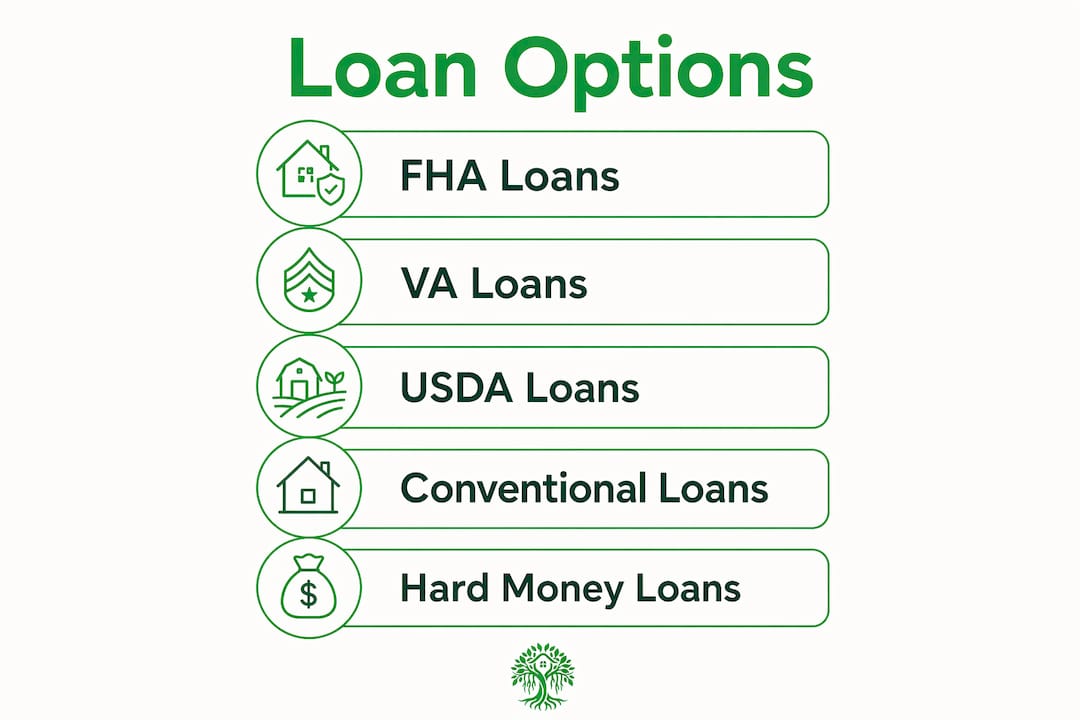
    Infographic illustrating loan options for low credit


    Loan options available if you’re financing a home with bad credit

    1. FHA loans

    FHA loans are the most accessible mortgage option for buyers with low credit. The Federal Housing Administration allows scores as low as 500, with 3.5% down for scores of 580 and above, and 10% down for scores between 500 and 579. Scores in the 500–579 range require manual underwriting, which means a human reviews your full file rather than an algorithm making the call.

    Woman filling FHA loan application form

    The catch is lender overlays. Many lenders impose minimums of 620 or even 640 on FHA loans, regardless of the federal floor. You’ll need to find a lender willing to work at the lower end. FHA loan limits in 2026 range from $524,225 to $1,209,750 for single-family homes, depending on county, so high-cost markets like California are covered.

    Advantages:

    • Low down payment (3.5% at 580+)
    • Manual underwriting available for scores below 580
    • Available to first-time and repeat buyers

    Drawbacks:

    • Mortgage insurance premium (MIP) required for the life of the loan in most cases
    • Lender overlays often raise the effective minimum above 580
    • Loan limits cap what you can borrow

    For a deeper look at how FHA loans work, Ficustree’s guide on FHA loans for first-time buyers covers the full picture.

    2. VA loans

    VA loans are the strongest mortgage product available, and credit score is not an official barrier. The VA sets no minimum credit score requirement, and the agency explicitly states that a lack of credit history is not viewed as a negative. Lenders, however, typically apply overlays requiring scores of 580 to 620. Scores of 740 and above get the best rates and terms, but approval is possible well below that threshold.

    Advantages:

    • No down payment required
    • No private mortgage insurance
    • Competitive interest rates even at lower scores
    • Non-traditional credit tradelines accepted

    Drawbacks:

    • Requires military service eligibility and a Certificate of Eligibility
    • Lender overlays still apply in practice
    • VA funding fee applies unless exempt

    Co-borrowers who are also VA-eligible can strengthen an application, but a non-veteran co-borrower does not extend VA benefits to the loan.

    3. USDA loans

    USDA Guaranteed Loans offer 100% financing with no down payment for eligible rural and suburban properties. The program sets no fixed minimum credit score, but the automated underwriting system (GUS) generally requires a score of 640 or above for a streamlined approval. Below 640, the loan moves to full manual underwriting, which is slower, more document-intensive, and accepted by fewer lenders.

    Advantages:

    • No down payment
    • No set credit score floor from USDA
    • Alternative credit documentation accepted for thin-file borrowers

    Drawbacks:

    • Property must be in an eligible rural area
    • Income cannot exceed 115% of area median household income
    • Manual underwriting below 640 limits lender options

    Ficustree’s guide on buying with no money down covers USDA eligibility criteria in detail.

    4. Conventional loans

    Conventional loans are the hardest to access with low credit. Most lenders require a minimum score of 620, and rates climb sharply below 700. Private mortgage insurance (PMI) is required when the down payment is below 20%, and PMI premiums increase as credit scores fall. For buyers with scores below 620, conventional financing is rarely the right starting point.

    5. Hard money loans

    Hard money loans come from private investors rather than banks, and approval is based primarily on the property’s value rather than your credit profile. They’re a last resort: interest rates are high, loan terms are short (typically 12–36 months), and fees are steep. They work best for buyers who plan to renovate and refinance quickly, not for long-term homeownership.

    The role of co-signers and co-borrowers

    Adding a co-borrower with stronger credit can meaningfully improve your loan eligibility. Lenders typically use the lower of the two middle scores, so the benefit depends on how the specific program handles co-borrower credit. A co-borrower shares ownership and financial responsibility. A co-signer, by contrast, backs the loan without holding title, though not all programs allow co-signers without co-ownership.


    How to check what mortgage you actually qualify for

    Knowing your options on paper is one thing. Knowing where you actually stand takes a few concrete steps.

    1. Pull your credit reports. Get free reports from all three bureaus at AnnualCreditReport.com. Review each one for errors, outdated accounts, and unfamiliar entries. Disputes on errors can raise your score within 30–45 days, and the Consumer Financial Protection Bureau outlines exactly how to file them.

    2. Know your actual score, not just the range. Free score tools often show a VantageScore; lenders use FICO. Purchase your FICO scores directly from myFICO.com to see what lenders will see.

    3. Calculate your DTI before approaching lenders. Add up all monthly debt payments (car, student loans, credit cards, minimum payments) and divide by your gross monthly income. Use Ficustree’s mortgage calculator to model what a new mortgage payment would do to that ratio.

    4. Estimate your true affordability. Credit score affects your interest rate, which affects your monthly payment, which affects how much house you can realistically carry. Run the numbers through a home affordability calculator that accounts for taxes, insurance, and HOA fees, not just principal and interest.

    5. Ask lenders directly about their overlays. Call or email and ask: “What is your minimum credit score for FHA loans?” and “Do you do manual underwriting?” Most lenders answer these questions upfront. If they don’t, move on.

    6. Seek lenders who specialize in low-credit underwriting. Credit unions, community banks, and mortgage brokers who work with government-backed loans often have more flexibility than large retail banks. Brokers can shop your file across multiple wholesale lenders simultaneously.

    7. Get pre-qualified before making offers. Pre-qualification gives you a realistic price range and signals to sellers that you’re serious. Pre-approval, which requires full documentation, carries more weight in competitive markets.


    How to improve your credit score before buying

    Credit scores respond to specific behaviors, and the most impactful ones are also the most straightforward.

    1. Pay every bill on time, without exception. Payment history accounts for 35% of your FICO score. One 30-day late payment can drop a score by 60–100 points. Set up autopay for minimums on every account.

    2. Reduce your credit card balances. Credit utilization, the ratio of your balance to your credit limit, makes up 30% of your score. Getting utilization below 30% helps; below 10% is better. Pay down the highest-utilization cards first.

    3. Dispute errors on your credit report. Incorrect late payments, accounts that aren’t yours, and outdated derogatory marks can all be disputed. Removing a single erroneous collection account can lift a score by 20–50 points.

    4. Avoid opening new credit accounts. Each hard inquiry drops your score by a few points and signals new risk to lenders. Hold off on new credit cards, car loans, or any financing until after closing.

    5. Keep old accounts open. Length of credit history matters. Closing an old card shortens your average account age and can reduce your score even if the card has a zero balance.

    6. Consider a secured credit card or credit-builder loan. If your file is thin, adding a secured card with a small limit and paying it in full each month builds positive history within six to twelve months.

    7. Work with a nonprofit credit counselor. HUD-approved housing counselors offer free or low-cost guidance on credit repair and mortgage readiness. Find one at hud.gov/findacounselor.

    Pro Tip: Even a 20-point score improvement can move you from one pricing tier to the next. Because credit score improvements lead to meaningful interest savings, spending three to six months on credit repair before applying often saves more money over the life of the loan than any negotiation tactic at closing.

    Realistic timelines: disputing errors can show results in 30–60 days. Reducing utilization shows up in the next billing cycle. Building positive payment history takes six to twelve months of consistent behavior. Major derogatory marks like foreclosures and bankruptcies take years to fade, though their impact diminishes over time.


    How manual underwriting and lender overlays affect your approval

    Manual underwriting occurs when an automated system is unable to make a decision and a human loan officer reviews the application. For low-credit buyers, it can be an important path to approval.

    Automated underwriting systems like Fannie Mae’s Desktop Underwriter and Freddie Mac’s Loan Product Advisor run your data through algorithms and return a recommendation in minutes. Below certain score thresholds, these systems return a “refer” or “refer with caution” result, which means a human must review the file. USDA’s GUS system follows the same logic: a score below 640 triggers full manual underwriting.

    What lenders examine in manual underwriting:

    • Rental history. Twelve to twenty-four months of on-time rent payments, verified by a landlord or bank statements, is one of the strongest compensating factors.
    • Employment stability. Two or more years with the same employer, or in the same field, signals reliable income.
    • Cash reserves. Having two to six months of mortgage payments in savings after closing reduces lender risk.
    • Low DTI. A DTI below 31% for housing costs and 43% total is the standard benchmark, though some programs allow higher ratios with compensating factors.
    • No recent derogatory marks. Lenders look for clean payment history in the twelve months before application, even if older negatives exist.

    The challenge is finding lenders who actually do it. Many retail banks have eliminated manual underwriting from their operations because it requires specialized training and takes significantly more time. Many retail banks lack loan officers trained to handle manual underwriting effectively, which is why working with a mortgage broker or a lender who specifically advertises FHA, VA, or USDA expertise matters.

    Lender overlays compound the challenge. A lender might technically offer FHA loans but impose a 640 minimum score overlay, effectively blocking the borrowers the FHA program was designed to help. Overlays vary by lender and change frequently, so asking directly is the only reliable way to know where a lender actually stands.


    What are alternative documentation loans, and who do they help?

    Alternative documentation loans, sometimes called alt-doc or non-QM loans, allow borrowers to qualify using income and credit evidence outside the standard W-2 and credit score framework. They serve two distinct groups: self-employed buyers whose tax returns understate their actual income, and thin-file buyers who have little to no traditional credit history.

    For thin-file borrowers, the most practical form of alternative documentation is nontraditional credit. Under USDA and FHA guidelines, 12–24 months of verified rental, utility, or insurance payments can substitute for traditional tradelines when a borrower has no credit score or fewer than two scores. The payments must come from a third-party source, not relatives, and must be documented through billing statements, canceled checks, or landlord verification forms.

    For self-employed buyers, bank statement loans are the most common alt-doc product. Instead of tax returns, lenders average 12–24 months of bank deposits to calculate income. These loans typically carry higher interest rates than conventional mortgages and require larger down payments, often 10–20%.

    Alt-doc loans are not government-backed in most cases, which means they don’t carry FHA or VA protections. Rates and fees are higher, and qualifying criteria vary widely by lender. They’re a legitimate tool for the right borrower, but they require careful comparison shopping.


    Pitfalls that catch low-credit homebuyers off guard

    Buying with a lower credit score introduces risks that buyers with strong credit rarely encounter. Knowing them in advance keeps them from becoming expensive surprises.

    Higher interest rates compound over time. A buyer with a 580 score might pay a full percentage point or more above what a 740-score buyer pays. On a $400,000 loan, that difference adds up to tens of thousands of dollars over a 30-year term. Use a mortgage calculator to see the actual dollar impact before committing to a rate.

    Predatory lenders target low-credit buyers. Lenders who advertise “guaranteed approval” or charge excessive origination fees are exploiting buyers who feel they have no options. Compare loan estimates from multiple lenders and review the APR, not just the interest rate, to catch hidden fees.

    Mortgage insurance adds to your monthly cost. FHA loans require an upfront mortgage insurance premium plus an annual premium for the life of the loan in most cases. On a $350,000 loan, this adds hundreds of dollars per month to your payment. Factor it into your affordability math from the start.

    Seller reluctance is real in competitive markets. Some sellers and their agents view government-backed loans as more complicated to close. In hot markets like California, this can put you at a disadvantage against conventional buyers. A strong pre-approval letter and a knowledgeable buyer’s agent help offset this perception.

    Overextending on price leaves no room for repairs. Low-credit buyers often stretch to qualify for the maximum loan amount, leaving nothing for maintenance, repairs, or an emergency fund. A house that costs everything you have to buy will cost more than you can afford to keep.

    Skipping the inspection to win a bid. Waiving the inspection contingency to compete with stronger offers is a significant risk for any buyer, but especially for one with limited financial cushion. A major repair discovered after closing can derail your finances entirely.


    Key Takeaways

    Buying a house with a low credit score is achievable in 2026 through government-backed loan programs, manual underwriting, and targeted credit improvement, but lender overlays and higher interest costs require careful planning.

    Point Details
    FHA is the most accessible path FHA allows scores as low as 500, with 3.5% down at 580 and 10% down below that.
    VA and USDA set no official score floor Both programs rely on lender overlays, making lender selection the critical variable.
    Overlays raise the real minimum Lenders routinely require 620–640 even on programs that allow lower scores.
    Manual underwriting opens closed doors Rental history, cash reserves, and low DTI can secure approval when automated systems decline.
    Credit improvement pays off fast Even a modest score increase moves you to a better rate tier and reduces total loan cost.

    FAQ

    Can you buy a house with a 500 credit score?

    Yes, but your options are limited. FHA loans allow scores as low as 500 with a 10% down payment and manual underwriting, but many lenders impose overlays that raise the effective minimum to 580 or higher. You’ll need to find a lender who works at the lower end of FHA guidelines.

    How hard is it to buy a house with poor credit?

    It’s harder, not impossible. Poor credit narrows your loan options, raises your interest rate, and requires more documentation. The biggest obstacle is usually lender overlays, not the federal program rules themselves, so shopping multiple lenders is the most important step.

    What credit score do you need for a $250,000 house?

    The loan program matters more than the price. FHA loans are available at 580 with 3.5% down; VA loans have no official minimum but lenders typically want 580–620; USDA loans generally require a credit score of 640 or higher for automated approval; borrowers with lower scores may qualify through manual underwriting, which depends on the lender’s willingness to process such loans. Conventional financing at that price generally requires 620 or above.

    What credit score is needed to buy a $400,000 house?

    At $400,000, FHA financing is available in most counties within the 2026 loan limits of $524,225 to $1,209,750. A score of 580 qualifies you for 3.5% down under FHA guidelines, though lender overlays may require 620 or 640. Conventional financing at that price point typically requires 620 minimum, with better rates at higher scores.

    Does a co-borrower help when your credit score is low?

    A co-borrower with stronger credit can improve your DTI and overall application strength, but most lenders use the lower of the two middle scores for qualification. The benefit depends on the loan program and lender policy, so ask your lender directly how they handle co-borrower credit before assuming it solves the score problem.


  • Seller Credits for Closing Costs: 2026 Buyer’s Guide

    Seller Credits for Closing Costs: 2026 Buyer’s Guide

    Seller credits for closing costs are negotiated amounts the seller agrees to pay toward your closing fees, directly reducing the cash you need to bring to the table on closing day. They are not a price discount, and they are not cash in your pocket. The seller pays specific, lender-approved fees on your behalf, and every dollar must be documented on your closing disclosure. Federal guidelines from Fannie Mae, Freddie Mac, HUD, and the VA set firm caps on how much a seller can contribute, and those caps vary by loan type and down payment size.

    Typical costs covered by seller credits include:

    • Loan origination fees
    • Appraisal and credit report fees
    • Title insurance and escrow fees
    • Prepaid property taxes and homeowners insurance
    • Discount points and interest rate buydowns
    • Recording fees

    Credits cannot cover your down payment, cash reserves, or any amount beyond your actual closing costs. If the negotiated credit exceeds what you owe at closing, the excess disappears. Lenders won’t allow cash back beyond your real costs.

    How seller credits work during a real estate transaction

    Real estate agent discussing seller credits with buyers

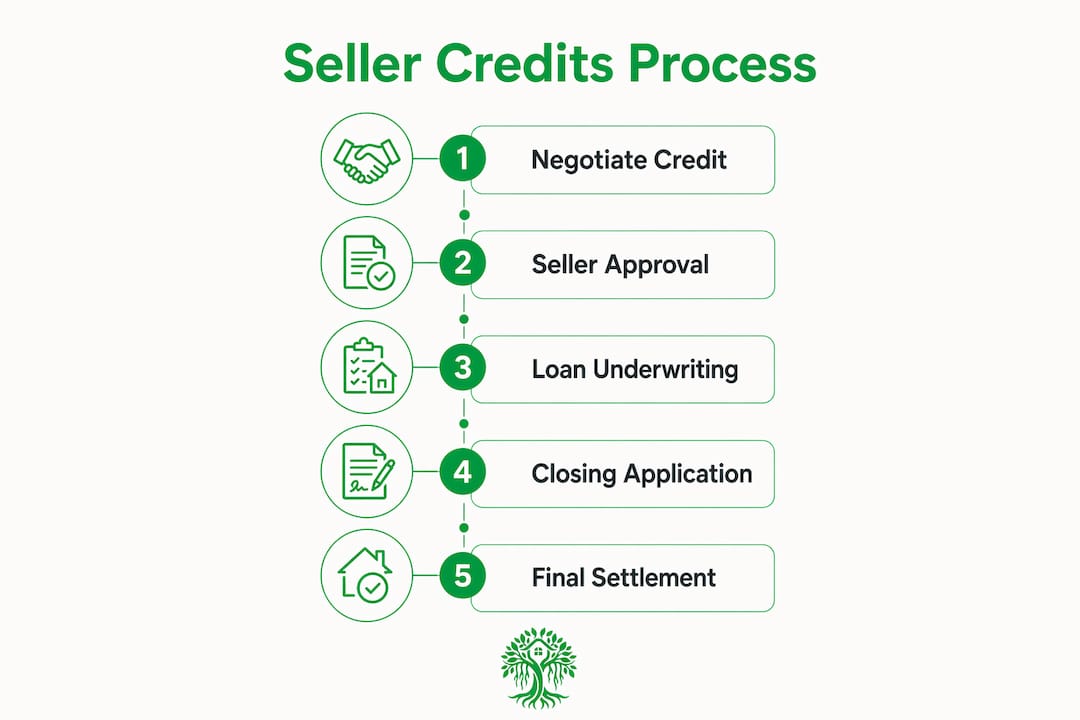
    Seller credits enter the deal during offer negotiations. You write the credit amount into the purchase contract, and the seller agrees to it as a condition of the sale. From that point, the credit sits in the deal until closing day, when it gets applied against your itemized closing fees on the settlement statement.

    Your lender plays a central role here. Before you request a specific dollar amount, your loan officer should give you a Loan Estimate showing projected closing costs. That number becomes your ceiling. Requesting a credit larger than your actual costs creates a problem at underwriting, not just at closing.

    • Include the credit amount and purpose explicitly in the purchase contract
    • Share the credit terms with your lender immediately after the contract is signed
    • Confirm the credit appears correctly on the Closing Disclosure before signing

    The credit also affects loan underwriting. If the agreed sale price is $400,000 and the seller offers $10,000 in credits, the lender still underwrites the loan at $400,000. The appraisal must support that price. If it doesn’t, the credit cap recalculates on the lower appraised value, which can shrink what the seller is allowed to contribute.

    Pro Tip: Ask your lender for a revised Loan Estimate after the purchase contract is signed. That document will show exactly how the seller credit applies and whether any amount is at risk of being wasted.

    Infographic illustrating steps in seller credits process

    What seller credits can and cannot pay for

    The list of allowable costs is broader than most buyers expect, but the prohibited uses are absolute across every loan program.

    Seller credits can cover:

    • Loan origination charges and processing fees
    • Appraisal, inspection, and credit report fees
    • Title insurance (both lender’s and owner’s policies)
    • Escrow and settlement fees
    • Prepaid homeowners insurance premiums
    • Property tax escrow deposits
    • Discount points and rate buydowns, including temporary buydowns
    • Upfront Mortgage Insurance Premium (UFMIP) on FHA loans

    Seller credits cannot cover:

    • Your down payment or minimum required investment
    • Cash reserves required by the lender
    • Any amount exceeding your actual closing costs
    • Personal property, moving expenses, or cash payments to you

    The prohibition on down payment contributions is firm across FHA, VA, conventional, and USDA programs. A seller who tries to funnel money toward your down payment through any channel creates a compliance problem that can kill the loan. The FHA draws this line clearly: closing costs can come from the seller within the applicable cap, but the down payment must come from you or an approved gift donor with no financial interest in the sale.

    Loan-type caps on seller credits in 2026

    Every loan program sets a maximum. Exceeding the cap doesn’t just waste money. It triggers a dollar-for-dollar reduction in the purchase price the lender uses to calculate your loan, which shrinks your maximum loan amount and forces you to bring more cash to closing.

    Conventional loans (Fannie Mae / Freddie Mac): Caps are tiered by down payment:

    • Less than 10% down: seller can contribute up to 3% of the purchase price
    • 10%–24.99% down: seller can contribute up to 6%
    • 25% or more down: seller can contribute up to 9%
    • Investment properties have a lower cap, regardless of down payment

    FHA loans: HUD caps seller concessions at 6% of the lesser of the sales price or appraised value. Every dollar above that threshold is reclassified as an “inducement to purchase” and reduces the price used for the loan calculation. HUD increased FHA loan limits for 2026 to reflect rising property values, which can raise the total dollar amount a seller can contribute, but the 6% percentage cap stays fixed.

    VA loans: The VA treats closing costs and concessions as two separate categories. Sellers can pay all of your standard closing costs with no cap applied to those payments. The 4% cap applies only to concessions, which the VA defines as extras like the VA funding fee, prepaid taxes and insurance beyond what’s customary, and payoff of your debts. You can receive full closing cost coverage and still have the entire 4% concession allowance available on top.

    USDA loans: The Rural Development program allows seller contributions up to 6% of the purchase price, similar to FHA rules.

    Fannie Mae’s 2026 guideline updates removed the fixed dollar cap on lender incentives but require separate documentation of seller credits versus lender incentives. If your lender is affiliated with an interested party to the transaction, their incentives are treated as sales concessions and subject to stricter limits.

    Seller credits vs. seller concessions: what’s the difference?

    These terms get used interchangeably, but they are not the same thing, and the distinction can cost you negotiating power if you miss it.

    Seller credits refer specifically to payments the seller makes toward your documented closing costs. They are financing concessions, applied line by line against fees on your settlement statement.

    Seller concessions is a broader term covering anything of value the seller adds to the transaction at no cost to you, including items that go beyond standard closing costs. The VA Lender’s Handbook makes this distinction explicit in Chapter 8 of VA Pamphlet 26-7.

    Key differences to know:

    • On VA loans, closing costs paid by the seller are not concessions under the handbook’s definition and don’t count against the 4% cap
    • On conventional and FHA loans, both terms generally fall under the same cap calculation
    • Lender overlays can impose stricter combined limits than the VA or GSE guidelines actually require
    • Fannie Mae distinguishes seller credits from lender incentives; lender-affiliated incentives are treated as sales concessions with tighter restrictions

    If you’re using a VA loan, ask your lender directly whether they apply the 4% cap to all seller contributions or only to concessions as the VA Lender’s Handbook defines them. Many retail lenders apply a blanket 4% rule that goes beyond what VA guidelines actually require. That’s a lender overlay, and it limits what you can realistically negotiate. For a deeper look at negotiating seller concessions, the distinction between these two categories is where most buyers leave money on the table.

    How to negotiate seller credits effectively

    Seller credits are a negotiation tool, not a given. Misunderstanding the caps or asking for the wrong amount can trigger loan reissues or reduce your maximum loan. Here’s how to approach it correctly.

    • Get your Loan Estimate first. Your loan officer can project closing costs before you make an offer. That number tells you exactly how much to request. Asking for $12,000 when your actual costs are $9,000 wastes the overage.
    • Request credits tied to real expenses. Arbitrary round numbers raise flags at underwriting. Tie your request to the itemized fees on your Loan Estimate.
    • Use the inspection as a second opportunity. If the home inspection reveals repair needs, you can negotiate a post-inspection seller credit instead of a price reduction. This keeps your loan amount intact while reducing your out-of-pocket costs.
    • Stay under the cap. Know your loan program’s limit before the contract is written. Exceeding it doesn’t give you more money. It reduces your loan amount dollar for dollar.
    • Check for lender overlays. Your lender may impose limits stricter than the program guidelines. Confirm this before you negotiate, not after the contract is signed.

    Pro Tip: In a buyer’s market, sellers are more willing to offer credits to close the deal. In a competitive market, a credit request can weaken your offer. Time your ask based on market conditions, not just your cash position.

    For buyers in California, the seller concession process has some state-specific nuances worth reviewing before you make your offer.

    How seller credits affect the sale price and appraisal

    Seller credits don’t reduce the official sale price. The contract price stays the same, and the lender underwrites the loan against that number. What changes is how much cash you bring to closing.

    The appraisal, though, can create a real problem. FHA and conventional guidelines calculate the credit cap based on the lesser of the sale price or the appraised value. If you agree to buy at $310,000 and the appraisal comes back at $295,000, the FHA’s 6% cap now applies to $295,000, not $310,000. A seller who committed to $18,000 in credits is now $300 over the limit, and that overage gets reclassified as an inducement to purchase, which reduces the price the lender uses to calculate your loan. The adjusted value drops, your maximum loan shrinks, and you owe more at closing than you planned. This scenario catches buyers off guard more than almost any other closing cost issue.

    Tax implications of seller credits

    For most buyers, seller credits carry no direct tax consequence. The credits reduce your out-of-pocket costs at closing but don’t change your cost basis in the property. Your cost basis for capital gains purposes is still the full purchase price, not the price minus the credits.

    For sellers, the IRS generally does not treat a properly disclosed seller credit as a taxable gift when it falls within standard real estate practice and stays within program limits. If a seller contributes an amount that exceeds the allowable cap and that excess is classified as a gift, the seller may need to file a gift tax return. This situation is uncommon in standard transactions, but it’s worth flagging if you’re negotiating unusually large credits outside normal program parameters.

    Discount points paid by the seller on your behalf may be deductible by you as mortgage interest in the year of purchase, depending on your tax situation. Consult a tax professional for guidance specific to your transaction.

    How seller credits affect the seller’s net proceeds

    Every dollar the seller credits to you comes directly out of their proceeds. A seller who accepts $400,000 and agrees to $10,000 in credits walks away with $390,000 before their own closing costs, agent commissions, and any outstanding mortgage balance. For a full picture of what sellers net after fees, the seller’s closing cost breakdown shows how credits stack against other seller-side expenses.

    Sellers sometimes prefer to offer credits rather than reduce the list price because the math works differently for both parties. A $10,000 price reduction lowers the buyer’s loan amount and monthly payment slightly. A $10,000 credit keeps the loan amount the same but puts cash back in the buyer’s pocket at closing. For a buyer short on cash to close, the credit is often worth more than the equivalent price cut. Sellers who understand this dynamic can use credits strategically to attract buyers without dropping their asking price.


    Key Takeaways

    Seller credits reduce your closing day cash by having the seller pay specific, lender-approved fees, but every loan program caps the total amount and prohibits using credits toward your down payment.

    Point Details
    Credits cover closing costs only Allowable uses include origination fees, title insurance, prepaid taxes, and discount points. Down payments are never covered.
    Conventional caps vary by down payment Fannie Mae and Freddie Mac set caps at 3%, 6%, or 9% depending on how much you put down, and investment properties are capped at 2% regardless of down payment.
    FHA cap is 6% HUD limits seller contributions to 6% of the lesser of the sale price or appraised value.
    VA treats credits and concessions separately Standard closing costs have no cap under VA rules; the 4% cap applies only to concessions as the VA Lender’s Handbook defines them.
    Exceeding the cap shrinks your loan Any overage reduces the purchase price used for loan calculation dollar for dollar, increasing your cash needed at closing.

    FAQ

    Do seller credits count as closing costs?

    Seller credits are payments toward your closing costs, not closing costs themselves. They offset fees you would otherwise pay out of pocket, reducing your cash needed at closing.

    What does $5,000 in seller concessions mean?

    It means the seller has agreed to pay an agreed amount toward your closing fees at settlement. That amount applies against itemized costs on your Closing Disclosure and cannot be taken as cash.

    Is it better to get a seller credit or a lower price?

    A lower price reduces your loan amount and long-term interest. A seller credit reduces your upfront cash at closing. If you’re short on funds to close, the credit often delivers more immediate value than an equivalent price reduction.

    What does 3% seller credit mean?

    A 3% seller credit means the seller will contribute 3% of the purchase price toward your closing costs. For example, on a $400,000 home, this percentage cap applies to calculate the maximum seller contribution allowed by lenders.


    Navigating seller credits is one of the more technical parts of buying a home, and getting the numbers wrong can cost you at the closing table. Ficustree gives first-time buyers in California and Texas the decision tools and direct representation to negotiate credits confidently, without overpaying for guidance. Buyers pay a closing fee plus commission and may keep a rebate where permitted.

    https://ficustree.ai

    Start your search at ficustree.ai →

  • Buying a House With Student Loans: Your 2026 Guide

    Buying a House With Student Loans: Your 2026 Guide

    Buying a house with student loans is possible. The key is understanding that lenders care far more about your monthly payment than your total loan balance. Your debt-to-income ratio (DTI) is the number that determines whether you qualify for a mortgage, and student loans feed directly into that calculation. Different loan programs treat student debt differently, which means the right program choice can dramatically change what you can borrow. Get the documentation right, pick the right program, and student loans become a solvable math problem rather than a dealbreaker.

    How buying a house with student loans affects your mortgage eligibility

    Student loans count toward your back-end DTI ratio for every major loan program. Back-end DTI is the percentage of your gross monthly income that goes toward all debt payments combined, including your future mortgage. Most programs cap total DTI at 43%–50%, depending on the program and underwriting method. That ceiling is where student loans can cause real friction.

    The biggest misconception is that your loan balance drives mortgage eligibility. The monthly payment assigned for DTI is actually the decisive number. A $90,000 balance with a documented $150 monthly income-driven repayment (IDR) payment affects your DTI far less than the same balance sitting in deferment with no documented payment.

    Mortgage officer advising couple on loans

    When your credit report shows a $0 payment, lenders do not simply ignore the loan. They apply a proxy payment, which is a calculated stand-in amount. That proxy can be significantly higher than your actual payment. This is the trap that catches most first-time buyers off guard.

    How student loans affect your credit score

    Student loans affect your credit score through payment history and credit mix, not through credit utilization the way credit cards do. Consistent on-time payments build your score over time. Missed payments or defaulted loans cause serious damage. Before applying for a mortgage, pull your credit reports from Equifax, Experian, and TransUnion and verify that every student loan account reflects its accurate status.

    Pro Tip: Errors on student loan accounts are common after servicer transfers. Dispute any inaccurate balance, payment status, or account duplication before your lender pulls your credit.

    • Check that deferred or IDR accounts show the correct payment amount, not a phantom figure.
    • Confirm no duplicate accounts exist from servicer transfers.
    • Verify that paid-off loans are marked closed and show a $0 balance.
    • Look for any collections entries tied to older loan periods.

    How do different mortgage programs treat student loan payments?

    Each major loan program uses its own rules for calculating student loan payments in DTI. Choosing the wrong program can cost you tens of thousands in borrowing power.

    Infographic comparing student loan treatments for mortgages

    Loan Program Payment used for DTI DTI cap (approximate)
    FHA 0.5% of balance if payment is $0 or undocumented 43% manual, up to 50–57% with compensating factors
    Conventional (Fannie Mae) Actual payment or 1% of balance if deferred Typically 45%–50%
    VA Can exclude deferred loans if residual income qualifies Flexible, residual income based
    USDA Fully amortizing payment or 0.5% proxy Generally 41%–46%

    FHA loans require lenders to count all student loans in the DTI calculation regardless of payment status. If your documented monthly payment is $0, FHA uses 0.5% of your outstanding balance as a proxy. On a $60,000 loan, that adds $300 per month to your DTI. FHA’s automated underwriting can approve DTIs up to 50%–57% with compensating factors like strong cash reserves or a high credit score.

    Conventional loans backed by Fannie Mae use the actual payment shown on your credit report or in documentation. If no payment is documented, a 1% proxy applies. On an $80,000 deferred loan, that 1% proxy adds $800 per month to your DTI obligation. That single number can eliminate a large portion of your buying power.

    VA loans offer the most flexibility for eligible veterans. VA guidelines can exclude deferred student loans from DTI entirely if your residual income exceeds the program threshold. Residual income is the money left over after all monthly obligations are paid, and VA weighs it heavily. If you qualify for a VA loan, this program deserves serious consideration.

    USDA loans typically require a fully amortizing payment or a 0.5% proxy if no payment is documented. They are geographically restricted to eligible rural and suburban areas, but the 0.5% proxy is more forgiving than Fannie Mae’s 1%.

    Pro Tip: Shopping across FHA, Conventional, VA, and USDA programs is not optional. Run your numbers under each program before committing to a lender. The difference in qualifying loan amount can be substantial.

    Steps to strengthen your mortgage application despite student debt

    Preparation is the most powerful tool you have. These steps directly improve your odds of approval and your qualifying loan amount.

    1. Get written payment documentation from your servicer. Lenders prioritize official proof over credit report amounts. A letter from your servicer confirming your actual IDR payment overrides the proxy calculation. Request this document before you apply, not after.

    2. Enroll in an income-driven repayment plan before applying. Switching from deferment to an active IDR plan can substantially lower your DTI by replacing a high proxy payment with a documented, lower actual payment. Even a $50 IDR payment beats a $400 proxy.

    3. Pay down smaller revolving debts first. Credit card balances and auto loans also count toward your DTI. Eliminating a $200 monthly car payment or a $150 credit card minimum can free up significant DTI room faster than attacking your student loan balance.

    4. Address capitalized interest before it grows. Capitalized interest increases your loan balance over time, which raises proxy payment calculations. Paying accrued interest before it capitalizes keeps your balance, and therefore your proxy, lower.

    5. Check your credit report for student loan errors. Misreporting or outdated repayment status can trigger inaccurate DTI calculations and lead to mortgage denial. Correct errors at least 60 days before applying so updates have time to appear.

    6. Explore the Parent PLUS consolidation strategy if applicable. Parent PLUS loans are not eligible for most IDR plans directly. However, a double consolidation approach can make them eligible, lowering the monthly payment counted in your DTI. This requires advance planning and several months of processing time.

    Use Ficustree’s home affordability calculator to model how each of these steps changes your qualifying price range before you talk to a lender.

    Pro Tip: Ask your mortgage officer to run your file under multiple programs simultaneously. A lender who only offers one program type cannot give you an objective comparison.

    Common mistakes when financing a home with student loans

    Most mortgage denials tied to student debt are preventable. The errors below show up repeatedly.

    • Assuming deferred loans do not count. They do. Every major program applies a proxy payment to deferred loans unless you provide documentation proving otherwise.
    • Ignoring co-signed loans. If you co-signed a student loan for someone else, that payment counts in your DTI too, even if you never make a payment. Lenders see it as your obligation.
    • Opening new credit during the application. A new car loan or credit card application during underwriting can shift your DTI above the approval threshold. Hold off on any new credit until after closing.
    • Waiting to shop mortgage programs. Many buyers lock into the first program a lender suggests. Program-specific rules around student loans mean the first option is rarely the best one.
    • Not updating your servicer after income changes. Your IDR payment recalculates annually based on income. If your income dropped but your servicer still shows the old payment, your DTI looks worse than it actually is.

    Treating student loan debt as a disqualifier is the most expensive mistake a first-time buyer can make. The actual barrier is almost always a documentation gap or a program mismatch, not the debt itself. Fix the paperwork, match the program to your loan status, and the math usually works.

    For a broader look at the joint borrower mortgage options available in 2026, including how co-borrowers can help offset DTI pressure from student loans, that guide covers the mechanics clearly.

    Key Takeaways

    Buying a house with student loans requires matching your repayment status to the right mortgage program and providing precise documentation to replace unfavorable proxy payment calculations.

    Point Details
    Monthly payment drives DTI Lenders use your assigned monthly payment, not your total balance, to calculate DTI.
    Program choice matters FHA, Conventional, VA, and USDA each treat student loan payments differently; shop all four.
    Documentation overrides proxies A servicer letter confirming your IDR payment can replace a higher proxy and improve your DTI.
    IDR enrollment helps Switching from deferment to an active income-driven repayment plan before applying lowers your counted payment.
    Errors cost approvals Outdated or inaccurate student loan data on your credit report can trigger denial; correct it early.

    What I’ve learned from watching buyers get this wrong

    By Anand

    Most first-time buyers I work with arrive convinced their student loans are the problem. They are usually wrong. The real problem is almost always one of two things: they are on the wrong mortgage program for their loan status, or they have not given their lender the documentation needed to use their actual payment instead of a proxy.

    I have seen buyers with $120,000 in student loans qualify comfortably for a $550,000 home in California because they were on an IDR plan, had a servicer letter in hand, and chose an FHA loan with compensating factors. I have also seen buyers with $40,000 in deferred loans get denied because their lender applied a 1% Fannie Mae proxy and nobody caught it until underwriting.

    The FHA versus Conventional decision alone is worth running carefully. FHA’s 0.5% proxy is more forgiving than Fannie Mae’s 1% for deferred loans, but FHA carries mortgage insurance premiums that add to your monthly cost. The right answer depends on your specific balance, your credit score, and how long you plan to stay in the home.

    My honest advice: do not walk into a lender’s office without your servicer documentation and a rough DTI calculation already done. Use a DTI calculator to run the numbers yourself first. Buyers who arrive prepared get better outcomes, not because lenders favor them, but because they catch program mismatches before they become denials.

    Student loan debt is a solvable math problem. Treat it like one.

    — Anand

    Ficustree helps first-time buyers cut through the confusion

    First-time buyers with student loans face a specific challenge: the rules are complex, the stakes are high, and most online tools do not account for how student debt actually affects mortgage qualification.

    https://ficustree.ai

    Ficustree is built for exactly this situation. The AI-powered platform helps you model your true home affordability including student loan payments, run DTI scenarios across different repayment plans, and match you to the right homes for your actual budget. Buyers in California and Texas pay $1,000 at closing plus 1% commission and keep a rebate of roughly 2% where permitted. The platform is free to use. Start with your numbers, and let the right home find you at ficustree.ai.

    FAQ

    Can I buy a house if my student loans are in deferment?

    Yes. Lenders apply a proxy payment to deferred loans rather than ignoring them. Providing servicer documentation of your actual payment, or enrolling in an IDR plan, can lower that proxy and improve your qualifying DTI.

    What DTI ratio do I need to qualify for a mortgage with student loans?

    Most programs require a back-end DTI below 43%–50%. FHA automated underwriting can approve DTIs up to 50%–57% with compensating factors like strong credit or cash reserves.

    Does the student loan balance or the monthly payment matter more for a mortgage?

    The monthly payment matters more. Lenders use your assigned monthly payment, not your total balance, to calculate DTI. A large balance with a low documented IDR payment has far less impact than a smaller balance with no documented payment.

    How do I lower my DTI if I have student loans?

    Enroll in an income-driven repayment plan to reduce your documented monthly payment, pay down smaller revolving debts, and provide your lender with written servicer confirmation of your actual payment amount.

    Are VA loans better for borrowers with student debt?

    VA loans can be the most favorable option for eligible veterans because deferred student loans may be excluded from DTI if residual income is sufficient. Veterans should always compare VA terms against FHA and Conventional options before deciding.

  • How to Avoid PMI as a First-Time Buyer in California

    How to Avoid PMI as a First-Time Buyer in California

    Private mortgage insurance, known as PMI, is the extra monthly cost lenders charge when your down payment falls below 20% of the home’s purchase price. For first-time buyers in California and Texas, knowing how to avoid PMI as a first-time buyer can save hundreds of dollars every month. PMI typically costs between 0.30% and 1.15% of your loan amount annually. That translates to roughly $30 to $150 per month for every $100,000 borrowed. The good news: several proven strategies let you skip it entirely or remove it faster than you think.

    How to avoid PMI as a first-time buyer: the 20% down payment path

    Putting 20% down is the most direct way to avoid private mortgage insurance. Lenders treat that threshold as proof you have enough skin in the game, so they drop the PMI requirement entirely. The math is simple. The execution, especially in California and Texas, is harder.

    Couple reviewing down payment plans on laptop

    In high-cost California markets like the Bay Area or Los Angeles, a 20% down payment on a $700,000 home means saving $140,000 before you close. That is a significant barrier for most first-time buyers. Texas prices are lower on average, but fast-growing metros like Austin and Dallas have pushed median home prices well above national norms.

    A few tools can close that gap:

    • Down payment assistance programs. State and local programs in California and Texas provide grants or subsidized loans that boost your equity at closing, sometimes enough to clear the 20% threshold.
    • Gift funds. Gift money from family members is accepted by most lenders when properly documented with a signed gift letter. This is one of the fastest ways to reach 20% without years of additional saving.
    • Buying at a lower price point. Targeting homes priced below your maximum approval amount can make 20% down achievable with your current savings.
    • California-specific programs. The California first-time buyer programs available in 2026 include deferred-payment loans that effectively act as a second mortgage to cover part of your down payment.

    Pro Tip: Freddie Mac research shows that draining your savings to hit 20% down can threaten your financial stability after closing. Keep at least three to six months of living expenses in reserve, even if it means accepting PMI temporarily.

    Can a piggyback loan help you skip PMI?

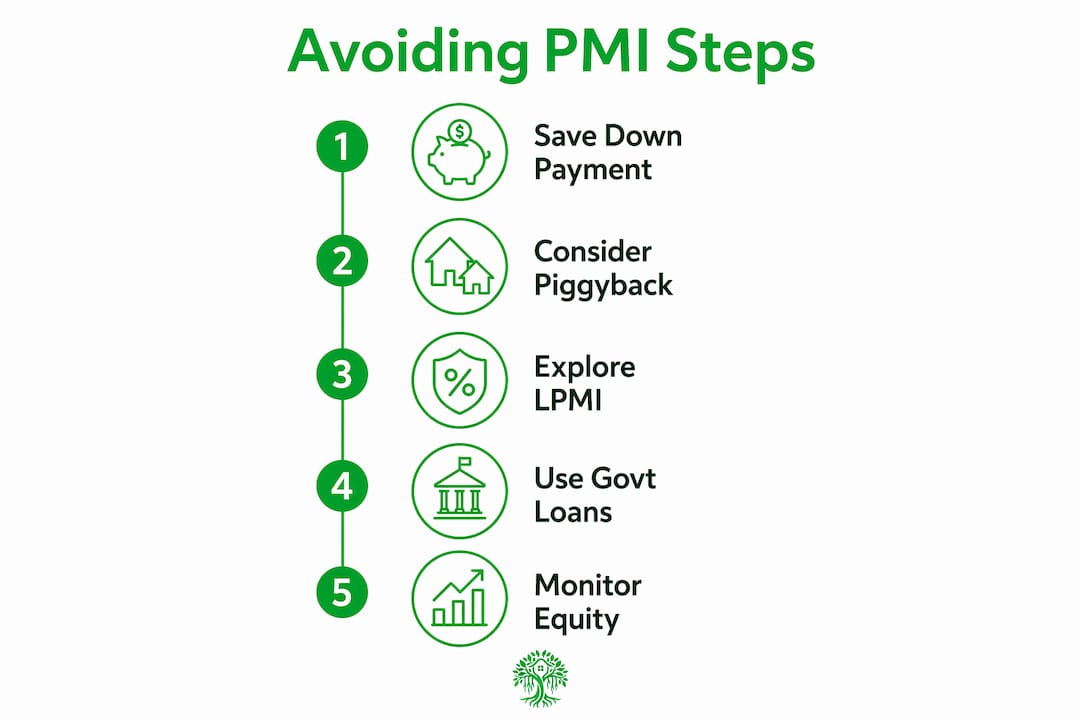
    A piggyback loan, most commonly structured as an 80-10-10, lets you borrow 80% on a primary mortgage, 10% on a second loan, and put 10% down yourself. Because your primary loan stays at 80% of the purchase price, you never trigger PMI. This structure is a legitimate PMI alternative for buyers who have solid credit but cannot reach 20% down on their own.

    The mechanics work like this:

    1. Primary mortgage (80%). This is your conventional loan at standard market rates.
    2. Second mortgage (10%). This carries a higher interest rate than your primary loan. Secondary financing in a piggyback arrangement comes with more qualification steps and administrative complexity.
    3. Your down payment (10%). You bring this to closing from your own savings or gift funds.
    4. Dual qualification. You must qualify for both loans simultaneously, which means lenders scrutinize your debt-to-income ratio more carefully.
    5. Closing costs on two loans. You pay origination fees on both the primary and secondary loan, which increases your upfront costs.

    The trade-off is real. A higher second-mortgage rate can cost more per month than PMI would have. Run the numbers before committing. If your credit score is below 700, the second loan’s rate may be punishing enough to make monthly PMI the cheaper option.

    Pro Tip: Ask your lender to model the total monthly payment for a piggyback structure versus a single loan with PMI. The difference is often smaller than buyers expect, and the piggyback adds complexity that can slow your closing timeline.

    Infographic outlining steps to avoid PMI for buyers

    Lender-paid PMI and government-backed loans as PMI alternatives

    Not all PMI avoidance strategies require a large down payment. Two other paths exist: lender-paid PMI (LPMI) and government-backed loan programs.

    Lender-paid PMI

    With LPMI, your lender covers the PMI premium in exchange for a permanently higher interest rate on your mortgage. There is no separate monthly PMI line item on your statement. The cost is baked into your rate instead. Lender-paid PMI raises your interest rate permanently and cannot be removed without refinancing the entire loan. For buyers who plan to sell or refinance within five to seven years, LPMI can make sense. For buyers who plan to stay long-term, monthly PMI that cancels at 80% loan-to-value (LTV) is usually cheaper over the life of the loan.

    VA loans

    VA loans require no PMI and no down payment for eligible veterans and active-duty service members. This is the most powerful PMI avoidance tool available, and it is completely free to use if you qualify. California and Texas both have large veteran populations, making this option widely relevant.

    USDA loans

    USDA loans serve buyers purchasing in eligible rural and suburban areas. They carry no PMI requirement and allow low down payments. Parts of California’s Central Valley and many Texas communities outside major metros qualify under USDA geographic guidelines.

    FHA loans and MIP: not the same as PMI

    FHA loans are popular with first-time buyers but carry a different cost structure. FHA loans require Mortgage Insurance Premium (MIP) for the life of the loan unless you refinance into a conventional mortgage. That is a critical distinction. Conventional PMI cancels automatically at 78% LTV. FHA MIP does not. Read the full breakdown in the FHA loan guide before choosing this path. For buyers who plan to build equity quickly, a conventional loan with PMI often costs less over time than an FHA loan with permanent MIP.

    How local assistance programs and home appreciation remove PMI faster

    You do not have to avoid PMI at the start to eliminate it quickly. Several strategies accelerate your path to the 20% equity threshold after closing.

    • State and local down payment assistance. California’s CalHFA programs and Texas’s TSAHC grants can push your starting equity above 10%, shortening the time before you hit 80% LTV and can request PMI cancellation.
    • Home appreciation. Rising home values build equity without any extra payments from you. Home appreciation can help you reach 20% equity faster, enabling PMI removal after a formal appraisal. Budget $300–$500 for that appraisal when the time comes.
    • Extra principal payments. Paying even $100 to $200 extra per month toward principal accelerates your LTV reduction. This is especially effective in the early years of a 30-year mortgage when most of your payment goes to interest.
    • Timely cancellation requests. Federal law mandates automatic PMI cancellation at 78% LTV, but you can request cancellation at 80% LTV. Do not wait for the automatic trigger. Submit a written request to your lender the moment your balance crosses 80%.
    • Lump-sum or split-premium PMI. Some lenders offer a single upfront PMI premium paid at closing, or a split structure combining a smaller upfront payment with reduced monthly premiums. These options lower your ongoing costs and can be worth negotiating.

    Monitoring your equity position every year is a habit worth building. California’s strong appreciation history means many buyers reach 20% equity faster than their amortization schedule would suggest.

    How do you choose the right PMI avoidance strategy?

    The best strategy depends on your credit score, savings, how long you plan to stay in the home, and the specific market you are buying in. There is no universal answer.

    • High credit score (740+). You qualify for the lowest PMI rates and the best second-mortgage rates on a piggyback loan. Both options are viable. Compare total monthly costs side by side.
    • Credit score below 680. PMI rates rise significantly, but second-mortgage rates rise even faster. Monthly PMI on a conventional loan may be your cheapest path.
    • Short time horizon (under 7 years). Lender-paid PMI can make sense here because you will not stay long enough for the higher rate to outpace the savings from no monthly PMI.
    • Long time horizon (10+ years). Monthly PMI that cancels at 80% LTV almost always beats LPMI over the long run. The break-even calculation is straightforward: divide the total PMI you will pay by the monthly rate difference between LPMI and standard PMI.
    • California and Texas market conditions. Both states have seen strong appreciation cycles. Buying sooner with PMI and riding appreciation to the 80% LTV threshold can be financially smarter than waiting years to save a full 20% down payment.

    Pro Tip: Avoiding common first-time buyer mistakes around PMI starts with running three scenarios before you apply: 20% down, piggyback loan, and conventional loan with monthly PMI. The numbers will tell you which path fits your timeline and savings.

    Key Takeaways

    The most effective way to avoid PMI as a first-time buyer is to combine a targeted down payment strategy with a clear understanding of your loan options, equity timeline, and local assistance programs.

    Point Details
    20% down eliminates PMI Gift funds, state assistance, and lower price points can make this threshold reachable.
    Piggyback loans carry trade-offs Secondary loan rates are higher and qualification is more complex; compare total costs carefully.
    LPMI costs more long-term A permanently higher rate cannot be canceled without refinancing, unlike monthly PMI.
    VA and USDA loans skip PMI entirely Eligible veterans and rural buyers can avoid PMI with no down payment required.
    Request cancellation at 80% LTV Federal law allows a borrower request at 80% LTV; do not wait for the automatic 78% trigger.

    The PMI decision most buyers get wrong

    I have watched first-time buyers in California spend two extra years saving toward 20% down while home prices climbed faster than their savings account. By the time they hit that threshold, the home they originally wanted cost $80,000 more. The PMI they were trying to avoid would have cost them far less than the price appreciation they missed.

    The conventional wisdom says “avoid PMI at all costs.” My experience says that is wrong about half the time. Paying PMI temporarily to buy sooner is a legitimate financial strategy, especially in markets where appreciation is outpacing savings rates. The real cost of waiting is rarely discussed in the same breath as PMI costs, but it should be.

    Piggyback loans deserve more scrutiny than they usually get. I have seen buyers take on a second mortgage at a punishing rate just to avoid a $150 monthly PMI payment, only to realize six months later that the second loan’s rate was costing them $200 more per month. Run the math before you commit.

    The one thing I would tell every first-time buyer: do not drain your emergency fund to hit 20% down. Owning a home with no financial cushion is far more stressful than paying PMI while you rebuild your savings. Homeownership stability matters more than a clean mortgage statement.

    — Anand

    Ficustree helps you model every PMI scenario before you commit

    First-time buyers in California and Texas face a genuinely complex set of financing decisions. Ficustree is built to cut through that complexity.

    https://ficustree.ai

    The Ficustree platform gives you AI-powered tools to compare loan structures, model PMI costs against appreciation timelines, and surface down payment assistance programs specific to your target market. You pay $1,000 at closing plus 1% commission, keep a rebate of roughly 2% where permitted, and get full platform access free. Ficustree’s home buying workflow tracks your equity position and flags when you are eligible to request PMI cancellation. For buyers who want clarity faster, start your search here and let the platform match you with homes that fit your financing strategy.

    FAQ

    What is PMI and when is it required?

    PMI, or private mortgage insurance, is required by lenders when a buyer’s down payment is less than 20% of the home’s purchase price on a conventional loan. It protects the lender, not the buyer, if the borrower defaults.

    How much does PMI cost per month?

    PMI costs between 0.30% and 1.15% of your loan amount annually, which equals roughly $30 to $150 per month for every $100,000 borrowed. Your exact rate depends on your credit score and loan-to-value ratio.

    When can I remove PMI from my mortgage?

    You can request PMI cancellation in writing once your loan balance reaches 80% of the original home value. Federal law requires lenders to cancel PMI automatically when your balance drops to 78% LTV.

    Is an FHA loan a good way to avoid PMI?

    FHA loans do not use PMI but charge Mortgage Insurance Premium (MIP), which lasts the life of the loan unless you refinance into a conventional mortgage. For buyers who build equity quickly, a conventional loan with cancellable PMI often costs less over time.

    Can I avoid PMI without a 20% down payment?

    Yes. Piggyback loans, lender-paid PMI, VA loans, USDA loans, and San Diego first-time buyer strategies all offer paths to skip or minimize PMI without a full 20% down payment. Each option has different cost and qualification requirements.

  • First Generation Homebuyer Program: 2026 Guide for CA and TX

    First Generation Homebuyer Program: 2026 Guide for CA and TX

    A first generation homebuyer program is a targeted financial assistance program for buyers whose parents have never owned a home in the United States. These programs go beyond standard first-time buyer grants by adding a second layer of eligibility tied to parental ownership history. In California, the CalHFA Dream For All program and in Texas, the TDHCA My First Texas Home program are the two primary state-administered options. Both offer meaningful down payment help, but each comes with income limits, credit score floors, and documentation requirements that catch many buyers off guard. This guide breaks down exactly what you qualify for, what you can receive, and how to apply without losing your spot.

    What is a first generation homebuyer program and who qualifies?

    A first generation homebuyer program combines two eligibility tests: you must be a first-time buyer, and your parents must not currently own a home. That second test is what separates these programs from standard homebuyer assistance programs. Standard first-time buyer programs only ask whether you have owned a home in the past three years. First generation programs also check your parents’ ownership history, sometimes going back seven years or for a lifetime depending on the program.

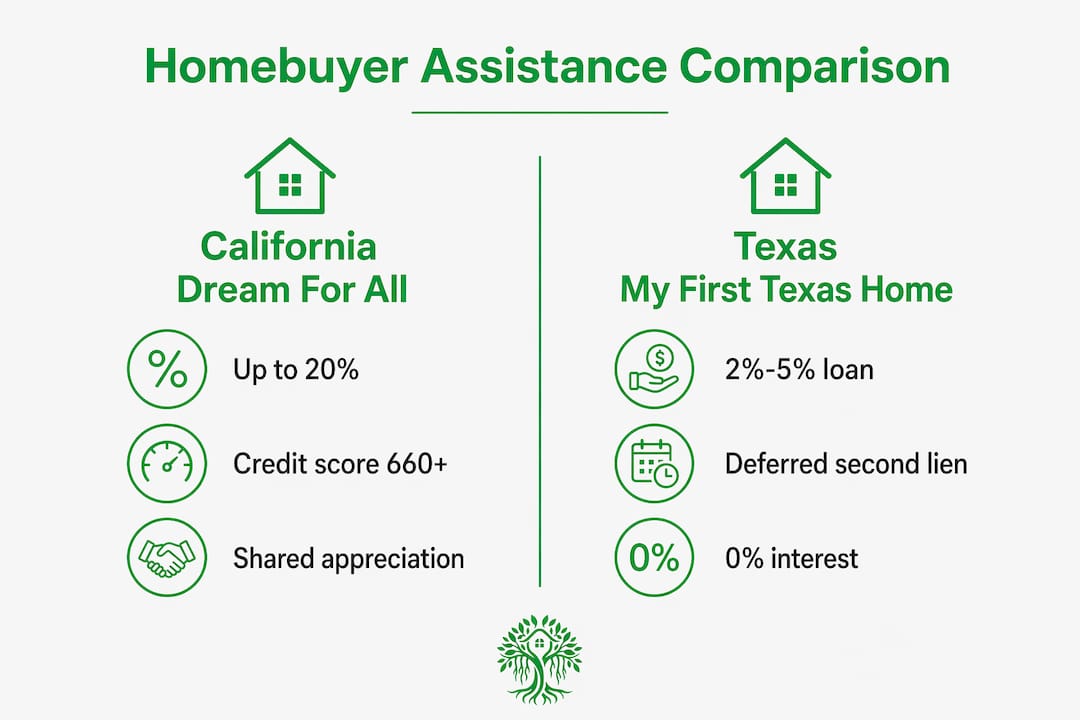
    California’s Dream For All program requires a credit score of 660 or higher and sets income limits by county and household size. Texas’s My First Texas Home program sets the credit score minimum at 620, making it accessible to buyers still building their credit profile. Both states also require buyers to work with program-approved lenders and complete a homebuyer education certificate before closing.

    Hands with credit score and eligibility documents

    The definition of “first generation” carries more weight than most buyers expect. Parental ownership checks include indirect ownership through trusts, inherited property, or partial interests, not just a deed in a parent’s name. If your parent holds a beneficial interest in a property through a family trust, that can disqualify you. The verification process is strict, and incomplete documentation is the leading cause of application denial.

    Here is a quick summary of core eligibility requirements across both states:

    • First-time buyer status: No ownership interest in a primary residence in the past three years
    • First generation status: Neither parent currently holds title to a home in the program’s jurisdiction
    • Credit score: 660+ for California Dream For All; 620+ for Texas My First Texas Home
    • Income limits: Set by county and household size in both states; California limits vary significantly between coastal and inland counties
    • Homebuyer education: Completion of an approved course and certificate required before loan closing
    • Approved lender: You must apply through a CalHFA-approved lender in California or a TDHCA-approved lender in Texas

    Pro Tip: Pull your parents’ property records before you apply. A title search on your parents’ names in every state they have lived in costs under $50 and can prevent a last-minute denial.

    What financial assistance do these programs provide?

    California’s Dream For All program offers up to 20% of the purchase price, capped at $150,000, as a shared appreciation loan. That means the state contributes to your down payment and receives a proportional share of your home’s appreciation when you sell, refinance, or pay off the loan. If your home doubles in value, the state’s repayment amount doubles too. That is the trade-off: significant upfront help in exchange for a share of future gains.

    Texas’s My First Texas Home program works differently. It provides 2%–5% of the loan amount as a deferred second lien at 0% interest. You owe nothing on that second lien until you sell, refinance, or pay off the first mortgage. There is no appreciation sharing. The state simply waits to be repaid the original amount, with no interest accruing.

    Infographic comparing CA and TX first generation homebuyer programs

    Feature California Dream For All Texas My First Texas Home
    Assistance amount Up to 20% of purchase price, max $150,000 2%–5% of loan amount
    Structure Shared appreciation loan Deferred 0% interest second lien
    Repayment trigger Sale, refinance, or payoff Sale, refinance, or payoff
    Appreciation sharing Yes, proportional to state’s contribution No
    Credit score minimum 660 620
    Application method Lottery-based First-come, first-served via approved lender

    CalHFA also administers additional programs that can layer with Dream For All. The MyHome and ZIP programs offer up to 3.5% as a deferred second loan and 3% for closing costs respectively. MyHome cannot be combined with Dream For All, but Dream For All can pair with ZIP closing cost assistance. That combination covers both your down payment and a portion of closing costs from a single application process.

    Pro Tip: Ask your lender specifically about Special Purpose Credit Programs (SPCPs). These programs use first generation status under the Equal Credit Opportunity Act to offer reduced costs and better terms. Many lenders offer them but do not advertise them publicly.

    Local city and county programs in both states can also stack with state aid. Cities like Los Angeles, San Jose, and Austin run their own down payment assistance funds. Stacking local and state programs requires a lender who understands both sets of rules, but the payoff can be substantial.

    How do you apply for these programs in California and Texas?

    The application process differs between the two states, but both follow a clear sequence. Working with the right lender from day one is the single most important decision you will make.

    1. Select an approved lender. In California, find a CalHFA-approved lender at calhfa.ca.gov. In Texas, use the TDHCA lender locator at tdhca.state.tx.us. Not every mortgage lender participates, and using a non-approved lender disqualifies you automatically.

    2. Complete homebuyer education. Both states require a certificate from an approved homebuyer education course before closing. HUD-approved counseling agencies offer these courses online. Budget four to eight hours and complete this early, since some programs require the certificate before you can even submit an application.

    3. Gather documentation. You will need tax returns, pay stubs, bank statements, and proof of your parents’ ownership status. California’s Dream For All requires documentation of indirect ownership including trusts and inherited interests. Start collecting this paperwork before you find a property.

    4. Submit your application through your lender. Your lender submits to CalHFA or TDHCA on your behalf. For Dream For All, applications are processed via a lottery. The most recent cycle closed march 16, 2026. Watch CalHFA’s website for the next opening. Texas My First Texas Home operates on a first-come, first-served basis with no lottery.

    5. Receive your reservation and shop for a home. Once approved, you receive a program reservation. In California, this reservation has an expiration date. Move quickly once you have it.

    6. Close with your assistance in place. Your lender coordinates the second lien or shared appreciation loan at closing. The funds appear on your closing disclosure alongside your primary mortgage.

    Pro Tip: Experienced loan officers who specialize in layered assistance programs close these deals faster and with fewer surprises. Ask any lender how many CalHFA or TDHCA loans they closed in the past 12 months before you commit.

    What challenges should first generation homebuyers watch for?

    The biggest trap is assuming that qualifying as a first-time buyer automatically qualifies you as a first generation buyer. It does not. Parental ownership verification is the step where most applications stall or fail. A parent who sold a home two years ago, holds a timeshare, or is listed as a beneficiary on a family trust can trigger a denial if you have not documented the situation correctly.

    Program stacking has real limits. Combining the wrong programs wastes time and can delay your closing. Here are the key restrictions to know:

    • Dream For All and MyHome cannot be combined in California
    • Dream For All can pair with ZIP closing cost assistance
    • Texas My First Texas Home can layer with local city programs in many cases
    • SPCPs from private lenders may stack with state programs but require lender verification
    • County income limits vary widely; a household that qualifies in Fresno may not qualify in San Francisco

    “The long-term cost of a shared appreciation loan depends entirely on how much your home appreciates. In a high-growth market like the Bay Area or Austin, the state’s repayment share on a Dream For All loan can exceed what you would have paid in PMI on a conventional loan. Run the numbers for your specific market before you commit.”

    Buyers also underestimate how much county purchase price limits matter. California sets maximum purchase prices by county, and in high-cost areas those caps can exclude a large share of available inventory. If you are buying in Los Angeles or Santa Clara County, confirm the current cap with your lender before you start making offers. For guidance on house hunting pitfalls that affect program applicants specifically, reviewing common inspection and offer mistakes early saves time later.

    The federal LIFT Homebuyers Act, if passed, would enable low-interest 20-year loans for first generation buyers, doubling equity build speed at comparable monthly payments. That legislation signals where federal policy is heading, but it is not law yet. For now, state programs remain your primary source of targeted financial aid for homebuyers.

    Key Takeaways

    First generation homebuyer programs in California and Texas offer the most substantial down payment assistance available to first-time buyers, but eligibility hinges on strict parental ownership verification and program-specific documentation.

    Point Details
    First generation definition is strict Parents must not hold direct or indirect ownership, including trusts and inherited interests.
    California Dream For All offers the most Up to 20% of purchase price, capped at $150,000, as a shared appreciation loan.
    Texas My First Texas Home is simpler Provides 2%–5% as a deferred 0% interest second lien with no appreciation sharing.
    Lender selection is critical Only CalHFA-approved or TDHCA-approved lenders can process these applications.
    Program stacking has rules Dream For All pairs with ZIP but not MyHome; local programs may layer with state aid in Texas.

    What I have learned from watching buyers navigate these programs

    I have seen buyers lose their Dream For All reservation because they spent three weeks searching for a home before confirming their parents’ ownership status. That is the wrong order. The documentation work comes first, before you fall in love with a property.

    The shared appreciation structure of Dream For All is genuinely misunderstood. Buyers hear “free money” and stop reading. The state is not giving you $150,000. It is investing alongside you and expects a return. In a flat market, that return is modest. In a market where prices climb 30% in five years, the repayment is significant. I think buyers in high-appreciation California markets should model both scenarios before signing.

    The federal LIFT Homebuyers Act is worth watching. A 20-year mortgage at a reduced rate for first generation buyers would be a structural change, not just a grant program. It would build equity faster without the appreciation-sharing trade-off. That is a better long-term deal for most buyers.

    My strongest advice: treat lender selection like hiring a specialist surgeon, not a general practitioner. The right loan officer for a first generation buyer knows county income limits, program stacking rules, and the lottery calendar. A generalist mortgage broker does not. That difference can cost you your reservation, your rate lock, or your closing date.

    Start your homebuyer education course the week you decide to buy. Do not wait until you have a property under contract. The certificate takes time, and some programs require it before your application can even be submitted. Getting ahead of that requirement is one of the simplest ways to compress your timeline. You can also use a home affordability calculator to confirm your true budget before you start the lender conversation.

    — Anand

    How Ficustree helps first generation buyers find the right path

    First generation homebuyer programs involve more moving parts than most buyers realize. Ficustree’s AI-powered platform matches you with homes that fit your budget after factoring in down payment assistance, and it organizes the steps you need to complete before closing.

    https://ficustree.ai

    Ficustree works directly for you as the buyer. You pay $1,000 at closing plus 1% commission and keep a rebate of roughly 2% where legally permitted. The platform helps you identify which California programs you qualify for, connects you with approved lenders who specialize in layered assistance, and tracks your homebuyer education requirements. Start your search at Ficustree and go from program confusion to a clear offer strategy in weeks, not months.

    FAQ

    What makes a first generation homebuyer program different from a first-time buyer program?

    A first generation homebuyer program adds a parental ownership check on top of the standard first-time buyer requirement. Your parents must not currently own a home, including indirect ownership through trusts or inherited property.

    How much can I receive from California’s Dream For All program?

    California’s Dream For All provides up to 20% of the purchase price, capped at $150,000, as a shared appreciation loan repaid when you sell or refinance.

    Does Texas have a first generation homebuyer program?

    Texas’s My First Texas Home program offers 2%–5% of the loan amount as a deferred 0% interest second lien. It does not require appreciation sharing and accepts credit scores as low as 620.

    Can I combine multiple homebuyer assistance programs?

    Yes, in many cases, but with restrictions. California’s Dream For All can pair with ZIP closing cost assistance but not with MyHome. Texas buyers can often layer state and local city programs. An experienced loan officer who knows both sets of rules is required to do this correctly.

    What happens if my parents owned a home years ago but sold it?

    Program rules vary. Some programs use a seven-year lookback period; others check current ownership only. Review the specific program guidelines with your lender and document your parents’ ownership history thoroughly before applying.

  • Top 3 Condo vs Townhouse First Time Buyer Alternatives 2026

    Top 3 Condo vs Townhouse First Time Buyer Alternatives 2026

    Finding home buyer representation software that actually supports first time buyers through every step is confusing and time consuming. Most platforms either stop at lead capture without tailored search or hide full negotiation and rebate features behind manual agent signup. This comparison lets you weigh price, agent access, and real service depth across three alternatives so you can match the best platform for your search style.

    Table of Contents

    ficustree

    https://ficustree.ai

    At a Glance

    According to the company, buyers pay $1,000 at closing plus 1% commission and keep a rebate of roughly 2% where legally permitted. Ficustree pairs AI guided search with neighborhood insights and disclosure analysis to guide buyers and independent agents. The platform focuses on California with Texas emerging as the next primary market.

    Core Features

    Ficustree combines AI guided home search and matching with neighborhood and property insights, disclosure review, and cost projection tools. The platform includes document analysis that flags contract issues and highlights financial assumptions. It also supports complete transaction steps from offer strategy to negotiations and closing assistance for buyers and agents.

    Key Differentiator

    Ficustree centers its product on an AI driven, holistic approach that links personalized matchmaking, disclosure analysis, and cost optimization with emotional intelligence. That blend helps buyers compare true affordability and contract risk alongside lifestyle fit. For agents, the platform consolidates CRM, lead management, and marketing workflows into a single interface.

    Pros

    Personalized, AI driven guidance narrows listings to match lifestyle, commute, and long term goals, cutting time spent on unsuitable properties. Integrated cost projection and risk analysis let buyers estimate PITI plus HOA, insurance, and maintenance before making offers. Buyers can use the platform without a traditional agent and keep the rebate in eligible areas, while agents can replace multiple legacy tools with one workflow.

    Cons

    • Primarily available in California, with waitlists for other states.

    Who It’s For

    First time home buyers in California, especially older millennials and Gen X, who want clearer affordability analysis and hands on negotiation support. Independent realtors and small teams looking to replace CRM, lead, and marketing tools with one platform will benefit. Buyers who want both financial modeling and emotional guidance fit this product well.

    Unique Value Proposition

    That pricing model makes active searching more affordable by letting buyers keep rebate money and access the premium platform free. For a first time buyer, saving on commission can free up down payment or inspection budgets. For agents, bundled features reduce subscriptions to separate CRM and marketing tools. The result is a single workflow that ties search, affordability, and offers together.

    Real World Use Case

    A first time buyer in California used Ficustree’s AI guided search and disclosure analysis to shortlist properties that matched commute limits and budget. The platform highlighted HOA fees and probable repairs during disclosure review. The buyer made an informed offer and reduced agent commission costs while keeping the platform tools available through closing.

    Pricing

    The vendor advertises variable pricing: the platform is free for buyers, and agent tiers start from $399/month with success fees. Realtor plans vary by experience and scale. Some agent tiers include marketing and CRM features, while buyer-facing premium tools remain available at no charge.

    Website: https://ficustree.ai

    Zeego

    https://zeego.ai

    At a Glance

    Zeego combines instant AI property valuations with licensed agent negotiation and offers cashback at closing. The platform targets buyers who already have a specific property in mind and want to handle most steps themselves while tapping licensed help for offers and closing. The service aims to cut transaction costs compared with traditional full-service brokerage models.

    Core Features

    Zeego delivers AI powered home valuation and comps, quick property disclosure analysis, and tools for offer and contract preparation in one workflow. The platform pairs those tools with licensed agent negotiation support and end to end closing management from offer to closing. Scheduling, calendar integration, and payment support help keep the transaction organized without a full-service agent.

    Key Differentiator

    Zeego blends automated property analysis with live licensed agent support so you manage the deal while professionals handle negotiations and paperwork. That hybrid model focuses on lowering fees and returning cashback at closing while preserving agent oversight for legally sensitive steps. The combination suits buyers who prefer control but still need professional signoff on contracts and disclosures.

    Pros

    The interface simplifies scheduling and keeps documents and calendar items in one place, which speeds decision-making for buyers already tracking a property. The vendor advertises high customer satisfaction for ease of use and perceived value. Licensed agent support is available when you need negotiation help or closing coordination, and the AI tools make fast valuation comparisons and disclosure checks possible.

    Cons

    • Occasional limitations on the free plan have been reported by users. These limitations can restrict access to advanced tools until you upgrade or pay for agent services.
    • The product suits buyers who already know the property they want. It gives less guidance for people still exploring neighborhoods or listings.
    • The focus on transaction management means limited handholding for first-time buyers who want a full search and neighborhood orientation.

    When It May Not Fit

    If you are early in the search phase and need comprehensive listing discovery, Zeego will likely be too narrow. The platform assumes you have identified a property and want a cost-efficient way to negotiate and close. Buyers seeking an agent to show many homes or curate neighborhood options should look elsewhere.

    Who It’s For

    Zeego fits cost conscious buyers who prefer a DIY approach to the purchase but value licensed agent backup for negotiation and closing. It matches people comfortable interpreting online listings and running initial comparisons who want lower fees and cashback incentives. It does not target first timers who need full search and showing services.

    Real World Use Case

    A buyer spots a house on Zillow and wants to avoid full commission while keeping professional oversight. They use Zeego for instant valuations, disclosure analysis, and to prepare an offer with a licensed agent handling the negotiation. The agent then manages escrow and closing steps so the buyer keeps control while saving on traditional brokerage costs.

    Website: https://zeego.ai

    casaamigo.ai

    https://casaamigo.ai

    At a Glance

    Free to use with no public pricing details. The site funnels visitors into online registration and interactive content to start connections with agents or sellers. It does not show a broad catalog of listings on the homepage, so first impressions focus on lead capture rather than browsing inventory.

    Core Features

    The platform collects user details through web forms and uses that input to route inquiries to real estate contacts. Interactive content aims to engage visitors and guide them to leave contact information. The overall flow emphasizes quick, digital connections rather than a browsing experience full of searchable listings.

    Key Differentiator

    casaamigo.ai emphasizes simple online forms and interactive pages to move people from interest to contact. That streamlined, form-driven approach targets users who want a rapid introduction to local agents or opportunities. It favors connection and response over curated property search tools.

    Pros

    The product leans into digital transformation with a clean, easy to use interface that lowers friction for people who prefer online contact. Its layout simplifies the first step of reaching an agent or investor and includes clear calls to action to drive engagement. For professionals, the platform provides a lightweight channel to gather leads without building a full site.

    Cons

    • Limited detail: The homepage does not display a wide range of properties or deep service explanations.
    • Manual dependence: The platform relies on user input and lacks automated matching across listings or agents.
    • Sparse public information: Specific features and workflows are not described in depth on the site.

    When It May Not Fit

    If you want to browse many listings before contacting anyone, this platform will feel thin. Buyers needing guided offer strategy, disclosure review, or direct buyer representation will want a full service broker instead. Agents or investors who require automated matching or integrated listing feeds will find the current setup too basic.

    Who It’s For

    Home buyers who prefer a quick online route to an agent or investor and who are comfortable sharing details up front will get value here. Small brokerages and solo agents seeking an easy lead capture landing spot will also benefit. People who want deep market data or full buyer representation will need a different tool.

    Real World Use Case

    A prospective buyer completes the registration form, states a preferred neighborhood and budget, and submits contact details. The platform routes that submission to a local agent or investor contact for follow up. That process reduces the time between discovery and a first conversation.

    Pricing

    The site lists the product as free to use and does not publish tiered pricing or service fees. No additional pricing details are available on the public pages, so paid services or premium features are not evident.

    Website: https://casaamigo.ai

    Comparison of alternatives

    Choosing the right platform for home-buying greatly impacts the experience, where each has unique strengths to consider. Below is a discussion of major dimensions that differentiate Ficustree, Zeego, and Casaamigo.ai.

    Guidance and tool integration

    Ficustree.ai excels by offering a platform integrating AI-guided real estate search with financial and legal decision-making tools. First-time buyers benefit from clearly analyzed listings matched to their needs, alongside tools projecting property PITI and other costs. In contrast, Zeego focuses on offering minimal services initially and adds components as needed. Casaamigo.ai targets users preferring a swift connection to realtors or properties, without in-depth analysis tools.

    Cost structure and flexibility

    Zeego stands out for its cost-effectiveness for users comfortable taking hands-on control of the buying process while needing professional oversight for closing. The cashback feature at finalization appeals to cost-conscious buyers. Ficustree.ai offers savings as well, particularly with rebates, providing affordability while supporting deeper engagement. Casaamigo.ai’s free entry limits insight into total costs upfront but emphasizes lead generation tools for agents and quick setups.

    Best fit

    • Buyers in California seeking personalized guidance and affordability projections with negotiation support should choose ficustree.ai.
    • Cost-conscious buyers preferring a platform combining DIY elements with professional help for contracts and closures can rely on Zeego.
    • Buyers or small agencies prioritizing quick setups and initial connections with agents or investors may focus on Casaamigo.ai.

    Our pick

    For first-time buyers or agents seeking a and affordable platform, Ficustree.ai provides value. Its combination of AI-driven search personalization, financial modeling, and legal analysis gives it a unique edge that simplifies and enhances property buying.

    Identifying the right home buyer representation platform involves considering each option based on unique core features and benefits.

    Product Core Features Best For Pricing Notable Limitation
    Ficustree AI-guided home search and matching, disclosure analysis, full transaction workflow First-time buyers in California Free for buyers, agents from $399/month Primarily available in California
    Zeego AI property valuations, agent negotiation, contract preparation DIY buyers with known properties Price not published Limited guidance for property discovery
    CasaAmigo.ai Online lead capture and agent connections Quick initial agent engagement Free to use Limited listing and market detail

    How to Choose Between a Condo and Townhouse With Clear Affordability

    Choosing between a condo and townhouse can feel overwhelming. You need to understand true affordability, including mortgage, HOA fees, insurance, and maintenance costs. Ficustree helps first-time buyers grasp these details with AI-powered clarity tailored especially for California and Texas buyers. The platform offers personalized home search matching your lifestyle and budget while cutting commission costs with rebate credits where allowed.

    Ficustree simplifies every step:

    • AI guided property and neighborhood insights
    • Disclosure analysis that highlights hidden expenses
    • Support from hourly showing agents when you need help

    Take control of your decision with Ficustree. Visit the site and start narrowing down your options with a clear view of your true costs and buying power.

    FAQ

    How does Ficustree help buyers evaluate costs for condos versus town houses?

    Ficustree provides integrated cost projection tools that allow buyers to estimate PITI, HOA fees, insurance, and maintenance costs. This feature helps buyers understand the true affordability of different property types, including condos and townhouses. Expect personalized guidance that clarifies the financial implications of each option.

    What is the difference between Zeego and Ficustree for first-time buyers?

    Zeego offers a straightforward approach to property valuation and negotiation, allowing users to manage their own deals with licensed agent support. In contrast, Ficustree focuses on personalized matchmaking and cost analysis, making it ideal for buyers seeking detailed guidance throughout the home buying process. Choose Ficustree for a more hands-on support experience.

    Which platform supports document analysis for buyers?

    Ficustree includes document analysis tools that flag potential contract issues and highlight financial assumptions, providing buyers with vital insights. This capability significantly lowers the risk of missing important details during the transaction. Consider this feature when choosing a platform that prioritizes transparency and informed decision-making.

    Can I use Ficustree to replace multiple software tools as a realtor?

    Realtors can utilize Ficustree to consolidate CRM, lead management, and marketing workflows into a single interface. This integration helps streamline everyday operations for independent agents and small teams. Expect to simplify your processes by leveraging Ficustree’s comprehensive feature set.

    How does Ficustree support first-time buyers during negotiations?

    Ficustree offers step-by-step assistance with offer strategies and negotiation tactics tailored for first-time buyers. This support helps demystify the negotiation process and empowers buyers to make informed decisions. First-timers can benefit greatly from this focused guidance throughout their experience.

  • First Time Buyer Down Payment Calculator: 2026 Guide

    First Time Buyer Down Payment Calculator: 2026 Guide

    A first time buyer down payment calculator is the fastest way to find out exactly how much cash you need before you can close on a home. Most first-time buyers focus only on the down payment percentage and miss the full picture. Your actual upfront cost includes closing costs, prepaid expenses, and cash reserves on top of the down payment itself. Loan programs like FHA, conventional, VA, and USDA each carry different minimums, and your credit score changes those numbers further. The median down payment for first-time buyers in 2025 was 8–10%, which means most buyers never hit the 20% threshold. Understanding your real number from the start saves months of confusion.

    How does a first time buyer down payment calculator work?

    Couple reviewing mortgage calculator on tablet

    A mortgage down payment calculator takes a handful of inputs and turns them into a clear cash estimate. The math is straightforward, but the inputs matter more than most buyers realize.

    Key inputs the calculator needs

    • Home price: Your target purchase price sets the baseline for every calculation.
    • Loan type: FHA, conventional, VA, and USDA each carry different minimum percentages and insurance rules.
    • Down payment percentage: You can test multiple scenarios, such as 3%, 5%, or 10%, to see how each changes your monthly payment.
    • Credit score: Your score determines which loan programs you qualify for and what interest rate you will receive.
    • Location: State and county loan limits affect FHA and conforming loan eligibility.

    What the calculator outputs

    A well-built home affordability calculator returns more than a single dollar figure. It shows your estimated monthly payment broken into principal, interest, taxes, and insurance (PITI). It also calculates private mortgage insurance (PMI) if your down payment falls below 20%, and it projects when PMI cancels based on your equity schedule.

    PMI typically costs 0.3–1.5% of the loan amount annually. On a $400,000 loan, that is roughly $250 per month added to your payment. That number disappears once you reach 20% equity on a conventional loan, but FHA mortgage insurance premium (MIP) lasts the life of the loan unless you refinance.

    Pro Tip: Run at least three scenarios in any down payment estimator: your minimum qualifying amount, a mid-range option, and 20% down. Comparing all three shows you the real cost of each choice over time.

    What are the minimum down payment requirements by loan type?

    Down payment minimums vary significantly depending on the loan program and your credit profile. Here is what each major program requires in 2026.

    Infographic comparing loan types and down payment amounts

    Loan Type Minimum Down Payment Credit Score Requirement
    VA 0% No set minimum (lender varies)
    USDA 0% Typically 640+
    Conventional 97 3% 620+
    FHA 3.5% 580+
    FHA (lower credit) 10% 500–579

    The 20% down myth deserves a direct correction. Putting 20% down avoids PMI, but it is not a requirement. Most first-time buyers in 2026 choose low-down programs and pay PMI rather than delay their purchase by years. The real question is whether the PMI cost is worth buying sooner versus saving longer.

    Choosing the wrong loan program can add $40,000–$100,000 in costs over a 30-year term. That gap comes from differences in interest rates, mortgage insurance structures, and fees across FHA, conventional, VA, and USDA loans. Comparing programs before you commit is not optional. It is the most important financial decision in the entire process.

    Down payment assistance programs

    Over 2,400 state and local assistance programs exist across the U.S. to help first-time buyers reduce upfront costs. Programs like CalHFA in California and My First Texas Home in Texas offer grants or forgivable loans covering 3–5% of the purchase price. These programs can effectively bring your out-of-pocket down payment to zero on qualifying properties.

    • Grants do not require repayment if you meet occupancy requirements.
    • Deferred loans postpone repayment until you sell or refinance.
    • Matched savings programs multiply what you deposit into a dedicated account.

    Pro Tip: Search your state housing finance agency’s website before assuming you need to save the full down payment yourself. California buyers can explore state assistance options that most buyers never find on their own.

    How to use a down payment calculator to build a savings plan

    A calculator gives you a number. A savings plan gives you a path to that number. Here is how to connect the two.

    1. Set your target home price. Use current median prices in your target neighborhood, not statewide averages. A $550,000 home in Austin and a $550,000 home in Sacramento carry different tax and insurance costs that affect your total payment.
    2. Choose your loan scenario. Pick the loan type that matches your credit score and eligibility. If you qualify for VA or USDA, start there. If not, compare FHA against conventional based on your credit profile.
    3. Add closing costs to your total. Closing costs add 2–5% of the purchase price on top of your down payment. On a $500,000 home, that is $10,000–$25,000 in additional cash needed at closing. This is the number most first-time buyers miss.
    4. Add a cash reserve. Lenders often want to see 2–3 months of mortgage payments in savings after closing. Factor this into your total target.
    5. Calculate your monthly savings requirement. Divide your total cash-to-close by the number of months until your target purchase date. That is your monthly savings goal.

    The three primary levers that actually move your timeline are extending your purchase date, lowering your target home price, or increasing your income. Small expense cuts rarely speed savings enough to make a meaningful difference. Focusing on the big three produces faster results.

    You can also use a monthly payment estimator to test how different down payment amounts change your PITI before you finalize your savings target.

    Pro Tip: Open a dedicated high-yield savings account for your down payment fund. Keeping it separate from your checking account reduces the temptation to spend it and makes it easier to track progress.

    What mistakes do buyers make with down payment calculators?

    A calculator is only as accurate as the inputs you give it. Several common errors produce misleading results.

    • Treating the down payment as the total cash needed. Your cash-to-close includes the down payment, closing costs, prepaid property taxes, homeowner’s insurance, and reserves. Buyers who plan only for the down payment often arrive at closing short.
    • Using national average home prices instead of local ones. A calculator set to a $350,000 national median gives you useless numbers if you are buying in San Jose or Dallas.
    • Ignoring the credit score field. Your credit score changes both your loan eligibility and your interest rate. A 620 score and a 740 score produce very different monthly payment estimates on the same home.
    • Forgetting post-closing costs. Repairs, moving expenses, and immediate maintenance costs are not included in any calculator. Budget an additional 1–2% of the home price for year-one costs.

    Borrowers who use personal loans or undocumented gifts for their down payment risk raising their debt-to-income ratio and triggering a loan denial. Lenders scrutinize every dollar of your down payment source during underwriting. Properly documented gift funds from family members are acceptable, but borrowed funds from a personal loan are not.

    “A down payment calculator tells you what you need. Your lender’s underwriter decides whether your source of funds qualifies. Plan both before you start saving.”

    Check your estimates against a full mortgage calculator that includes taxes and insurance. A bare principal-and-interest estimate can understate your true monthly cost by $400–$800 per month in high-tax states.

    Key Takeaways

    A first-time buyer’s total cash-to-close equals the down payment plus 2–5% for closing costs plus cash reserves, and choosing the right loan program determines how much of that you actually need to save.

    Point Details
    Down payment minimums vary by loan VA and USDA require 0%; FHA requires 3.5% at 580+ credit; conventional starts at 3%.
    PMI adds real monthly cost PMI runs 0.3–1.5% annually and stays until you reach 20% equity on conventional loans.
    Closing costs are non-negotiable Budget 2–5% of the purchase price beyond your down payment for closing costs and reserves.
    Assistance programs reduce upfront cash Over 2,400 programs exist; CalHFA and My First Texas Home offer 3–5% in grants or forgivable loans.
    Wrong loan choice is expensive Selecting the wrong program can cost $40,000–$100,000 extra over a 30-year mortgage term.

    What I’ve learned from watching buyers use these calculators wrong

    Most first-time buyers I work with arrive with a number in their head. It is usually the down payment percentage they read somewhere, stripped of every other cost. They have done the math on 3.5% of a home price and stopped there. That number is real, but it is incomplete.

    The buyers who move fastest are the ones who run their calculator with their actual credit score, their actual target zip code, and a realistic home price for that market. National averages are useless in California and Texas, where prices, taxes, and insurance costs diverge sharply from the median. A buyer in Plano, Texas, and a buyer in Pasadena, California, face completely different cash-to-close numbers even at the same purchase price.

    The other thing I see consistently: buyers who skip the FHA loan details and default to FHA because it is familiar. FHA is the right call for lower credit scores. For buyers above 680, a conventional loan with PMI often costs less over five years because the mortgage insurance cancels. That comparison is worth running before you commit to any program.

    My honest advice: treat the calculator as a starting point, not a final answer. Use it to narrow your range, then verify with a lender who can pull your actual credit and give you a real loan estimate.

    — Anand

    How Ficustree helps you calculate and plan your down payment

    Figuring out your down payment is one piece of a much larger financial puzzle, and Ficustree is built to help you see the whole picture.

    https://ficustree.ai

    Ficustree’s AI-powered platform gives first-time buyers in California and Texas access to mortgage calculators, loan comparison tools, and a guided workflow that connects your savings target to real homes in your price range. You can test FHA versus conventional scenarios, factor in assistance programs, and track your cash-to-close progress in one place. Ficustree charges $1,000 at closing plus 1% commission, and buyers keep a rebate of roughly 2% where legally permitted. The platform is free to use. Start planning your purchase and see how much home your savings can actually reach.

    FAQ

    What is a first time buyer down payment calculator?

    A first time buyer down payment calculator estimates the upfront cash you need based on your target home price, loan type, and credit score. It outputs your required down payment, estimated closing costs, and projected monthly payment including mortgage insurance.

    How much should a first-time buyer save for a down payment?

    The minimum depends on your loan type: 0% for VA and USDA, 3% for conventional, and 3.5% for FHA with a 580+ credit score. Add 2–5% of the purchase price for closing costs to get your true cash-to-close target.

    Does a down payment calculator include closing costs?

    Most basic calculators show only the down payment amount. A full cash-to-close estimate requires adding 2–5% of the purchase price separately to cover title fees, inspections, prepaid taxes, and insurance.

    Can I use down payment assistance with a calculator?

    Yes. Enter your reduced out-of-pocket down payment after subtracting any grant or forgivable loan amount. Over 2,400 assistance programs exist nationwide, and programs like CalHFA can cover 3–5% of the purchase price for eligible buyers.

    Does my credit score change my down payment requirement?

    Your credit score directly affects which loan programs you qualify for. An FHA loan requires 3.5% down at 580+ but jumps to 10% down for scores between 500 and 579. Conventional loans require at least 620 to access the 3% minimum.

  • Buying a House with No Money Down: 2026 Guide

    Buying a House with No Money Down: 2026 Guide

    Buying a house with no money down means securing a mortgage that requires zero upfront down payment, and three real paths exist to do it in California and Texas right now. VA loans, USDA loans, and state-sponsored down payment assistance programs each offer 100% financing options for qualified buyers. None of these paths are free rides. Each carries credit score minimums, income limits, and financial requirements you need to meet before a lender will say yes. This guide breaks down every option, what it costs you in the long run, and how to put yourself in the best position to close.

    What loan programs allow buying a house with no money down?

    Three primary zero down payment mortgage programs serve California and Texas buyers in 2026. Each targets a different buyer profile, so knowing which one fits your situation saves you months of wasted effort.

    Hands pointing at no down payment loan options

    VA loans

    VA loans are the strongest no money down home loans available. They require zero down with no PMI, which immediately lowers your monthly payment compared to conventional loans with private mortgage insurance. Eligibility requires active duty service, veteran status, or qualifying surviving spouse status. The catch most buyers miss: you need a Certificate of Eligibility (COE) before any lender can process your loan. Many veterans assume their DD-214 discharge papers are enough, but lenders require the COE specifically. Request it online through the VA portal before you start shopping for homes.

    VA loans do carry a funding fee. For first-time zero down use in 2026, that fee is typically 2.15% of the loan amount. On a $500,000 home, that adds $10,750 to your financed balance. It rolls into the loan, so you do not pay it upfront, but it does raise your monthly payment.

    USDA loans

    USDA loans offer 100% financing for properties in USDA-designated rural and some suburban areas. The program caps household income at 115% of the area median income. That limit is more generous than most buyers expect. A family of four in many Texas counties can earn well above $100,000 and still qualify. The property must be your primary residence and must sit within an eligible zone, which you verify on the official USDA eligibility map.

    California and Texas down payment assistance

    California’s Dream For All program, administered by CalHFA, provides up to 20% of the purchase price up to $150,000 as a shared appreciation loan. Texas takes a decentralized approach. The state hosts 77 local and state programs offering up to 5% assistance toward down payment and closing costs. Texas buyers who only use one program typically leave money on the table.

    Program Who qualifies Down payment Key condition
    VA loan Veterans, active duty, surviving spouses 0% COE required; 2.15% funding fee
    USDA loan Buyers in eligible rural/suburban areas 0% Income at or below 115% AMI
    CA Dream For All California first-time buyers Up to 20% covered Shared appreciation repayment on sale
    Texas DPA programs Texas first-time buyers (varies by program) Up to 5% covered Program-specific income and purchase limits

    Infographic comparing federal and state zero down mortgage options

    What financial qualifications do no down payment loans require in 2026?

    Zero down does not mean zero scrutiny. Lenders apply strict financial standards to every no money down home loan application.

    Credit score is the first filter. VA lenders typically require a FICO score of 620–670. USDA lenders prefer 640 or higher. Hitting 640 on a USDA application matters for a practical reason: scores at or above 640 qualify for streamlined underwriting, which speeds up approval. Scores below 640 trigger manual review, which adds time and uncertainty to your closing timeline.

    Debt-to-income ratio (DTI) is the second major filter. Both VA and USDA programs target a DTI at or below 41%. DTI measures your total monthly debt payments divided by your gross monthly income. If you earn $7,000 per month before taxes, your total monthly debts including the new mortgage payment should stay at or below $2,870. Buyers who carry heavy car loans, student debt, or credit card balances often fail this test even with strong credit scores.

    Income limits apply specifically to USDA and state DPA programs. USDA caps household income at 115% of the area median income for your county. California’s Dream For All and Texas DPA programs each carry their own income ceilings, which vary by county and household size.

    Financial qualification checklist:

    • Credit score of 620+ for VA loans; 640+ preferred for USDA
    • DTI ratio at or below 41%
    • Stable, verifiable income for at least two years
    • Household income within program limits for USDA and DPA programs
    • No recent bankruptcies or foreclosures within program-required waiting periods
    • COE documentation ready for VA loan applications

    One financial reality catches many first-time buyers off guard. Closing costs still apply even with a zero down payment mortgage. They typically run 2%–5% of the home price. On a $400,000 purchase, that is $8,000–$20,000 due at closing. Planning for closing costs is not optional.

    Pro Tip: Ask your lender for a Loan Estimate within three business days of your application. It itemizes every closing cost line by line, so you know exactly what cash you need at the table.

    How do you navigate down payment assistance programs in California and Texas?

    Down payment assistance programs reward buyers who do their homework before they apply.

    California’s Dream For All program opened its 2026 application window in february. CalHFA funded the program at $150–$200 million. The program provides a shared appreciation loan, which means CalHFA contributes up to 20% of your purchase price and receives 20% of the home’s appreciation when you sell or refinance. If you buy at $500,000 and sell at $700,000, CalHFA receives 20% of the $200,000 gain, which is $40,000 back to the program on top of the original loan amount. That is a meaningful reduction in your net proceeds. Buyers who plan to sell within five years should model this math carefully before committing.

    Texas buyers face a different challenge. No single statewide program dominates. Instead, 77 local and state programs operate across Texas counties and cities. The most effective Texas strategy is layering multiple programs to cover both down payment and closing costs. A buyer in Houston, for example, might combine a state-level forgivable loan with a city-level grant and a lender credit to arrive at closing with minimal out-of-pocket costs. Buyers who rely on a single program often still face thousands in uncovered closing costs.

    Pro Tip: Some California DPA programs use lottery or random selection when demand exceeds funding. Check CalHFA’s website for the exact application window and submit on day one. Waiting even a week can mean missing the funding round entirely.

    For both states, seller concessions are an underused tool. Sellers can contribute toward your closing costs as part of the purchase agreement. In a slower market, asking for 2%–3% in concessions is reasonable and can eliminate most of your remaining out-of-pocket expense after DPA funds are applied.

    What steps should first-time buyers take to buy a home with no money down?

    A clear sequence separates buyers who close from buyers who stall.

    The first step is confirming your eligibility for the program you want to use. VA loan applicants must obtain their COE before approaching lenders. USDA applicants must verify the property address on the official USDA eligibility map, which updates regularly. An address that qualified last year may not qualify today. Check the map for every property you seriously consider, not just once at the start of your search.

    The second step is finding a lender who actively works with your target program. Not every lender processes VA or USDA loans efficiently. Ask specifically how many VA or USDA loans the lender closed in the past 12 months. A lender who closes two per year will move slower and make more errors than one who closes 50.

    The third step is stacking your assistance. Confirm which DPA programs you qualify for, apply to all of them simultaneously where permitted, and communicate with your lender about how each layer interacts with your primary loan.

    Milestone Action required Timing
    Eligibility check Obtain COE (VA) or verify USDA map address Before home search
    Pre-approval Submit income, credit, and DTI documentation Week 1–2
    DPA application Apply to all qualifying state and local programs Concurrent with pre-approval
    Offer and contract Request seller concessions for closing costs At offer stage
    Closing Confirm final cash-to-close figure with lender One week before closing

    Understanding California closing costs in detail before you reach the closing table prevents last-minute surprises that can delay or kill a deal.

    What common mistakes derail no money down home purchases?

    Most failed applications share the same avoidable errors.

    • Ignoring credit score minimums. Applying for a USDA loan with a 620 score triggers manual underwriting and often rejection. Hit 640 before you apply.
    • Skipping the COE for VA loans. Lenders cannot process a VA loan without it. Delays here push back your entire closing timeline.
    • Assuming USDA property eligibility. The USDA map updates. Verify the specific address, not just the general area.
    • Using only one DPA program in Texas. Stacking local and state programs is the standard move for well-prepared buyers. Using one program alone leaves assistance unclaimed.
    • Forgetting closing costs. Zero down does not mean zero cash at closing. Budget 2%–5% of the purchase price for closing costs, and plan to cover any gap not addressed by seller concessions or DPA funds.
    • Underestimating the VA funding fee. At 2.15% of the loan amount, this fee adds real dollars to your financed balance. Factor it into your total loan cost calculation, not just your monthly payment.

    Reviewing common first-time buyer mistakes before you start the process gives you a significant advantage over buyers who learn these lessons the hard way.

    Key Takeaways

    Buying a house with no money down is achievable in California and Texas through VA loans, USDA loans, or state DPA programs, but each path requires meeting specific credit, income, and documentation standards.

    Point Details
    Three real zero down paths VA loans, USDA loans, and state DPA programs each serve different buyer profiles.
    Credit score thresholds matter VA requires 620–670 FICO; USDA prefers 640+ for streamlined approval.
    Closing costs are not optional Budget 2%–5% of the home price even with zero down payment financing.
    Stack Texas DPA programs Combining local and state programs covers more upfront costs than any single program alone.
    Dream For All has long-term costs CalHFA recaptures 20% of appreciation on sale, which reduces your net proceeds.

    The part most buyers skip until it’s too late

    I have watched buyers spend four months chasing a VA loan only to discover at pre-approval that their COE had an error that took six weeks to resolve. The documentation step feels administrative and boring, so buyers put it off. That is the single most expensive mistake you can make with a zero down purchase.

    The second thing I see buyers consistently underestimate is the long-term math on shared appreciation loans. California’s Dream For All is a genuinely useful program for buyers who plan to stay in a home for a decade or more. But if you are buying a starter home with a five-year horizon, you need to model what 20% of your appreciation looks like at sale. In a market where California homes appreciate at historical rates, that repayment can be substantial. The program is not bad. It is just not right for every buyer, and nobody in the transaction has a financial incentive to tell you that except you.

    Texas buyers have the opposite problem. The assistance is there, spread across 77 programs, and most buyers never find most of it. The buyers who close with the least cash out of pocket are the ones who spent two weeks researching every county and city program before they ever talked to a lender. That research is unglamorous, but it is worth thousands of dollars.

    Zero down does not mean zero cost. It means zero down payment. The buyers who succeed are the ones who understand that distinction before they sign anything.

    — Anand

    How Ficustree helps first-time buyers find the right no down payment path

    Sorting through VA loans, USDA eligibility maps, and 77 Texas DPA programs while also managing offers and inspections is a lot to carry alone.

    https://ficustree.ai

    Ficustree is an AI-powered platform built specifically for first-time buyers in California and Texas. It functions as your decision intelligence layer, not a listings site. The platform helps you identify which no down payment programs you qualify for, tracks your documentation checklist, and connects you with showing agents on demand. Buyers pay $1,000 at closing plus 1% commission and keep a rebate of roughly 2% where permitted. You get the full platform free. Ficustree’s home buying workflow tools compress the typical six-month confusion cycle into two months of clear, guided steps.

    FAQ

    What is a zero down payment mortgage?

    A zero down payment mortgage is a home loan that requires no upfront down payment from the buyer. VA loans and USDA loans are the two federally backed programs that offer this, and state DPA programs can cover the down payment on conventional loans.

    Can I buy a house with no money down in California without being a veteran?

    Yes. California’s Dream For All program through CalHFA provides up to 20% of the purchase price as a shared appreciation loan for qualifying first-time buyers who are not veterans. Income limits and application windows apply.

    What credit score do I need for a no money down home loan?

    VA loans typically require a FICO score of 620–670. USDA loans prefer 640 or higher, with scores below 640 triggering manual underwriting and slower approval timelines.

    Do I still pay closing costs with a zero down mortgage?

    Yes. Closing costs run 2%–5% of the purchase price regardless of your down payment amount. Texas and California DPA programs, combined with seller concessions, can offset most or all of these costs for well-prepared buyers.

    How do I verify USDA loan eligibility for a specific property?

    Check the official USDA eligibility map at the USDA website using the exact property address. The map updates regularly, so verify each property individually rather than assuming an area qualifies based on past searches.

  • How Long Does It Take to Buy a House in 2026

    How Long Does It Take to Buy a House in 2026

    Buying a house takes 3–6 months from the first serious step to closing day. That range covers financial preparation, house hunting, offer negotiation, and the mortgage closing process. The exact timeframe for purchasing a house depends on your financing type, how competitive your market is, and how organized your paperwork is before you start. First-time buyers who understand each phase avoid the most common delays and close with far less stress.

    How long does it take to buy a house, start to finish?

    The complete home-buying process typically runs 3–6 months, but that clock does not always start where buyers expect. Most people count from the day they begin touring homes. The real starting line is financial readiness, and that phase alone can add 2–6 months if you need to repair credit or save for closing costs beyond the down payment.

    Breaking the process into phases makes the timeline concrete:

    • Financial preparation: 1–6 months (credit repair, savings, pre-approval)
    • House hunting: 2 weeks to 4 months
    • Offer to closing: 30–60 days for conventional loans, 7–14 days for cash buyers

    Each phase feeds the next. A buyer who enters the search without a pre-approval letter loses days or weeks every time a seller declines to negotiate seriously. Getting financially ready first compresses the overall buying a house timeline significantly.

    How long does mortgage pre-approval and financing take?

    Couple discussing house with real estate agent outside

    Pre-approval is the fastest part of the mortgage process. Lenders issue pre-approval letters within 24–72 hours after you submit a complete application. Those letters stay valid for 60–90 days, which gives you a real window to shop without reapplying.

    The heavier lift comes after your offer is accepted. Underwriting typically takes 2–3 weeks, and the total closing timeline depends heavily on your loan type:

    • Cash purchase: 7–14 days, no appraisal or underwriting required
    • Conventional loan: averages 42–43 days to close after offer acceptance
    • FHA or VA loan: 45–60 days, with additional documentation requirements
    • USDA loan: 60–70 days or more, due to extra agency review steps

    The CFPB requires lenders to provide a Loan Estimate within 3 business days of your application. Use that document to compare total cash-to-close costs across lenders, not just interest rates. The rate you see advertised rarely tells the full story.

    Pro Tip: Request your Loan Estimate from at least two lenders on the same day. Comparing them side by side on identical terms is the only way to know which offer actually costs less.

    Infographic illustrating home buying timeline steps

    What is the typical duration of the home search and offer stage?

    House hunting is the most variable phase in the entire home buying process duration. The range is wide: some buyers find a home in two weeks, others search for four months. Your timeline depends on how specific your criteria are, how much inventory exists in your target area, and how quickly you can move when the right property appears.

    Here is how the search and offer stage typically unfolds:

    1. Define your criteria. Buyers who enter the search with a clear list of non-negotiables, location, size, school district, commute, move faster than those who refine preferences on the fly.
    2. Tour homes actively. Plan to see 10–15 homes before making an offer. In competitive California markets, that number can be higher because multiple-offer situations require more attempts.
    3. Submit an offer. Writing and submitting an offer takes one day. Seller review and response typically happens within 24–72 hours.
    4. Negotiate terms. Straightforward negotiations close in 2–3 days. Contested repairs or price adjustments can stretch negotiation to a week or more.
    5. Reach mutual acceptance. Once both parties sign, the escrow clock starts and the closing phase begins.

    Market conditions shift this timeline more than almost any other factor. In a low-inventory market, buyers often lose multiple offers before one is accepted. Each failed offer adds weeks to the overall search. Staying flexible on minor preferences, like finishes or lot size, shortens the search without compromising what matters most.

    What happens after an offer is accepted?

    Once a seller accepts your offer, the escrow process begins and a predictable sequence of steps follows. Each step has its own timeline, and delays in one phase push back everything that follows.

    Phase Typical Duration Key Notes
    Home inspection 1–2 weeks Scheduling depends on inspector availability
    Appraisal 7–14 days Appraiser shortages add delays in many markets
    Underwriting review 2–3 weeks Faster with clean, complete documentation
    Closing Disclosure delivery 1 day Triggers mandatory waiting period
    Federal waiting period 3 business days minimum Required by law before signing
    Closing appointment 1–3 hours 100–150 documents signed; certified funds required

    The federal 3-business-day waiting period after the Closing Disclosure is delivered is not negotiable. It exists so you can review your final loan terms carefully before signing anything. Use that time to compare the Closing Disclosure against your original Loan Estimate and flag any numbers that changed.

    Pro Tip: Bring a cashier’s check or arrange a wire transfer for closing day. Personal checks are not accepted above nominal amounts, and a payment error on closing day can delay your keys by 24 hours or more.

    What factors can extend or shorten the home buying timeline?

    Several specific conditions push the home buying process duration past the typical range. Knowing them in advance lets you plan around them.

    Factors that add time:

    • Complex financial documentation. Self-employed buyers or those with irregular income face more underwriting requests. Financial documentation complexity is one of the top causes of extended underwriting timelines.
    • Appraisal backlogs. Appraiser shortages in 2026 continue to add at least 5 days to scheduling and reporting in many markets. Rural areas face longer waits than urban ones.
    • Repair negotiations. If the home inspection reveals significant issues, negotiating repairs or credits can add 1–2 weeks before the transaction moves forward.
    • Title problems. Liens, ownership disputes, or clerical errors in public records require legal resolution before closing can proceed.

    Factors that shorten the timeline:

    • Paying cash eliminates underwriting and appraisal requirements entirely. Waiving contingencies can compress a cash closing to 3–7 days, though that approach carries real risk if you skip the inspection.
    • Sellers who have already cleared title and are motivated to close quickly move transactions faster than average.
    • Buyers who submit complete, organized financial documents at pre-approval face fewer underwriting conditions later.

    The single most controllable variable is your own preparation. Buyers who gather tax returns, bank statements, pay stubs, and employment verification before applying move through underwriting faster than those who collect documents reactively. Review common first-time buyer mistakes before you start so you are not learning those lessons mid-transaction.

    Key Takeaways

    The average time to buy a home runs 3–6 months, and the biggest delays come from financial unreadiness and underwriting complexity, not the search itself.

    Point Details
    Total timeline Plan for 3–6 months from financial prep through closing day.
    Pre-approval speed Lenders issue pre-approval letters in 24–72 hours; letters stay valid for 60–90 days.
    Loan type matters Conventional loans average 42–43 days to close; USDA loans routinely take 70 or more days.
    Post-offer phases Inspection, appraisal, and underwriting together add 4–7 weeks after offer acceptance.
    Mandatory waiting period Federal law requires 3 business days after the Closing Disclosure before you can sign.

    What I have learned about timing your first home purchase

    First-time buyers consistently underestimate the financial preparation phase. They focus on the search and treat pre-approval as a formality. The reality is that credit repair, building reserves for closing costs, and understanding what you can actually afford often take longer than the search itself.

    The other thing buyers get wrong is treating the inspection as a checkbox. A thorough inspection takes time to schedule and review, and the negotiation that follows a bad report can add two weeks to your timeline. That time is worth it. Skipping or rushing the inspection to close faster is one of the few decisions in real estate that you cannot undo after the fact.

    What actually speeds up a purchase is not cutting corners. It is showing up organized. Buyers who have their documents ready, respond to lender requests within hours instead of days, and stay in close contact with their escrow officer consistently close faster than buyers who are reactive. The process rewards preparation more than urgency.

    Modern tools help significantly here. AI-powered platforms that surface the right homes faster and flag disclosure issues early reduce the time you spend on properties that were never going to work. That is time you get back in the search phase, which is where most buyers lose weeks they did not need to lose.

    — Anand

    How Ficustree helps you close on time

    Ficustree is built for exactly this situation: a first-time buyer who wants clarity on timeline, costs, and next steps without wading through conflicting information.

    https://ficustree.ai

    The Ficustree platform uses AI to match you with homes that fit your actual criteria, not just your search terms. It surfaces disclosure issues early, helps you track where you are in the process, and gives you on-demand showing agents by the hour. Buyers pay $1,000 at closing plus 1% commission and keep a rebate of roughly 2% where legally permitted. If you want a clear home buying workflow that keeps every phase on track, Ficustree is where to start. The house should find you.

    FAQ

    How long does it take to buy a house from start to finish?

    The full process takes 3–6 months for most buyers, covering financial preparation, house hunting, and mortgage closing. Buyers who need credit repair or additional savings may need more time before the search even begins.

    How long does mortgage approval take after an offer is accepted?

    Underwriting typically takes 2–3 weeks after offer acceptance. Conventional loans average 42–43 days to close; government-backed loans like USDA can take 70 or more days.

    How fast can I buy a house with cash?

    Cash buyers can close in 7–14 days by skipping underwriting and appraisal. Waiving contingencies can compress that to 3–7 days, but doing so without an inspection carries significant financial risk.

    What is the mandatory waiting period before closing?

    Federal law requires a minimum 3-business-day waiting period after the lender delivers the Closing Disclosure. This period gives buyers time to review final loan terms before signing.

    What is the most common cause of closing delays?

    Incomplete financial documentation and appraisal scheduling backlogs are the two most frequent causes. Buyers with self-employment income or irregular earnings face the most underwriting requests and the longest delays.

  • Best San Diego Neighborhoods for Buyers in 2026

    Best San Diego Neighborhoods for Buyers in 2026

    San Diego’s best neighborhoods for buyers are defined by the balance between price, school quality, commute time, and daily lifestyle. As of 2026, only 11% of San Diego households can afford the city’s median home price of roughly $954,000. That stat tells you everything: the right neighborhood choice is not a preference question. It is a financial strategy. The good news is that pockets of real value still exist across South Bay, East County, and the northern suburbs, with median prices ranging from $650,000 to $825,000. This guide covers the top areas to buy in San Diego for first-time buyers and young families, organized by what matters most to you: affordability, schools, lifestyle, and commute.

    1. Best San Diego neighborhoods for buyers on a budget

    Affordability in San Diego is relative. The median household income in the city sits around $115,000, which falls short of what most neighborhoods require to qualify comfortably. That gap makes sub-market selection critical for first-time buyers.

    The most affordable San Diego neighborhoods for buyers in 2026 are concentrated in South Bay and East County. Chula Vista, National City, and El Cajon offer median home prices in the $650,000 to $800,000 range. These areas include newer single-family builds, solid community infrastructure, and reasonable access to downtown San Diego.

    Here is what each area offers:

    • Chula Vista: Newer master-planned communities, strong parks system, growing retail corridor, and a median price near $700,000. Commute to downtown runs about 20 minutes.
    • National City: One of the most affordable entry points in the county, with older housing stock and a tight-knit community. Prices can dip below $650,000 for condos and townhomes.
    • El Cajon: Larger lots, more single-family inventory, and a suburban feel. Median prices hover near $750,000, with good access to Highway 8.

    Pro Tip: Compare older housing stock in National City against newer builds in Chula Vista before committing. Older homes often have lower list prices but higher maintenance costs in year one. Use a home affordability calculator to factor in repairs, HOA fees, and insurance before you set your budget.

    2. Family-friendly neighborhoods with top-rated schools

    School district quality is the single biggest driver of long-term home value in San Diego. Buyers with children, or planning to have them, should prioritize neighborhoods where school performance is documented and consistent.

    Carmel Valley

    Carmel Valley sits in the Del Mar Union School District and the San Dieguito Union High School District, both among the highest-rated in California. Carmel Del Mar Elementary and Torrey Pines High School consistently post strong academic results. The neighborhood is master-planned, with walking trails, community parks, and low crime rates. Median prices run higher here, typically above $1.2 million, so it suits buyers with more purchasing power or access to first-time buyer programs.

    Rancho Bernardo

    Rancho Bernardo combines suburban calm with genuine community infrastructure. Rancho Bernardo High School ranks among the top public high schools in San Diego County. The area features golf courses, senior centers, and a town center with walkable retail. Median prices sit in the low to mid $800,000 range, making it more accessible than coastal alternatives.

    Suburban street life in Rancho Bernardo neighborhood

    Rancho Peñasquitos

    Rancho Peñasquitos offers a similar profile to Rancho Bernardo at a slightly lower price point. Safety scores and school metrics both rank high, and the neighborhood connects easily to Mira Mesa and Sorrento Valley job centers. Families get larger homes, good parks, and a genuine neighborhood feel without paying coastal premiums.

    Key amenities across these three neighborhoods:

    • Highly rated public elementary, middle, and high schools
    • Community recreation centers and organized youth sports leagues
    • Low crime rates with active neighborhood watch programs
    • Proximity to major employers in Sorrento Valley and Carmel Mountain Ranch

    3. Urban neighborhoods for lifestyle-driven buyers

    Not every buyer wants a cul-de-sac. Some buyers prioritize walkability, restaurants, arts, and transit access over square footage. San Diego’s urban core delivers on all of those.

    North Park, South Park, Hillcrest, and University City are the four neighborhoods that consistently attract younger buyers and urban families. Each offers a distinct character but shares a common thread: density of experience within walking distance.

    Neighborhood Walkability Arts and Culture Transit Access Housing Mix
    North Park High Strong arts scene, galleries, breweries MTS bus lines Bungalows, condos, small lots
    South Park High Boutique shops, local restaurants Limited, car helpful Craftsman homes, duplexes
    Hillcrest Very high LGBTQ+ cultural hub, dining, nightlife Strong MTS access Condos, apartments, mixed use
    University City Moderate University of California San Diego adjacent Trolley access Condos, townhomes, single-family

    North Park is the standout for buyers who want character and community. The neighborhood has seen consistent price appreciation because demand from younger buyers remains strong. South Park offers a quieter version of the same energy, with slightly lower prices and a more residential feel. University City appeals to buyers connected to the biotech and research corridor along Torrey Pines Road.

    4. Up-and-coming neighborhoods worth watching

    The best areas to buy in San Diego are not always the ones with the most name recognition. Some neighborhoods are mid-cycle, meaning prices have not yet caught up to their improving infrastructure and amenities.

    Barrio Logan sits just south of downtown and has seen significant investment in arts infrastructure and community development. Prices remain below the city median, and the neighborhood’s proximity to the waterfront makes it a long-term value play for buyers who can tolerate a transitional environment.

    City Heights offers one of the most diverse communities in San Diego, with strong transit connections and a growing food scene. Entry-level prices for condos and smaller single-family homes remain accessible. The neighborhood benefits from proximity to Balboa Park and the 15 freeway corridor.

    Mira Mesa sits between Rancho Bernardo and University City and draws buyers who want suburban space with urban access. The area has a large Vietnamese American community, excellent food options, and solid schools. Commute times to Sorrento Valley run about 20 minutes, making it practical for tech workers.

    5. How commute time shapes your neighborhood decision

    Commute time is a cost that does not show up on your mortgage statement, but it affects your quality of life every single day. Commute times vary significantly across San Diego’s neighborhoods, and the trade-off between price and drive time is one of the most important decisions you will make.

    Here is how the math works in practice:

    Buyer profile Priority Best-fit neighborhood type Typical commute
    Budget-focused family Lowest price, decent schools South Bay or East County 20–35 minutes
    School-first family Top-rated districts Carmel Valley, Rancho Bernardo 25–40 minutes
    Urban professional Walkability, lifestyle North Park, Hillcrest 10–20 minutes
    Space-focused buyer Larger lots, quieter streets Rancho Peñasquitos, Mira Mesa 20–30 minutes

    The 2026 buyer market has more inventory and more room to negotiate than the previous two years. That means you have time to be deliberate. Do not let urgency push you into a neighborhood that does not fit your commute tolerance or lifestyle.

    Pro Tip: Drive your target commute route at 7:30 AM on a Tuesday before you make an offer. Traffic patterns in San Diego shift dramatically by neighborhood and time of day. What looks like a 20-minute drive on a map can be 45 minutes in practice on the 5 or 805 corridors. Read up on seller concessions to offset costs if you end up in a pricier area closer to work.

    6. What first-time buyers often miss when choosing a neighborhood

    Price and schools get most of the attention, but three factors consistently catch first-time buyers off guard.

    HOA fees and Mello-Roos taxes are common in newer San Diego communities, especially in Chula Vista, Carmel Valley, and Rancho Bernardo. A home listed at $750,000 with a $400 monthly HOA and $300 monthly Mello-Roos effectively costs you an extra $8,400 per year. That changes your affordability calculation significantly. Always run the full PITI (principal, interest, taxes, and insurance) plus HOA before comparing neighborhoods.

    Flood and fire risk vary by zip code in San Diego County. East County neighborhoods near wildland-urban interface zones carry higher homeowner’s insurance premiums. Some lenders require additional fire coverage that can add $200 to $400 per month to your carrying costs. Check the California Department of Insurance’s fire hazard severity zone maps before you commit to a neighborhood.

    Resale liquidity matters even when you plan to stay long-term. Neighborhoods with thin sales volume, meaning fewer than 15–20 transactions per year, can be harder to exit quickly if your circumstances change. North Park, Chula Vista, and Rancho Bernardo all have active resale markets. Smaller or more transitional neighborhoods may not. Review the California first-time buyer guide to understand how these factors affect your offer strategy.

    Key takeaways

    The most effective approach to finding the best San Diego neighborhood is to match your income, commute tolerance, and school priorities before you ever tour a home.

    Point Details
    Affordability gap is real Only 11% of San Diego households can afford the median home; target sub-markets priced at $650K–$825K.
    Schools drive long-term value Carmel Valley and Rancho Bernardo rank highest for school quality and safety among family neighborhoods.
    Urban buyers have strong options North Park, Hillcrest, and University City offer walkability and lifestyle without leaving the city.
    Commute time is a hidden cost East County and South Bay save money on price but add 20–35 minutes each way to most downtown commutes.
    HOA and taxes change the math Always calculate full monthly carrying costs, including HOA and Mello-Roos, before comparing neighborhoods.

    What I’ve learned about picking a San Diego neighborhood

    After watching hundreds of first-time buyers go through this process, the pattern is consistent. Buyers who focus only on list price end up surprised. The ones who do well are the ones who treat neighborhood selection like a financial decision, not just a lifestyle preference.

    The 2026 market is genuinely more favorable for buyers than anything we have seen since 2019. More inventory means you can afford to be selective. But “selective” does not mean waiting forever. It means knowing your criteria before you start touring.

    The buyers I see make the best decisions are the ones who visit neighborhoods at different times of day, talk to neighbors, and check the actual school performance data rather than relying on general reputation. Rancho Bernardo has a great reputation, and it earns it. But so does Mira Mesa, which gets far less attention and often delivers better value per square foot.

    One thing I would push back on: the idea that you have to choose between affordability and quality of life. In San Diego, that trade-off is real but not absolute. Chula Vista has improved dramatically over the past decade. City Heights has genuine community energy. The neighborhoods that get overlooked because they lack brand recognition are often where the best long-term value sits.

    Avoid the common mistakes that most first-time buyers make: skipping the full cost calculation, ignoring resale liquidity, and letting urgency override research. The house that fits your life is out there. The work is in knowing what your life actually requires.

    — Anand

    How Ficustree helps you find the right San Diego neighborhood

    Choosing a neighborhood is the hardest part of buying a home in San Diego. Ficustree is built to make that decision clearer, faster, and less stressful for first-time buyers.

    https://ficustree.ai

    Ficustree’s AI-powered platform filters neighborhoods by your budget, commute tolerance, school priorities, and lifestyle preferences. You get matched to areas that fit your real numbers, not just your wish list. Buyers pay $1,000 at closing plus 1% commission and keep a rebate of roughly 2% where legally permitted. That savings goes directly toward your down payment or closing costs. Start your search at Ficustree or use the buyer platform to see which San Diego neighborhoods match your profile today.

    FAQ

    What are the most affordable neighborhoods in San Diego for first-time buyers?

    Chula Vista, National City, and El Cajon offer the most affordable entry points, with median home prices ranging from $650,000 to $800,000 as of 2026.

    Which San Diego neighborhoods have the best public schools?

    Carmel Valley and Rancho Bernardo rank highest for school quality, with schools like Torrey Pines High School and Rancho Bernardo High School posting strong academic results.

    How much income do you need to buy a home in San Diego?

    Income requirements range from $145,000 to $620,000 depending on the neighborhood, and only 11% of San Diego households can currently afford the city’s median-priced home.

    Is 2026 a good time to buy in San Diego?

    Yes. The 2026 market has more inventory and more room to negotiate than recent years, giving prepared buyers a real advantage if they know their criteria and budget.

    What hidden costs should buyers watch for in San Diego neighborhoods?

    HOA fees, Mello-Roos taxes, and wildfire insurance premiums are the three most common costs that catch first-time buyers off guard. Always calculate full monthly carrying costs before comparing neighborhoods.